Category Archives: Game Logs

Back to the Trenches!

I decided to hit up an XBLA game for a change – there are plenty of Arcade games that I want to play but it’s already challenging enough to manage my backlog of physical titles which often leads to me forgetting all about these excellent downloadable games. Still, every now and then I choose to hop into one. This time it is Toy Soldiers by Signal Studios.

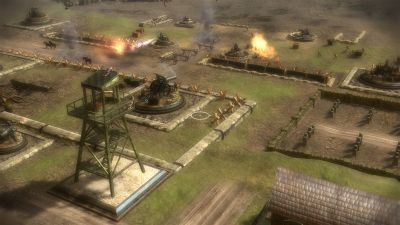
Tower defense games are oddly hit and miss for me – when they’re done just right they totally click with me in a very satisfying, addictive way and when they’re not I usually can’t even be bothered to try feigning interest in them enough for a second try. Toy Soldiers is definitely in the former category. It takes the classic, simple tower defense gameplay, gives it an awesome World War I come toys theme, and adds in the ability to control towers and other units (tanks and planes) by hand to up their effectiveness and/or your score. It’s a very simple concept but executed almost perfectly with an awesome presentation and a healthy layer of polish.

Surveying the (toy) carnage.
“Surveying the (toy) carnage.”

The World War I theme doesn’t get visited in video games (or much else) very often and, if you think about it, the static trench warfare that is typically associated with it is right at home with the tower defense genre. You have troops attacking in waves, trying to reach objectives, and you can place certain defenses such as barbed wire, machine gun nests, mortars, and artillery in their way to hopefully wipe them out before they get there. Right on! As usual, the more enemies you kill the more money you make and the more money you have the more you can upgrade your defenses which you’ll need to do as enemy waves get more and more difficult. That’s it in a nutshell.

The fact that you’re actually supposed to be playing with toys takes little away from the game – units are animated and are fairly realistic. In fact I often found myself forgetting that the sun was actually a gigantic desk lamp and that my tank had a huge winding key sticking out of the back of it and finding myself immersed in the gritty battlefield. Still, having the units break into pieces and vanishing instead of turning the toy-box into a horrid gore-fest is actually a pretty smart way to get around any ratings concerns. Using toys also gives the developers license to more or less do whatever they want. How about we fight a massive uber-tank this time? What if flying saucers show up instead of tri-planes? Again, pure genius.

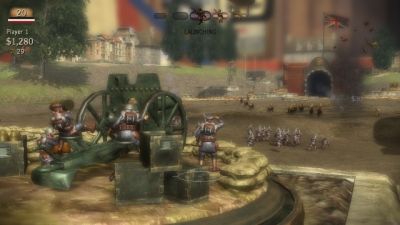
About to fuck up some toy horses... and probably my own guys.
“About to fuck up some toy horses… and probably my own guys.”

The maps are pretty varied and are often quite challenging, sometimes involving a bit of trial and error though if you play conservatively enough with your cash flow you can often adapt to surprises in the enemy waves. In some of the trickier scenarios finding just the right balance between managing your turrets and controlling a turrets or units is key to a successful defense. There aren’t many types of turrets and units available at first glance but each turret can be upgraded and not all upgrades are of the simple “+1 damage” variety. For instance, I sometimes preferred a level 2 anti-infantry gun for tracking and killing off cavalry quickly versus a level 3 which is basically a small canon, and thus fires and tracks a little less quickly despite doing a lot more damage over a wider area.

I ended up playing through the campaign on normal difficulty as well as playing through the campaign+ mode (which thankfully mixed up the maps from the normal campaign a lot more than I was anticipating) and both DLC campaigns including “Invasion!” which added all kinds of flipped out new enemy units and culminated in you fighting a giant robot. AWESOME! Sadly I didn’t get around to try multiplayer but I can easily imagine it being a ton of fun. I can’t wait to get my hands on Toy Soldiers: Cold War now though I’ll likely wait a while before leaping into that one.

Digging waaaay back into the physical backlog I also played through The Darkness by Starbreeze Studios. Being a fan of The Chronicles of Riddick: Escape from Butcher Bay on the original Xbox and thinking the concept looked cool I’d been wanting to play this one for quite awhile. Unfortunately I came out on the other side mostly disappointed.

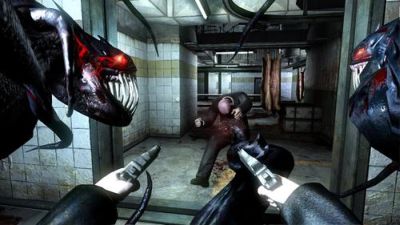
Viva la aim assist!
“Viva la aim assist!”

First, the game in case you’ve never heard of it or more likely have forgotten about it by now: It’s a first person shooter where you play a mobster who gets possessed by The Darkness, some kind of wacky demonic presence that wants nothing more than to kill mofos and eat their hearts. Doesn’t everybody? The Darkness grants you some powers and abilities in additional to the normal FPS running and gunning you’re used to which should help aid you in hunting down the mob boss who is trying to rub you out. Additionally, it thrives in the darkness (go figure!) so sneaking around in the shadows and shooting out lights becomes a major factor in the gameplay as well. The other big gameplay twist is that you’re mostly running around in a small but semi-open world city (complete with side missions!) rather than the usual level based structure we see in FPS games. You’ll also make a few trips to a twisted, dark re-imagining of World War 1. Yes, another World War 1 game… err, sort of!

The game looks and sounds great, I particularly love the use of the first person view, though overall it feels very last gen at times – maybe this is because of it being very early in this generation or maybe it’s a Starbreeze thing. I don’t really know. The sound is pretty excellent overall – good voice acting, for instance. I was concerned about Mike Patton being the voice of The Darkness since I’m a big fan and was worried that such a bizarre role would somehow come across poorly but I should have had more faith in him as he hits a home run with his performance here. Really, the only thing I found difficult to live with was its controls: maybe I’ve been spoiled by some of the newer shooters out there but they’re a bit on the clunky side in The Darkness which is definitely not what you want in a console FPS. Still, thanks to a heavy dose of auto-aim they’re serviceable enough.

That leads me to The Darkness powers themselves. I was actually pretty surprised by how little your possession by The Darkness actually gives you. Looking at them all on paper it seems like a nice selection of abilities to augment your character but their execution was a bit rough around the edges, both in terms of using the powers and of how some of the special mechanics they introduced were used in the game. In other words, so close but yet so far…

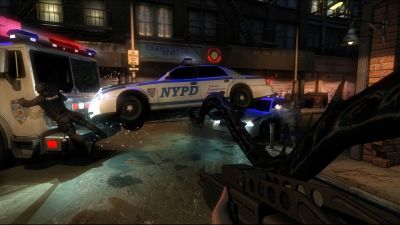
The Darkness knows how to party!
“The Darkness knows how to party!”

The “Darkness Vision” which was supposed to be kind of a nightvision+ kind of sucked. The “darklings” you can summon to help fight with you were barely useful and died or otherwise vanished way too quickly. The “Creeping Dark” power seemed awesome but was needed perhaps too little and could sometimes be a little disorientating to use. The “Demon Arm” power also seemed to be required a little too infrequently and mostly served me as a way to quickly (err, usually) take out lights without wasting all of my ammo. The guns seemed nice but also seemed to deplete your darkness too quickly to be useful. Finally, the last power you get, the vortex, was almost an “I win” button but even that was perhaps a little too iffy to target and, on top of that, a bit too sensitive to range. I found myself occasionally landing it just a bit too far and having it sitting there seemingly close to my enemies as they stood their attacking me, unaffected.

Keeping track of your darkness power levels was kind of head scratching to me at first. The game frequently referred to having to stay out of the light and in the darkness to fuel your Darkness powers, and referenced how certain abilities drain your Darkness at different rates, but this Darkness power is never represented anywhere in game that I ever noticed. Having a meter on screen or SOMETHING would have gone a long way into making my darkness powers feel more useful as well making the whole “staying out of the light” and “hunting for hearts to eat” thing a bit more urgent and fun. I’m guessing this was done in the name of having a minimal UI (your health also goes unrepresented and guns and ammo display can be a little sketchy as well) but to me, in this case, it largely detracted from the experience.

The open world structure is kind of pointless. It worked well in the Riddick but in this game it didn’t really serve to help immerse me in the environment at all. Instead, it just felt tedious having to travel around everywhere, back and forth to the same bite sized hunks of map, loading screens in between. Perhaps a real, seamless open world and/or better navigational aids could have helped this a bit but ultimately I just didn’t think it fit well with the story.

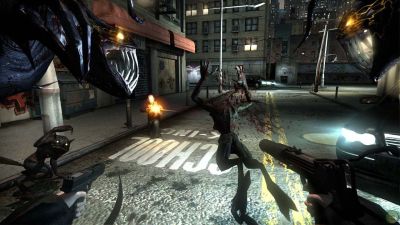
You'd think with this much firepower a single schlub with a gun wouldn't be owning me.
“You’d think with this much firepower a single schlub with a gun wouldn’t be owning me.”

Finally, the story. I understand that The Darkness was based on a comic book series and perhaps I’d have some better appreciation for it if I had ever read any of it, but as it was, it didn’t do much for me. There seemed like so many missed opportunities to take it into more interesting places. For instance, your character, Jackie, hardly has any sort of reaction to being possessed. Really? You’d think suddenly having an evil demonic entity sprouting out of your body and speaking directly into your brain might elicit SOME kind of reaction. Nah, not so much. I mean, you could tell an entire series of stories based JUST on him dealing with this shit! Instead Jackie hardly has any sort of reaction to anything! There have definitely been times when the silent protagonist thing has worked just fine in video games but The Darkness is pretty ham-fisted with the whole thing. One minute he’s blabbing about meatballs or making some vapid comment about riding on the subway in a loading scene and the next he seems entirely unfazed by having his entire life, and even his entire concept of reality, turned upside down. Come on, guys…

The death cut scenes and the loading scenes were interesting touches and add a little more flavor though the loading scenes in particular often felt bizarrely out of place and were where the worst of the horrible Italian-American cliches came in. Honestly, Jackie didn’t really need any help feeling like a one-dimensional moron, but whatever. Despite my issues with some of these scenes, and I don’t say this a lot, I think the whole presentation, both in terms of the story and of the flawed open world structure I mentioned earlier, would have worked so much better if the game were more linear with more cut-scenes or at least more focused on the narrative. As it is it just doesn’t feel well executed to me.

Technically it is fine, and even conceptually it’s quite solid, I just feel like they designers missed a lot of opportunities to capitalize on what could have been a much more exciting game with more unique and cool mechanics and a much more engrossing story. It came close to being something really special and I’m quite curious to see if the developers of The Darkness 2 will be able to succeed where Starbreeze couldn’t. Not a bad game overall but probably not really worth revisiting if you missed it originally. All of that said, the very last cut-scene was surprisingly touching and having the credits roll on to a Tomahawk song was awesome!

As usual, Xbox 360 screenshots mercilessly looted from teh interwebz. Yarr!

More Like L.A.me Noire!

Am I rite???

All jokes aside, I’ll apologize in advance for the extra-ranty tone of this log as I’m pretty disappointed in Team Bondi/Rockstar’s L.A. Noire. Not for the usual reasons though – I wasn’t expecting the next Grand Theft Auto here. No, I was so hyped for this game because some previews heralded it as the next evolution of the traditional adventure game, and even those that didn’t certainly made it seem that way. The detective angle also fit perfectly into my hopes for the game, conjuring up thoughts of Deja Vu, Police Quest, and Tex Murphy. Even all of those expectations aside, adventure game elements + Grand Theft Auto 4 sounded right up my alley. I even broke my new game embargo and bought this sucker close to release, bumping my back log to play it. So, where do I start?

In L.A. Noire you play a police detective in 1947 Los Angeles. I kind of wish the game had exploited the setting and the whole period noir vibe just a little more: more rainy nights, more sassy dames, more cartoon gangsters, hell I would have even settled for a crap-ton of cheesy, film noir style first person narration, but the game keeps it all fairly straightlaced. Anyway, you have to investigate and solve various cases which eventually start mingling together to form a cohesive plot relating to a larger conspiracy. You do this investigation by visiting crime scenes, looking for clues and interviewing witnesses, chasing those clues and accounts to more witnesses and suspects, looking for clues at their locations and interviewing them, sometimes with some action scenes thrown in, and eventually either interviewing the suspects one last time or having the case culminate in some sort of action that ends up wrapping things up. Cutscenes provide some extra story during and especially in between cases. That’s the most basic description I can give it – yes, it really is that formulaic and yes, thanks to the lack of variety in the cases it can indeed start feeling repetitious.

Adding to that explanation the whole thing feels almost exactly like Grand Theft Auto 4 – I realize it is the same engine, but no, down to a more granular level, the whole game feels very close to GTA4. Driving feels exactly like a slightly tighter controlling GTA4. Walking around locations in third person feels exactly like GTA4. Combat feels pretty much the same as well. You do all of these things quite a bit too. The focus of the game isn’t really on any of these things, however, it’s on the investigation and interrogation stuff and fittingly those two areas are where the game feels like the biggest departure from GTA and its ilk.
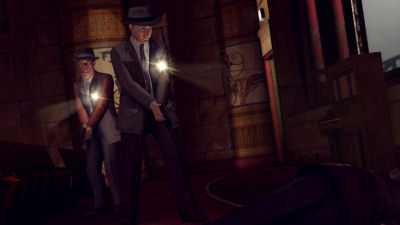
Actor hunting in Hollywood.
“Actor hunting in Hollywood.”

First we have crime scene investigations. You walk around in third person looking for items on the ground and other clues. Some of these items can be tricky to spot, bringing back the old point and click adventure gamepixel hunt” to some extent, though to its credit L.A. Noire does employ a couple of tricks to make this phase a little less frustrating: a vibration effect to alert you when you’re nearby new points of interest and a sound that plays when you come across clues you’ve already investigated. Another thing that helps is that music will play the entire time you’re in the investigation area (the game is still very much an open world so you can wander away from where you’re supposed to be quite easily) and will cease once you’ve found all of the relevant clues in the area. I say relevant because there are plenty of annoying red herrings lying around – maybe “red herrings” is too generous of a term to use, rather it is trash and other miscellaneous junk that you can, for some reason, interact with. I suppose the designers put this extraneous stuff in to make crime scenes a little less cut and dry. The real problem with these items is that occasionally they are actually relevant. I can think of at least two cases where a matchbook is an important clue instead of just the meaningless trash it represents another dozen times throughout the game, meaning you’ll probably want to examine every one you come across just in case. Doh. It wouldn’t be so annoying if there weren’t so many extra button presses involved. You don’t just pick up an item and instantly add it to your inventory, as it were, rather you often have to rotate it around and/or press the interact button a second time to further investigate the item. I’m guessing this was done to simply avoid the game feeling like a Heavy Rain style QTE fest. I suppose it succeeds… but it feels worse for it.

As I mentioned before there are also action sequences. Frequently at that. These range from typical GTA4 style car chases, fist fights, and fire fights, to item manipulation puzzles, foot chases, and even the odd platforming puzzle. These types of occasional action scenes help break up the monotony of the investigation stuff but GTA4 stuff (which I like – who doesn’t like spraying gangsters with a tommy gun?) aside, they often felt a little unsatisfying, and sometimes even frustrating. The stealth-like missions where you have to shadow someone at a distance were 100% pure, distilled anti-fun. Surprisingly many of the action sequences can even result in instant case failure and/or death which is pretty damn jarring when you compare it to the no-fail way interrogations work. In another nod to old adventure games though, the game seems to almost acknowledge that the action isn’t necessarily what you’re there for and if you fail a scene enough times you can simply skip it with no consequences. You can also easily skip the vast majority of driving around from location to location if you’d like. Alrighty then.
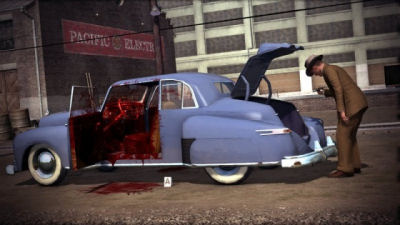
What a mess - at least we can cross vampires off the suspect list!
“What a mess – at least we can cross vampires off the suspect list!”

Finally, onto interrogations. These can take place either at an investigation scene or in an interrogation room at the station, and can range from simple information gathering to full on desperate attempts to get a confession from a suspect… but they all work the same way. There’s some (spoken) dialog between your character and the NPC which eventually leads into a clip that you’ll need to react to based on the person’s statement, tone, and notably facial expression. You react by choosing “Truth” which denotes that you believe the NPC was telling the truth, “Doubt” which denotes that you believe the NPC was lying or otherwise hiding something in their answer, or “Lie” which denotes that you believe the NPC is lying AND you have the proof to back it up. Your answers here can cause the interrogation to branch off (a little) sometimes granting you additional people or places to investigate, or straight up clues.

The whole interrogation system, which along with the new facial scanning technology was touted as the most unique thing in the game, actually holds my biggest complaints about it as well. First of all, there apparently is no way to fail an interrogation. If you choose poorly, the game goes on, which can sometimes cause you to miss vital clues and/or ultimately charge the wrong suspect. I personally thought this was a pretty nice touch and decided that no matter how bad I did on my first playthrough I’d accept all of the consequences and just go with the flow as in Heavy Rain. This became immensely unsatisfying, however, as even though you can’t necessarily fail an interrogation or a case as a whole the game is still extremely keen on letting you know when you’ve screwed up: when you react incorrectly in an interrogation a tone immediately lets you know, at the end of an interrogation it tells you how many you got right, and at the end of the case you’re given a 1-5 star rating based on how well you handled the investigation overall. If I’m supposed to just play through the case should it really be constantly slapping me down when I screw up? Worse yet, if I do choose to correct my actions I can’t – the only way to back out of a decision is to either restart the game before it saves again, doing the whole scene over again, or replay through the entire case. Wow. Make up your minds, Team Bondi! Do you want me to just keep going or do you want me to play to perfection?

Perhaps this wouldn’t burn me quite as badly if interrogations actually worked a little better. There’s nothing like doing badly and feeling like it isn’t your fault. While the new facial expression tech is indeed awesome I was surprised to find myself having an extremely difficult time spotting tells at times. Sometimes it is obvious, over the top even, but other times I was sure I was right and still got the reaction wrong. After I started doing so poorly I became more and more careful about choosing my reaction and still frequently got my guess wrong. Arrrrgh. Apparently it’s not just the mannerisms when answering you need to look out for as I had at least two NPCs answer very straight faced only to act shifty in their idle animations after the fact and turn out to be lying. Fair enough, but adding that into my bag of tricks still didn’t help matters much. I sometimes wondered if you weren’t just supposed to be trying to do what Phelps would do in the situation rather than base your decisions on what you, as the player, believed. It perhaps wouldn’t be as difficult if the difference between “Doubt” and “Lie” wasn’t so nebulous, never mind that those three choices don’t even clearly fit as appropriate reactions to every statement you’ll run across while interviewing, and that you’re not even presented with the option to ask a lot the questions that you, as a player, have probably already formed by the evidence you’ve gathered.
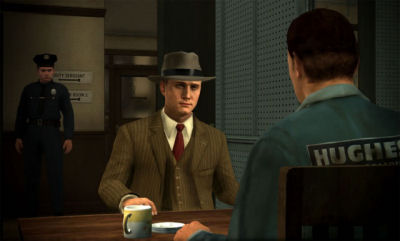
Truth, I mean... lie! Wait, no, doubt!
“Truth, I mean… lie! Wait, no, doubt!”

Delving further, the “Doubt” option freaked me out occasionally – doubt, to me at least, imparts a causal feeling, but a few times when I used it during interrogations my character went from mild mannered, friendly even, to TOTALLY FLIPPING OUT and screaming at the suspect. It totally took me out of the game the first time it happened and seemed a little out of character for Phelps. The “Lie” option is an even more interesting case study. Like I said, the line between “Doubt” and “Lie” wasn’t always so clear – fair enough, I take a look at my clues and maybe I don’t have the evidence to prove that the suspect is telling me a lie, or maybe I just don’t make that connection. In reality though, some of the logic between the NPC’s previous statement and the clues you have is a little on the fuzzy side and it can be hard to pick the right clue. Some of the “correct” clues you’re suppose to present as evidence are things that the NPC wouldn’t know so bringing it before them, saying what little your character says, wouldn’t actually convince them to start talking, for example. More problematic is that I often found the subject of the interview changing IN BETWEEN me picking the “Lie” option and having to present the evidence. WHAT THE FUCK? How was I supposed to KNOW I had the evidence if I didn’t know what I needed to provide evidence for until AFTER picking “Lie”? REALLY GUYS?

Here’s an example from The Naked City DLC case. I’ll try to be vague and not spoil it too badly:

I’m interrogating a guy, the husband of a friend of the victim. I had been told before by the victim’s house keeper that the victim was dating a man from San Francisco. I ask this guy if he knows of this fellow. He claims ignorance. Following me? At this point to branch to a new topic I have to call him a liar yet none of my evidence clearly says or even mildly suggests that they would know each other. The first time I played the case I think I chose “Doubt” instead of “Lie”. Regardless I got it wrong. The second time, after I do choose “Lie” he then admits that maybe he does in fact know him, but doesn’t know where he is from, stating that it might be New York. Evidence time! The correct answer is to present the victim’s house keeper’s statement that she knew of the guy and that she thought he might be from San Francisco. Wait a minute? I’m presenting evidence about where this boyfriend fellow is from? The original statement I called a lie was the NPC’s claim that he didn’t know of him, nothing to do with where he was from! Regardless, what did I just prove? That, in fact, he doesn’t know where the guy is from just like he stated he didn’t, because the house keeper says he’s from San Francisco? WTF? How does any of this make any sense? Let’s recap: I called him a liar, which means I have to present evidence to prove he is lying, yet I have none. Then it ends up being that the evidence I have to present isn’t even directly in response to the original statement I called a lie. Then I present a piece of evidence that essentially proves nothing – the guy claimed to be fuzzy on where this boyfriend fellow was from, and all we did was tell him that WE know where he was from. Take that! How is this helpful? Gah.
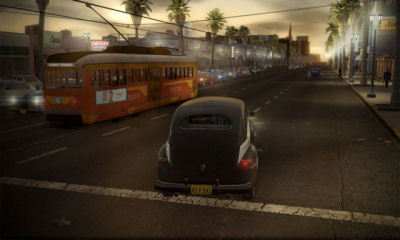
Look familiar? Well it also feels familiar...
“Look familiar? Well it also feels familiar…”

It’s almost as if half of the time the “Lie” response isn’t so much to call out that person’s statement as a lie, as it is presented, as much as it is to scream “HEY YOU’RE A LIAR!” and to watch them squirm to see what they rattle on about. The evidence will have to be related to whatever they say AFTER you call them out. This is reinforced by the fact that, unlike with the other responses, you can back out of your “Lie” response. How bizarre! Are you supposed to just test this out on every question you ask? Really? Here’s another, more brief example from the same case: I’m told by an NPC I’m interviewing that a man I’m trying to track down doesn’t exist. If I choose “Lie” the topic suddenly turns to this NPC’s alleged role in a burglary which causes him to get defensive and challenge me on providing a list of stolen items. For evidence I can provided a list of stolen items recovered which all tie back to him. Fair enough on the challenge and evidence but the evidence is in no clear way related to the original accusation that I responded to! Ugh!

As a quick aside, I’ve played all of the DLC cases and they feel more or less identical in quality to the main cases and, if you’ve got them installed while playing through the campaign, fit fairly closely into the main case flow of the story. The one exception being Nicholson Electroplating which, despite acknowledging the events occurring up till then, fell into an awkward place at the end of the game that made switching back over to a relatively ho-hum arson case feel a little jarring.

Back to bitching. So let’s go over the ways that interviewing can be a major exercise in fail: facial expressions and other tells don’t always indicate the reaction as you’d expect them to > the line is blurry between doubt and lie, if any of the three options even seem suitable in the first place > when you do choose “lie” sometimes the clues don’t make a ton of sense, sometimes even relating to topics brought up AFTER choosing the option. Awesome… a point of failure along every step of the process. Good luck 5 starring every case without a walkthrough!

Indeed, I sucked at this game the first time through. I’d say half of my cases were 4 stars, while the rest were 2 or 3, with even one or two 1 star cases. Admittedly some of these scores might have been marked down a bit for driving like a maniac, but still. I decided to play through the game a second time with a walkthrough 5 starring every case so I could see how differently the game played out when I did everything “right” and I was, quite unexpectedly, sorely disappointed. The cases don’t really branch out as much as you might expect. In fact when you fail at an interview or you feel like you missed a vital clue somewhere you get the impression that if you had done better it would have turned out entirely different. In reality it seldom makes much of a difference. At best, some new events might take place if you do things differently, specifically if you branch conversations better in the interrogation parts or visit locations in a different order… but this seemed relatively rare.
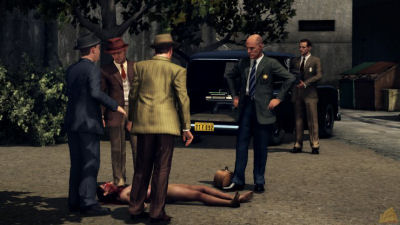
This game has you doing more corpse fondling than your weird uncle Leroy
“This game has you doing more corpse fondling than your weird uncle Leroy.”

I admit that I started to get more into the game as the story started developing. Bondi and Rockstar did a good job at fleshing at the characters a little bit, at least enough for me to develop a fondness for your character, Phelps, and his various partners… even Roy, somehow. When the main plot started really coming together I was pretty much riveted. Even so I do take exception to the sometimes ham-fisted nature of the storytelling. First of all, there’s a twist later in the game that I really didn’t see coming. Normally twists like that are pretty cool but this time I felt like the game had been lying to me about who Phelps was and only offered the tiniest, most miniscule hints about what he might do and why up until that point. The finale of the game, on the other hand, you can see from miles away thanks to the entire story being heavy-handedly foreshadowed, almost spoiled even, through the numerous WWII flashbacks and newspaper scenes that you encounter FREQUENTLY over the entire course of the game. Some mystery…

Overall, despite all of my nitpicking, I actually enjoyed the game. I loved the graphics, the acting work, the music, the journal system, the 1940s setting, and the whole police procedural feel in general. For every triumph though it seems that there was also a misstep. It felt surprisingly GTA4-like for a game that so many people were quick to point out wasn’t that style of game yet, as feedback shows, it doesn’t really hold up as that kind of game either. When those new adventure game elements that I was so anxious to experience showed up I was surprised to see how many of the well-known negative adventure game tropes they brought with them: pixel hunting, out of place actions sequences, instant deaths/failures… and yet the positives weren’t nearly as strongly represented. I tried giving it a fair shake regardless of all of these things but they quickly started to dramatically affect my enjoyment level. I really hoped replaying it would help me appreciate the game’s intricacies more but it actually only served to reinforce my suspicions about many of its issues. With so long in development and two developers working (apparently quite poorly) together on the game it really makes me wonder how much of a potentially amazing game was somehow lost along the way. 🙁

As usual Xbox 360 screen shots stolen. PC version isn’t out yet!
Frozen Fables

I know I’m amazingly late to the party with this one but I finally got around to playing (and beating) Fable 2 for Xbox 360! Between playing the original Xbox Fable at release and watching/hearing other friends of mine play through Fable 2 I was really, really looking forward to playing this one. Despite having a lot of fun with the game I somehow don’t really have a whole lot to say about it… perhaps I’ve waited a bit too long to write about it, but I’ll try to put down a few thoughts regardless.

Fable 2 absolutely oozes a style of its own: the odd designs brought to life by the colorful graphics, the unique (in gaming, certainly) 17th/18th century meets middle ages aesthetics, the funny voice acting, hilarious item descriptions, and all around healthy dose of humor injected into the world, and all of that brought together in what feels like a relatively well produced, high budget package. I was immediately hooked!

Significantly less dangerous than he appears.
“Significantly less dangerous than he appears.”

The gameplay is pretty simple and very easy to get into and start having fun with – combat, for instance, is quite streamlined, just a button for each weapon type, and it is only much later, when you start improving your various skills, that the combat system begins to become gradually deeper. My main character was a mage and while I typically don’t play pure mages in these types of games the magic system felt a little odd and a bit limited. You can only have one of each spell rank equipped and you cast all 5 spells (there are 5 ranks) by holding the same button down for increasingly longer lengths of time. From poking around on the forums there seemed to be quite a lot of people confused about how to assign and cast your different spells. That said, once you figure it out it’s a breeze to use and quite effective. There were definitely a lot of other odd design decisions made with Fable 2, not just with magic. Knowing Peter Molyneux’s reputation for interesting, ambitious design I’m assuming that there were many, much more extreme ideas penned that were eventually dumbed-down or cut for various reasons. At the very least the game still succeeds in feeling fairly unique and doing so without too many negatives.

The two new features that got the most attention in the press, your canine companion and the sparkly golden breadcrumb traill, were both successes in my book. The dog was pretty neat and when he wasn’t around I felt myself actually feeling more alone in the world – I missed the little flea bag. I did somehow expect him to be a bit more effective in combat than he ended up being, but oh well. The bread crumb trail, which always points you to the next step in your active quest, only ever annoyed me when it wasn’t working correctly (I found myself occasionally outrunning it, which made me think it was trying to point me in the opposite direction, for instance) otherwise I found it to be quite useful and easy enough to ignore when I wanted to explore a bit.

You'll probably spend way too much time hitting on peasant ladies (and/or dudes.)
“You’ll probably spend way too much time hitting on peasant ladies (and/or dudes.)”

I was pretty surprised at how quickly I progressed through the plot, figuring Fable 2 would have a pretty epic storyline after the backlash about how oddly quick the original Fable went. I agreed with those original assessments, by the way. To me it seems like many of the mechanics of Fable, and even more so Fable 2, particularly the character development and customization over time aspects, cater more towards longer and/or more open world game but I concede that perhaps my views simply don’t line up with the designers’ intent. That was another thing – I had gotten the distinct impression that Fable 2 was much more of an open world experience than Fable was, despite still maintaining a strong central story. Eh, not so much… definitely improved, but still lacking something in the way of a truly open feel. Regardless I dug playing through the story and customizing and progressing my character. Many of the side quests just didn’t feel that interesting and I had a hard time forcing myself to even be bothered with them though, I admit, this may be partially blamed on not playing many of them until after beating the main storyline.

Speaking of side quests, I did end up playing through the two DLC add-ons, Knothole Island and See The Future, which both provide you with some short side stories including a variety of additional quests. Both were easy enough to skip but recommended if you absolutely love the game and want a little more. Knothole Island was my favorite of the two, with its Zelda-esque series of quests into different temples/dungeons. It also got me my beloved dog back. 😉

All around, a fun game – I’m still a fan of the series and Fable 3 is definitely on my wish-list now. As an aside, I didn’t purposely go after many of them but some of the bizarre shit you have to do for achievements in that game was quite fun.

Going down?
“Going down?'”

I played through the original Portal on PC again with the intention of refreshing myself before playing Portal 2. What’s to say? Still a fun game – especially given that you can breeze through the entire thing in just one or two sessions. Perhaps it is part of growing up and having less free time but I love shorter game experiences. It always amazes me that I managed to never get stuck for more than a minute or so my first time through. Knowing the way my dysfunctional mind operates I figured I’d bash my head against many of the puzzles – here’s hoping I have the same sort of luck with the sequel.

Finally, I recently picked up Frozen Synapse on PC. I’ve been hearing whispers about this game for what must be a couple of years now. They were offering a beta access for early buyers program similar to what Minecraft is doing but I decided to keep waiting out the formal release on Steam and that day has finally arrived.

The game is sort of reminiscent of the turn based, tactical combat found in games such as the original X-com and Jagged Alliance series, yet the mechanics give the whole thing a very different feel. Instead of being given a certain amount of time units, action points, or the like, you simply have to 5 seconds per turn and you can do whatever you have time to do in that window. It may be quite similar in principal but it is a little harder to know exactly what I have time to do and not do in Frozen Synapse without simply previewing my turn, though that is easy enough to do. In X-com everything you can do, from firing, to turning around, to moving, has a hard value associated it with it – such a thing likely exists in FS’s engine as well, but it’s just not presented that way.

Actually winning for once...
“Actually winning for once…”

Speaking of presentation, the interface is also some what of a departure from that style of game, feeling more like the planning stages of the old PC Rainbow 6 games than a typical turned based tactical game. Turns are also simultaneous which is another big difference from most games like this. I don’t know that it really ups the challenge but it certainly does make turns a lot more suspenseful. A major plus to this is that it is setup to allow for asynchronous gaming – you can be playing multiple games as once, swapping back and forth when your turn is ready. You can play by email, continue a half-finished game the next day, whatever. It’s very cool.

One thing that kills me about FS (literally, it gets me killed) is difficulty judging my line of sight and, particularly, my enemy’s line of sight to me. In one of my first online matches half of my squad got obliterated by a rocket blast that somehow slipped through 4 or 5 tiny openings that, because of the perspective, didn’t even look passable to me. I’d love a tool to clearly show me LoS views. Whatever… live and learn! I’ve been doing a lot of learning lately – my online record is currently atrocious. Most of my loses were very, very close… but it’s not like anyone can see that when looking at my win/loss record. 🙁

Anyway, it’s a fun game. It’s different enough that it doesn’t really scratch my X-com itch in the way something like Silent Storm did, but for a relatively cheap indie game that has good online capabilities and an active player base, I feel like it has been worth my money and time so far.

As usual, Xbox 360 screens lifted from elsewhere. Fable 2 was a perfect example of a game where I couldn’t find much in the way of ACTUAL screen shots, showing the game as it looks when it is being played with interface and all – mostly only canned shots released by PR. 😕