Tag Archives: Xbox Series X

Pig Papillomas Patrimony

I’m slightly too old to have been one of those Harry Potter kids, but I begrudgingly checked out the first movie when it was relatively new and already massively popular, and despite my skepticism, I actually enjoyed it. That led to me eventually watching them all, many times, including several in the theater, reading and/or listening to all the books, and having way more fun than any middle aged man should admit to with The Wizarding World of Harry Potter stuff at Universal Orlando. My partner, a bit younger than me and more in-line with the age to have been enraptured by it as a kid, is similarly afflicted. When Hogwarts Legacy came out and started getting a lot of acclaim, she ended up picking up a copy. I figured she’d love it because on top of loving Harry Potter, she’s played plenty of open world games, but while she didn’t bounce off it, the gameplay didn’t quite hook her either. After a few sessions she lost interest. I, on the other hand, liked what I saw and added it to my backlog. It had been a while since I’ve played a game of this sort, and feeling in the mood for one, one day I dusted it off and jumped in.
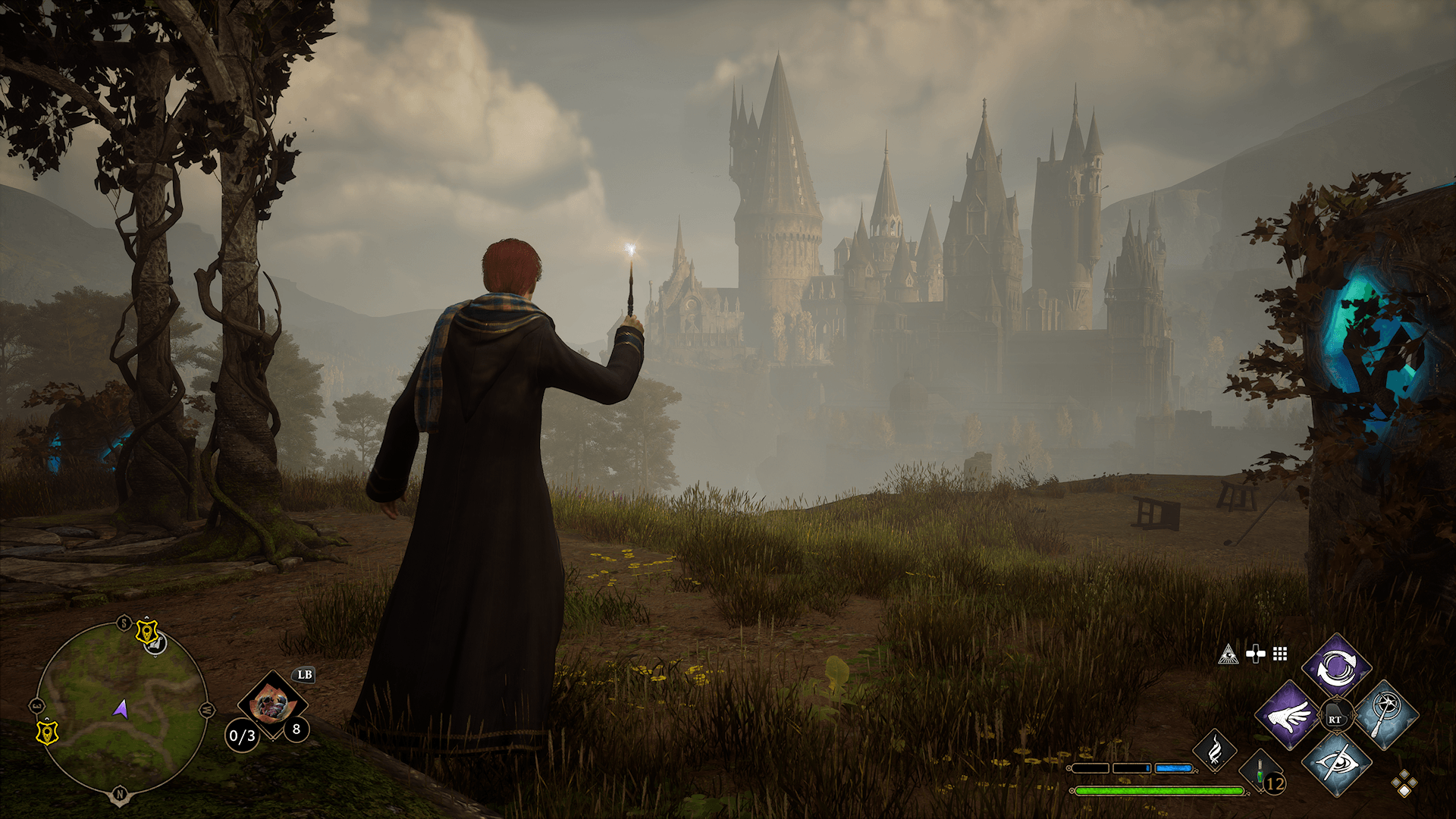
There it is, Hogwarts Castle.
“There it is, Hogwarts Castle.”

First, I should say that the game looks (and sounds) quite beautiful. The developers did a bang-up job realizing the world. While I’ve not played even a single other Harry Potter related game so I can’t really compare it to previous efforts, I can say that a lot of love and care was put into crafting the world, particularly Hogwarts itself. It’s huge and absolutely brimming with secrets and insane details, so much so that not being able to find my way around eventually started to get a little old. Thank Ignatia Wildsmith for Floo Flames, eh? Seeing Hogsmeade at Christmas time was another highlight. Unless you’re simply not a Harry Potter fan, this all goes a long, long way all by itself. Overall, the game feels very competently made, and while I wasn’t really familiar with Avalanche Software before this, they’re now very much on my radar. I’m impressed!

As for the gameplay, after you get through the introduction which sets up the main story of the campaign, you’re finally plopped down in Hogwarts. From there on, the game consists of an open world where you can more or less do anything you want, with most quest triggered by approaching the relevant NPC and chatting with them. Of those quests, the main story related quests tend to be much more linear and focused, and of course, include quite a few cutscenes. The rest are a bit more of the variety you’d usually find in an open world game, with some being a bit more involved than others. There are also quests related to going to your classes, though these are usually more like cutscenes which usually lead to special assignments from your professors that result in the opportunity to learn new spells. All of the main story quests, classes, and some of the more notable side and relationship quests are grouped together so that you need to complete everything in the group to unlock the next main quest, and completing that will unlock the next group of quests. This actually works quite well in ensuring that you don’t skip anything too important to the overall story.
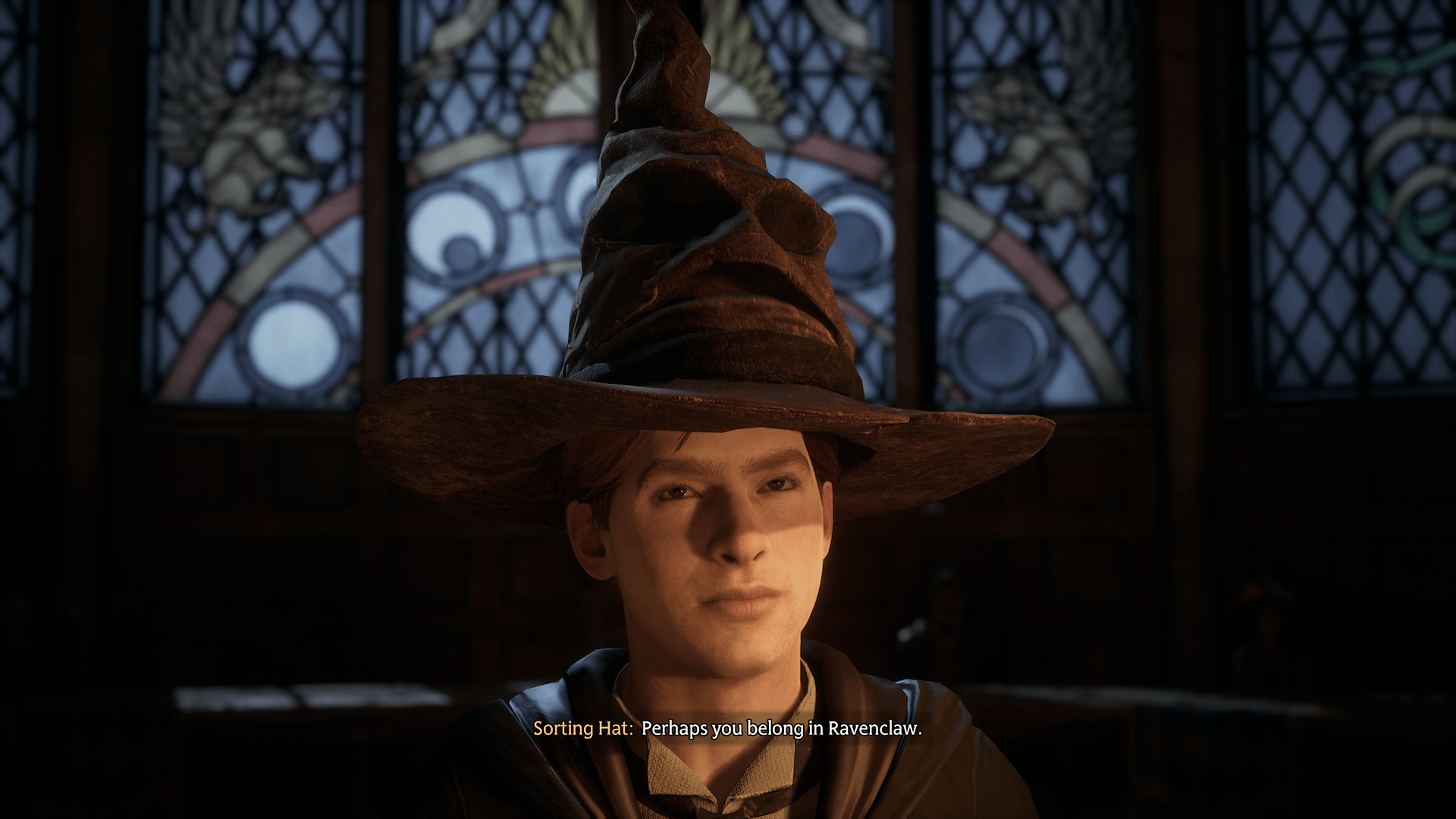
Correct answer. Get fucked, Gryffindor!
“Correct answer. Get fucked, Gryffindor!”

Combat is action RPG focused, mostly consisting of your spammable basic cast and more interesting spells which are on cooldown timers. There’s not really a mana system or anything like that; as long as a spell isn’t on its cooldown, you can use it, and the more spells you have, the less you need to use your basic cast while waiting around for other spells to become available again. It’s all pretty straightforward. One of the funnest and amusingly weird things about the game is how incredibly violent combat actually is. You have a huge selection of spells by the end, but even the most mundane ones you have at the beginning are pretty brutal. Levitate someone so they’re helplessly flapping around in the air, then shoot the shit out of them, then pull them closer to you, still keeping them floating, then push them away, violently slamming them into a wall. You can “juggle” them like that for quite a while too, although I prefer using some of the interesting spells you get later instead. I mean, why not burn them alive in the process as well? While I think the spells are represented accurately enough, seeing them actually used like this doesn’t quite fit the tone of Harry Potter. This might turn some off, but as I said, I find it darkly humorous.

You know, early on, I came to the realization that between the over the top, whimsical British vibes and this particular style of the open world action RPG gameplay, Hogwarts Legacy actually reminded me quite a lot of the Fable games, particularly Fable II. Of course, combat aside, a bit less over the top. I mean, there’s no farting to impress prostitutes in Hogwarts Legacy, but I guess we can’t have it all. (/s) Searching around a bit, I definitely don’t seem to be the only person who saw the similarities, and I’m quite curious about how much the upcoming Fable game is going to end up resembling Hogwarts Legacy when it’s released.
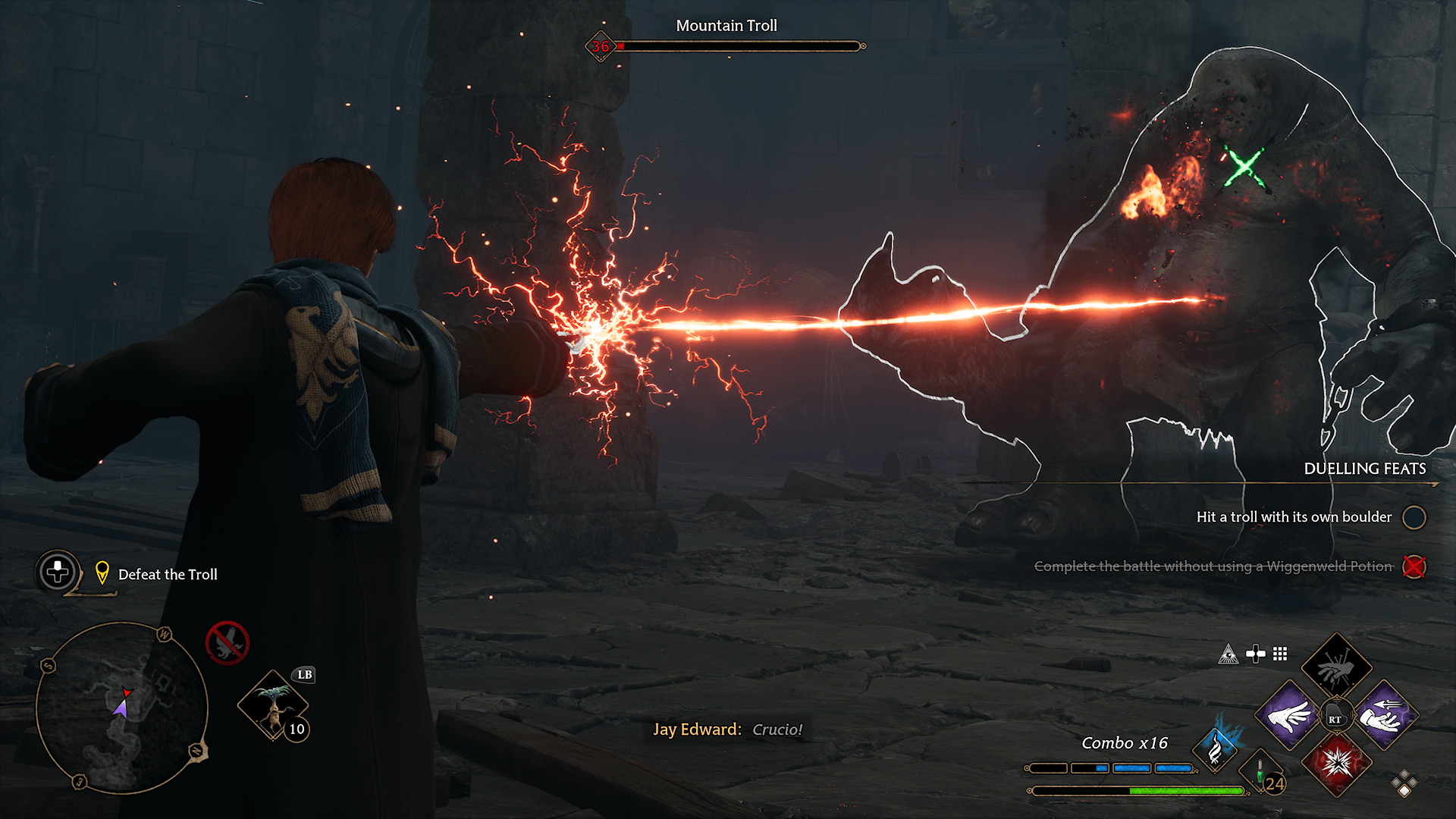
Torturing a Mountain Troll and not feeling too bad about it.
“Torturing a Mountain Troll and not feeling too bad about it.”

One big difference between Hogwarts Legacy and the Fables games is that there’s no morality system in this game at all. You’re supposed to be a student at Hogwarts but by the time the campaign is over you’ll probably have brutally murdered hundreds of dark wizards, poachers, and beasts, trespassed everywhere, and stolen everything not nailed down and no one, absolutely no one, cares. Nowhere is this more clear when it comes to “unforgivable curses”. Yes, you can learn some of the infamous, highly illegal spells that only dark wizards use. You can agonizingly torture someone with Crucio right in front of other students and even teachers and no one bats an eye. You can even learn Avada Kedavra (the killing curse, which instantly kills a target) later too. Yep, met with a shrug by everyone around. It’s hilarious!

The main quests take you all over the map, from very familiar locations like Hogwarts itself, Hogsmeade, and the Forbidden Forest, to innumerable tiny hamlets, ruins, caves, dungeons, and other points of interest. In fact, this relates to my another complaint about the game. I wouldn’t say its absolutely massive, but I do think the world is too big for this game. It would have been better to tighten the map up to just the notable areas from the books and maybe a small number of hamlets and specific side quest locations. Instead, this game takes the opposite approach and fills a pretty large area with a number of random puzzles and collectibles. Like I said, it’s been a bit since I’ve played an open world game like this, so I went kind of OCD trying to do and collect everything. This was mostly pretty fun, but the game did start to feel a bit like a massive checklist outside of the quests.
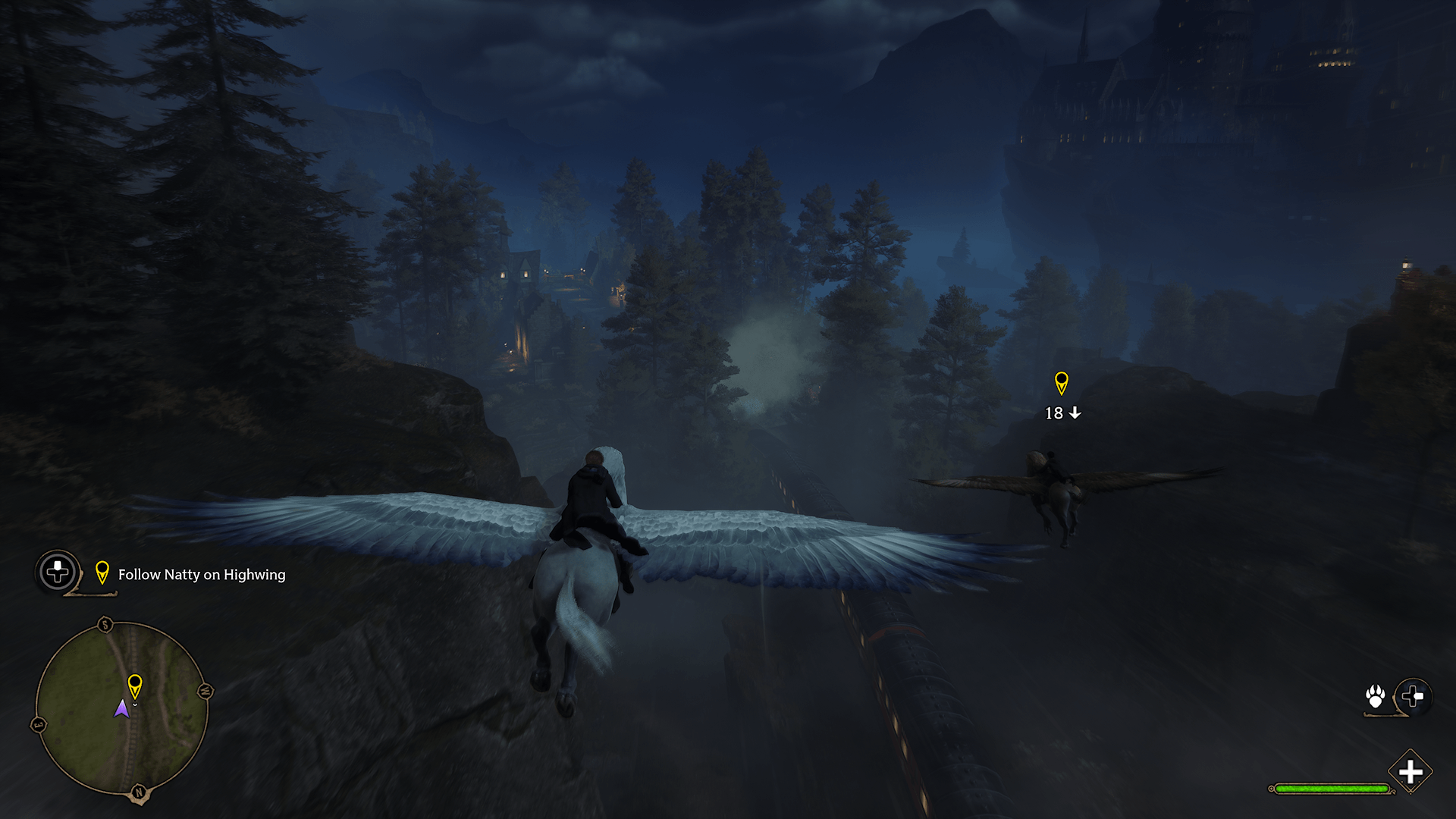
Flying a Hippogriff at night, Hogwarts Express below.
“Flying a Hippogriff at night, Hogwarts Express below.”

At least you can fly around the map, and I have to say, I love the way flying a broom feels in this game. Some may complain about the lack of maneuverability, but to me it looks and feels exactly like it’s portrayed in the movies. My only real complaint is that they somehow neglected to include Quidditch. I suppose adding an entire sports game inside of the already content rich main game was just too heavy of a lift for Avalanche Software, but it does feel like a bit of an oversight, even if there is a flimsy in-game excuse for why the season was cancelled.

There are a lot of other diversions, from growing and gathering herbs and other spell ingredients to brew potions with, to decorating your own magical “room of requirement” space, and even capturing and breeding beasts. I put around 70 hours into the game and while I got pretty close, even with my compulsion to check all of those boxes, I still didn’t 100% the game. I wanted to, but there was just too damn much to do, even though I was still having fun with the game.
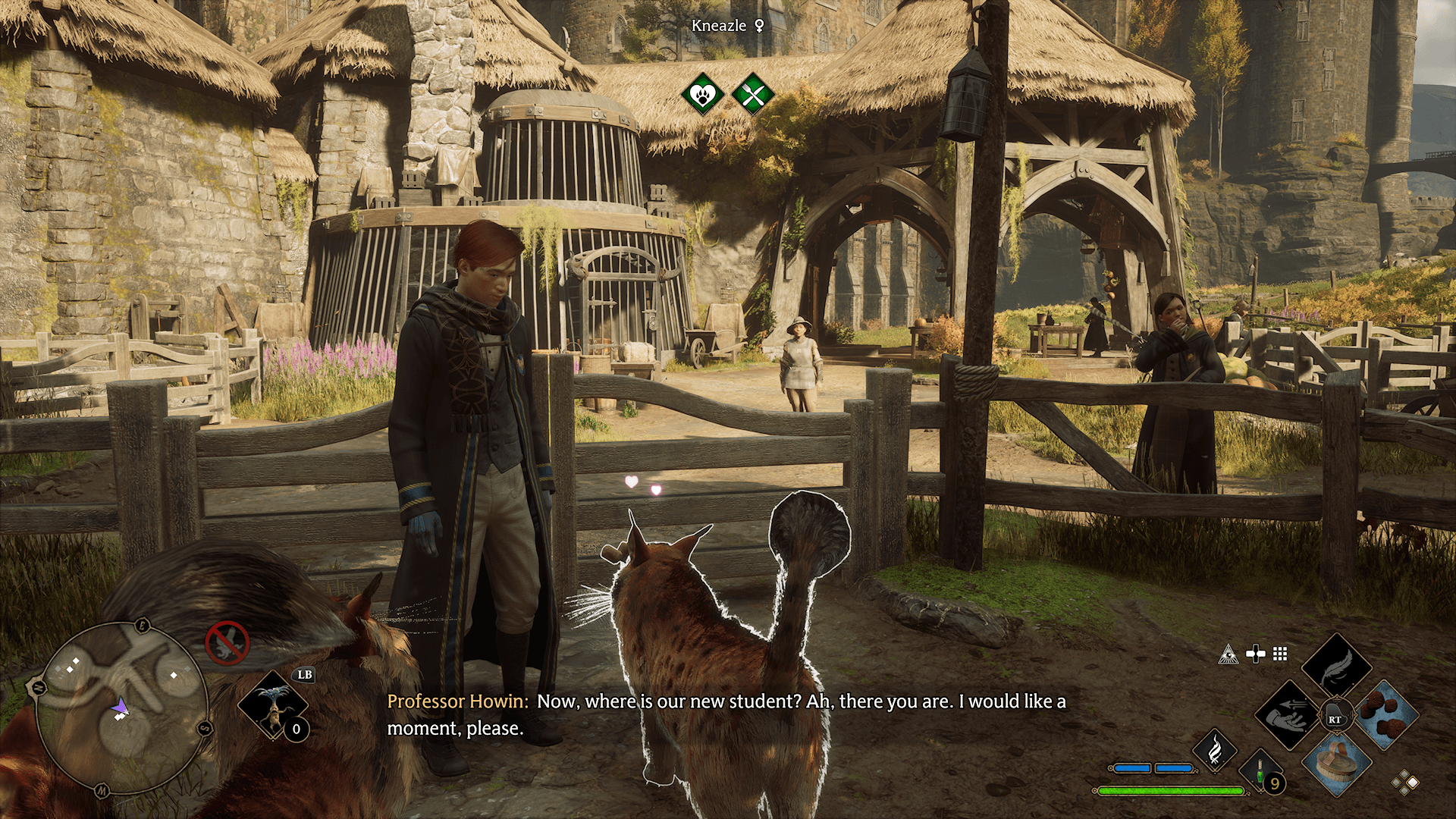
Trying to make a Kneazle like me in my Care of Magical Creatures class.
“Trying to make a Kneazle like me in my Care of Magical Creatures class.”

Overall, quite an enjoyable game, and yes, I will definitely be paying attention to the details on its sequel as more are revealed. Part of me is kind of surprised that it’s getting one, as after the initial hype died down, it seemed like everyone stopped talking about the game. Then again, it was the global best-selling video game of 2023. Who knew?!
Halo Fest 2020 – Infinite

By the time I began following Halo Infinite’s development, there were already indications of significant issues at 343 Industries that all but extinguished hopes that many of its more intriguing rumored features would ever materialize. That big, ugly delay didn’t exactly instill confidence either. However, three weeks before the game’s official launch date, its multiplayer was unexpectedly released early, and at its core was a game that somehow felt like Halo again. While the community’s frustrations have come to overshadow this, when the full game launched few weeks later, reviews of its campaign were overwhelmingly positive too. Although I dove right into its multiplayer, it’s been a real test of my willpower to wait this long to finally play the campaign.

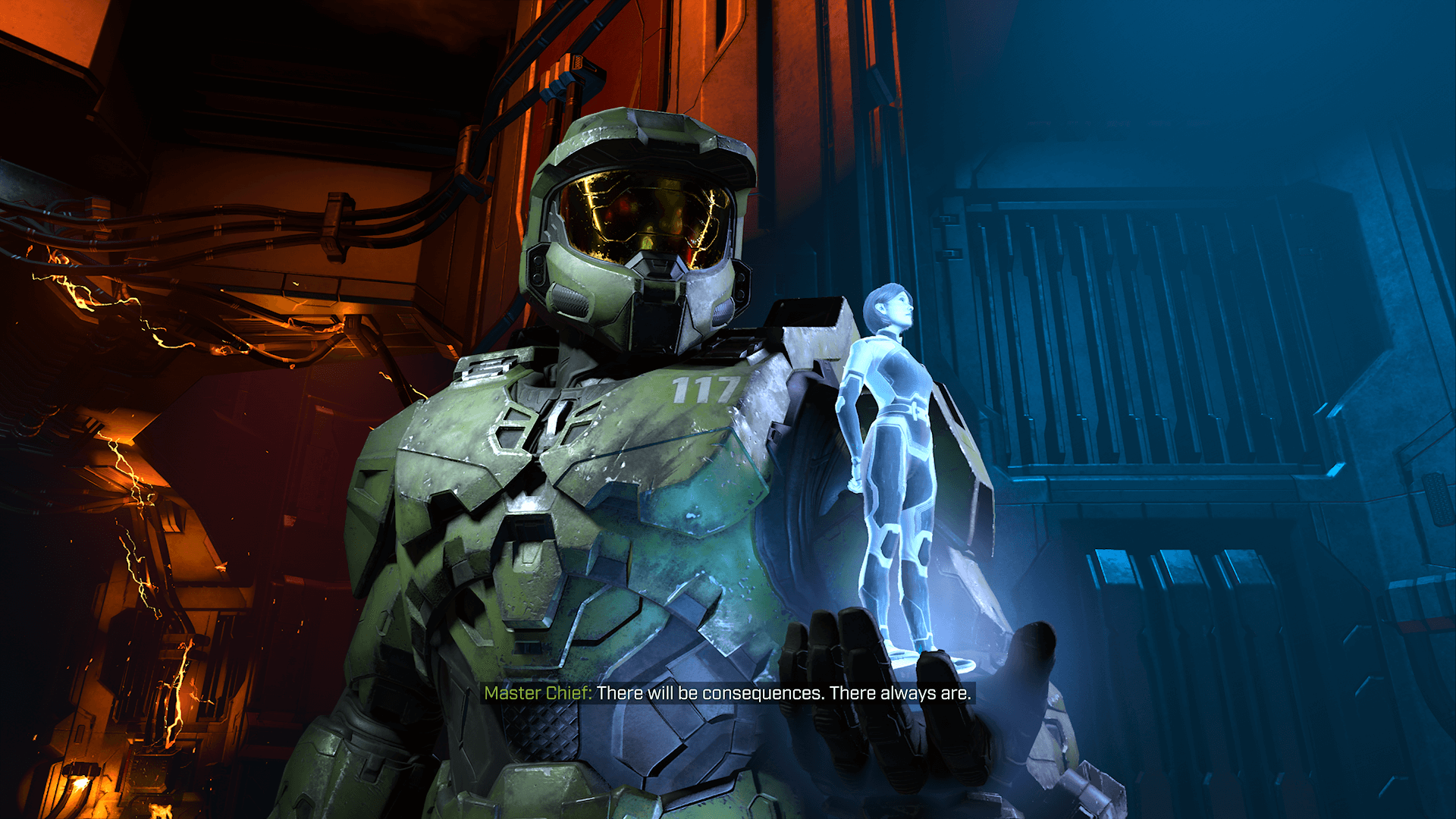
There will be consequences...
“There will be consequences…”

Aesthetically, Halo Infinite feels like a bit of a throwback. While the game can look amazing at times, on a technical level, it’s not as ambitious as I think many fans expected. Coupled with 343’s return to the Bungie days of Halo stylistically, which, don’t get me wrong, I absolutely love, the whole thing looks just a little… stale? While there are countless articles and videos you can dig into to understand its technical issues, one of the game’s biggest visual shortcomings is simply its lack of diverse environments. While Halo campaigns have always featured a rich variety of distinct maps, apart from Banished and Forerunner areas, Infinite mostly takes place in a single biome. Hell, a dynamic weather system or even just a more aggressive day/night cycle could have helped. It’s a shame, as overall, I like the game’s look and I really like the vast majority of its new designs, but it falls short of the home run Halo deserved.

With no technical issues to wrestle with, Infinite’s similarly Bungie inspired soundtrack fares far better. Incorporating elements of and otherwise influenced by the series defining work of Marty O’donnell and Michael Salvatori, including some full remakes of classic tracks, I have zero complaints. Again, 343 played it fairly safe here, but after the more experimental soundtracks of Halo 4 and Halo 5, I think returning to its roots was a good move. Specific nitpicks aside, the rest of the audio work, from the way weapons sound to the voice acting, is similarly top-notch.

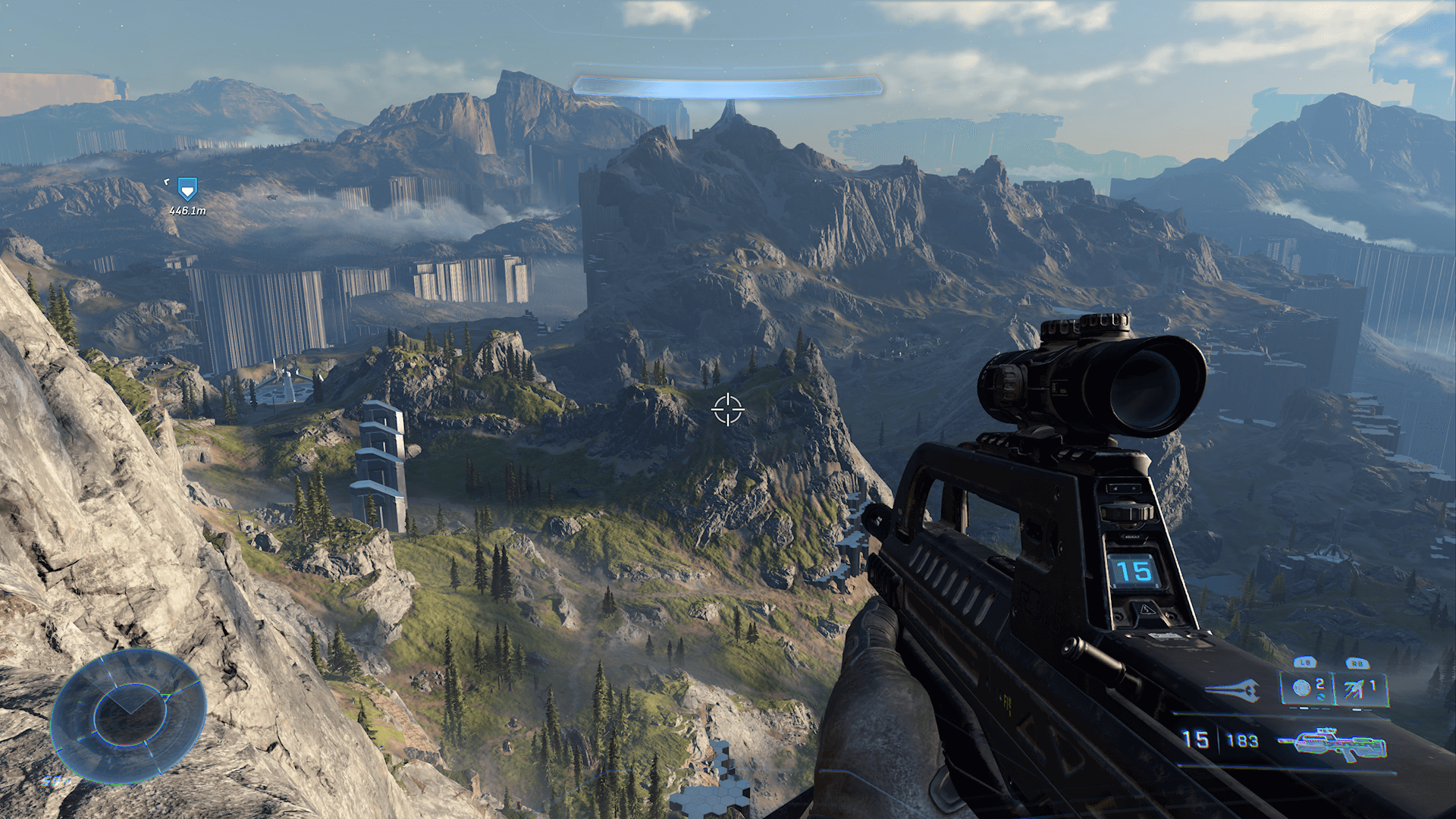
Hey, I can see my house from here!
“Hey, I can see my house from here!”

Not surprisingly, the majority of my notes are on gameplay, as that’s where 343 took the most risks. Borrowing heavily from the open-world genre, while Infinite’s campaign still consists of a series of linearly progressed levels, there’s now a huge map that you can explore between missions. Oftentimes these more classic-style missions are triggered by reaching specific locations on the map, while others actually take place in the open world itself. Combat-wise, these open world segments don’t feel dissimilar from the larger areas in previous Halo levels, but having such a vast map, so untethered from the campaign’s mission structure is a new concept for the series. Personally, I think it works, though it’s a bit rough around the edges.

First it has to be said, combat in Infinite really feels like Halo in a way that, while hard to describe, is damn satisfying. The weapon balance is just about perfect, and many favorites return in one form or another. There are some new additions, like the Commando, something of a peculiar blend of a DMR and a SAW, though I was particularly attached to Infinite’s take on the good old, versatile Battle Rifle. On the Banished side, the new shock weapons like the Disruptor pistol and the Dynamo grenades are surprisingly effective, as are the long-range Stalker Rifle and Skewer. The two new Forerunner weapons, the Heatwave and the Cindershot, seem practically designed to promote battlefield chaos with their multiple ricocheting projectiles and bouncing explosions, respectively. As for difficulty, playing on Heroic, I felt fairly challenged by fights, especially when I was overmatched yet too careless with my approach, though I admit, most of my deaths early on were probably from falling off of the edge of the map. Well, that, and bosses. There are a number of missions that include scripted boss battles. These don’t play out too differently from similar fights in previous Halo games, but some of these fights were really fun. Overall, big thumbs up!

Not a great time to run out of charges.
“Not a great time to run out of charges.”

This means that moving through the open world, encountering Banished patrols and camps, and tactically taking them out in any way you want, is fantastic too. Naturally, 343 also made some half-hearted attempts to pepper the map with other diversions. You can rescue captured marines, destroy Banished propaganda towers, and take down “high value target” mini-bosses, all of which are just minor spins on the typical fights you’ll have in the world. You can re-take overrun UNSC bases which function similarly to the “tower” mechanic popularized by Ubisoft open world games, revealing notable locations on your map, as well as serving as fast travel and resupply points. You can, of course, also hunt down various collectibles from skulls and audio logs to multiplayer cosmetics. Then there are the Banished outposts, which are open world missions involving taking over much larger Banished bases. Again, at their core, they’re just more opportunities for combat, but they verge on feeling like actual scripted campaign missions. Probably the biggest issue with all of these side activities is how much of a pace-destroying, repetitive slog the campaign can turn into if you’re prioritizing completing/collecting everything, as I did, but that’s not exactly a new problem for the genre.

Adding more types of enemies, weapons, and vehicles could have gone a long way in keeping the open world exciting. Again, 343 were a bit conservative here. The lack of vehicles is particularly egregious with such an expansive open world available for the first time. There are vehicles, certainly, but they show up in the world surprisingly infrequently. Worse yet, when they do show up, the enemy AI’s use of them is bizarrely restrained, while friendly AI doesn’t even bother using vehicles at all. I can imagine patrols of marine Warthogs flying over the hills out of nowhere, massive tank battles in the distance, and air to air skirmishes unfolding overhead as Banshees chase down Pelicans. Come to think of it, we got far more of that kind of stuff in the older games. A real missed opportunity.

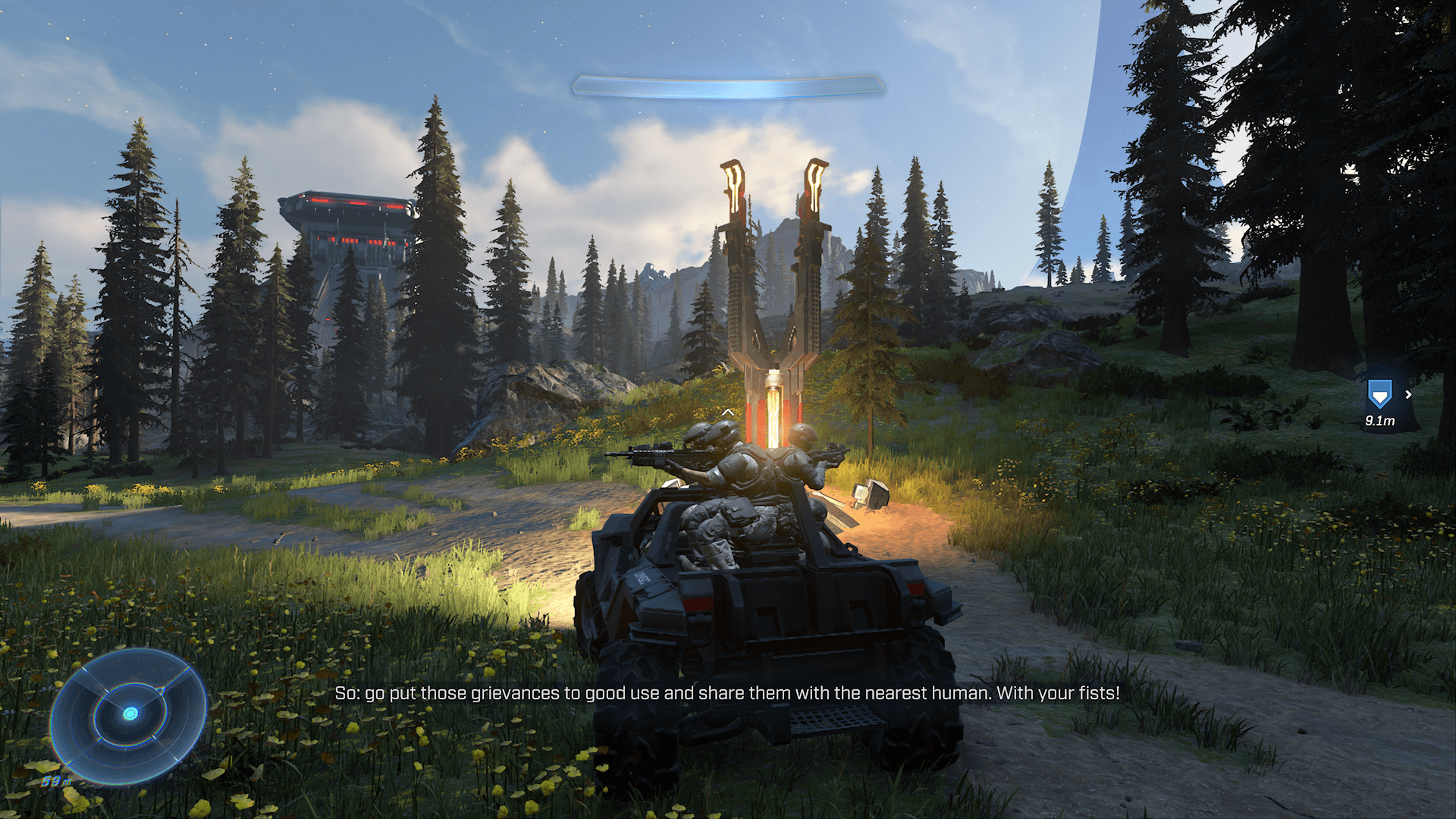
Taking the boys out on a Sunday drive.
“Taking the boys out on a Sunday drive.”

That doesn’t stop you from using vehicles, of course. Along with the staples of the series and some returning favorites from Halo 5, we have access to the new UNSC Razorback troop transport. That might sound boring, but loading a Razorback up with marines armed to the teeth is far more effective than the developers probably intended, even if the wonky physics of the Warthog-like vehicles sometimes conspire to ruin the fun. Seriously, who doesn’t love spending several minutes equipping and loading up your marines only to flip over 10 seconds after leaving your FOB?! The Banished’s selection of vehicles is a bit worse, especially since we know they have a lot more in their arsenal from their appearance in Halo Wars 2. More vehicles are added to the sandbox as you upgrade your FOBs from completing activities and unlock more of the map by progressing the campaign, and by the time you’ve made it to the last major section of the map, you’ll probably be spending much of your time exploiting the Wasp to simply fly everywhere. It’s a game changer for sure, and despite the sudden appearance of Banshees and Banished troops armed with Shock Rifles in hopes of countering you, almost the funnest way to travel.

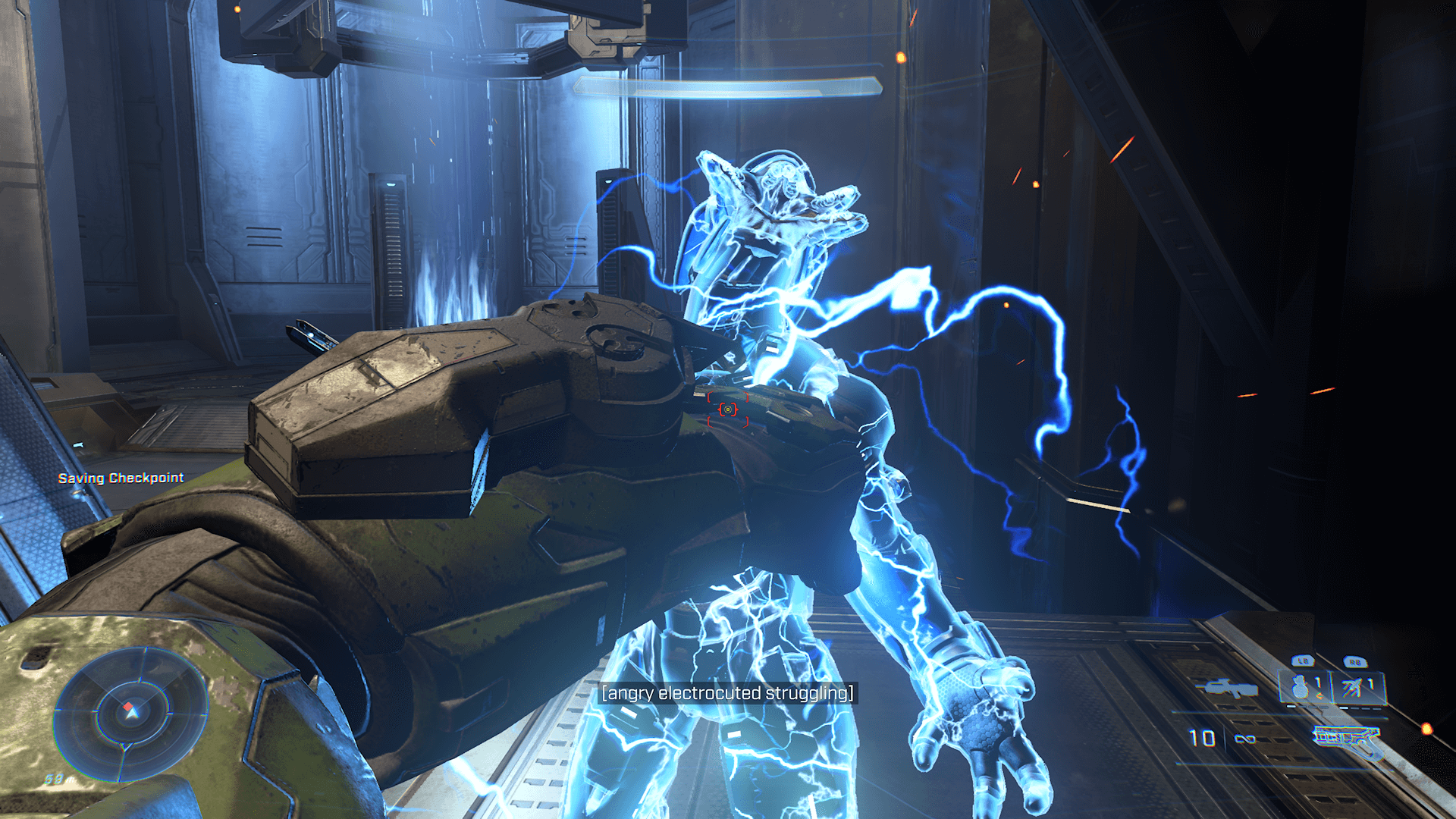
Yes, by far the most unique new addition to the Chief’s tool belt is the Grappleshot, a launchable and retractable grappling hook. We’ve never seen anything like this in Halo before, and oh man, is it satisfying. I’d go as far as to say that the addition of the Grappleshot single-handedly saves Infinite’s new open world from mediocrity. How fun would exploring be without being able to easily scale huge structures and even mountains, and save yourself from the inevitable deadly falls that follow? Oh, and zipping directly onto an enemy, perfectly timing meeting their face with the butt of your rifle (or better yet, an Energy Sword or a Gravity Hammer) is just… *chef’s kiss*

The upgraded Grappleshot also electrocutes your enemies! *grin*
“The upgraded Grappleshot also electrocutes your enemies! *grin*”

Finally, we have the story. As this is the last game of this series, and I’ll want to talk about it a bit, let’s go ahead and summarize the plot right here. As usual I’ll keep it reasonably vague, but this, as well as the two paragraphs after it, contain spoilers. Skip the next three paragraphs if you’ve not played Infinite yet and care about the sort of thing!

The Story: Having spent a year evading the Created, the UNSC flagship Infinity is dispatched to Installation 07 to execute a plan to defeat Cortana. Mere moments after their arrival, the Infinity and her escorts are ambushed by a massive Banished force. The Infinity is abandoned, with its surviving crew scattering to the ring’s surface. During the chaos, the Master Chief comes face to face with Atriox, the leader of the Banished. In the ensuing melee, the Chief is thrown from the Infinity and left for dead. Six months later, he is discovered amongst the debris and revived by a lone UNSC Pelican pilot. Together they discover an encoded message being sent from the Halo and head to its surface to investigate. The Chief finds the Weapon, a copy of the Cortana AI that was the linchpin in UNSC’s now evidently successful plan. The Chief and the Weapon unite and attempt to rally the scant surviving UNSC forces against the ring’s Banished occupiers, now led by Atriox’s lieutenant Escharum after Atriox’s apparent death. During their mission, they encounter the installation’s monitor, 117649 Despondent Pyre, who hysterically warns them of the Harbinger, a dangerous entity that the Banished have released. Later the pair encounter the Harbinger herself, who divulges her plan to repair the ring and free the rest of the Endless, an ancient race imprisoned there by the Forerunners. After being taunted by a hologram of Escharum, who imparts that the Banished and the Harbinger share the same goal, Master Chief and the Weapon hatch a plan to disrupt the Harbinger’s attempts to accelerate the ring’s repair systems. In the process, they discover that these repair efforts are being focused on a specific mysterious part of the ring known as the Silent Auditorium. Escharum again taunts the Chief, baiting him with the coordinates to where he is holding the Pilot captive. Soundly defeating the Banished warlord, the Chief and the Weapon continue on to the Silent Auditorium. While searching the facility, they encounter numerous corrupted fragments of Cortana’s memories. Ultimately, these visions reveal that Cortana sacrificed herself to stop Atriox from releasing the Endless and ensure that the Weapon remained active to guide the Chief. The Chief locates and defeats the Harbinger, but too late as Atriox, in an unknown location, is already freeing the Endless himself.

Before playing it, I was under the impression that Halo Infinite more or less ignored the plot of Halo 5. It doesn’t. In fact, despite leaving out a lot of those details above, it’s actually quite important to Infinite’s plot. Regardless, this was still an incredibly unsatisfying way of following up the semi-cliffhanger ending of Halo 5, skipping ahead and barely even referencing much of the preceding drama outside of audio logs. Playing these games back to back, one moment the fate of the entire galaxy hangs in peril thanks to Cortana’s Created and their Guardian enforcers, the next you’re just facing off against the newest batch of wanna-be Covenant goons, and you completely miss most of that action to boot! Like a good Noir story, there can be something compelling about putting the pieces together after the fact, but I’d argue that Infinite doesn’t lean far enough into it to make it interesting. Instead, it just feels like a flimsy excuse to go a different direction with the story without having to worry too much about the details.

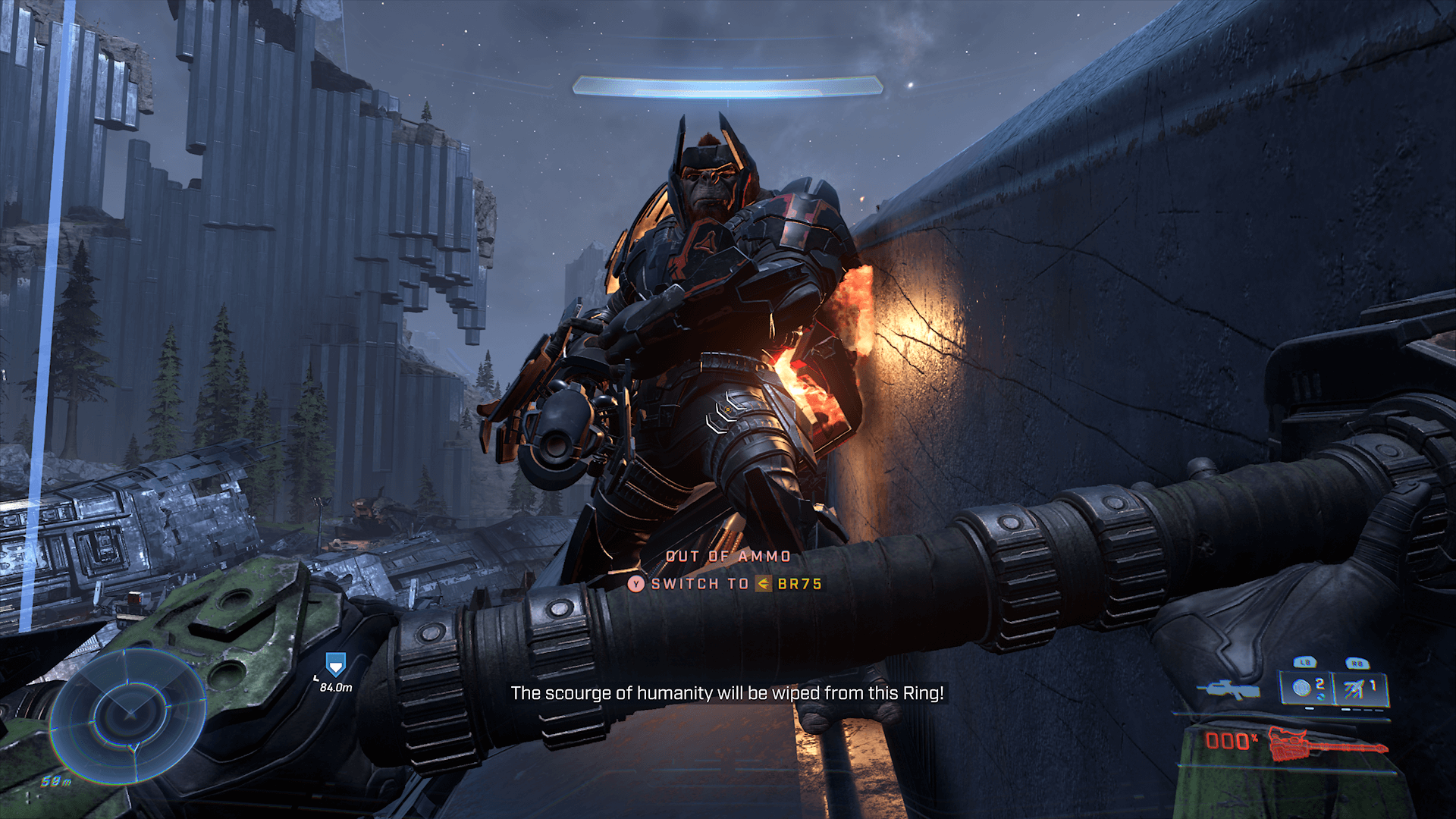
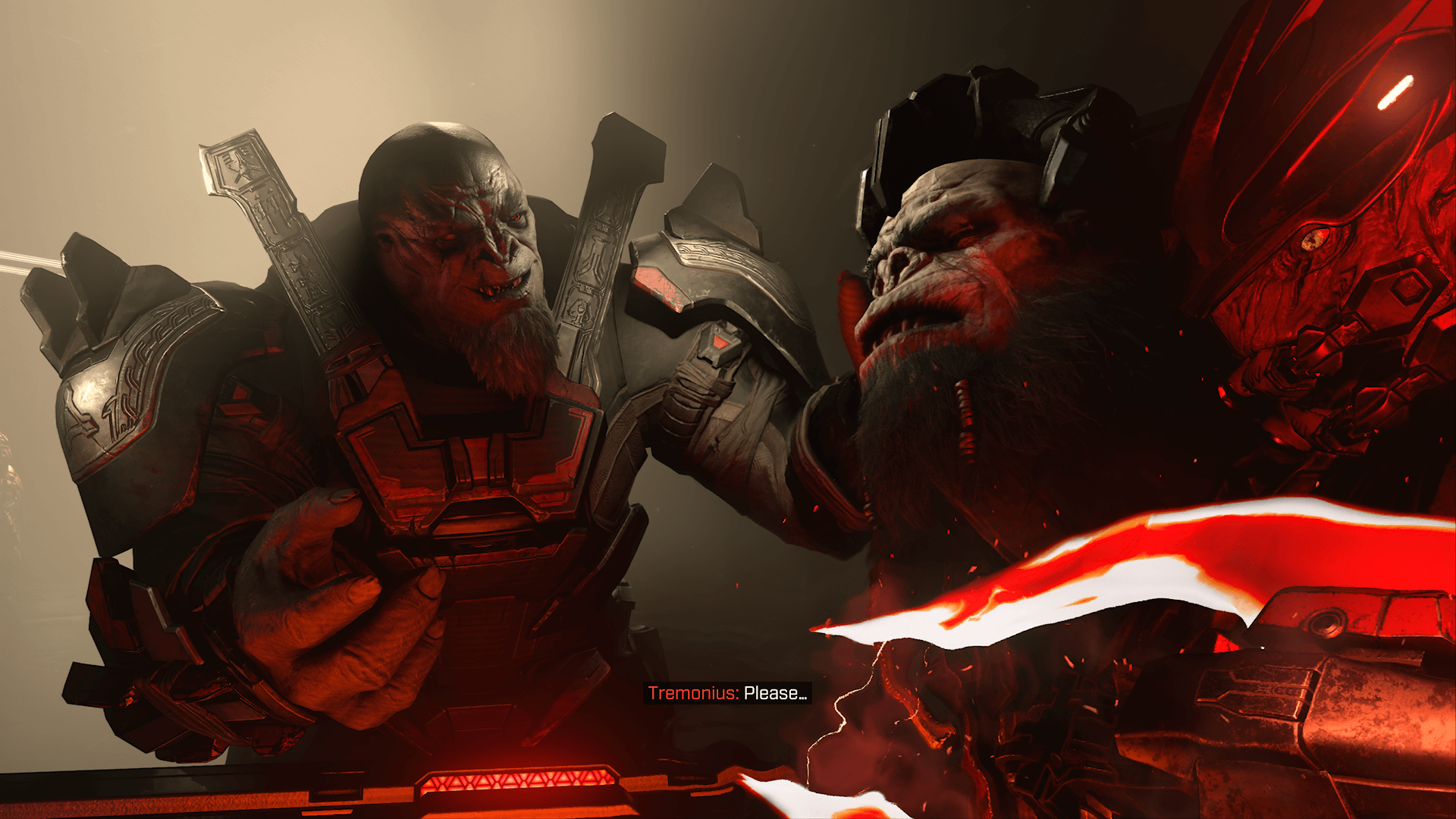
Sign up now for Escharum's officer morale improvement seminar!
“Sign up now for Escharum’s officer morale improvement seminar!”

That wanna-be Covenant comment aside, I do really like the way the Banished are portrayed here, being my favorite depiction of the Brutes by far, and they’re about as fun of an enemy as I could imagine facing while rehashing the Covenant yet again. I also enjoyed the dynamic between Master Chief and his naive new AI companion “the Weapon”, and running around solo with just her at your side (err, in your head) feels like a welcome return to form after Halo 5. I also kind of appreciate Infinite’s attempt to deliver a more grounded, less epic “hero saves the entire universe” kind of story this time around, even though, if we ever get it, I expect the DLC (or standalone sequel) that has us dealing with the Endless to be more along those lines.

That uncertainty is the saddest thing about Infinite. I’d imagine that most of my complaints were due to that aforementioned rocky development, resulting from compromises to get the game shipped, but Infinite was supposedly going to live up to its name by being something of a “live service” game. Yet, it’s obvious that 343 has utterly failed to make that happen, even struggling to put out fixes and new maps for multiplayer with any sort of expediency. With recent news of more departures and layoffs, this could even end up being the last 343 Industries developed Halo game. It’s a shame because the core gameplay and a lot of the ideas here are great, and if fully realized, I think Infinite could have finally been the game to prove that 343 was worthy of carrying the torch. In the end, it is definitely worth playing, but it’s definitely not that.

Well, after that gut punch, I’ll cover the live-action stuff quickly. A pair of teasers, Forever We Fight and Carry On are kind of neat, with the latter showing the Chief squaring off against a Banished Brute. Less neat, the UNSC Archive trailers Unspoken, Project Magnes, and Lightbringers may also be of some interest too. Much more on this subject next!

Halo Fest 2020 – Guardians

With my decision to skip out on the Xbox One meaning I’d likely never play Halo 5, I stayed oblivious to both the considerable amount of pre-release hype and the immediate post-release criticism around the game. That’s not to say I don’t know anything about it as these days it’s difficult to find yourself in any sort of Halo community without stumbling across a ridiculous meme bashing Spartan Locke. Indeed, the game has a remarkably terrible reputation, often slated for having the worst campaign of any of the mainline Halo games. This means I was totally intrigued to finally play it, but my expectations weren’t exactly high.

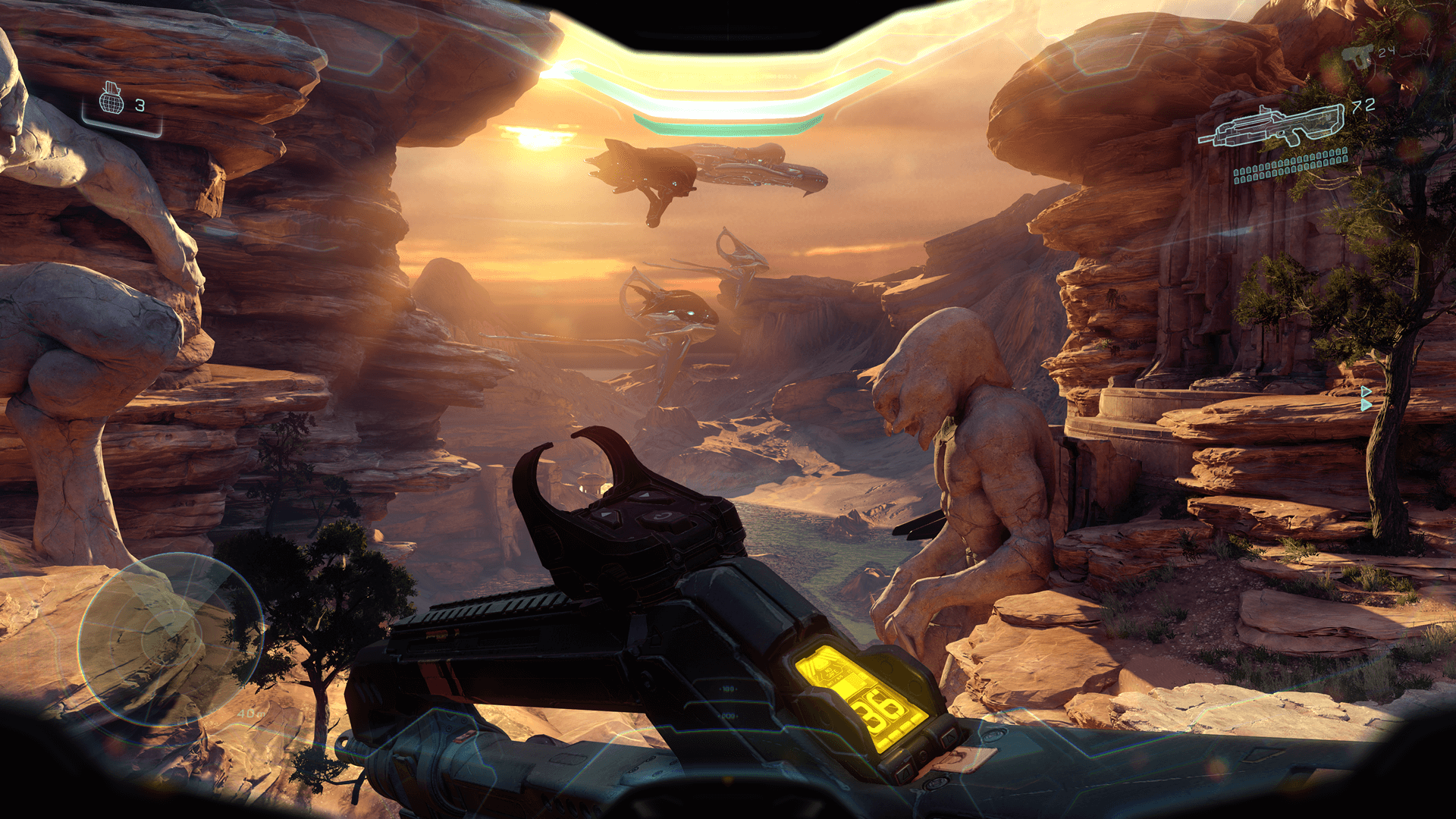
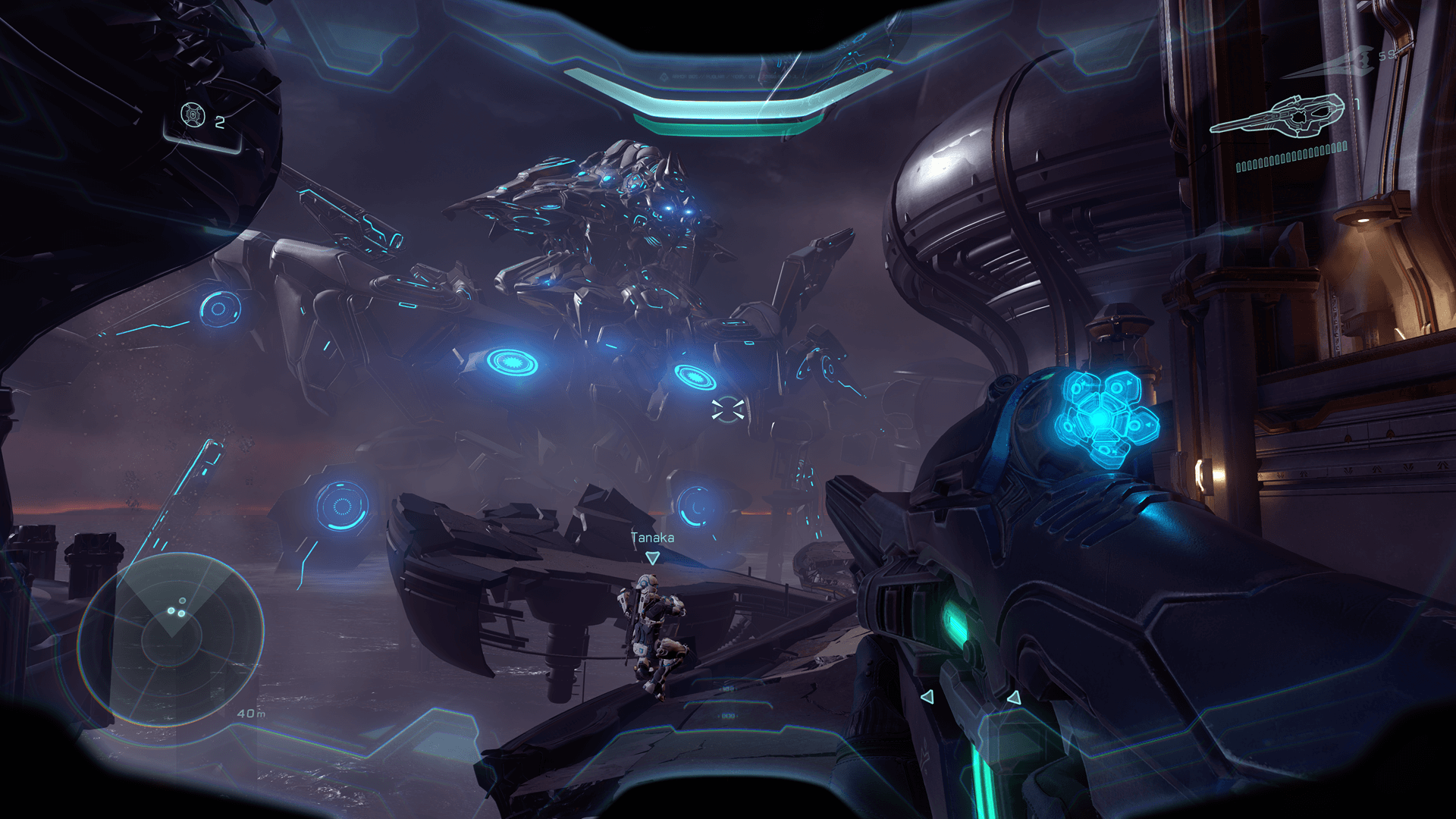
Guns down in Sanghelios.
“Guns down in Sanghelios.”

Graphically, the Halo franchise’s entry into the 8th generation definitely didn’t disappoint and of course Halo 5 continues the tradition of featuring levels that span across diverse environments which helps showcase this, the awesome “glassed” moon Meridian and the beautiful Elite homeworld Sanghelios being particular standouts. Quite a nice looking game with all of the little touches and polish you’d expect from the series. Technical fidelity aside, 343 Industries continued the stylistic overhaul they started with Halo 4, bringing more of an overall cohesion to the designs of the UNSC. Some of these changes, such as with my beloved Scorpion tank, were perhaps the biggest departures from Halo: CE yet, while still quite respectful of their classic designs. The Covenant and particularly the Prometheans were similarly given a fresh coat of paint.

Things fare a little worse when it comes to gameplay. For the first time in Halo Fest 2020, I was struck by how different Halo 5 felt to play. It’s hard to describe, but it didn’t quite feel like Halo anymore. It was as if the series was moved to a new engine without much care being put into trying to replicate the feel of the previous one. On top of that, the overhauls I mentioned above didn’t stop with the graphics, with many weapons being heavily reworked as well. The classic Assault Rifle / melee combo I’d used as my crutch in literally every game since Halo: CE no longer felt quite as effective. Of course, I quickly got used to all of this and adapted, but I have to imagine that this is a big part of why fans heaped so much praise on how Halo Infinite feels to control.

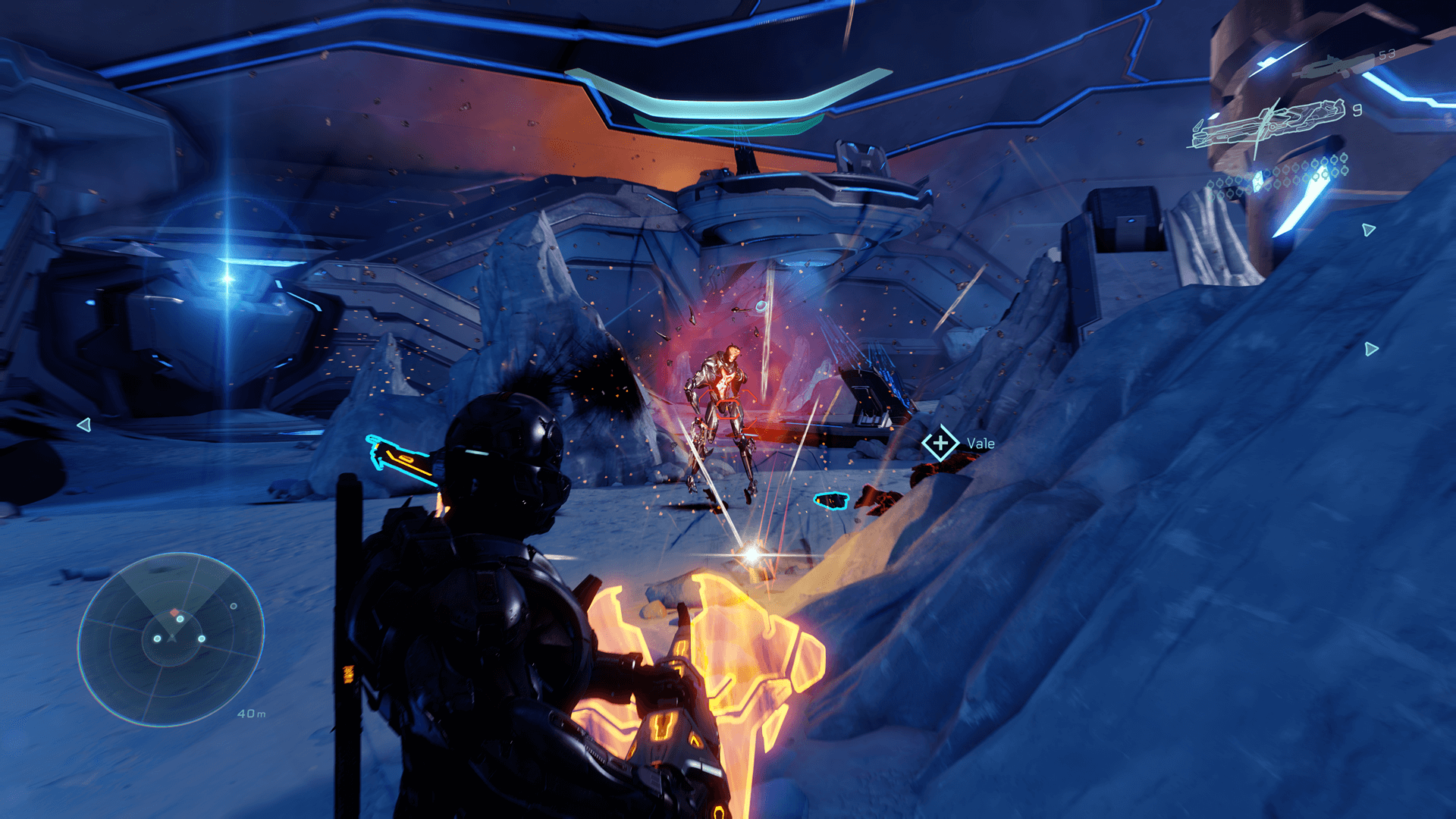
Atomizing a Promethean Soldier with a Splinter Turret.
“Atomizing a Promethean Soldier with a Splinter Turret.”

Gone are the armor abilities that had been evolving since Halo 3, replaced instead with some inherent “Spartan Abilities”. You can now sprint at will, have built in thrusters to propel you directionally, and you can also perform special charge and ground pound attacks. The charge in particular is used a lot in the campaign to break through walls, unlocking secret stashes or alternate routes. There’s also a new ledge grab, which improves jumping and climbing quite a bit. I’m honestly not sure how “Halo” it all feels, but you’ve definitely got dramatically more maneuverability than ever before. Not technically a Spartan Ability but “assassination” melee moves are also a prominent part of the game now too. Another core change is that all weapons have an “aim down sight”-like system of zooming which is helpful without going all the way into Call of Duty territory.

Speaking of weapons, new to Halo 5 we have the tracking UNSC mini rocket launcher, the Hydra, the Covenant Plasma Caster, which is kind of a combination of the old Concussion Rifle with an alt-fire mode that charges up to fire a high damage projectile, and the Promethean Splinter Turret, which feels like some sort of cannon, and I absolutely grabbed it every time I had the opportunity. They also replaced our beloved SPNKR missile launcher with a totally new model that tracks like in Halo 2. On the vehicle front, the most notable additions are the UNSC Wasp, yet another Hornet and Falcon like aircraft, and the Phaeton, something of a Promethean equivalent. As mentioned, quite a lot of the weapons were tweaked and adjusted, with the Promethean weapons in particular being heavily altered. While I might prefer the old Suppressor, at least it feels like a distinct weapon now.

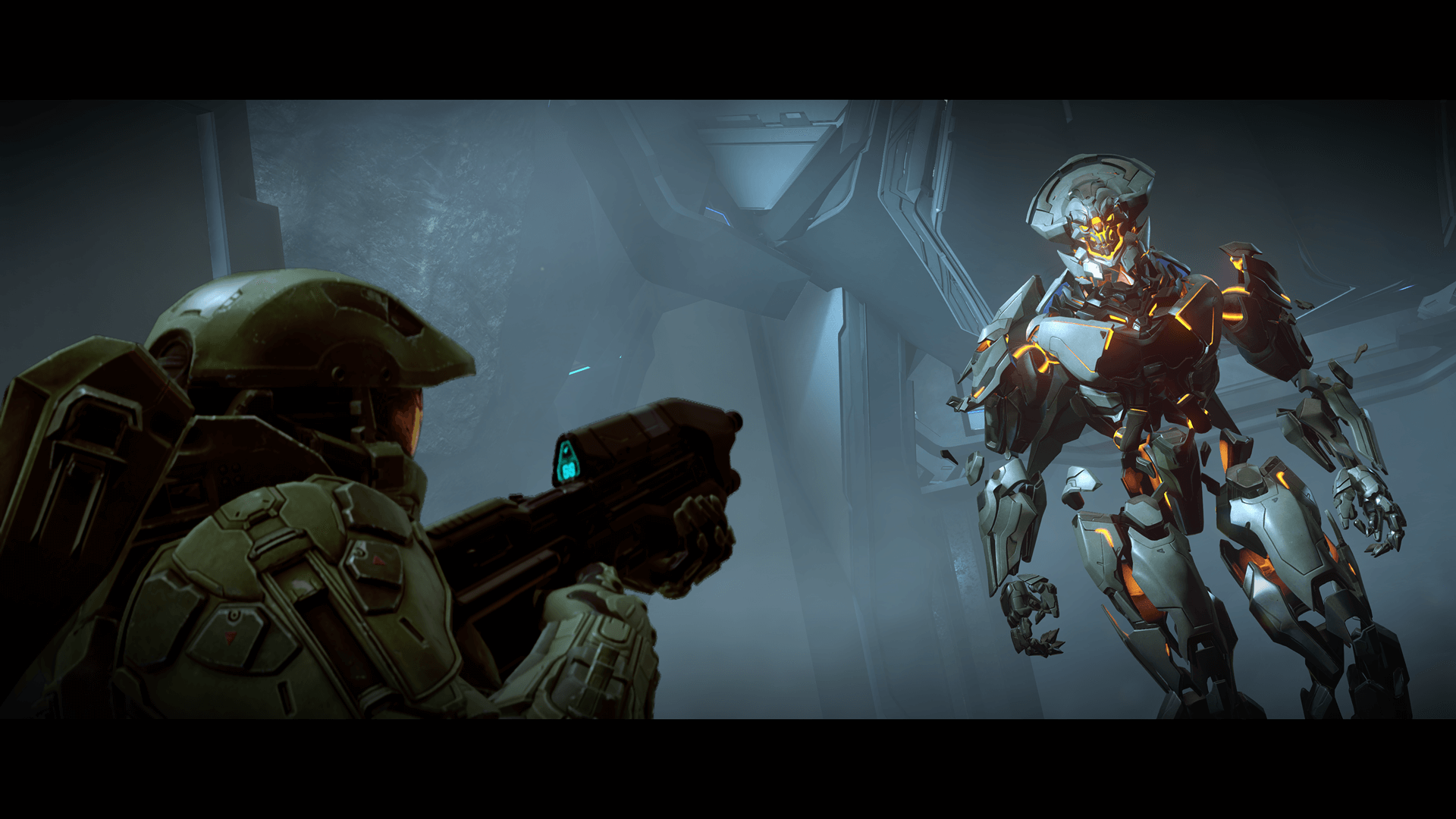
Chief finally meets the Warden.
“Chief finally meets the Warden.”

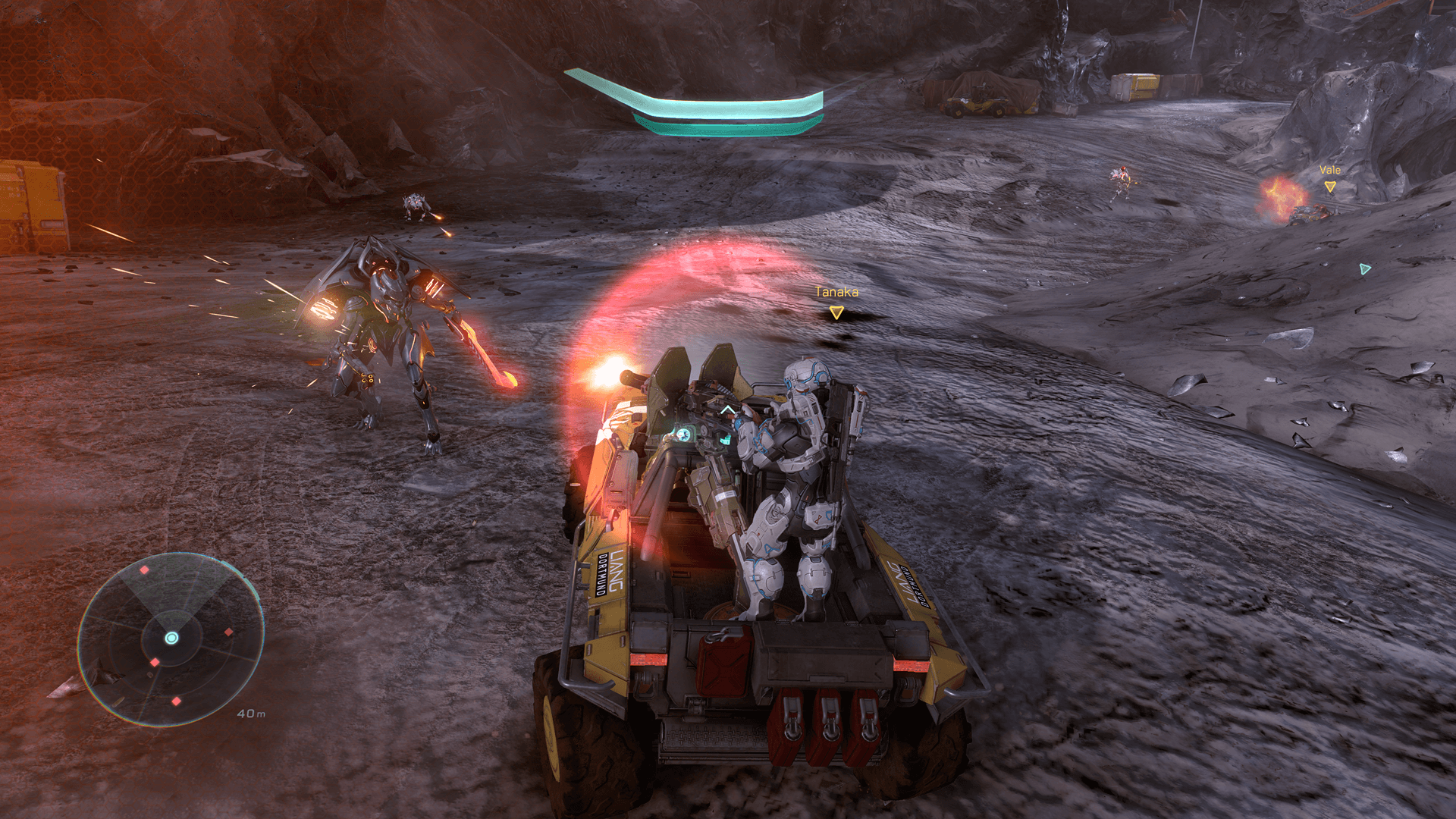
Oddly, the difficulty struck me as a bit more brutal than the last few games. Playing on “Heroic” as usual, I felt like I could be killed in only a few shots, encouraging further engagement distances and a bit less aggressive play than usual for me. When things did go pear-shaped, my squadmates could usually be trusted to save the day and revive me. That is, for the first time in the Halo series, every single mission has you running as part of a four person fireteam. You have a single context sensitive button, being able to order them to go to a particular location, get in a vehicle, pick up a weapon, engage an enemy, etc. This works reasonably well, but is a far cry from the highly tactical experience I first dreamed of when hearing about Halo: Reach, largely thanks to the AI squadmates being absolute blithering idiots. At least they give us plenty of banter during missions…

The missions themselves are quite quick. If I hadn’t been obsessively scouring every map for hidden intel and skulls I think I would have wrapped up Halo 5’s campaign in record time. This wasn’t an issue for me though; the game was paced with a momentum that never left me ever stopping to wonder if I was bored, even with the addition of a few new “guns down” areas where all you’re expected to do is wander around and talk to other characters. Really, my only major complaint around the campaign structure and level design is with the repeated Warden Eternal boss fights, and even if it was a bit repetitive running into this goon over and over again, the fights were at least a fun challenge.

Filling a Promethean Knight full of lead.
“Filling a Promethean Knight full of lead.”

Since I griped about them quite a bit during my Halo 4 post, I should mention that the Prometheans have been pretty thoroughly reworked. Knights are now mini-bosses, complete with a “shoot parts off their armor” mechanic for taking them down, and they, along with the Watchers, appear a lot less frequently. Crawlers also appear a lot less, and in much smaller groups when they do. Instead, the Promethean roster now includes a new type of humanoid robot called a “Soldier”. Soldiers can teleport, though not as a frustrating way of fleeing from firefights as with Halo 4’s Knights, and they can wield a variety of weapons, including the above mentioned Splinter Turret. All in all, this version of the Prometheans is far less of a chore to fight and personally, I’m pretty damn happy about that.

So, by now I must have mentioned at least half a dozen things that you might imagine could be responsible for the derision this game constantly gets from the Halo community, but not so fast! I think it’s time for us to talk about Halo 5’s story. Since I feel the need to nitpick it, and from Halo 4 on the games are only loosely connected anyway, I’m going to go ahead and summarize the plot right here. As usual I’ll keep it somewhat vague, but this, as well as the two paragraphs after it, will definitely contain spoilers. Skip the next three paragraphs if you want to avoid them!

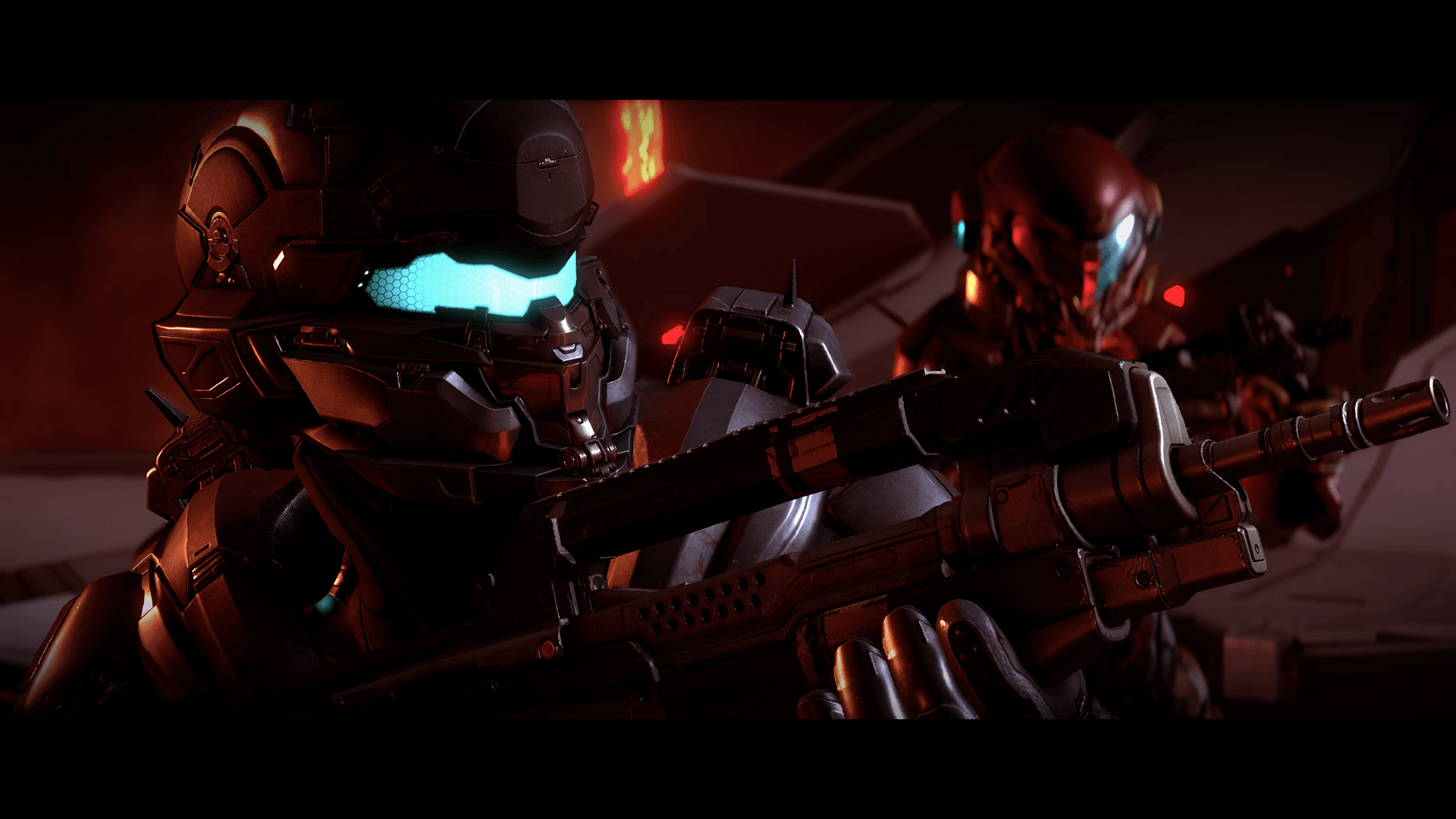
Fireteam Osiris heading towards a distant Forerunner Guardian.
“Fireteam Osiris heading towards a distant Forerunner Guardian.”

The Story: Spartan Fireteam Osiris, led by Spartan Jameson Locke, is dispatched from the UNSC Infinity to rescue Dr. Halsey from Covenant faction leader Jul’Mdama. Once planetside, the Spartans find that the Promethean and Covenant forces have turned on each other. Taking advantage of the chaos, Osiris eliminates Jul’Mdama and his retinue and successfully extracts Halsey. Meanwhile, the Master Chief and his fireteam “Blue Team” are conducting a routine mission when the Chief sees a vision of Cortana, who gives him a cryptic message about the planet Meridian. Deciding to investigate instead of returning to the Infinity, Blue Team are listed as AWOL. Arriving on Meridian, Osiris tracks Blue Team to a Forerunner structure housing a Guardian, massive Forerunner ancilla built to police entire systems. Soon after, Osiris catches up to and briefly confronts Blue Team, but they’re able to escape onto the Guardian, leaving Osiris to hastily flee the structure and later the Meridian itself as the Guardian activates and jumps away to devastating effect. Blue Team arrives on an unknown Forerunner planet where Guardians from all over the galaxy are gathering. There Master Chief reunites with Cortana, who shares that when the Didact was defeated his ship performed an emergency jump to this planet, Genesis, where she was able to join the Forerunner data network, the Domain, curing her of her rampancy. She also reveals her plan to take up the Forerunner’s “Mantle of Responsibility” herself, enforcing a new era of peace across the galaxy, seemingly accepting the death and destruction this will inevitably cause. Eager to show Master Chief that her plan will work, she places Blue Team in stasis. Aboard the Infinity, Halsey hatches a plan to hijack a dormant Guardian located on Sanghelios, the Sangheili homeworld. Despite being embroiled in a civil war against the remnants of Jul’Mdama’s Covenant, the Arbiter and his Swords of Sanghelios get Osiris to the Guardian just as it is about to jump away. On Genesis, Osiris, with the help of the planet’s caretaker AI, 031 Exuberant Witness, is able to wrest control of the planet’s systems away from Cortana, freeing Blue Team in the process. Cortana and her fleet of Guardians jump away to continue with their plan. Some time later, with innumerable AIs joining her cause, Cortana and her “Created” begin disabling ships and other technology all over the galaxy, sending the UNSC Infinity on the run.

From the cutscene at the beginning, which is the most over the top depiction of Spartans I’ve seen since “The Package” in Legends, I was bracing for the worst, but thankfully I found most of the claims of the story being a train wreck to be hyperbole. I think my aforementioned low expectations helped a lot, but, despite so much of the story between Halo 4 and Spartan Ops as well as other crucial background information (like who the hell Blue Team actually is, for one) being left to the most dedicated Halo fans to discover via novels and comics, I was able to follow the plot reasonably well. I admit, I was disappointed that the events of Spartan Ops were wrapped up in such an unceremonious way, but I’d probably be even more bummed out to have never played through Spartan Ops and have no idea why Halsey was hanging out with the Covenant and missing an arm, if I even knew who she was in the first place. Regardless, while there are many signs that maybe the game had been rewritten perhaps one too many times and I’m absolutely certain that a closer examination of the game’s plot would reveal it to be a swiss cheese of much more disconcerting plot holes, there are some very cool ideas here.

That actual main character of Halo 5, Spartan Locke.
“That actual main character of Halo 5, Spartan Locke.”

A much more immediate issue is Halo 5’s dialog. I can generously interpret that 343 intended to depict Blue Team as “quiet professionals” but Master Chief hardly says anything and half of the little he does say is, well, just kind of stupid. It’s easy to imagine that after the traumatic loss of his only companion after so many months fighting the Covenant on his own he’s chosen to lose himself in his work, but the game doesn’t make any effort to show us that, and that is an example of what people really mean when they say Halo 5’s writing is bad. Cortana is the real standout to me though, as her physical depiction, voice acting, and even her behavior (like cruelly mocking the members of Osiris towards the end of the game) barely resemble the Cortana we know. Sure, this could be explained by everything that happened to her since Halo 4, but it just feels… off. Speaking of Osiris, it’s absolutely mind boggling that, after the well-known fan backlash over playing the Arbiter for a third of the game in Halo 2, 343 would have us playing Locke and Fireteam Osiris for all but three of the 15 missions in Halo 5. *facepalm*

While I could go much, much further, this is already getting too long. I actually enjoyed the game quite a bit more than I was anticipating. Still, it fails to continue Halo 4’s character development of either Master Chief or Cortana and it fails to wrap up the events Spartan Ops set up in any meaningful way. Indeed, it also sounds like, despite introducing a huge new threat and ending on somewhat of a cliffhanger, it doesn’t connect in an important way to the story of Halo Infinite either. So, while maybe Halo 5 might not deserve every bit of the ridicule it gets online (and indeed, much of the community was quite fond of its multiplayer, and its Forge is supposedly incredible) that doesn’t exactly make it an impressive entry into the series either.

To briefly carry on the tradition of talking about live action media around the series, the “Hunt the Truth” campaign advertisements The Hunt Begins, All Hail / The Cost, and A Hero Falls set up a seriously epic showdown between the Chief and Locke, which, yeah, isn’t even close to what happened. Ooops! What was it I said about too many rewrites again?