At long last we make it to the first game of the modern series, 1998’s highly influential Metal Gear Solid. From everything I’ve seen on the subject, Hideo Kojima’s plans for the game seemed to mostly revolve around adapting the series’ existing gameplay to a 3D engine. Given that few outside of Japan had ever played the game MGS shares most of its DNA with, Metal Gear 2: Solid Snake, and that the results of this technical overhaul were quite impressive for the time, there’s little wonder why it’s an absolute classic to this day.
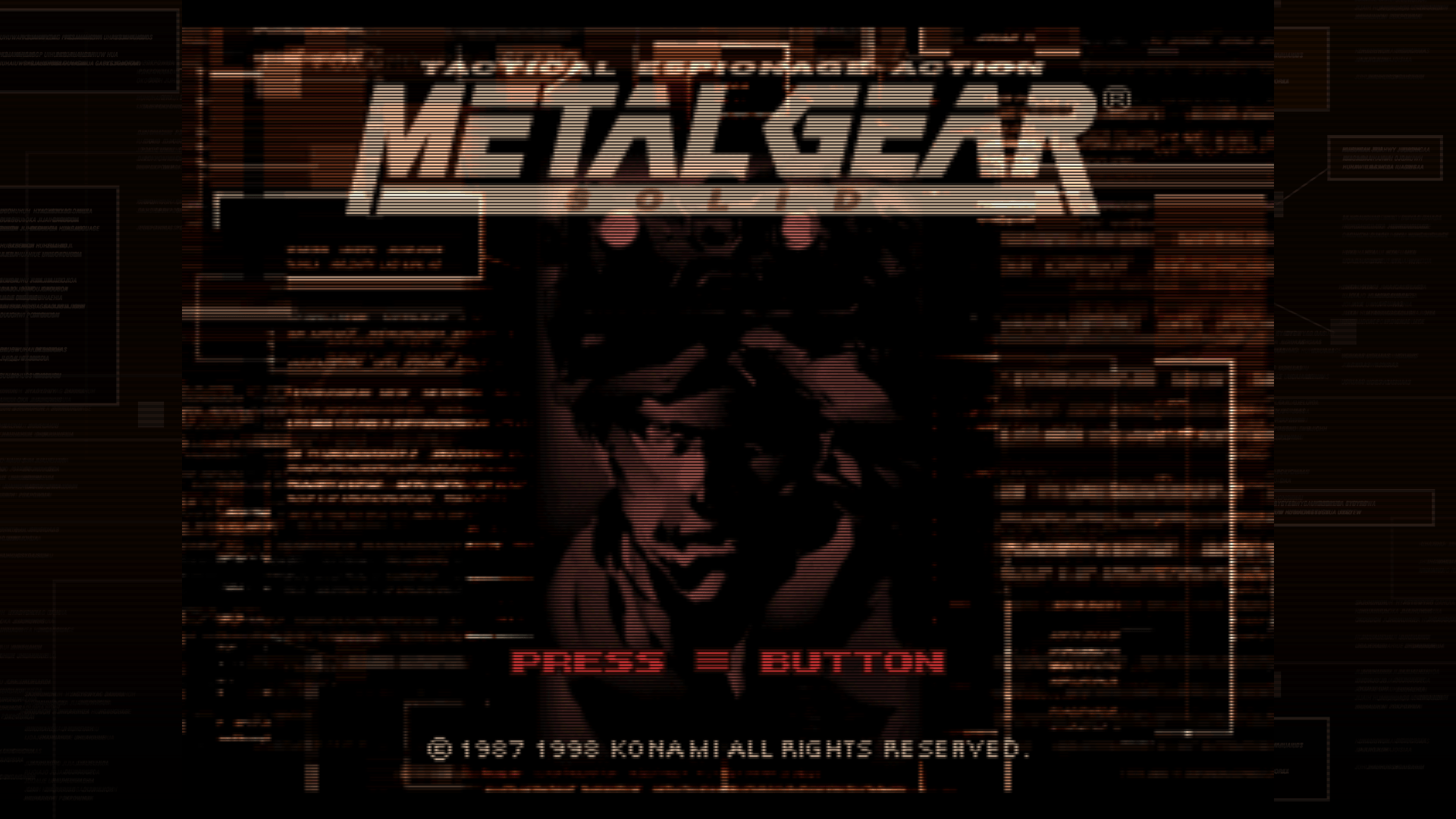
“Metal Gear Solid – Tactical Espionage Action!”
As for me, I sided with Nintendo in the 5th gen console war and the only exposure I had to PlayStation games was what I played at friends’ houses. Word about Metal Gear Solid must have caught up to me though, as I distinctly remember almost buying a copy to play with “Bleemcast!” on my Dreamcast a little later. It wasn’t until the release of the Metal Gear Solid: Master Collection Vol. 1 in 2023 that I had a legitimate way to go back and play the first Metal Gear Solid on a console I actually owned. Yes, I’m sure a lot of people will be reading this thinking of all the other ways I could have played it before then, and I’ll be addressing all of that in a separate bonus post. In any case, for this playthrough I played that version, which is actually the original PlayStation version running in some kind of proprietary emulator, on my Xbox Series X. It’s fairly no-frills compared to what you can do with emulation on a PC, but alas, it’s definitely sufficient… plus, achievements! I’m running the game in the original 4:3 aspect ratio with both smoothing and the CRT screen filter enabled, which is an okay approximation of what the game looked like back in the day, and also why my screenshots look a little dark. Unbeknownst to me they added the ability to run the game upscaled in its final 3.0 patch, released after I started this playthrough. It looks quite good, though definitely a departure from the 1990s experience.
While comparing Metal Gear Solid to its predecessor will be a running theme here, from a presentation standpoint, it’s such a massive upgrade that it’s almost beyond comparison. Starting the game launches into a slick, fully voiced introductory cutscene depicting series protagonist Solid Snake being launched from a submarine while being briefed on the mission. It’s all very cinematic and absolutely brimming with flavor pulled straight from the best political espionage thrillers. If you want to get extra nerdy, you can launch a separate briefing menu from the title screen that goes much deeper into the context. Watching that, I found myself being a bit surprised by how impressed I was with the voice acting. Once I got into the game proper, I continued to be impressed with how fluid the animation, camera, and controls all felt. The music was also great, and a perfect moody fit for the cold lighting and even colder Alaskan setting. A great first impression for a game that is almost 30 years old. It stays consistently excellent as it goes along too – I found myself particularly sucked into the snowy outside areas. it’s definitely a vibe and quite immersive.
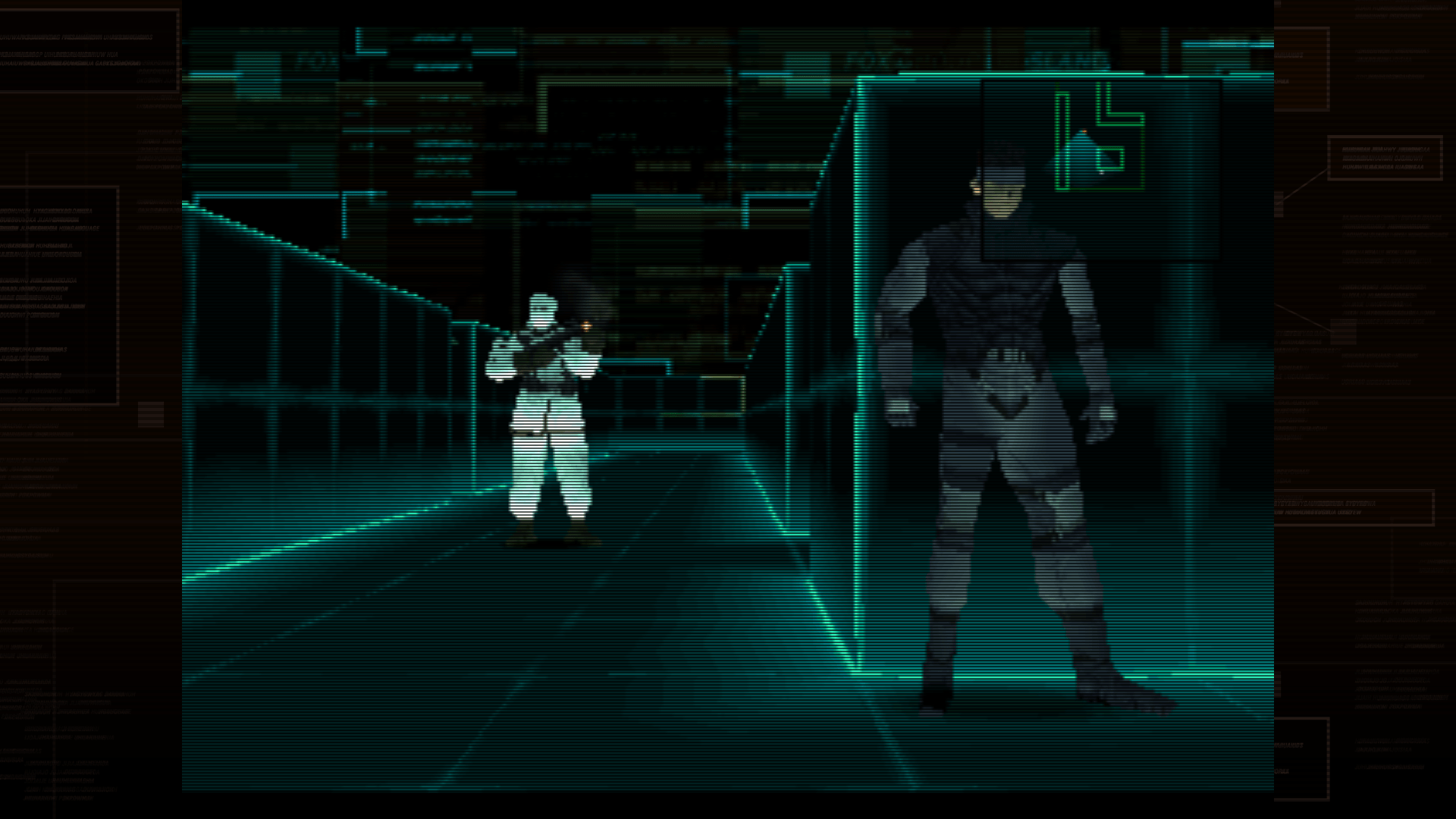
“Virtually hiding around a virtual corner from a virtual guard.”
The user interface and control scheme are both very familiar, with gear selection associated with the left trigger and weapons being accessed and equipped using the right, for example, though I realize a large part of that is due to the console ports of the first two games being retroactively influenced by the later MGS games. Regardless, I found it to be pretty easy to pick up. Despite being 3D, the game largely confines you to fixed overhead camera angles. While similar to its predecessors, this feels oddly restrictive since the camera is otherwise quite dynamic. It’s also a bit more zoomed in, sometimes annoyingly hindering your ability to see the items, enemies, and other obstacles around you. Two new features help with this, though: the ability to back up to and look around corners, which besides looking pretty damn cool, moves the camera down to a more typical third person perspective, and the addition of a dedicated button to look around in first person. You can’t really move or shoot in either mode, but in terms of getting your bearings, they work.
The stealth gameplay mechanics are all quite iterative of what we got in Metal Gear 2. Guards are a bit more intelligent, responding to more varied conditions, even bodies on the ground. On the other hand, recalling the first Metal Gear, their patrol paths and sight lines feel more predictable so it’s quite easy to sneak around or up behind them. I find that to be more fun, personally, though a less positive step back is the lack of the sometimes hilarious overabundance of hiding places to crawl into that most areas of MG2 had, making it a bit more challenging to run and hide or to quietly wait for guards to pass. Another mechanic that was nerfed a bit was that of my beloved cardboard box; guards are now much more likely to be suspicious of it, especially if it’s too close to their patrol route. Because of the much greater risk involved, I barely used it. Conversely, MGS’s mini-map has been upgraded to the “Soliton Radar” which shows the enemy cones of vision in addition to movement, making it vastly more useful for avoiding detection and planning your routes. The alert system is almost identical to MG2’s, but addressing one of the major gripes I had with that game, guards are way less annoying when triggered, appearing in smaller numbers and less often, and once you lose them, it feels like the alert phase ends and things get back to normal much more quickly.
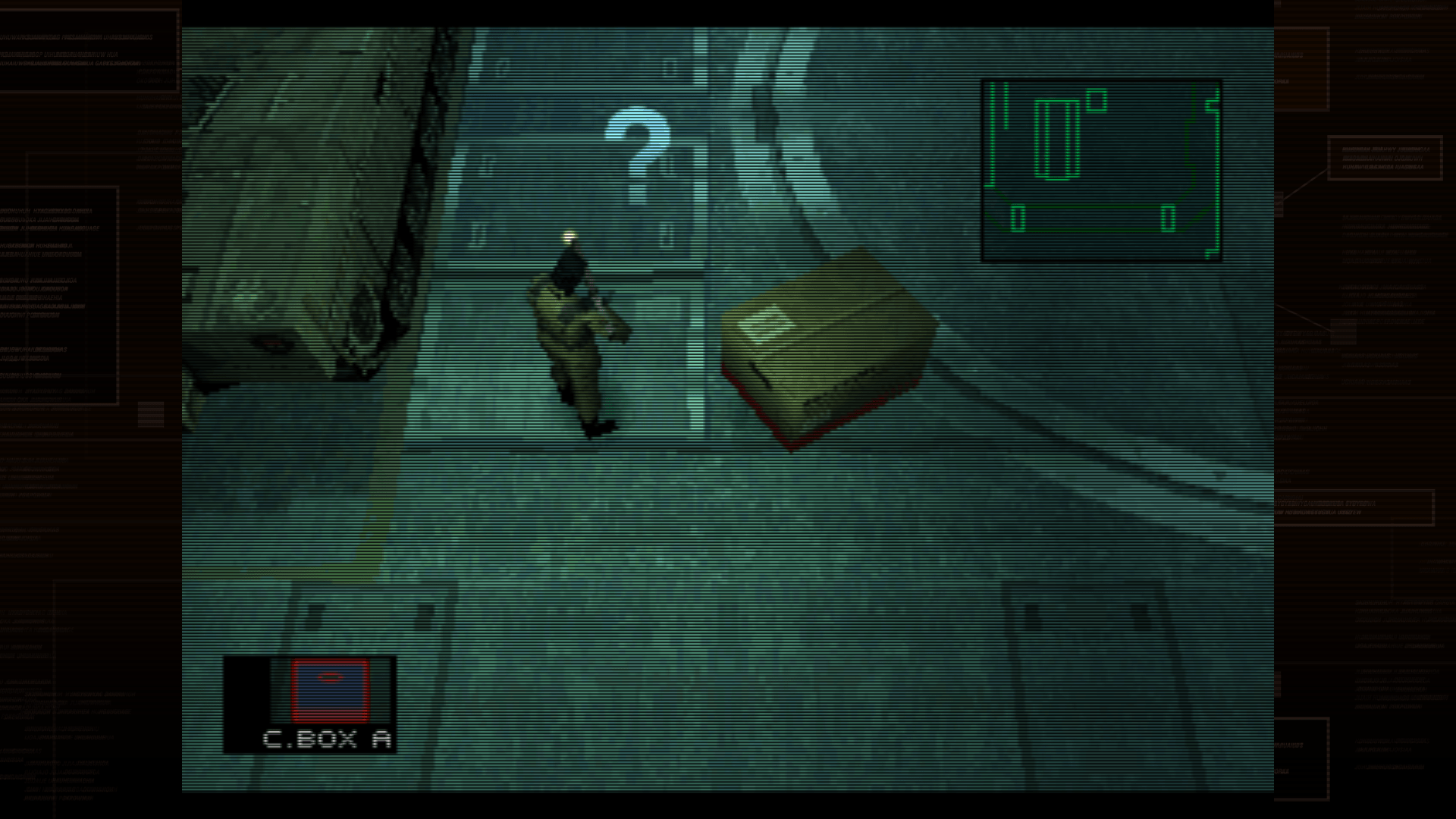
“Huh? It’s just a box…”
One of the biggest departures from the first two games is that combat feels way less viable. While Snake’s repertoire of hand-to-hand moves is larger – you can now grab, throw, and choke enemies – I never developed anything resembling “accuracy” when lining up attacks. This is even more pronounced with shooting; I could always take out my targets, sure, but whether I could do so without setting off an alert was a total crapshoot. I’d rather avoid guards entirely than try to take one out given the high chance of failure. If I had been able to line up a perfect head shot and/or consistently knock out guards, this game would have played very differently. This is fine, and perhaps even intentional, but from playing more modern stealth action games, I couldn’t help but feel like I had a lack of tools at my disposal for handling the more routine encounters in a reasonably stealthy way.
Structurally, MGS is a lot more linear than the first two, more Metrovania styled games, with “gates” typically tied to plot progression. You still have a ton of cool items to collect but they’re not really used as overt “keys” into new areas. Instead, new gear usually provides you with more options for handling different scenarios, but aren’t necessarily required. There are still actual key cards, of course, but placement of areas that require them seems much more intentional. That’s not at all to say there is no backtracking in MGS; even if playing the critical path, you’ll be revisiting the armory multiple times, and there are at least two sections where backtracking was added as what feels like a blatant attempt to pad out the playtime. At one point Snake even complains about it, much to my amusement. Thankfully, Shadow Moses is a lot smaller than it feels so these sections aren’t as painful as they sound. As an aside, there has been a notable “quality of life” improvement with key cards in that you only keep one in your inventory now. I still wish it didn’t need to be manually equipped, but I’ll take what I can get!
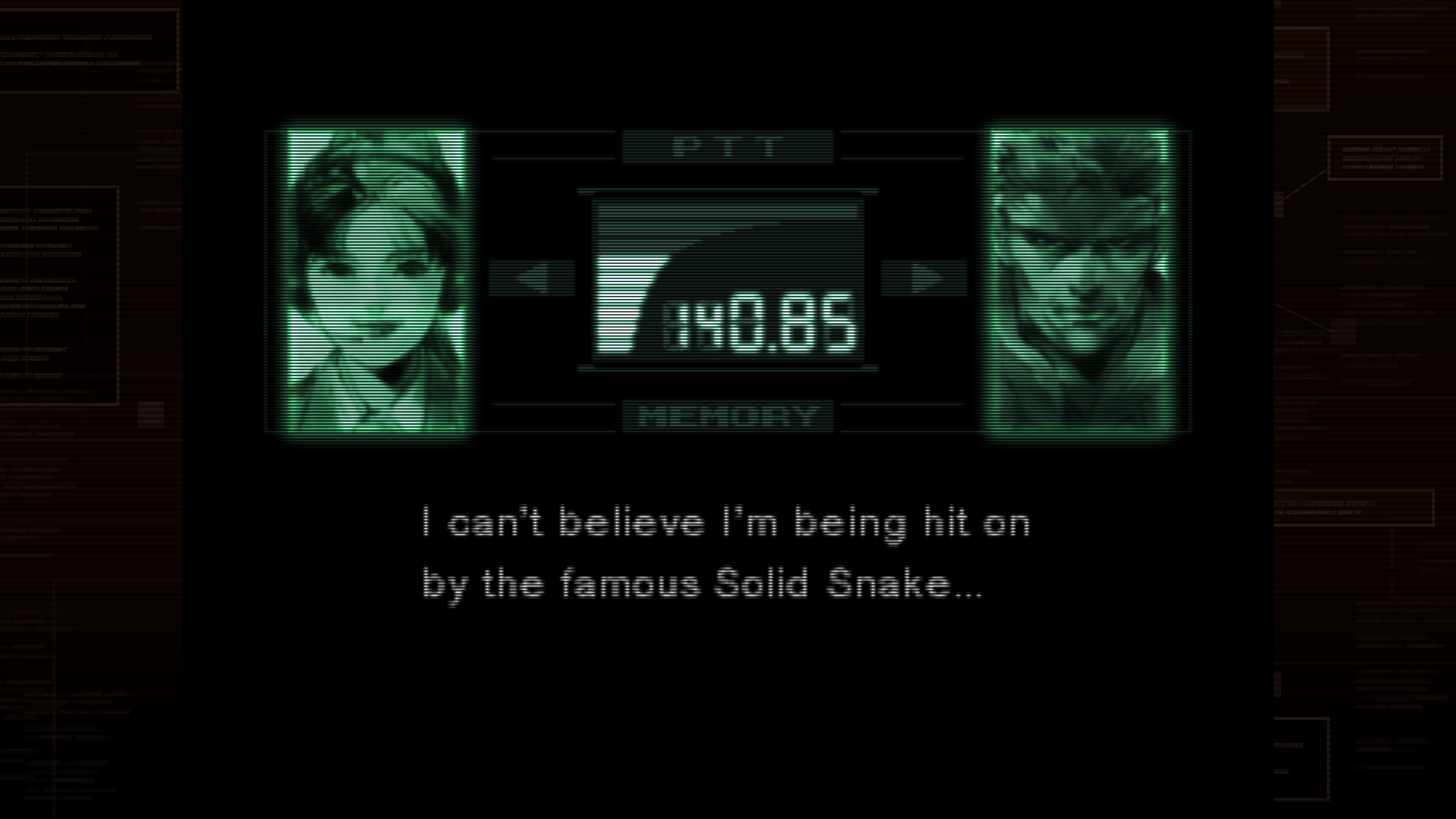
“Trust me, Mei Ling, that doesn’t make you special.”
Gone are the characters you could talk to in-game for hints and background details, being almost entirely replaced by codec calls and cutscenes. Codec calls are a perfect evolution of MG2’s radio conversations; they’re lengthy and detailed, two-way, often involving multiple people, and most importantly, fully voiced. Just about every one of your contacts has something relevant to say at any time, and they are even context sensitive to some degree. The interface isn’t too different either, though I really love the character portraits by Yoji Shinkawa. MGS’s use of cutscenes actually feels pretty modern, existing mostly to set up a scene or show events outside of player control. Between being rendered seamlessly in-engine and their often creative camera work, they’re a key component to the cinematic quality I mentioned, which itself is definitely an important ingredient in MGS’s special sauce. They’re also mostly relatively quick; the series certainly hadn’t reached total insanity when it comes to long cutscenes yet, and with the exception of Nastasha’s preachy diatribes on nuclear weapons, even the longer codec calls feel pretty quick the first time around.
With that, let’s jump into our story re-cap. Expand the box below for a short but spoiler-filled synopsis of the game’s plot. When I say “short” this is by far the longest one of these I’ve ever written, and I left so much out too!
Story Synopsis - Spoilers!
2005. FOXHOUND takes over a secret nuclear weapons facility on Shadow Moses island, Alaska, demanding the US government give them $1 billion dollars and the remains of Big Boss or face a nuclear strike. Solid Snake is forced out of retirement to infiltrate the island and rescue two of the hostages being held there, DARPA Chief Donald Anderson and ArmsTech President Kenneth Baker, as well as assess the threat. Colonel Roy Campbell returns to lead the operation, revealing that he has a personal stake in that his niece Meryl Silverburgh is on-site. Once inside Solid Snake quickly locates the DARPA Chief who reports that FOXHOUND has seized a new model of the nuclear armed Metal Gear, codenamed REX, being covertly tested there, then suddenly dies of a heart attack. Moving deeper into the facility, Snake locates the ArmsTech President being held by FOXHOUND’s Revolver Ocelot. During a tense shootout in which Ocelot seems to have the advantage, a mysterious cyborg ninja appears, slicing off Ocelot’s hand, forcing him to withdrawl. Snake interrogates Baker who tells him to contact Meryl, as she has the PAL cards needed to disarm REX’s warheads, along with Dr. Hal “Otacon” Emmerich, REX’s designer. Baker then too suddenly dies. On his way to meet Otacon, Snake is ambushed by the cyborg ninja, leading to an intense close quarters fight. As the ninja retreats, Snake realizes that it is none other than his old FOXHOUND colleague Gray Fox, who he believed he had killed at Zanzibar Land. With Otacon providing directions to REX’s hanger, Snake and Meryl team up, but the pair soon find themselves under fire from FOXHOUND’s Sniper Wolf. Wolf hits Meryl multiple times, incapacitating her. Snake moves in only to be surrounded and knocked out. He awakens to find himself strapped to a table, face to face with Revolver Ocelot and the leader of FOXHOUND, Liquid Snake. Liquid confirms suspicions that he and Solid Snake are brothers and that they are the sons of Big Boss. Ocelot then brutally tortures Snake. Somehow holding out, Snake is taken to a cell where Octacon is able to help him escape. Upon reaching Metal Gear REX’s hanger, Snake overhears Ocelot and Liquid discussing their final preparation for their nuclear strike and Liquid’s plans to turn Shadow Moses into a new version of Outer Heaven. After the two depart, Snake attempts to deactivate REX’s weapons but is shocked to discover that FOXHOUND never had the means to activate REX’s warheads, and he has inadvertently done it for them. Snake runs to confront Liquid, who reveals that Snake’s handlers have been lying to him, and that he was actually sent to Shadow Moses to serve as a vector to spread a genetically engineered virus called FOXDIE, designed to kill specific people based on their DNA. The US government wanted to eliminate FOXHOUND and hide all evidence of their attempted takeover, while also acquiring Metal Gear REX for themselves. Liquid jumps into REX and targets Snake. Gray Fox appears, blocking the attack and disabling REX’s radar. Fox reveals that he is there for a final showdown with Snake, but Liquid catches Gray Fox off guard, killing him. Liquid then challenges Snake to a final fistfight atop the hulking Metal Gear, baiting him with Meryl, who he has tied up nearby. During the melee, Liquid tells Snake about “Les Enfants Terrible”, the cold war era project that birthed them in an attempt to create the ultimate super soldier from the legendary Big Boss’s DNA. Snake throws Liquid off of REX and frees Meryl. Racing out of the facility, the two are confronted by Liquid Snake yet again, though he suddenly dies from the effects of FOXDIE. Colonel Campbell vows to keep Snake’s survival secret, though it’s unclear how long it will be before he, like his brother, succumbs to the virus. In an epilogue, Revolver Ocelot calls the President of the United States, who is revealed to be a secret third clone of Big Boss, Solidus Snake.
Whew!
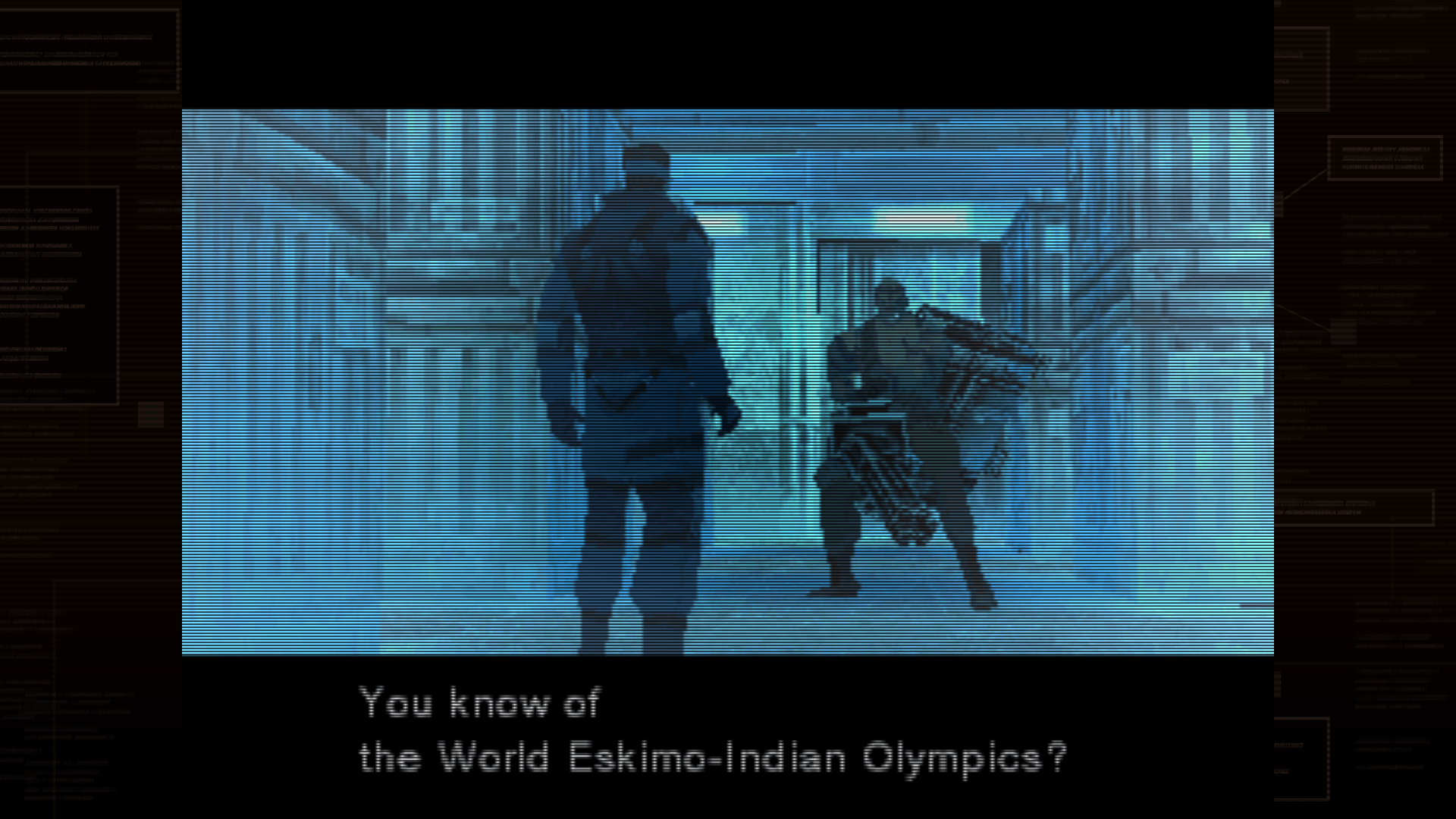
“Yeah, I know it. You must be a real threat in the Muk-Tuk eating contest.”
Compared to the previous games, the writing in Metal Gear Solid is on another level. Much more of a soap opera, there are so many twists and turns, double-crosses, surprise reveals, and weird references that I’d be surprised if most kids playing this in the 90s came anywhere close to fully understanding it. There is so much of this stuff that I’ve been hearing spoilers for this game for almost 30 years and was still surprised by some of the plot twists. There are the occasional clumsy exposition dumps and needless overexplanations, though they’re kind of endearing in a way. Likewise, the frequent insertion of references to real-world military technology, science, and politics comes across a little more like a geeky obsession than anything close to realistic, and yet, this is a fun video game about a dude who is practically a martini and an English accent away from being James Bond, so hey, it works for me. Speaking of, Snake’s penchant for hitting on every female he comes across is even worse than in MG2. There are some other slightly pervy moments too, like Meryl’s ass being a significant part of the plot, but I think it mostly keeps it together. The first Metal Gear had some hints of the quirky humor often associated with the series, but MG2 was quite a bit more buttoned up. With MGS, it’s out in full-force. Personally, I think this is all pretty amusing, somehow managing to strike the balance of injecting moments of silliness into an otherwise very serious story without throwing off the tone. Unsurprisingly, there is some stuff that just comes across as more cheesy than quirky, though. A lot of the dialog around the whole “love blooming on the battlefield” theme, for example, just didn’t land with me. It’s sometimes hard to tell if it’s knowingly a little dumb or legitimately a bit hamfisted in its execution, but really, I’m not sure it matters.
When it comes to a lack of realism, the game’s numerous bosses, which are now a much bigger part of the plot, are where we go from a semi-plausible espionage story with some questionable stuff about genetics and a bit of deep state conspiracy theory to complete nutso fantasy. I don’t remember FOXHOUND being some kind of rogues gallery of super-villains when Snake was a member of the unit, but then again, I guess we were never shown too much about them. Among our bosses we have a cyborg ninja, a mustache twirling Russian gunslinger, a telepathic psychokinetic flying fetishist, a hulking Inuit shaman who wields a massive Vulcan cannon and has some kind of a magical connection to ravens, a master sniper femme fatale who rocks the cleavage even when laying prone in snow, and of course, the series namesake, a badass mech “like one of my Japanese animes!” A huge positive for having this weird cast of characters is the varied mechanics around each one. Everyone has heard of Psycho Mantis and his fourth wall shattering attempts to mess with the player, but practically every boss fight in the game is unique and memorable. Even the Hind D fight (yes, another one…) was really cool, blowing away those in earlier games. Speaking of fourth wall breaks, yeah, MGS has those in full-force too. They’re everywhere, not just with Psycho Mantis; you’ll have some of your crew telling you what buttons to hit on your controller, friends and enemies alike discussing your saving habits, weird rumble shenanigans, etc. It’s fun!
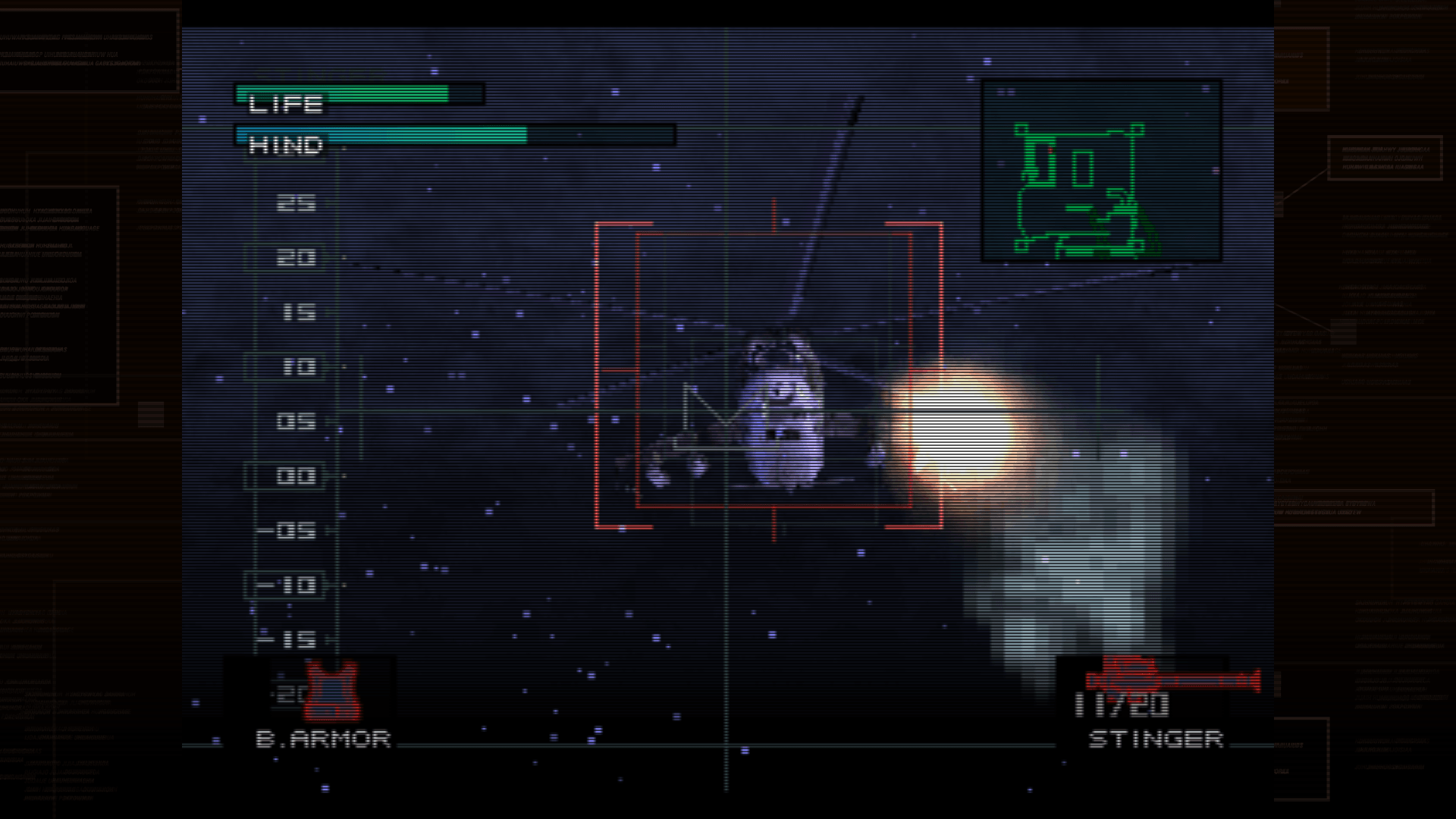
“Another Metal Gear game, another Hind D fight…”
I played the game on “easy” difficulty after learning that it was the normal difficulty in the original Japanese release, and I definitely think it was a bit easier than the earlier games. I didn’t use a map at for this playthrough and only glanced at a walkthrough from time to time to get my bearings when it had been a long time between play sessions. That said, you’ll need to do a lot of exploring if you want to find every item and have a good amount of supplies, and as mentioned, anything besides a strategy of avoiding guards is going to be challenging. One tip I’ll impart to anyone planning on playing is to not be an idiot like me and use your damn grenades! Stun and especially chaff grenades are kind of an easy button in many situations. Despite the variety of mechanics, none of the boss fights are that obtuse either, and a quick codec call during a fight will often tell you exactly what you need to know. That doesn’t mean there aren’t still some really frustrating moments. For example, my first attempt or two at counter-sniping Sniper Wolf was aggravating as she kept hitting me, interrupting my aim before I could get a bead on her, and I absolutely hated the final jeep sequence where it seemed almost impossible to hit Liquid. Also, my checkpoint before the Ocelot fight had me low on both rations and ammo, which made it incredibly challenging. Speaking of, saving in MGS is another case of a positive iteration over what MG2 did. This time we have modern checkpoints which you can usually resume from any time you die. However, you need to use your codec to actually save your game between sessions, though its pretty quick if you can resist chatting with Mei Ling. As an added bonus, there’s also a cool “mission logs” feature that dynamically describes the previous events from your playthrough every time you load a save game from the main menu. I love this kind of thing, though as I heavily leaned on my Xbox’s “Quick Resume”’ feature, loading a save was a rarity for me.
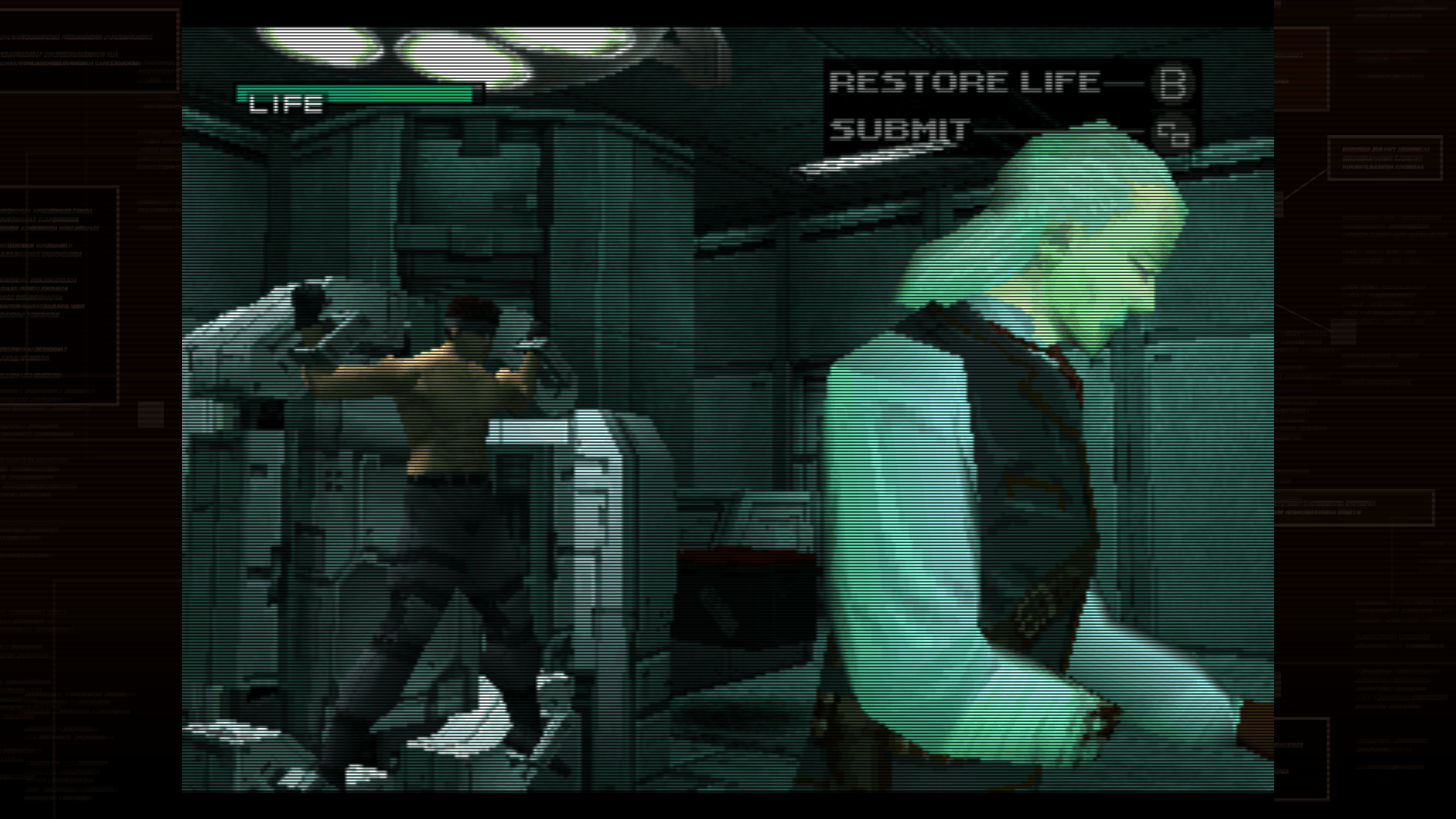
“Tap for your life! Err, well, Meryl’s life…”
There’s so much more I could go into about the game, though the most important thing I haven’t mentioned yet is the unusual level of detail here. MGS is full of little one-off mechanics that don’t really feel necessary, seemingly just because Kojima thought they were cool. There’s also a ton of easily missed codec conversations, weird interactions, and secrets sprinkled throughout. Toss that in with reasonably open gameplay in which almost every scenario has multiple solutions and this leads to some unique emergent, or at the very least highly memorable, moments. This all goes to make the game feel deeper, letting players’ minds run wild imagining the possibilities, which is surely an important factor in why MGS resonated with so many people.
Wrapping up, I think if I hadn’t just played Metal Gear 2: Solid Snake I’d have a lot more to say about the gameplay and systems of Metal Gear Solid, as frankly I’m a bit surprised by how similar the games are in so many respects. Yet, I’m glad I did given how much MGS references it, and I definitely think MGS is the better game, having improved just about everything, and upping the ante on the presentation to the point that it’s easily one of the standout games of its generation. I’m absolutely positive that if I’d owned a PlayStation and played the game back in the day, I would have loved it, and I’m quite happy to have finally experienced it. It’s a damn good thing too, as I still have a lot of Metal Gear games to get through… 😅
“I suspect this isn’t the last time we’ll hear about that place.”
I should quickly mention a couple of other related releases. Metal Gear Solid: VR Missions is something of a standalone expansion that greatly expands on the VR training missions that served as an optional tutorial in the main game. While I’m sure I would have tried to complete all 300 of these back in the day, a handful of more interesting missions aside, they’re mostly a test of the player’s mastery of the mechanics, and the mechanics, particularly the combat, weren’t really my favorite part of MGS. Once I got to some slightly more challenging missions, I found them more frustrating than fun and made the hard call to bail. I’m still tempted to go back and finish them, honestly. The other would be Metal Gear Solid: The Twin Snakes, which is the 2004 remake of MGS for the GameCube. That game will be getting its own article when we get to it.
By release date, Metal Gear Solid for the Game Boy Color (AKA Metal Gear: Ghost Babel) should be next, but considering it is going to be included in the upcoming Metal Gear Solid: Master Collection Vol. 2, I’ve decided to wait and play that version. Barring any delays, it should be released by the time I make it through my next game, Metal Gear Solid 2: Sons of Liberty.