Category Archives: Game Logs

Metal Gear Mania 2025 – Metal Gear 2: Solid Snake

Like most in the West, I didn’t know Metal Gear 2: Solid Snake even existed for the longest time. Instead, we had the NES exclusive Snake’s Revenge. It comes up in just about every piece about the game these days, but there’s a fun anecdote about how Snake’s Revenge actually led directly to the development of Metal Gear 2. In brief, Kojima was not involved with or apparently even aware of the development of Snake’s Revenge until he had a chance run-in with a former teammate who mentioned being assigned to the team working on it. Learning of its existence inspired Kojima to immediately start thinking about how he’d design a true Metal Gear sequel. This quickly escalated, with Kojima seeking and being given the greenlight from Konami to actually make it. While amusing, if even a little true, it’s quite revealing about the development of both titles.
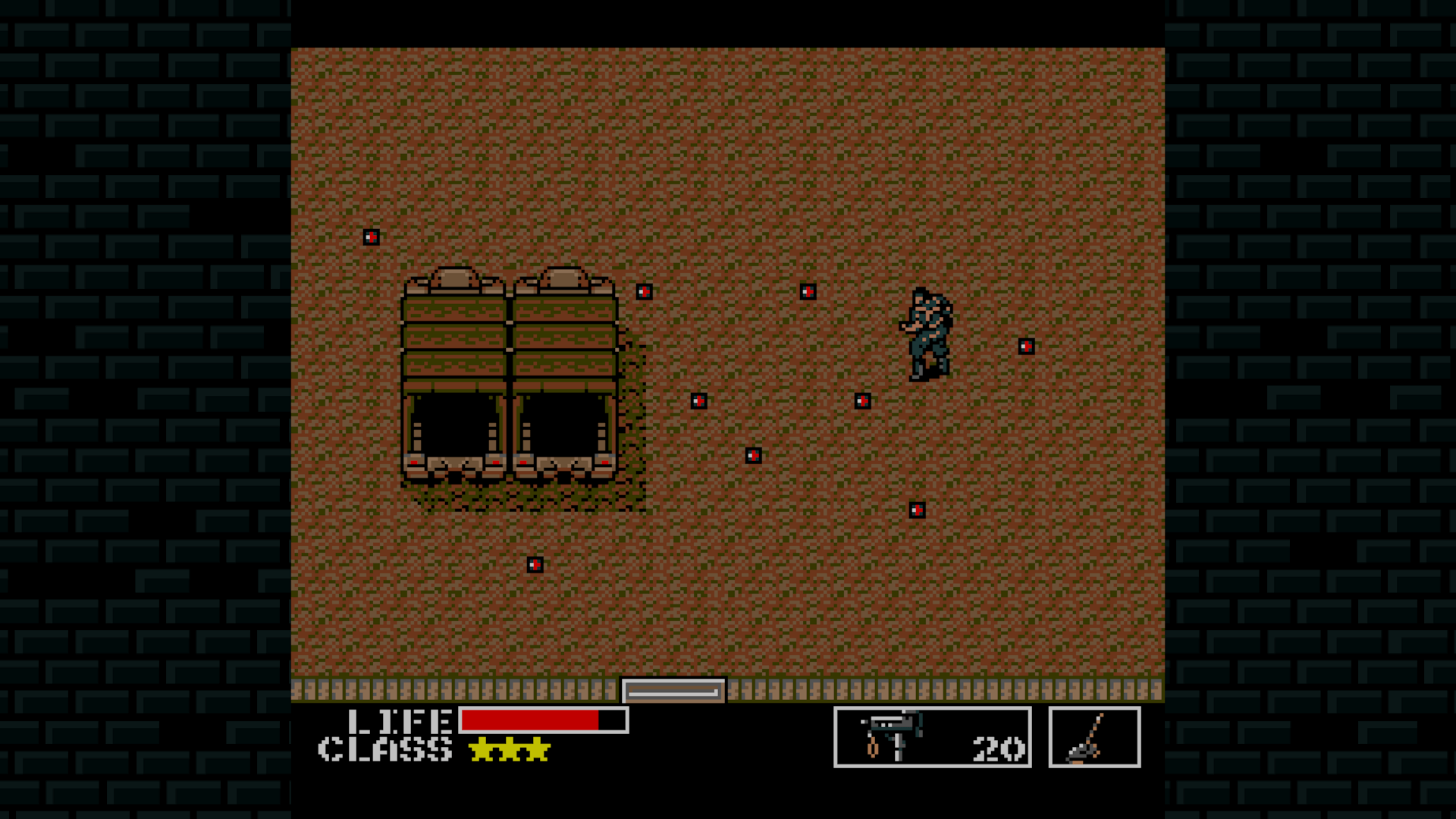
Metal Gear 2 - bigger and badder.
“Metal Gear 2 – bigger and badder.”

And that’s about it for me talking about Snake’s Revenge. Beyond Kojima not being involved in its development and it being in no way canon, Snake’s Revenge being the potential second game in what would become a long running series brings its entire status as a Metal Gear game into question. That is, regardless of whatever merits it might have had, it’s clearly not the direction that Kojima would have taken the series, making it a bit more of an evolutionary dead end than even later non-canon entries in the series would be, in my opinion. While I admit that I’m a little curious about the game, I have to trim the fat somewhere. Apologies, Snake’s Revenge fans!

As for the actual Metal Gear 2, after its Japanese release in 1990 it stayed an MSX exclusive without even so much of an official English translation. Like the MSX version of the first game, a port of Metal Gear 2: Solid Snake eventually made it to the West in 2006 as bonus content for Metal Gear Solid 3: Subsistence. This was later included with the HD Collection and that version is included with the recently released Metal Gear Solid: Master Collection Vol. 1, which is how I played it. Like the first game, this is actually a port of an older mobile port, but looking at a list of the differences between this and the original version, I mostly see improvements, so here’s hoping this is a decent enough representation of the original game to base my impressions off of.
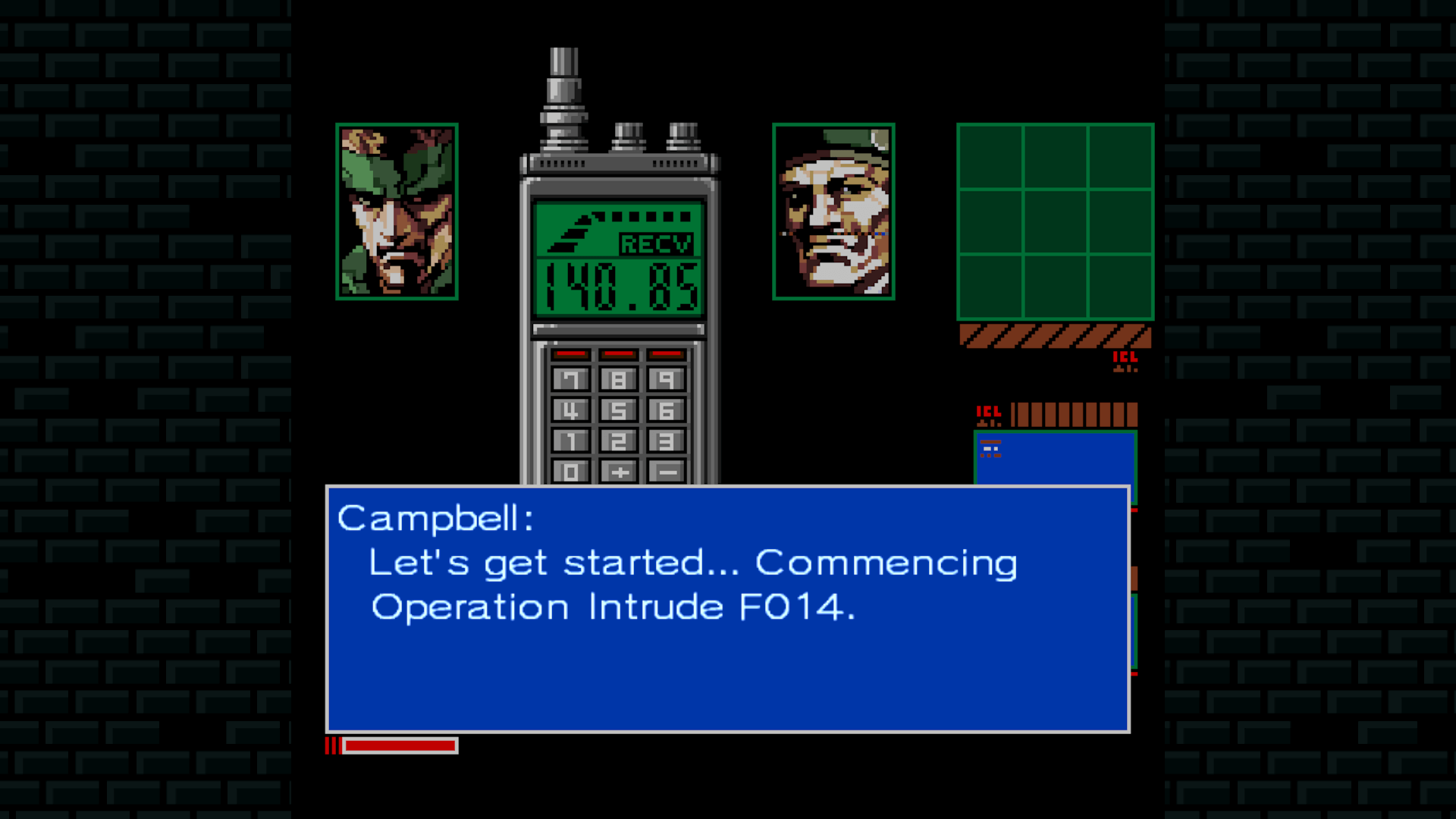
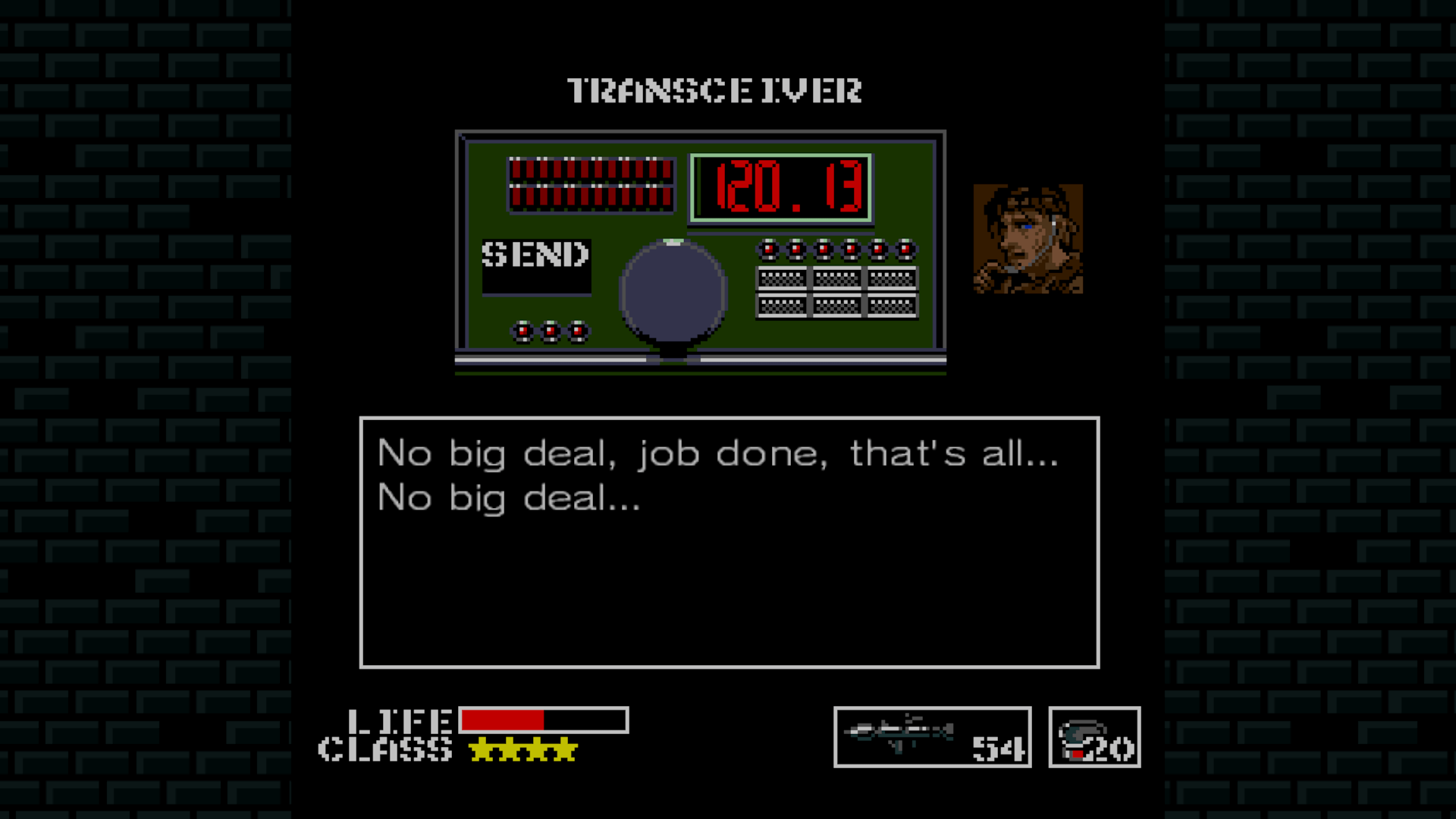
The new radio interface, the new boss, and the new assignment.
“The new radio interface, the new boss, and the new assignment.”

Loading it up, MG2 immediately feels like a substantial upgrade from Metal Gear. The game opens with a lengthy intro sequence showing some really nice, colorful artwork and setting up the plot of the game, all while a banging chiptune track that is far more intricate and varied than anything in the first game blasts away. This continues as you enter the game, with better sprites, animations, sound effects, and a continuation of the excellent soundtrack. You’ll also instantly recognize that the UI is more complex, hinting at what is overall a much more complex game with more items, more dialog, a bigger and more varied map, and more interesting puzzles and other gameplay systems. Not unlike something like the leap between Super Mario Bros and Super Mario Bros 3 on the NES, despite both being MSX2 games, MG2 feels like a full generation beyond its predecessor. Kojima and his team were clearly swinging for the fences here.

At the top of the expanded features list is stealth. Guards now have a cone of vision and will move their heads to look around when stationary. Their patrol paths also seem to be a little less simple, making avoiding guards a bit trickier than in Metal Gear. The alert and evasion phases are distinct now, too. If you’re spotted, guards will enter alert mode during which they’ll aggressively hunt you, with additional guards popping out of every available door. Seriously, I groaned every time they came out of the back of a cargo truck that was empty just moments ago! When in this mode, it’s almost impossible to hide, rather you need to lose the guards or otherwise get rid of enough of them first. Oh, and alerts are no longer room-based, either, so simply leaving the screen isn’t going to cut it. This new alert mode was probably my biggest source of frustration with MG2. That is, practically every alert, no matter where you are, how many guards are in the room, or the manner in which you were spotted, results in the same ridiculous swarm of guards, and by the end of the game, this was damn tedious to deal with. When you finally do, you’ll enter evasion mode in which guards will carefully search for a bit. A handy display in the UI shows the phase and a countdown timer, with a design seemingly swiped from one of my favorite animes, Gunbuster, incidentally. Assuming you can stay hidden and outlast the timer, they’ll give up and you’ll be back in the default infiltration mode.
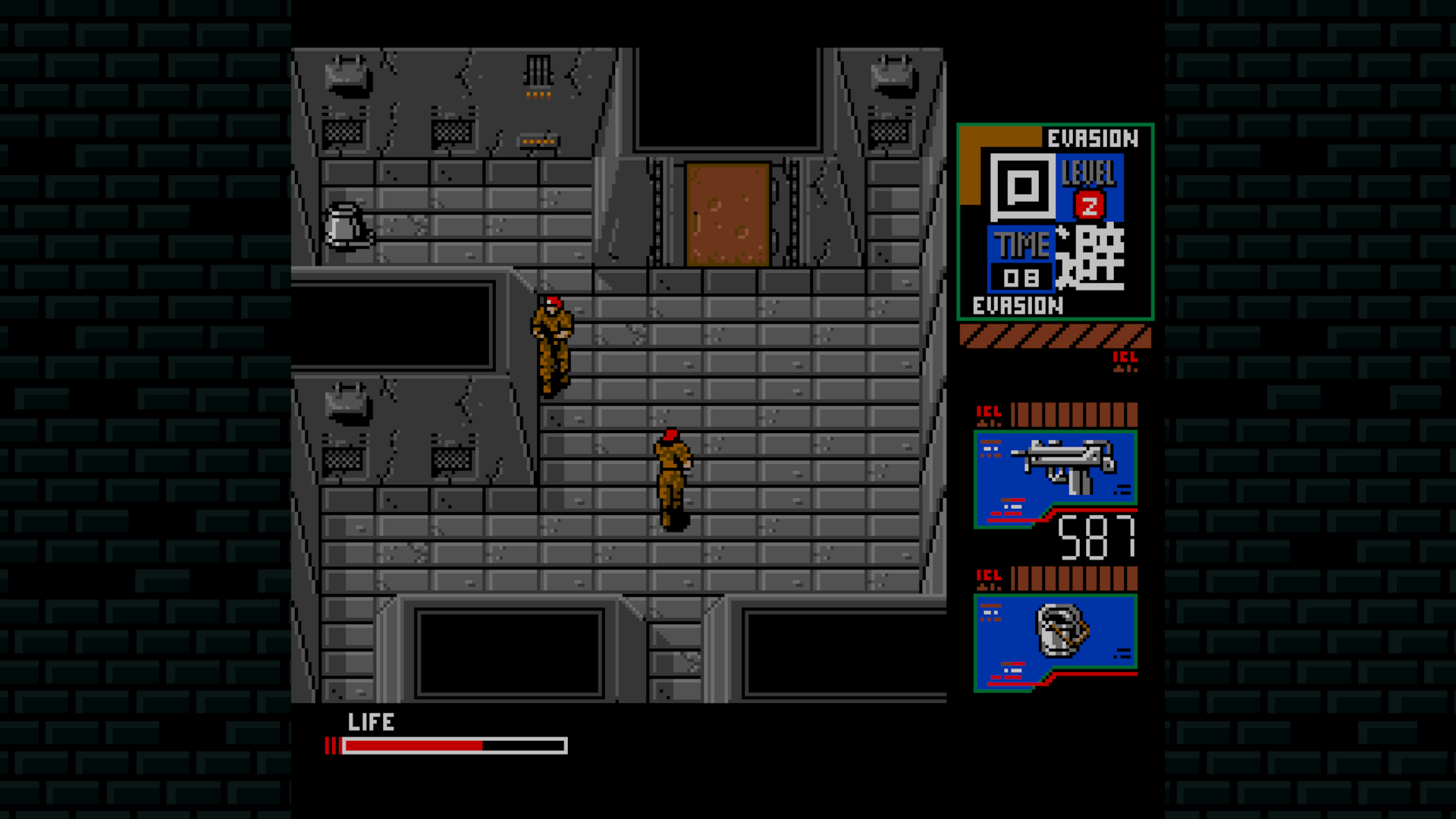
Step aside cardboard box, the bucket is peak stealth action gameplay!
“Step aside cardboard box, the bucket is peak stealth action gameplay!”

There’s also a mode similar to evasion mode that is triggered by a guard hearing a suspicious sound, during which they’ll go to its source to try to figure out what made it. Yes, that means there is a more developed sound component to stealth now, with certain types of ground surfaces making noise when you walk on them. You can also purposely make noise by, for instance, punching a wall, which lets you manipulate the guard positions to more easily sneak by them or take them out. To avoid making noise on accident, there’s a new crouching and crawling mechanic. This is an extremely important addition to Snake’s repertoire, and utilized everywhere, with just about every room having multiple places you can crouch behind or crawl into or under to conceal yourself. You also have some familiar tools returning from Metal Gear like the suppressor and your old friend the cardboard box. The box is now slightly riskier though, as guards will pop a few shots off at it if they walk up on it. Then there is perhaps my favorite new item, the bucket, which works the same as the cardboard box but it’s bulletproof, though it does come with the tradeoff of making noise if you walk while wearing it. Given how utterly silly the animation of Snake walking around almost entirely covered by a giant metal bucket is, I’d say it’s worth it though. Finally, there’s the camouflage mat, which lets you deploy a piece of hidden cover to hide under just about anywhere you want.

Last but not least, I can’t talk about all of that without bringing up what is perhaps the biggest addition to both the overall stealth system and the UI, the mini-map. This is the obvious predecessor to the “Soliton Radar” that appears in a lot of the later entries in the series, showing a top down view of the screen Snake is on as well as the 8 screens around him, complete with enemy and other character positions and live moment updates. Incredibly useful when planning your routes, I got used to using it almost immediately, as if I’d also had it throughout my run of the first game too. The only real downside to having such a powerful new item in your toolkit is that you don’t have it all the time – it gets jammed during alert modes, with the neat little alert phase display temporarily replacing it. Honestly, I was usually too busy frantically murdering tons of guards during alerts to worry about it that, though.
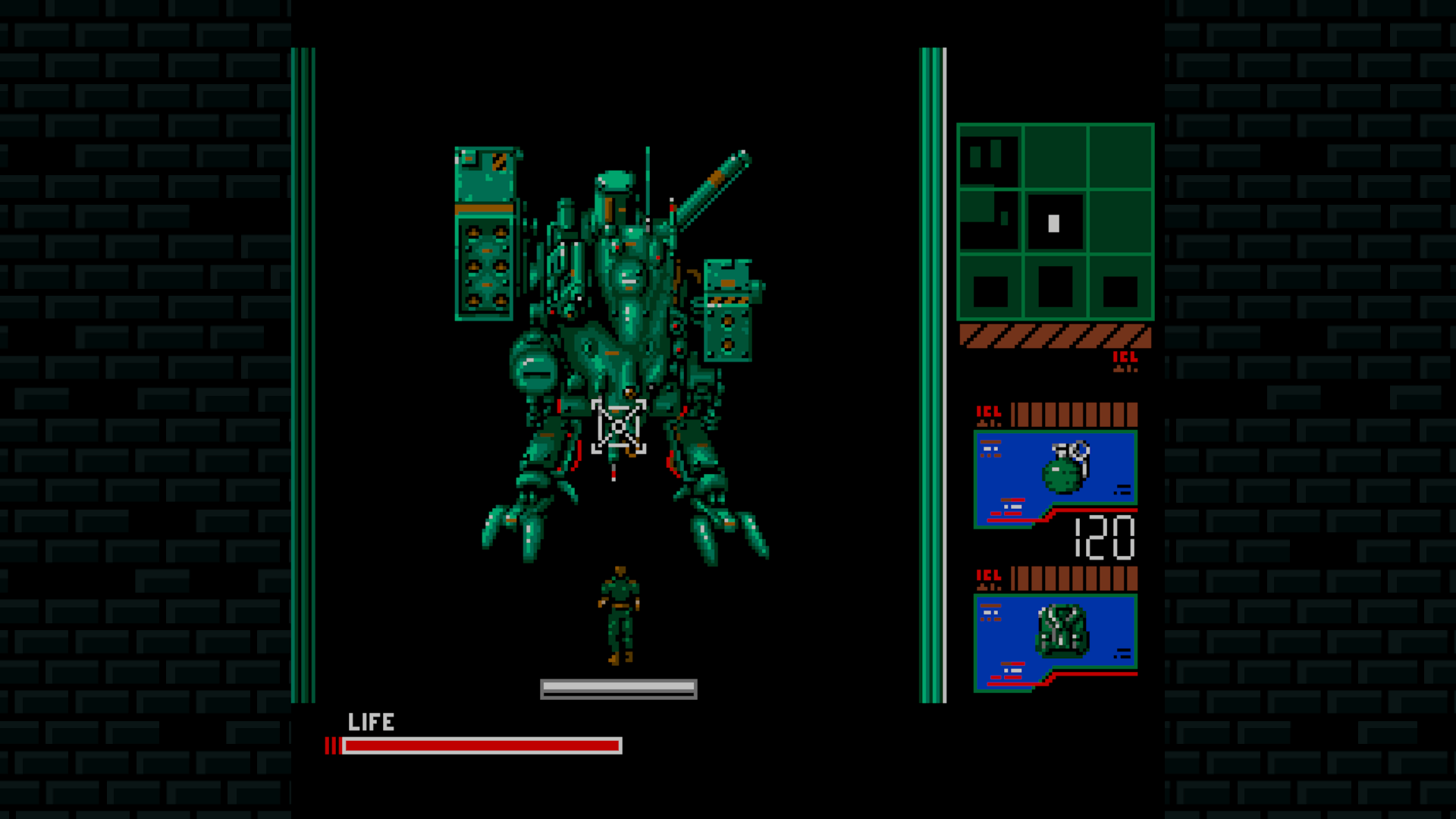
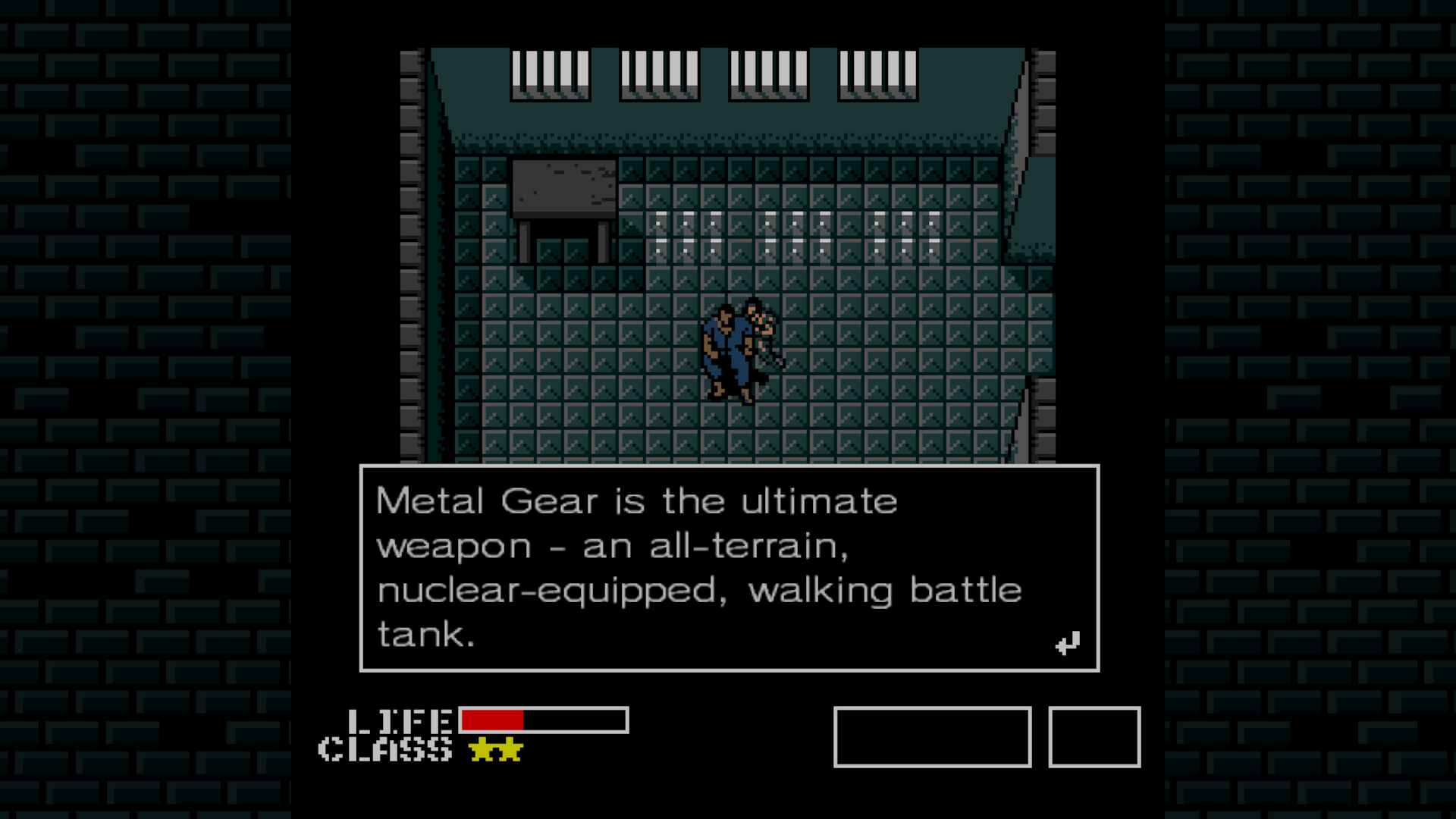
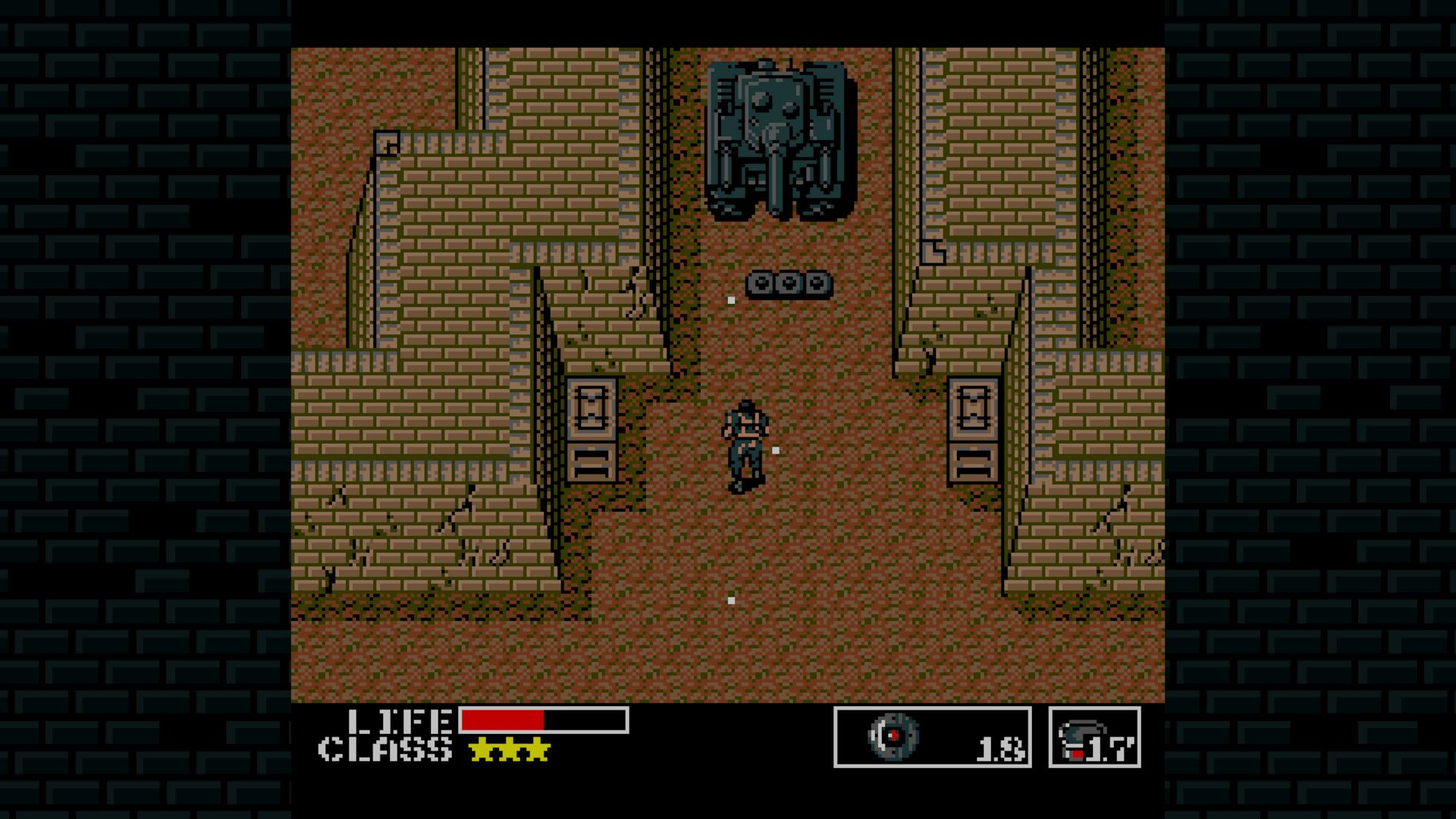
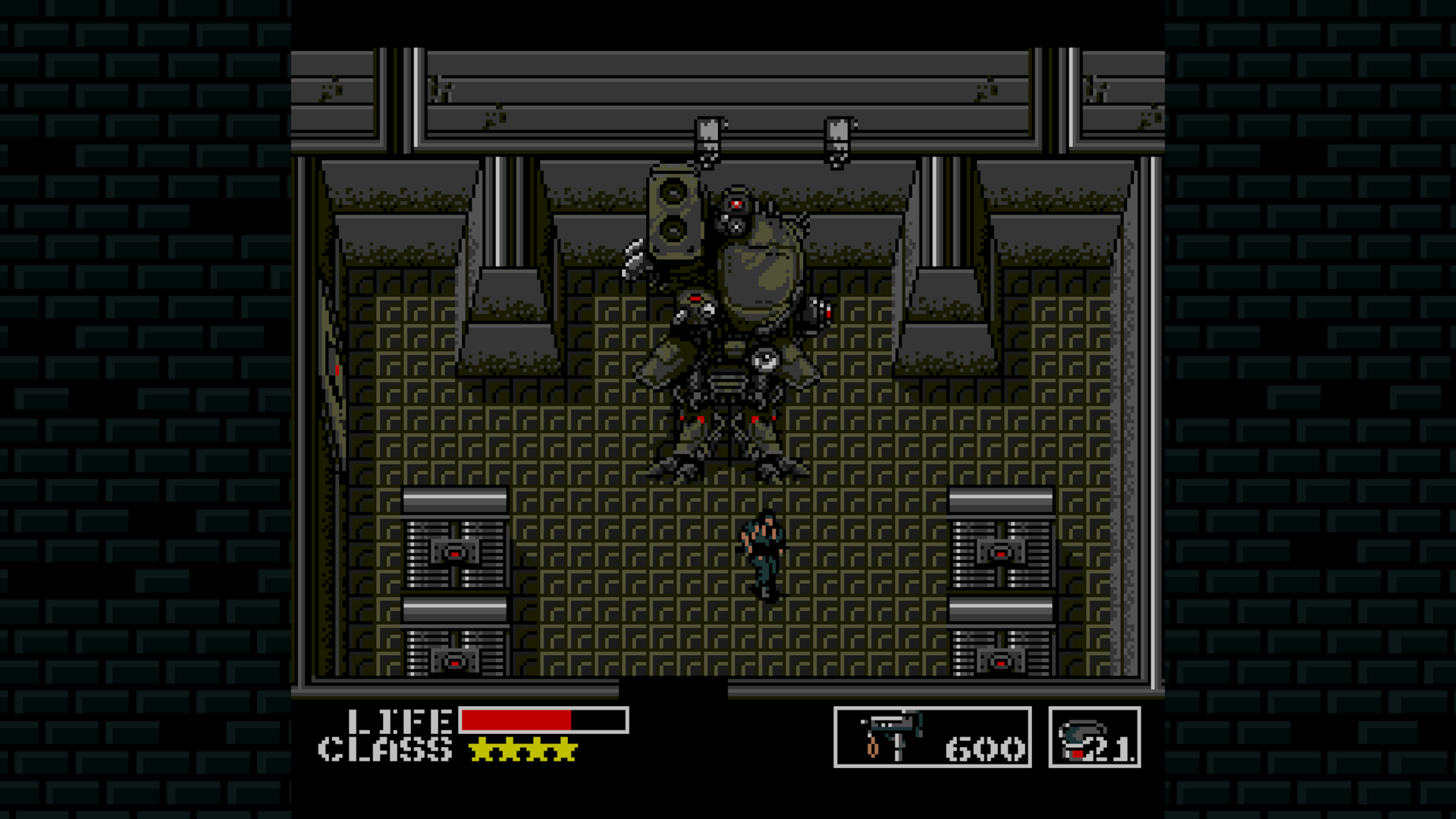
The Metal Gear D is, appropriately, highly vulnerable to a grenade to the dick.
“The Metal Gear D is, appropriately, highly vulnerable to a grenade to the dick.”

MG2 retains the Zelda like item gating gameplay of the first game, but with more items and more complexity all around, I personally got a lot less of that Metroidvania vibe this time around. It just feels a bit less intentionally designed, and I think the game suffers just a little as a result, despite just about every individual element being improved. For instance, while keycards are still an annoyance, you can now trade them up for combined versions, reducing the 9 you have by the end of the game to 3, and they also feel a bit less randomly assigned to doors to boot. Fast travel has undergone some improvements, whether you’re hiding in a box and hitching a ride on a conveyor belt, into a cargo truck, or floating through the sewers, it all works so much better. It also seems that using weapons as a gate around boss fights is mostly eliminated. There are some bosses that are easier with certain weapons, sure, but aside from the Hind D fight (yes, another one) I’m struggling to think of another example. Speaking of weapons, I found myself using melee a lot less this time, as I really didn’t want to risk triggering the aforementioned annoying guard swarms. In fact, by the end of the game I was taking full advantage of the slow projectiles (also making a return from the first game) to “pre-fire” shots at guards before they’d round corners or otherwise enter my field of view. Cheesy but kind of satisfying.

Another massive upgrade comes with the radio, which much more closely resembles the codec calls found in later Metal Gear games. Radio conversations happen more often, between more people, are much lengthier and better written. Hey, they’re also two-way now, so Snake finally has a little bit of a personality! People also actually answer their damn calls now too, making the radio much more useful in general. While there are a few little non-radio conversations, and you occasionally run into war orphans wandering around Zanzibar Land who impart similar one-liners, there are no more POWs to give you clues, so the majority of your hints and other guidance will come from these calls. I do wish more of those conversations were more useful, though. Master Miller almost exclusively says generic stuff and I swear I missed Kasler’s initial call or something, as I didn’t know his frequency until later in the game. The radio has one more function exclusive to the modern port – they replaced the original character portraits (hilariously swiped from stills of famous actors) with more stylized artwork by Yoji Shinkawa. While the intent was more likely to avoid legal trouble, the effect is that the game now looks more like a cohesive part of the greater series beyond.
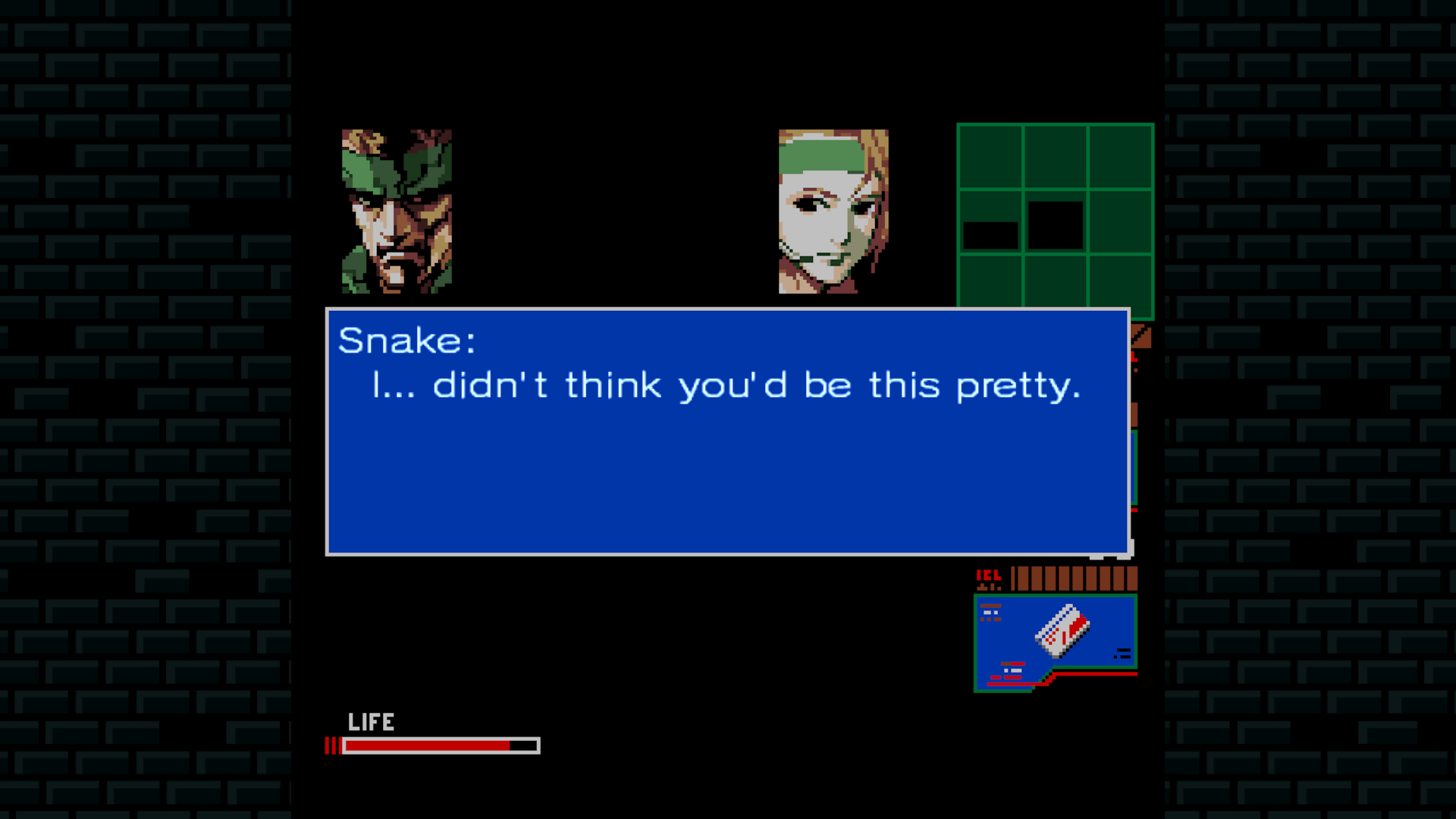
Snake, if you need a cold shower, you already know where the women's restroom is.
“Snake, if you need a cold shower, you already know where the women’s restroom is.”

This feels like a good time to talk about the story. Expand the box below for a spoilerific though fairly terse synopsis of the game’s plot.

Story Synopsis - Spoilers!1999. On the verge of a global energy crisis, biologist Dr. Kio Marv develops OILIX, a new way to synthesize high-grade petroleum. Soon after his discovery is publicized, Dr. Marv is kidnapped by agents of Zanzibar Land, a small nation that has recently gained attention on the international stage due to aggressively seizing nuclear weapons from neighboring countries, attempting to gain unmatched power as the rest of the world dismantles its nuclear programs to enter a new era of peace. Colonel Roy Campbell, FOXHOUND’s new commander, brings Solid Snake out of retirement for Operation Intrude F014, a daring covert operation to infiltrate Zanzibar Land and rescue Dr. Marv, and with him the secret of OILIX. Once on the ground, Solid Snake gains the assistance of Holly White, a CIA agent posing as a journalist. During the course of the mission, Snake rescues Dr. Madnar, the scientist behind Outer Heaven’s robotics programs. Dr. Madnar had been forced to resume his work and is well underway with mass producing a new model of the Metal Gear walking tank for Zanzibar Land. Snake also learns that his former commanding officer turned mercenary leader of Outer Heaven, Big Boss, is leading Zanzibar Land. While Snake continues his search for Dr. Marv, the group encounters ex-FOXHOUND agent Gray Fox, now loyal to Big Boss, who recaptures Dr. Madnar and blocks Snake’s pursuit. Eventually reaching the base’s main prison complex a different way, Snake locates Dr. Marv’s cell but finds him deceased, having succumbed to torture. Holly radios Snake to let him know that not all is as it seems with Dr. Madnar, who is also being held here, and that he actually returned to Big Boss’s side voluntarily. As Snake turns to confront Dr. Madnar, Dr. Madnar attacks him from behind, forcing Snake to incapacitate him. Assembling clues that Dr. Marv left, Snake recovers the OILIX data from a clever hiding spot and begins his exfiltration. Snake once again encounters Gray Fox, and after an explosive showdown, disables Gray Fox’s Metal Gear D, leaving the two to have a final hand-to-hand fight to the death. Having just defeated his former comrade, Snake is taunted by Big Boss, who he quickly tracks down. Big Boss tries to convince Solid Snake to join his cause, explaining his goals for Outer Heaven and Zanzibar Land – to give soldiers like him a means to survive on their own terms rather than be used as pawns by uncaring governments. Snake refuses the offer, and Big Boss attacks him. Unarmed, Snake moves from hiding place to hiding place, but is able to cobble together an improvised weapon, eventually catching Big Boss by surprise. With Big Boss dead and the OILIX data in hand, Snake rendezvous with Holly and the two are airlifted out of Zanzibar Land.


Certainly, themes of nuclear disarmament and a crisis around fossil fuel shortages were reasonable to speculate on in the late 1980s, and the game as a whole feels a bit more “near-future” than the first did. Beyond that, it’s hard not to feel like MG2 is something of a remake of the first game. Sure, some of the story details are different, but the structure is very, very similar, and a lot of specific gameplay elements return as well. There are also returning characters, starting off with the seemingly random addition of Outer Heaven resistance leader Schneider, who I’d assumed was dead. It all feels like a bit of a soap opera, but I know that’s just the tip of the iceberg for this series. Despite how Zanzibar Land might just be Outer Heaven v2.0, I did appreciate that MG2’s vastly expanded script gave our main antagonist a chance to actually explain his motives a little bit more. It frames the whole “mercenary state” thing much more clearly. On the other hand, Snake’s attempts to hit on women, particularly Holly, felt awkwardly out of place to the point where I actually found myself laughing at them. Really, while there are still some silly bosses with silly names, other than some fun references to video games and the MSX in particular, there are no fourth wall breaks and most attempts at humor are somewhat subdued to the point where it wasn’t always obvious if the writing was intentionally quirky, or genuinely kind of weird. I mean, you can’t tell me Running Man doing a mad sprint around a building to prove how amazingly fast he is, only to come back panting after a single lap isn’t damn funny. 😂
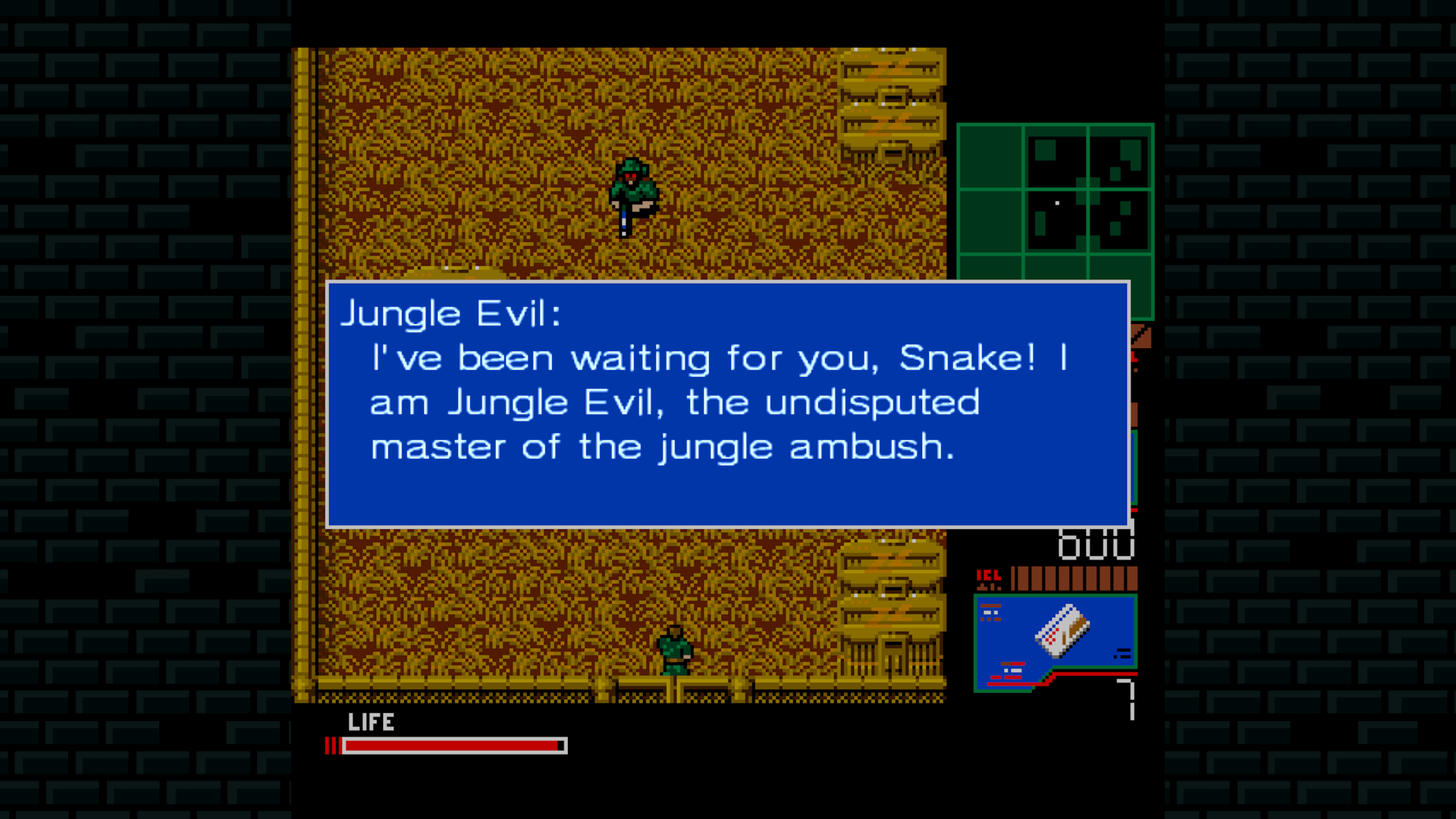
Honestly, I *do* dispute his ability to ambush given that he announced his presence.
“Honestly, I *do* dispute his ability to ambush given that he announced his presence.”

With boss fights being less about gating progress around certain weapons, they now have more traditional boss fight mechanics. Nothing all that tricky, but more varied and funner than what we got in Metal Gear, certainly. Besides my aforementioned burnout with alerts, I think the most difficult aspect of the game is its structure. As mentioned, that satisfying Metroidvania-like formula is just a little off. Hints given via the radio or by the occasional war orphan are usually less direct than those in Metal Gear, which isn’t necessarily a bad thing, but it does make the game feel less linear and more prone to trial and error and arduous backtracking. There is also a lot more light puzzle solving this time around, and some of the puzzles get pretty wacky. How about finding and hatching an egg that turns into an owl, which you’ll need to equip so it hoots, fooling a guard into thinking it’s night time, and for some reason they turn off a perimeter security in this particular area at night? Nope, none of that makes any goddamn sense, does it? There are also rather wickedly designed areas, like the infamous jungle which requires tailing a guard who is constantly checking behind him, and if you lose him for even a second the jungle turns impassable and you’ll need to go back to the beginning and try all over again. The swamp is perhaps an even worse offender, as it’ll outright kill you if you stray too far off the hidden path for more than a few seconds, and the path is long and windy, but of course!

If you do die, save game checkpoints are aligned to specific areas, but it’s perhaps even less clear where those checkpoints actually are. In Metal Gear they were usually the last elevator you entered, but in MG2 they seem to be tied to loading screens… except for when they aren’t. Honestly, after I got further into the game I just avoided the issue altogether by abusing my Xbox’s Quick Resume feature and trying my damnedest not to die. Sometimes easier said than done, as you can no longer stock up on endless rations and ammo by leaving and reentering rooms like you did in Metal Gear, and if you trigger alerts way too often like I did, you’ll end up needing those rations. I played on “easy” difficulty again and discovered one big advantage of it – if you die too many times in a row, you’ll respawn with full ammo and rations on your next continue. I got into at least one situation near the beginning of the game when I was still figuring things out where this really helped me. Overall, it’s not a hard game, but it has potential to be longer and more taxing than Metal Gear was. Unless you get a particular amount of joy from playing this old school, draw your own maps and trial and error your way through puzzles style of game design, I’d recommend you at least use some notated maps, as with the first game. Unlike the first game, however, I might also throw in a walkthrough too. I used a spoiler free walkthrough as a reference here and there, but I absolutely abused the hell out of the maps themselves. While I know I would have gotten more satisfaction from figuring everything out myself, I’m sure it would have also taken twice as long and been a lot more frustrating along the way.
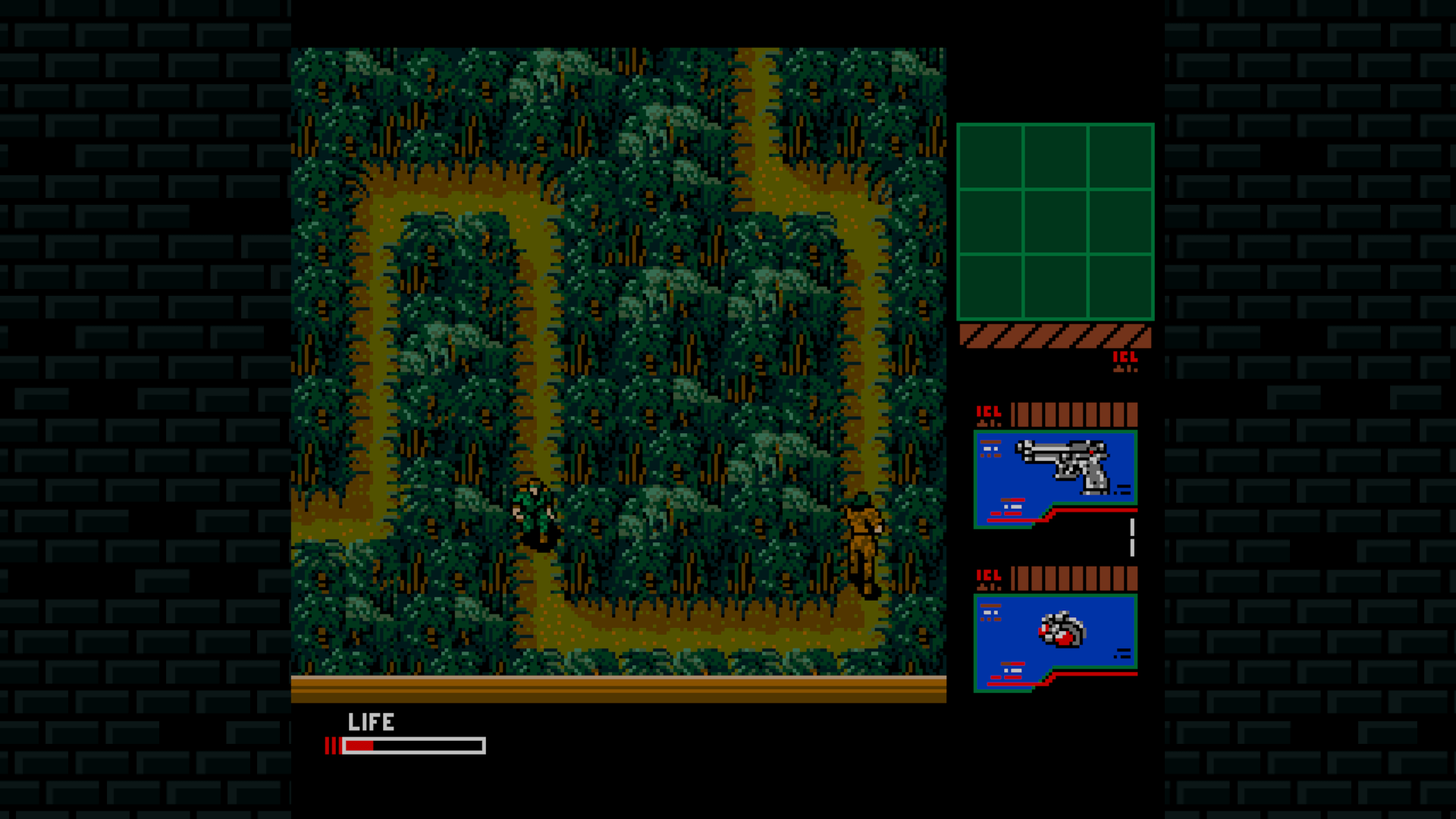
Fuck this fucking jungle section!
“Fuck this fucking jungle section!”

I think the biggest advantage of the more complex and varied gameplay of MG2 is the possibility for the kind of emergent moments you’d expect out of a more open game. As an example, there was one section of the map that I kept going back to where there was no way to get past a guard without getting spotted. After just dealing with triggering an alert several times, I figured out that I could knock on the outside of a wall he was near and he’d walk over to it. He could still just barely see me if I tried to creep by him, but I could then blast the Zanzibar Land national anthem cassette tape to make him spring to attention, facing straight ahead, letting me get by him unseen. For an example of a funnier emergent moment, I almost fell off of my couch when I accidentally killed a war orphan while attempting to blow up a wall with C4 – I just assumed children would be invulnerable so I wasn’t too concerned when he wandered up, but… hey, 1990 was a more innocent time! 😅

While I had some mixed feelings on Metal Gear 2, all in all, there’s no denying that it is a much more impressive game than its predecessor. It really improves on virtually every aspect of the first game, and while it might have taken me a bit of time to adjust to the added complexity, in the end I had a lot of fun with it. I’ll have to get further into these playthroughs to be able to really judge MG2’s place in the series, but at this early point I’d definitely recommend Metal Gear fans give it a go.

Next, we move on to the game that kicked off a love of the franchise for so many people, Metal Gear Solid

Digging Holes

Man, Deep Rock Galactic had been on my radar for ages, and worse yet, I’d even owned it for a couple of years now. We’ll get to my excuses later…

You play as a fairly archetypal dwarf (read: loves precious gems and rare ores, drinking, and long walks in dark caverns) who teams up with his dwarven miner buddies to work for the Deep Rock Galactic company. As hinted at by the “galactic” part, this is a sci-fi twist on those fantasy dwarf tropes, which of course means you and your crew have to defend yourselves against a variety of subterranean alien creatures, and with appropriately sick guns and other sci-fi equipment. I mean, I already kind of love dwarves, plus like every Warhammer 40,000 fan who got started back in the first edition, I have an extra special place in my heart for squatty space dwarves. I’ve also talked a bit about my fondness for voxel based mining in games like Minecraft and Astroneer, so yeah, this game sounded right up my alley.

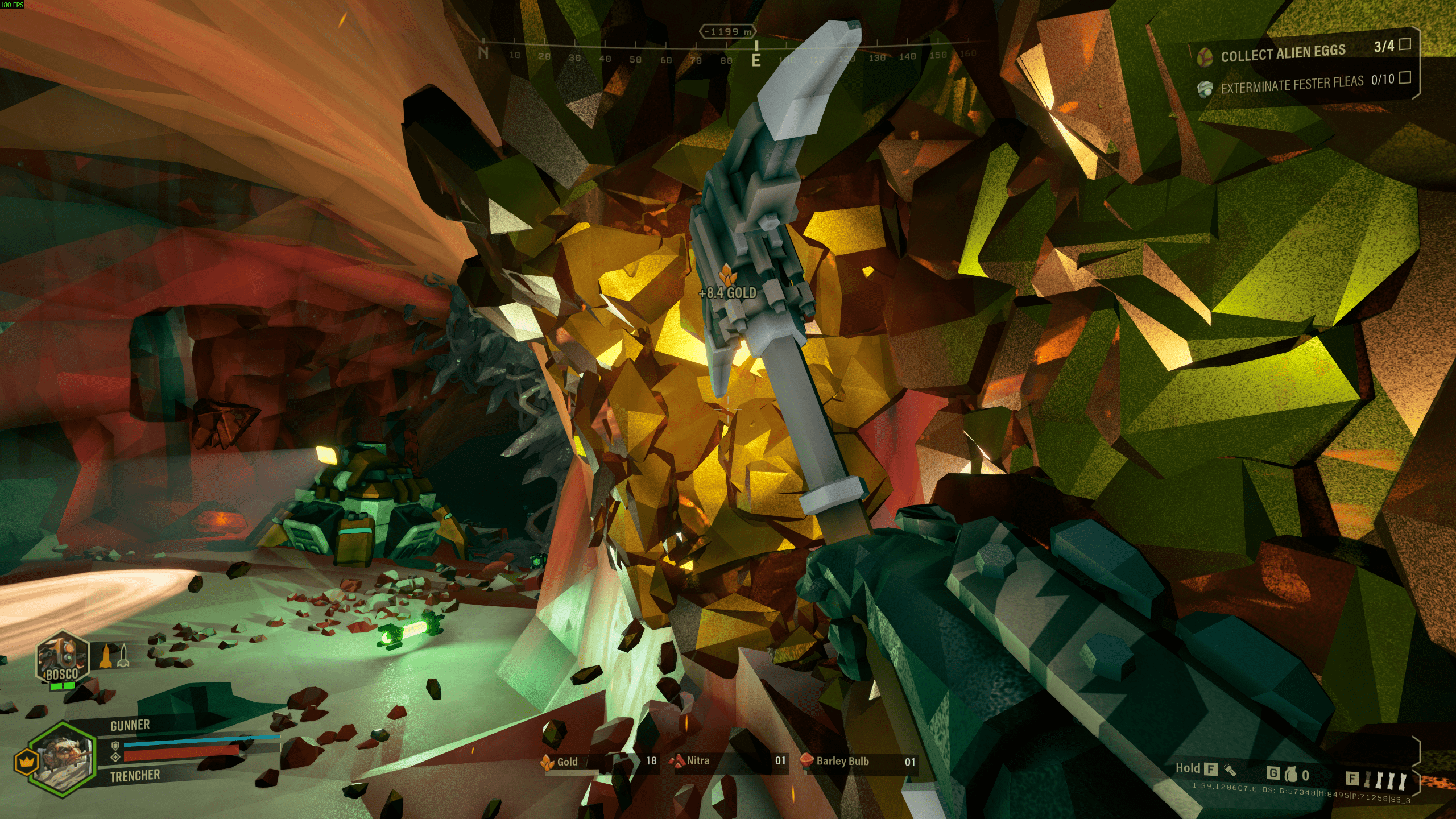
Gold! Man, I love how quick pulling out and swinging your pick axe is.
“Gold! Man, I love how quick pulling out and swinging your pick axe is.”

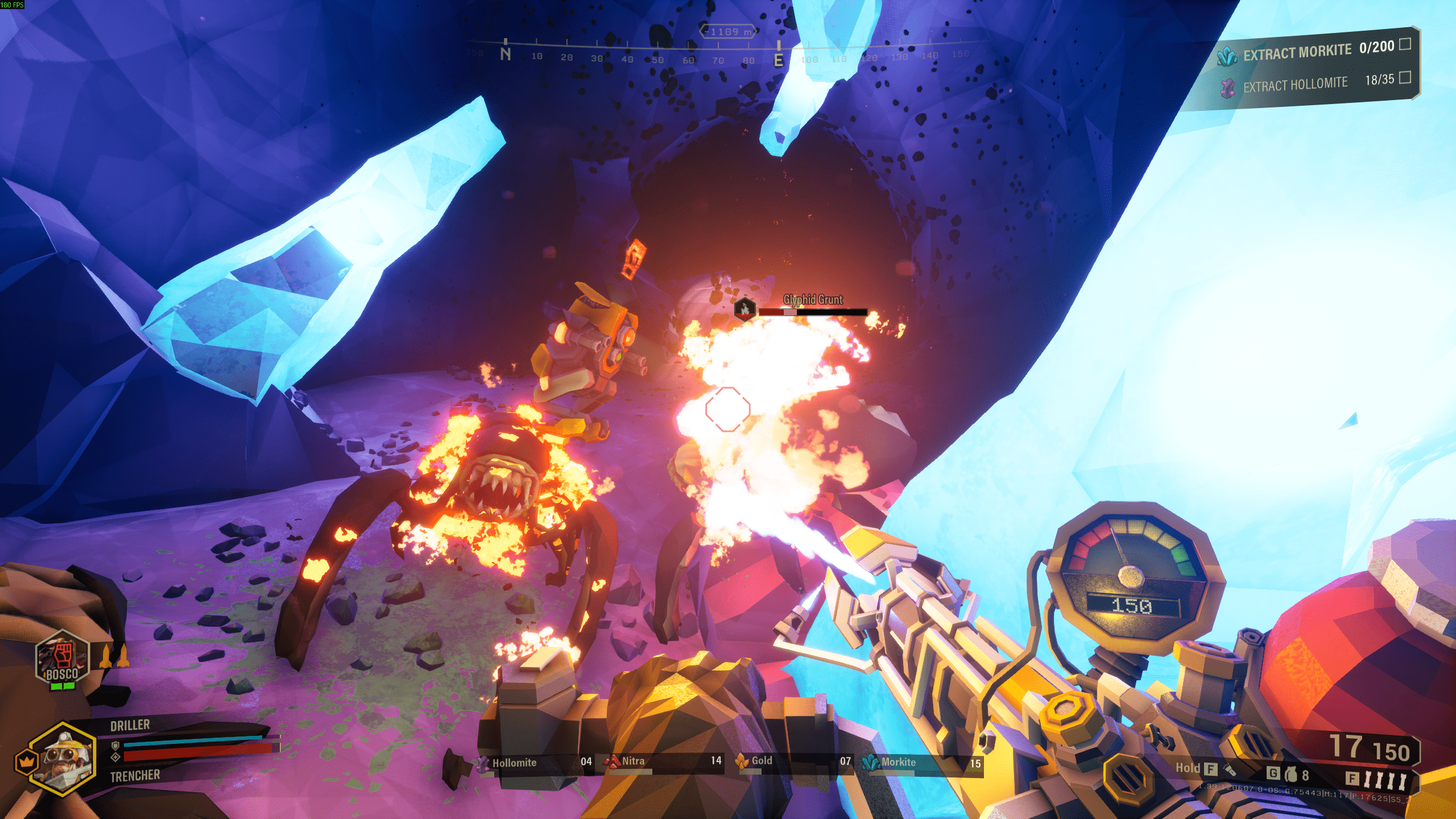
Continuing with some of the gameplay tropes I mentioned with Helldivers 2, DRG is a session based first-person cooperative game which has you and your crew pick a mission with particular difficulty and set of objectives and get blasted down into a procedurally generated cave system to complete it. Some of the time this is almost pure mining, but even when it isn’t, you’ll always be mining, if only to gather some extra resources and create new routes to move through. As mentioned, there are obstacles to contend with in the form of attacks by the not-so-friendly denizens of these caves, environmental obstacles, navigational challenges, and even the darkness itself. A lot of these obstacles are specifically designed to allow for horde mode style defensive situations – requiring one person to slowly activate a device, or having to guard a device while it completes a process, for instance. Of course, there are random enemy rushes as well, just to spice things up a bit.

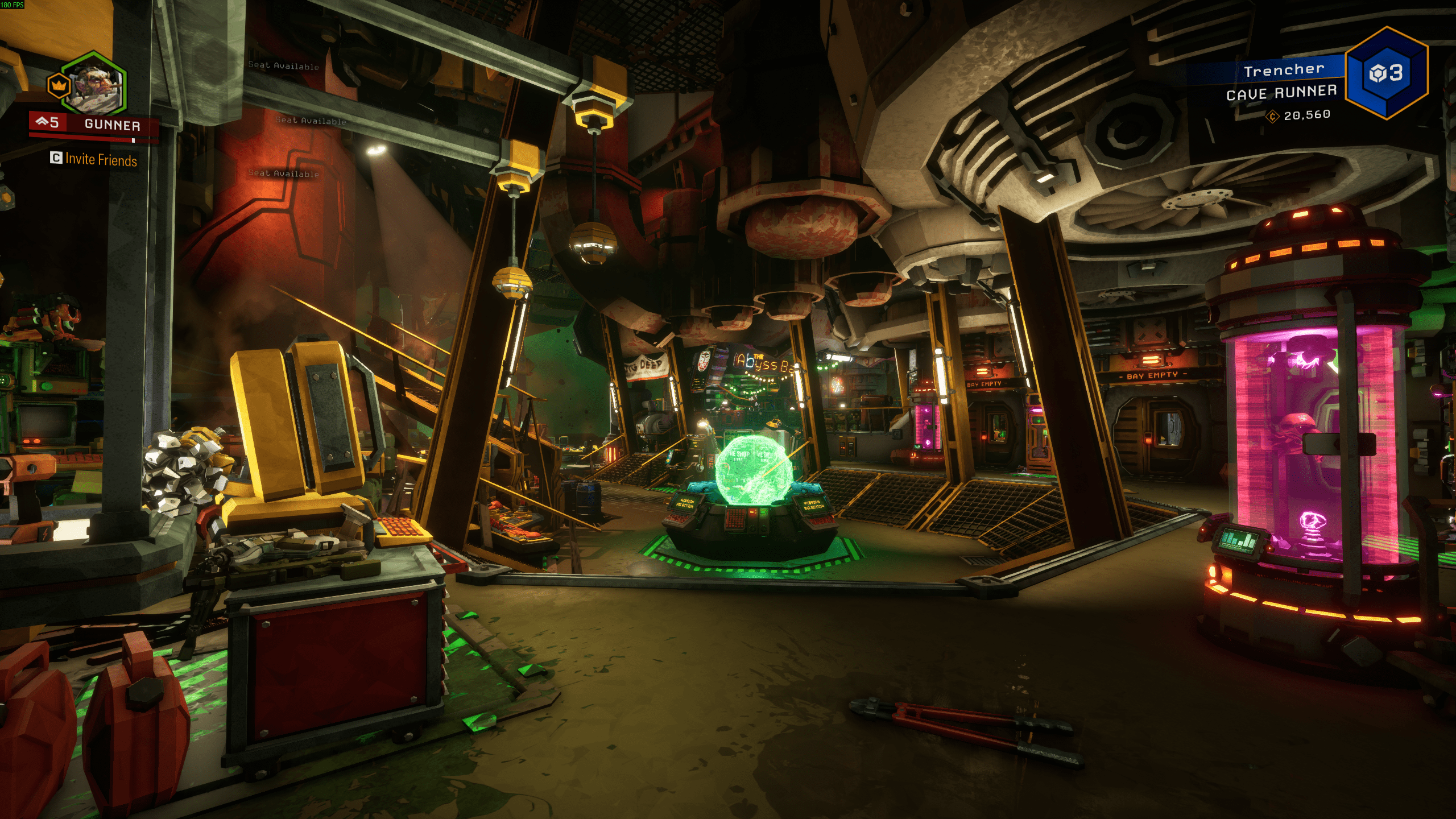
Oh, and the game is class-based, with 4 classes: a fast moving scout who is able to grapple around and shoot flares, an engineer who can deploy sentry turrets and build platforms, the gunner who carries massive weapons and can also deploy ziplines, and finally the driller, who has a super badass mining drill that shreds through terrain. In between missions there is a progression system that allows you to upgrade your dwarf’s skills and equipment, purchase cosmetics, etc. This is all done somewhat diegetically via an in-game hub area. Standard stuff, though I don’t mean to say that in a derogatory way, as DRG is definitely one of the games that helped refine this genre.

But sometimes you need to clear out a few bugs first...
“But sometimes you need to clear out a few bugs first…”

One odd thing about DRG’s place in the genre is actually its business model. It definitely feels like a “live service game” – it’s frequently updated and its progression systems are designed in such a way that you’ll want to keep playing for months on end, especially with the addition of seasonal battle passes. Yet, the battle passes are totally free, there are zero micro-transactions, and the only DLC is a handful of packs of themed cosmetics that are entirely unnecessary. 🤔

Despite its relatively low fidelity, its stylized graphics and the general level of polish really help elevate it. In fact, one of the things I personally like the most about Deep Rock Galactic, both in terms of presentation and gameplay, is its attention to detail, with a lot of neat and probably totally unnecessary little features, and some immersive and sometimes fun to play with physics. I also love the lighting, with its use of bright colors, often from the numerous luminescent plants and minerals featured in each biome (and more games need throwable glowsticks!) contrasting with the ever present darkness that comes with being god knows how deep below the planet’s surface. In short, the developers went hard!

Home sweet home! Back on the space rig hub area.
“Home sweet home! Back on the space rig hub area.”

Another aspect of DRG that definitely deserves a mention is the community. While I haven’t played many games with randoms, judging mostly from encounters on forums, Reddit, Discord, and the like, the DRG community has a highly infectious fun spirit founded on the light-roleplay elements of a mutual love of slamming back a space beer and greedily digging up some precious alien gems while obnoxiously shouting “ROCK AND STONE!” at literally every opportunity. Like Helldivers 2, the fact that the game is 100% PvE and players are pretty much always united in cooperation probably goes a long way towards enforcing this more fun and friendly atmosphere. Regardless of the reason, it feels like a breath of fresh air to encounter such generally positive players.

Unfortunately, my core gaming friends don’t number amongst them, with none of them seeming all too interested in DRG, at least not while I was. I eventually bought a copy when I joined a local gaming Discord community that had regular nightly DRG sessions for a while, though I never actually ended up joining them. It wasn’t until a friend who I’d never really gamed with mentioned that he’d been playing it that I finally dove in. He gave me a crash course on the basics and we completed a small handful of missions together, and while it was fun for me, I got the sense that he had already seen enough of DRG and had really only fired it up for my benefit. I continued on solo, which is a very different experience, but DRG is perhaps even less enjoyable of a solo experience than Helldivers 2 is. It’s totally doable, but the caverns are a little creepier, the enemies a little scarier, and missing all of the casual voice chat punctuated by occasional shouting during those more tense moments takes away from the entire gameplay experience. In any case, it always feels pretty obvious that these types of games were designed around multiplayer when you try to play them alone. Thankfully, DRG gives you an upgradable robot companion to assist you when running solo, which does help on the gameplay front, at least.

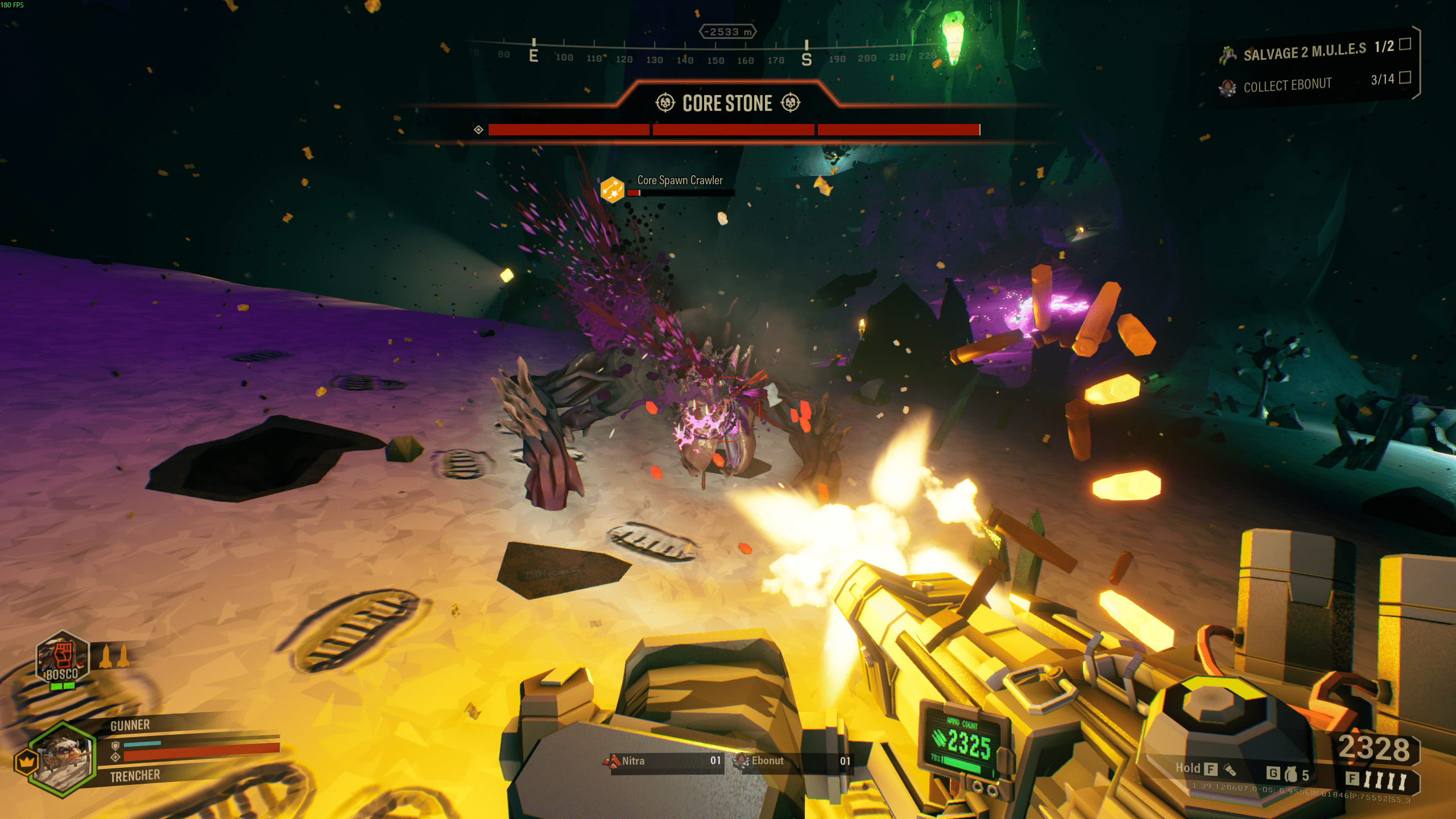
I'm not really sure what this ugly thing is, but it dies just the same.
“I’m not really sure what this ugly thing is, but it dies just the same.”

So, not unlike Darktide and Helldivers 2, I regretfully have to leave Deep Rock Galactic behind before really spending all that much quality time with it, despite how much I really love about the game. If a true sequel is ever released (A spinoff, Rogue Core, is on its way soon!) I may jump in nice and early, crew or not!

Next up is a… *gasp* single player game all about mining, and all from the comfort of your own backyard!

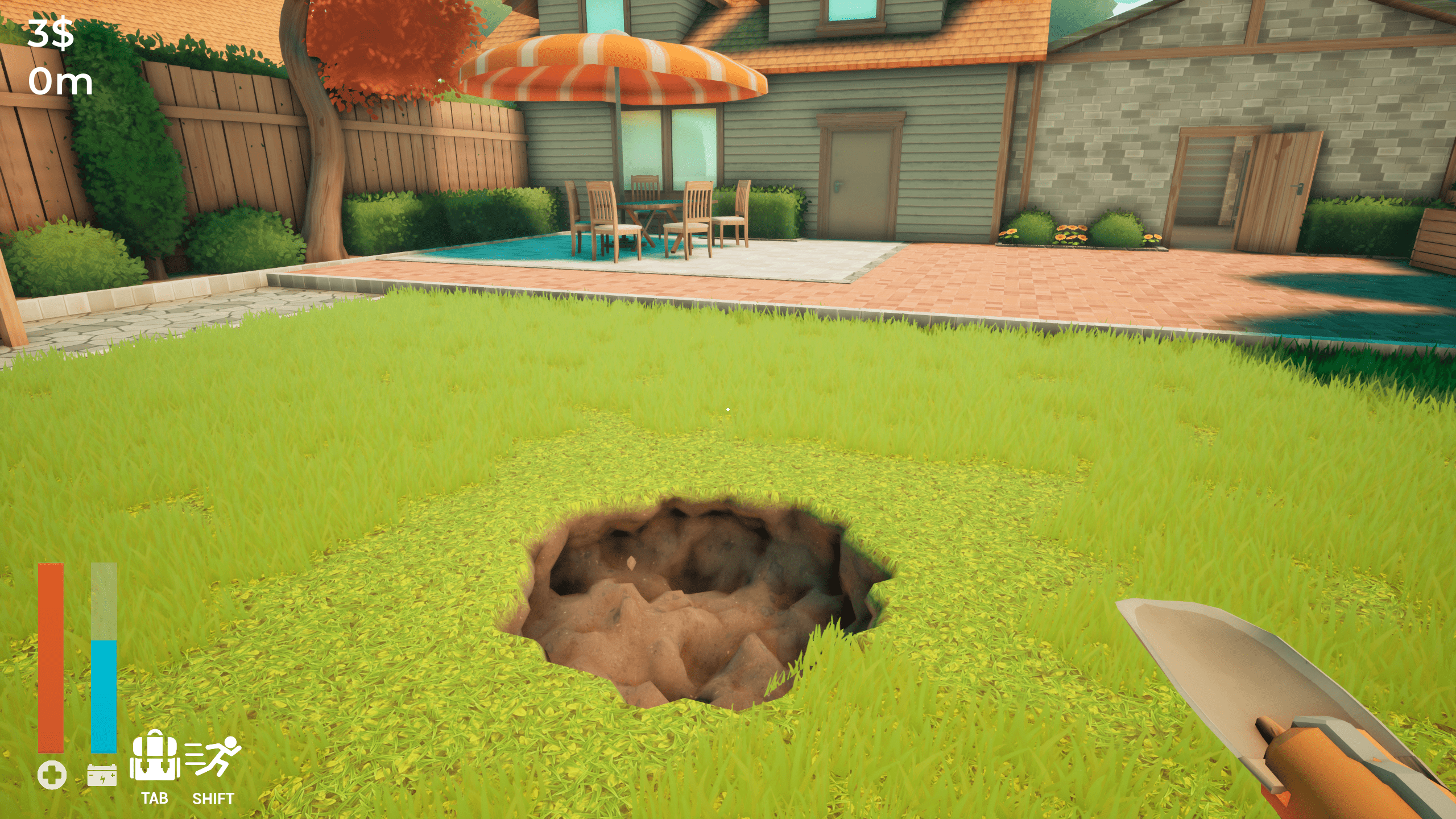
A Game About Digging A Hole is… well, yeah, okay, the premise is the game doesn’t go much further than its title. You buy a new house on the cheap after being told there’s buried treasure there, move in, roll up your sleeves, and get to work. You’ve spray painted a big red X in the middle of your backyard, you’ve got your trusty shovel, and evidently, nothing but time on your hands. No day job? Man, this already feels like an amazing fantasy!

I got turned onto this game by hearing Anthony talk about it on Rebel FM, and the idea of an easy to pick up and play, quick to complete single player voxel based mining game had me intrigued, given that many of these types of games are multiplayer (like Deep Rock Galactic) and/or massive live service game slogs (also like Deep Rock Galactic.) Bought!

Things start modestly enough...
“Things start modestly enough…”

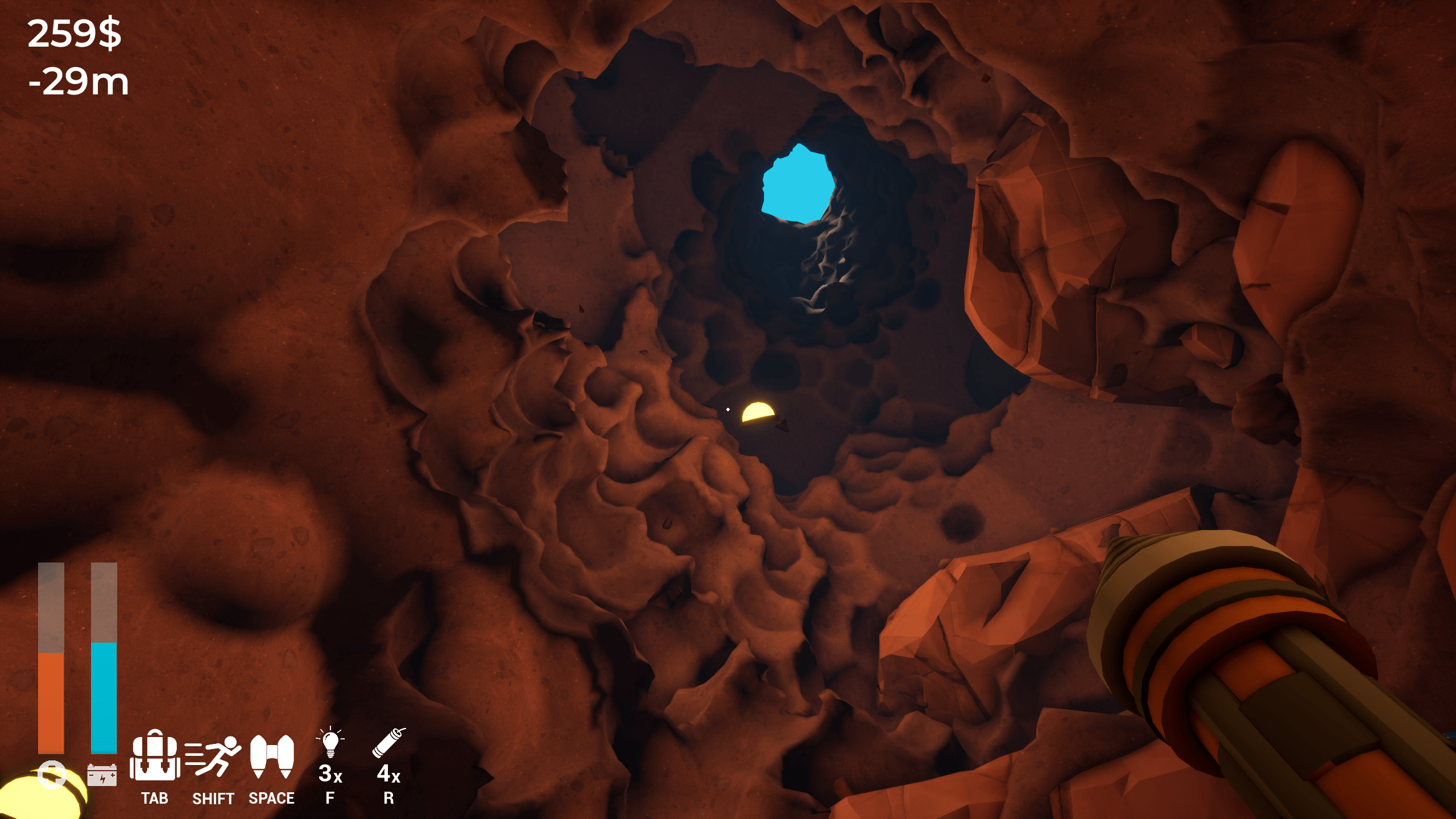
AGADAH’s gameplay loop is far from complex. You dig… a lot. Your energy depletes as you dig. You find the occasional valuable chunk of ore, gemstone, and other interesting junk and throw them in your inventory. Your inventory fills up and/or your energy starts to run out. You head back into your garage (the command and control of your grand yard destruction project) and sell these rare resources to get money to upgrade your equipment (which is all abstracted for instant gratification, of course.) Then head back out again. Eventually you’ll move from your shovel to a huge mining drill, you’ll get a jetpack to make going up and down the insanely deep hole you’ve dug easier, you’ll be able to upgrade your inventory size and your battery reserves, and even purchase some dynamite to spice things up a bit. Essentially, all things to make your job easier, and each run back down into the hole last a little longer. Of course, the deeper you go, the more dirt you’ll need to shift, the more obstacles you encounter, and the darker it gets. Naturally, this is offset by more and more valuable resources, and thus, more and more money.

It’s a seemingly very chill game that, for me and I suspect quite a lot of others, scratches that same addictive itch as games like PowerWash Simulator. You have an easy, repetitive task, yet somehow it’s just rewarding enough to keep you cleaning every last goddamn surface area on the level, or in this case, digging every last speck of loose dirt from your backyard. It’s also oddly charming, with its simple graphical style and its equally simple gameplay loop that conceals a very well-considered design. One that, as someone who has dabbled in game design myself, I’m jealous of the developer for coming up, especially given that they apparently just casually tossed this game together while on a work break for a few weeks. Anyway, eventually you reach the bottom of the hole and… well, I won’t spoil whether you find your promised treasure or not, but let’s just say the end of the game is definitely worthy of a fun discussion.

But it's easy to get carried away.
“But it’s easy to get carried away.”

One interesting thing about A Game About Digging A Hole is its achievement system. I didn’t get a single achievement until I beat the game. Indeed, I don’t believe you can get many of them without at least a second playthrough, at which point you’ll discover that not only have you probably already met the requirements to earn some more of them, but you can even track them via an in-game display in your garage. The game hooked me enough that I almost immediately started going into a second playthrough to get some of the achievements I missed without much of a second thought, but then I remembered that I don’t actually care that much about Steam achievements and snapped the hell out of it.

If this sounds at all like something you’d be into, then I’d recommend it. It’s 5 bucks and a few hours well spent.

Metal Gear Mania 2025 – Metal Gear

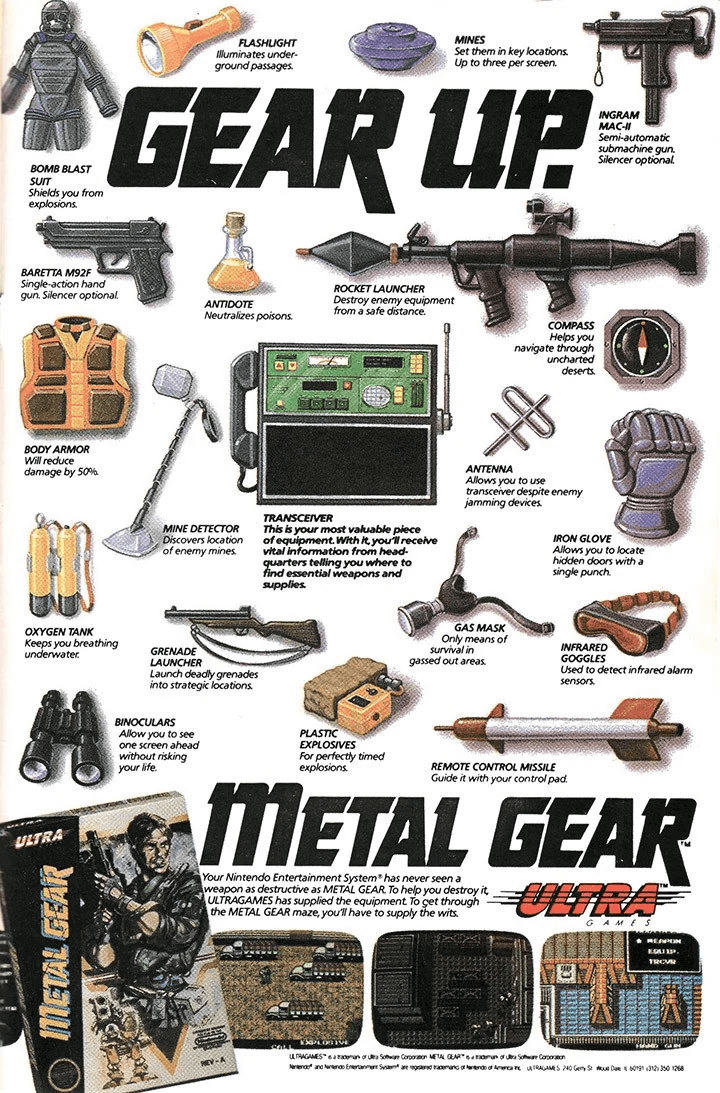
Growing up in the 80s, I associate the original Metal Gear with a single equipment laden advertisement which was plastered on the back covers of every other Marvel comic book published for what seemed like years. As a kid obsessed with military and spy gadgets, man, this ad triggered something in me. I’d spend extra time looking it over just about every time I came across it and I distinctly remember doodling some of the gear from it in my notebooks at school. Despite this though, I never actually played the game. While new console games were something of a rarity in my household, I did borrow them from friends and eventually talked my parents into renting them for me somewhat regularly, so I have no idea why I never got around to checking out Metal Gear or its weird unofficial sequel, Snake’s Revenge. 🤔

Alright, here we go!
“Alright, here we go!”

I suppose it’s common knowledge these days that Metal Gear was originally developed for the Japanese MSX2 personal computer in 1987, but most Americans know it from its Nintendo Entertainment System port later the same year. Sadly, that version deviates from the original in mostly negative ways, and these days playing the original MSX version is almost always recommended for anyone without specific nostalgia for the NES version. Thankfully the MSX version is now easy to come by, as a port of it (actually a port of an earlier mobile port) was originally included in the Metal Gear Solid 3: Subsistence release, which then found its way into the HD Collection and other, subsequent collections, including the current Metal Gear Solid: Master Collection Vol. 1 release, which is where I played it. I was curious about the technical differences between this port and the original version, but outside of some minor aesthetic differences (i.e. the color palettes used on some screens) the biggest changes appear to be in the further overhauled translation of the text, adaption of the game’s controls to modern controllers, and the additions of an “easy” difficulty and a boss rush mode. While I’m sure there are also changes to more fundamental things like the enemy AI, there’s at least nothing too worrisome on the surface.

First, a bit about presentation. Graphically, the MSX2 appears to have been on the higher end of 8-bit gaming consoles and personal computers, with graphics that aren’t too dissimilar from those of the NES or the Sega Master System. While I don’t think it’s going to win any awards, the sprite work isn’t bad at all, color palettes are tastefully used, and overall, despite being a bit simple, I think it’s aged well. There’s not much sign of the series’s later art style, with Snake just looking like some generic soldier, and while the Metal Gear TX-55 does look a bit more Japanese, it still looks nothing like future Metal Gear designs. The sound isn’t too shabby either, though both its music and sound effects strike me as extremely reminiscent of some of my favorite NES titles. Given that they were both Konami games this might not be a total coincidence, but some of the audio work here gave me flashbacks of banging my head against Teenage Mutant Ninja Turtles for hours on end as a kid. The biggest let down here is the music, which isn’t bad, but most of the tracks seem to be fairly short loops and there aren’t nearly enough of them so they quickly become extremely repetitive.

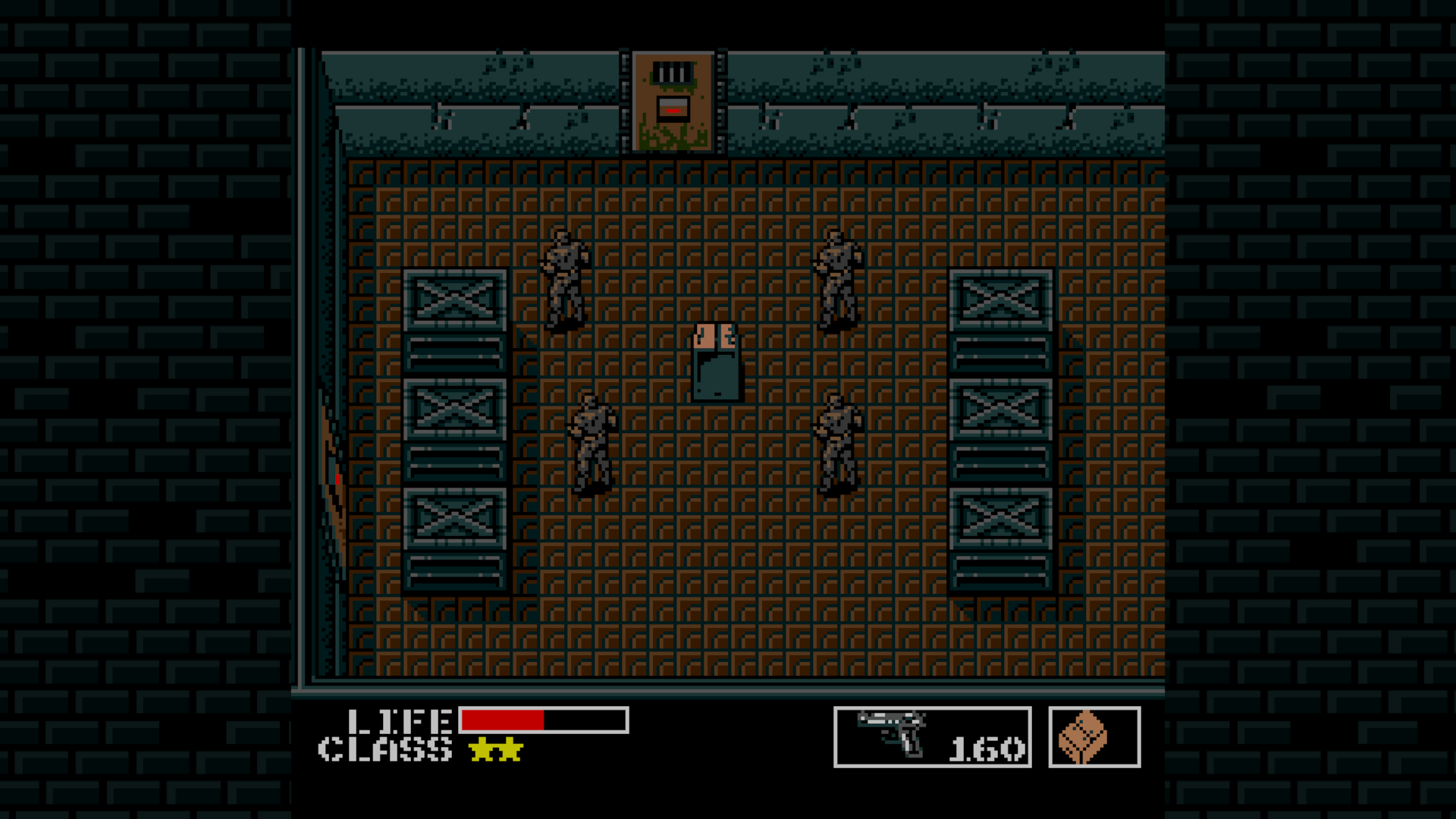
This is what peak stealth action gameplay looks like!
“This is what peak stealth action gameplay looks like!”

The game begins with Solid Snake having infiltrated Outer Heaven with nothing on him but a pack of cigarettes. As this place is essentially a rogue state occupied almost entirely by mercenaries, naturally it’s absolutely teaming with armed guards, so we have little choice but to immediately get acquainted with Metal Gear’s stealth mechanics. While far from the first, Metal Gear is one of the more notable early contributors to what would eventually become the stealth genre, so it’s interesting to see what features were present at this early point. Basically, in their default state, guards can only see in a straight line in whatever direction they’re looking, and they have no other methods of detecting you outside of being alerted by something else – another guard, a gunshot, or some other kind of alarm, and only on the same screen. This means you can safely stand right next to one if they’re looking the other way. They do turn to face different directions and even move around, and they almost always appear in groups of 2 or more, but as they move on set paths, it’s usually quite easy to study their patterns for just a few seconds and plot a safe course around them. You also quickly find the infamous cardboard box which makes it so that guards won’t alert unless they see you actually moving in front of them. Why they’re not more suspicious of a gigantic cardboard box suddenly appearing near them is anyone’s guess though. In any case, I was actually surprised to see that this silly series-long trope started all the way back here!

If a guard does see you, they’ll sound an alert which will make all of the guards in the screen absolutely freak the hell out, frantically searching for you and shooting indiscriminately. It turns out that escape is just as important as evasion is here – for a basic alert of this kind, simply changing screens will reset the guards. There’s another, rarer type of alert that works more like the alarm states found in later stealth games, though. If a double exclamation point appears above a guard’s head instead of a single one then the enemies will follow you from screen to screen for quite a while, unless, of course, you kill them all. Yep, combat is always an option. Snake can sneak up on an enemy and throw a few punches at them to take them out. This sounds risky, but each punch will stun the guard just long enough to throw the next, and they won’t alert their comrades while stun-locked either. It’s highly effective. Naturally, you will find weapons, though they have the downside of alerting the entire screen at once when fired. A bit later into the game you’ll find a suppressor which is automatically attached to both the handgun and the submachine gun, eliminating this negative altogether. Suppressed or not, you can blast your way through rooms only risking that you may catch a stray bullet or two in the process, and the only real effect is a lower rating after you beat the game (another feature that I believe was added in the HD Collection port.)

Equipping the mine detector reveals the otherwise invisible land mines in the desert areas.
“Equipping the mine detector reveals the otherwise invisible land mines in the desert areas.”

Stealth aside, I was surprised with just how close Metal Gear comes to aligning with the characteristics of a “Metroidvania” style platformer, or more accurately, a Zelda like action-adventure game, being absolutely chock-full of item/ability gating. That is, you’re in what is essentially an open world, but many rooms and areas require finding and using the correct item to access. The most cookie-cutter of these are door keys in the form of numbered keycards, though many are more thematic, like using an oxygen tank to swim through deep water, a mine detector to skirt otherwise hidden land mines, or infrared goggles to see and avoid laser traps. You generally find new items in these new areas or by defeating bosses that drop them, with many bosses themselves being gated by requiring a specific type of weapon to defeat. You’ll also frequently need to backtrack to previously inaccessible areas, though there are a few shortcuts, such as the cargo trucks you can stowaway on, that help ease this. With layer upon layer of gating and the fact that there’s almost always hints about where to go next or how to solve a particular puzzle, like most games of the above mentioned genres, progression actually feels reasonably linear.

Some of Snake's only characterization is this incredibly awkward sign-off. Love it!
“Some of Snake’s only characterization is this incredibly awkward sign-off. Love it!”

Speaking of those hints, exposition comes in two flavors. First, by way of what would become a major feature of the series, your transceiver, AKA your “codec”. Upon entering specific rooms you’ll be called by your commanding officer, Big Boss, along with various allies, and they’ll direct you to your next mission priority or otherwise give you some information on how to proceed. You can also make outbound calls, with whether or not you get an answer also seemingly tied to specific locations on the map. I rarely ever got responses, and when I actually did, they were usually quite terse, so this didn’t feel worthwhile enough to keep experimenting with. The second is by interacting with prisoners. Most of these come in the form of the generic POWs scattered throughout the game’s map, typically behind locked doors. Rescuing POWs not only usually supplies you with some sort of a often useful info, but the more of them you rescue, the more your in-game rank goes up, which in turn boosts your health pool and the quantity of consumables you can carry. Gotta collect ’em all!

Thanks for the details Grey Fox! I'm sure we'll never see you again...
“Thanks for the details Grey Fox! I’m sure we’ll never see you again…”

While we’re here, let’s talk about the story itself. Unlike what I did with Halo Fest 2020, I’m going to talk about each game’s story in its own entry, just to make things a little less confusing. That said, I will be experimenting with a spoiler tag system, so please let me know in the comments if this does not work for your browser of choice! As I did last time, I will try to be somewhat reductive with these summaries, skipping unimportant side stories and irrelevant details. They’ll also be kept mostly to what is explained in the game or its manual, which is especially notable with the Metal Gear series since release order of the games and their in-game chronology do not align at all.

Story Synopsis - Spoilers!1995. The United States Army black ops unit FOXHOUND deploys their newest recruit, Solid Snake, to Outer Heaven, a militant breakaway state in South Africa rumored to be building a weapon of mass destruction. Solid Snake’s mission, named Operation Intrude N313, is to locate and rescue Gray Fox, one of the unit’s top agents with whom contact was lost during a previous attempt to infiltrate Outer Heaven. Successfully entering the heavily fortified base, Snake is guided via radio by his commanding officer and handler Big Boss, and utilizes intelligence provided by local resistance members to eventually locate Gray Fox, who is being held in the base’s dungeons. Gray Fox reveals that Outer Heaven is building “Metal Gear”, a bi-pedal super tank capable of launching a nuclear attack from anywhere in the world. Luckily, Metal Gear has not been fully completed, and its creator, Dr. Madnar, is being held nearby. With further help from the Outer Heaven resistance, Snake is able to locate Dr. Madnar who, having been forced to develop Metal Gear against his will, gives Snake its location along with the details of a vulnerability that will allow him to destroy it. As Snake heads across the desert to another part of the complex, Big Boss’s communications become increasingly agitated, even insisting that Snake abort the mission altogether. Undaunted, Snake heads deep into the underground facility where he finds the prototype Metal Gear TX-55 and successfully sabotages it, though he inadvertently triggers a self-destruct countdown in the process. As Snake attempts to escape, he’s confronted by Big Boss himself, who is revealed to be a double agent, and is actually the leader of Outer Heaven and its mercenary forces. Big Boss admits that Snake’s mission was never supposed to succeed and the two face off in a tense showdown. Underestimating Snake, Big Boss is killed, and Snake continues his hasty withdrawal, narrowly escaping the massive explosion that engulfs the entire base. As Snake radios to request an exfiltration his signal is interrupted by Big Boss who, somehow surviving both their confrontation and the ensuing destruction of Outer Heaven, vows revenge.


While its story is relatively basic, like many of Metal Gear’s systems and other gameplay elements, the foundation laid here in terms of characters and themes will influence the rest of the series to come, with some of it even retconn’d in very interesting ways in way, waaaay later games.

The only way to defeat the tank boss is to lay mines in its path, dodging bullets and shells.
“The only way to defeat the tank boss is to lay mines in its path, dodging bullets and shells.”

I mentioned boss fights. Metal Gear’s bosses are reasonably varied, ranging from your typical boss screens where a single boss with a special attack or other ability needs to be defeated to rooms/areas with single, large boss sprites that don’t move or move very little, and these almost always require a specific weapon to defeat. For example, only the grenade launcher will take down the Hind-D and only land mines can destroy the tank. At times this felt a little arbitrary, if not downright illogical. For example, I found myself frustratingly questioning why I couldn’t use land mines to take down the bulldozer when just moments ago I destroyed the very similar tank boss with them. Bosses often have some pretty silly names, both in the original and the updated versions. For instance, one boss is called “Coward Duck” (renamed Dirty Duck) who I can only guess was inspired by Marvel’s Howard the Duck. There’s also the fan favorite Machinegun Kid, perhaps an early hint at the recurring theme of child soldiers, but more likely just silly. For better or worse, funny names and occasional poorly translated text aside, there’s not much else in Metal Gear’s first outing that hints at Kojima’s quirky humor, nor any of the more fantastic elements found in later games. I mean, I guess one of the bosses (actually a pair of androids tellingly called “Arnolds” in the original version) does appear to be based on The Terminator, and there is one very obvious fourth wall break late in the game too, but all in all, it’s fairly grounded.

While I admit I played on the “easy” difficulty, I didn’t find any of the boss fights too hard either. Instead, most of my deaths came from things like accidentally killing hostages during the Dirty Duck fight, or accidentally touching the tank boss when trying to lay mines in front of it, and of course the occasional trap I wasn’t quick enough to avoid. As mentioned, there are fairly direct hints to help guide you to the next step of the game that you’ll definitely find if thoroughly exploring, rescuing every POW, etc. You can also stock up on consumables like rations and ammo by reentering the room you find them in, which definitely helps make things easier. Oh, and did I mention that bullets and other projectiles are kind of slow? Yep, you can dodge them much of the time. They also don’t do a ton of damage, so face-tanking many scenarios is absolutely an option. While I don’t think you need a walkthrough for this game, with all of the similar looking rooms and corridors, and the numbered keycards with little logic to what door requires what card, it can definitely help a hell of a lot to play with a notated map. Throw in the small number of hidden destructible walls and the pit traps that suddenly appear in some places, particularly near the end of the game, and I’d highly recommend it. I don’t think I’d have enjoyed my time nearly as much without using one myself. The save system is also worth a mention. At a glance it looks like Metal Gear lets you save anywhere, but it actually uses something more like a modern checkpoint system (originally a password system, I believe) with your manually saved games just starting you back at the most recent checkpoint, which is usually the last elevator you entered. Once you’re aware of that, though, it’s easy enough to work with.

The titular Metal Gear TX-55. Pretty cool, even if it doesn't actually work.
“The titular Metal Gear TX-55. Pretty cool, even if it doesn’t actually work.”

I was happy to see that also included in the Metal Gear Solid: Master Collection Vol. 1 was the NES version of Metal Gear along with Snake’s Revenge. I’d always assumed that while the NES version might have taken some liberties here and there (most infamously, the game doesn’t culminate with Snake destroying the titular Metal Gear) and deviated in some other ways, as ports often did back then, it was still basically the same, good game. I popped into it not long after beating the MSX game and completing a playthrough of the boss rush mode, only to get my ass utterly handed to me, never making it out of the added introductory jungle area despite multiple restarts. There are numerous differences, but I suspect that the biggest culprit was the fact that the brief invincibility frames you get after being hit are gone in the NES version, so even a single basic guard can practically insta-kill you if close enough to land a barrage of shots. Not fun at all!

In the end, Metal Gear was actually quite a surprise to me. While it still remains to be seen how much I’ll like the next game, I figured these first two, early titles would be massive slogs, and that I’d get little value out of playing them beyond being able to claim I was reasonably thorough with this series retrospective. Instead, I actually really enjoyed it and I’m eager to jump into the next game. Tellingly, I think if I had played Metal Gear all the way back when I was drooling over its advertisements as a kid, I would have liked it, even if the NES version might have required a bit more stubborn persistence and maybe some Nintendo Power maps to crack.

On to our next game, Metal Gear 2: Solid Snake!

Note: Screenshots taken from the HD Collection / Master Collection version, which is why there are big, weird borders on either side. I thought about editing the borders out but decided to leave them be for consistency.