Tag Archives: PC

A (Personal) Battlefield Retrospective

Fresh off of somehow managing to dump 8 or 9 hours into the recent Battlefield 6 open beta, with all of the claims of it being something of a “return to form” after the lackluster performance of the last two games, I started to wonder exactly what that “form” is, or at least what people really mean when they say that sort of thing. While it may mean something similar to a majority of people, it’s totally subjective, I’m sure, and that conclusion has led me to reflecting a lot on my own time with the Battlefield series.
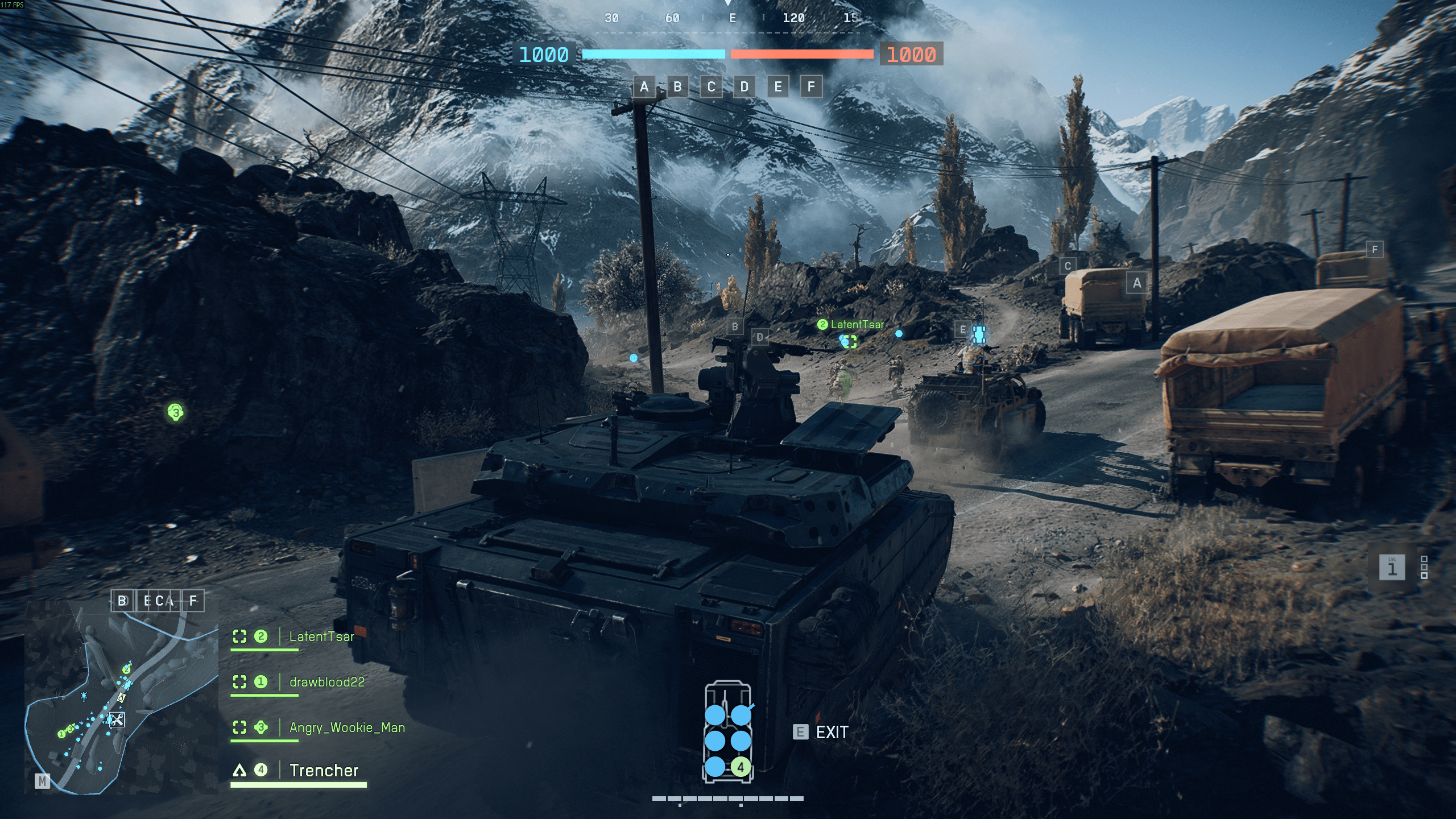
Hitching a ride to the frontline in the BF6 open beta.
“Hitchting a ride to the frontline in the BF6 open beta.”

While I’ve mentioned it once or twice here over the years, I’ve never gone into my absolute adoration for Battlefield 1942. One fateful day a co-worker who I occasionally ran into, and probably the only gamer I knew of at that place, was telling me all about how he’d just started playing this new “Battlefield” game and was talking about how you could do anything from crew a tank, fly a plane, or even captain a battleship in these massive, crazy online battles. This sounded a lot like World War II Online, which I’d been intrigued by but was always intimidated by due to its reputation for having clunky, simulation-like controls, but he assured me that it played more like a typical first person shooter. I was skeptical but curious. After doing a bit research I concluded that I just had to try it out, and picked up the game in something around November 2002. It was apparently a good recommendation, as I put an unspeakable amount of time into its multiplayer between 2002 and 2003, and even recruited a lot of other friends and co-workers to the cause. While I played a ton of mostly asynchronous “door” games like Legend of the Red Dragon on dial-up BBSes, Doom modem to modem, and Quake on the Internet in the 90s, apart from the very different Ultima Online, BF1942 was the first online game I was utterly obsessed with.

I was partial to infantry roles and focused on *gasp* playing the objectives, which in its default Conquest game mode, was kind of the point. I’m not a total dork though – I always enjoyed abusing tanks when one happened to be available too, of course. I also remember going out and buying a new flight stick so I could better handle the game’s relatively simple but fun to fly aircraft, and while I was never the best pilot out there (to this day, there are some people that have legitimately scary levels of skill when it comes to flying in these games) I more or less mastered the bonus Coral Sea map and would consistently clean house on it. F4U Corsairs and Zeros winding around those hilly islands is a core gaming memory for me, and I even made my own dog fighting map, filled end to end with huge mountains and massive valleys to make those kinds of pursuits even more fun. It also inspired me to take one of my first stabs at video editing, putting together a video of me dog fighting on Coral Sea in the pre-YouTube days. Unfortunately I’d have to strip out the sick Iron Maiden soundtrack if I were to upload it anywhere, plus the video quality is likely beyond abysmal by today’s standards.
Flying through a canyon (sideways) in my crappy BF1942 map.
“Flying through a canyon (sideways) in my crappy BF1942 map.”

Probably reading about it on a Battlefield forum or a gaming news site, I ended up joining a semi-private tournament community called Battle for Europe. The basic idea behind BFE (and the other communities I’m about to mention) was actually kind of simple – add a persistent, progressive campaign around Battlefield 1942’s already huge battles. The fact that the game included maps representing battles all around World War II and players could pick from axis and allied forces meant all you’d need to do is organize regular matches, keep track of losses and victories, and tie it all together with a Risk-like campaign map. It was a great idea, though it might sound quaint these days since persistent player progression is now fairly standard, and while the Battlefield series may not have any sort of long term campaign progression, other games like Foxhole and the aforementioned World War II Online have done this to varying degrees too. (Editor’s note: For posterity, it’s worth noting that BFE was probably better known for applying this concept to other World War II games released around that time such as Day of Defeat and Call of Duty, and ran for several years after this.)

The battles themselves were absolutely epic! We filled out the 64 player slots on our server, plus extra observers, and had a ton of people on standby. How did we account for having more than 64 people in the community who wanted to play? Easy! We made the matches last as long as possible and ran these battles all day. Literally hours on end, with the idea that players could tag in and out, ultimately supporting a lot more players, and across multiple timezones to boot. As a whole our player base represented a wide variety of skill levels, though of course most of the types of people who’d join a dedicated community like this were at least above average, and the battles would be correspondingly vicious. While not quite a “milsim” or realism community of the sort that would later become popular with a variety of military shooters, we also had a player ranking system in which players could advance, as well as take on particular roles which, given the limited number of vehicles and need for a well balanced roster, was also a must. Leadership was especially vital if your side actually wanted to win, and I soon found myself being promoted to a squad leader, and then to an NCO role where I was in charge of something like 50 players. Speaking of, strategy was an interesting aspect of these long matches, as unlike a typical clan versus clan league or tournament match, there was way more than enough time for the other side to figure out exactly what you were doing and adjust to it, which made active leadership all that more important.

Creeping up to an enemy spawn in a BF1942 WGO match.
“Creeping up to an enemy spawn in a BF1942 WGO match.”

The reasons were a bit hazy at the time, never mind today, but there was a growing air of discontent around much of the BFE BF1942 community leadership, and as is often the case, there were people who had their own ideas of how they could do the whole thing better waiting in the wings. Several of the more vocal community members banded together to leave BFE and “roll their own” calling it War Games Online. With many of those involved being people I liked and respected, I was asked and accepted to come along for the ride, thus becoming one of the founders and administrators of this new community. I also signed up to help with the development of our new site which we had some pretty cool ideas for, such as an interactive campaign map. While this would take some time, we went ahead and launched our first campaign as something of a proof-of-concept. I still have fairly visceral memories of at least one intense and chaotic match on one of the semi-asymmetrical Road to Rome maps, which were new at the time. Sadly the whole thing went a bit pear shaped pretty quickly due to the head of our new community suddenly stepping down. As he wanted to maintain the WGO name, the rest of the leadership council spun it off into yet another new community called Global Conflict. I was starting to play Battlefield 1942 less and less by this point thanks to other distractions (namely Planetside) and I bowed out very early into GC’s life. While I ultimately had very little influence on what Global Conflict would become, it lived on through various games and is still around in some form today, which is very cool to see.

All that, and I didn’t even mention the fantastic Desert Combat. Desert Combat was a massive total conversion mod that introduced a ton of new weapons, vehicles, and maps to the game, shifting its focus from World War II to a now very familiar modern setting. While I never played it in any organized way, I spent a huge amount of time with it, and have especially fond memories of huge, immersive tank battles in desert maps, and there was absolutely nothing like hunting ground targets in an A-10 or SU-25 on the classic BF1942 map El Alamein. (Editor’s Note: Like many old games and mods, even ones as popular as Desert Combat was, there’s little detail online about it, though I stumbled upon this excellent series of posts about the game that I can’t help but to share – Part 1, Part 2, Part 3, Part 4)
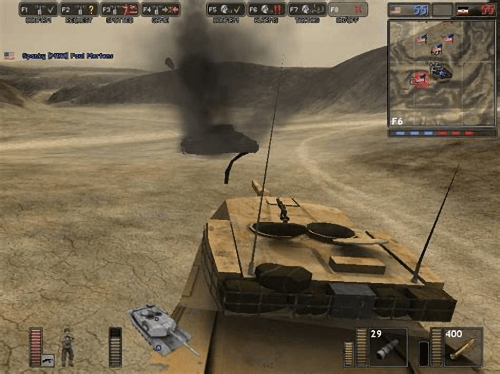
I loved tank battles in BF1942 but there was nothing like Desert Combat.
“I loved tank battles in BF1942 but there was nothing like Desert Combat.”

Another reason that Battlefield 1942 (and Desert Combat) is important to me is that it is a rare example of my dad really getting into a game. My dad’s taste in games has always been totally enigmatic to me. Simply put, certain seemingly random games over the years have really grabbed him, but attempts to understand his tastes and turn him onto other, similar games has usually been met with a lukewarm response at best. He’d always been a World War II nerd, and as I was still living with my parents at the time, I showed him BF1942. Not only did he think it looked cool, but he watched me play round after round, eventually asking me to let him play, which then became a regular thing. This was kicked into overdrive when I showed him Desert Combat, and one evening coming home from work to find him on my PC playing a match. My dad barely touched computers, so the fact that he figured out how to get online, start up Battlefield, and get into a match all by himself was kind of shocking to me. Some time later I built a new computer for my brother which came with the added bonus of enabling my dad and I to play together. With one of us driving/piloting and one of us gunning DC’s various helicopters, planes, and tanks, mowing down endless hordes of bots was a hell of a lot of fun.

Around the time my excitement for Battlefield 1942 started to wane Planetside came into my life and in most ways supplanted it, though there was a brief time some months later when I got a little burnt out on Planetside and decided to go back to Battlefield 1942, even trying out for a semi-sweaty clan called The Devil’s Brigade. They had kind of a template for how they’d assess potential new recruits, running me through various exercises that involved things like attacking a small bunker with multiple clan members defending it, and inversely, attempting to defend solo as they relentlessly attacked it. While my skills probably peaked before quitting to play Planetside, I was still pretty decent at the game, and it was actually kind of a thrill to be tested like that. I recall doing so-so overall, though I wasn’t exactly sure how well I was supposed to do in these scenarios, and I got quite a few kills against other members of the clan that I thought would be sure to impress, and sure enough, I was accepted. They seemed like a cool group of guys and I was really looking forward to playing with them, but I also felt like I owed my loyalty to my existing friends in my Planetside outfit, The Praetorian Guard, more than any potential new ones there, resulting in having a change of heart and regretfully bowing out of TDB before putting much time in with them at all.
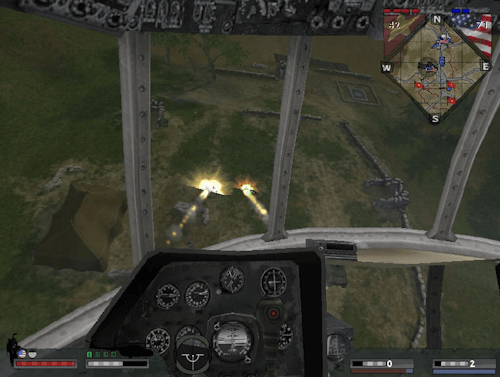
Choppers were freakin' everywhere in Battlefield Vietnam.
“Choppers were freakin’ everywhere in Battlefield Vietnam.”

After TPG’s original stint as a Planetside outfit slowed down, we were constantly dabbling in various other games together, sometimes in a fairly organized way, but often times we’d just all just squad up and hop into public games, not really employing all that much teamwork or anything. When Battlefield Vietnam was released in 2004 I and several others in the clan were hyped enough for it to pre-order it or otherwise grab it on launch day, and we played it together as a semi-disorganized group quite a bit. Unfortunately there was something about Battlefield Vietnam that just didn’t gel right for me. I don’t know what it was – the map designs, the asymmetrical armies, the particular combination of vehicles and weapons, the helicopter controls when compared against DC’s, subtle changes to the engine, or maybe some odd mix of all of those? Of course, I know it’s one of the more fondly remembered older titles in the series so I’m not claiming to be in the right here, but I really only kept playing it to play with my friends, with a dwindling hope that maybe something would eventually click.
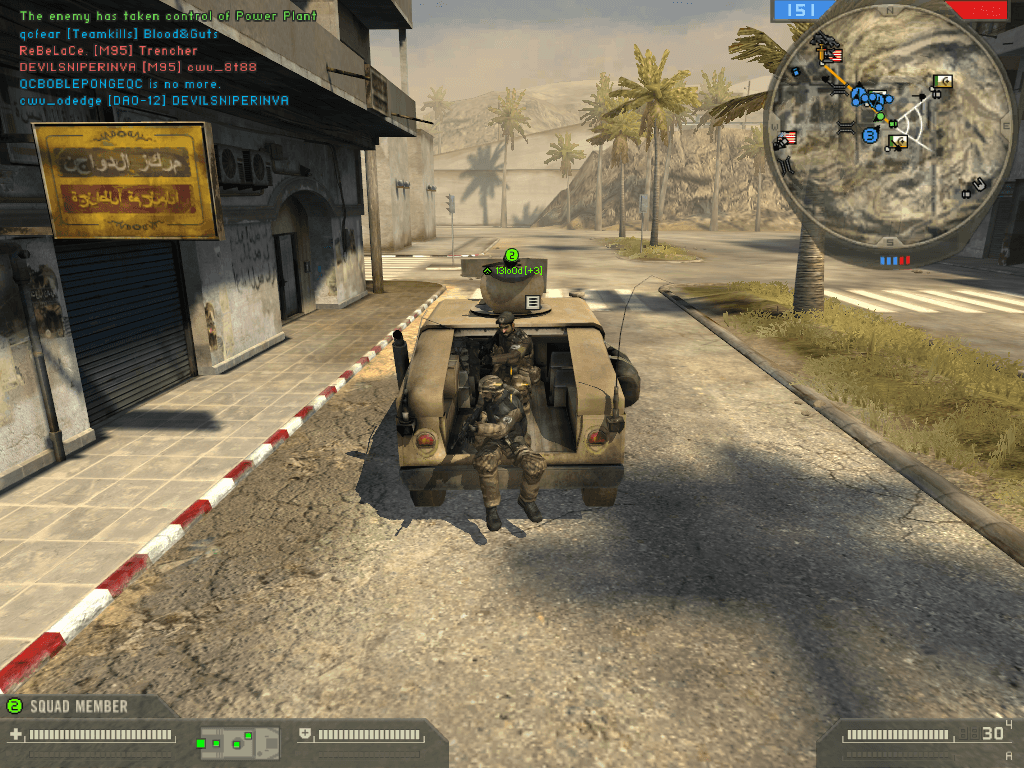
Hitching a ride with my old TPG buddy Blood in BF2.
“Hitching a ride with my old TPG buddy Blood in BF2.”

It’s a similar story with Battlefield 2. I was extremely hyped for an official DICE take on what we got earlier with Desert Combat, especially since the guys who made DC would be helping out, and there were a lot of undeniably cool enhancements to the engine and the gameplay in general, including a new squad system, persistent player progression (which would be a staple of the series from that point on) and the introduction of the RTS-like commander mode that saw one person on each team giving orders, dropping supplies, and otherwise attempting to direct and assist the fight from afar. When the Battlefield 2 demo built around the Gulf of Oman map dropped, a few of us played it like absolute madmen and really, really dug it. When the full game was released, most of the core members of TPG dove in as well, though it ended up not hooking me to anywhere close to the level I expected it to. Looking back now, I honestly don’t remember why that was – perhaps it was a similar situation as with Battlefield Vietnam, though I also have some vague recollections of having some technical issues with the game that might have kept me from playing as much as I wanted to. As an aside, I did briefly return to BF2 years later to play with some of its bigger mods, as mentioned here.
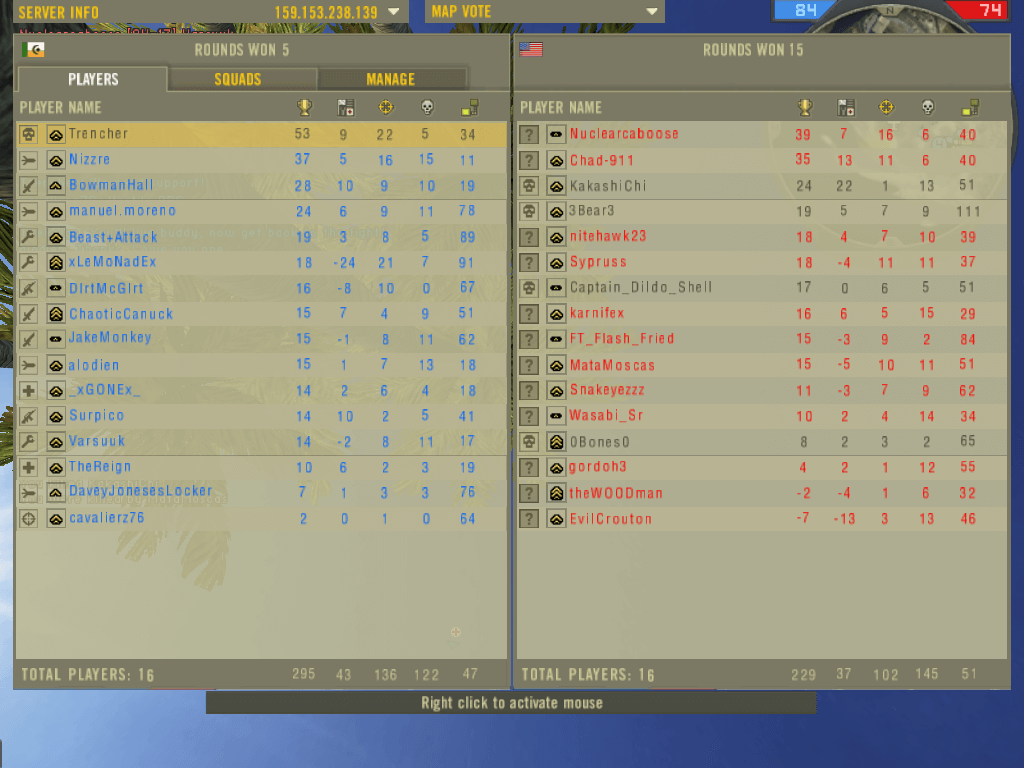
Look, proof that I didn't totally suck at Battlefield 2!
“Look, proof that I didn’t totally suck at Battlefield 2!”

I skipped the BF2 follow-up/spin-off Battlefield 2142, despite the fact that, given my love of the similarly sci-fi heavy Planetside, you’d think I would have been all over it. In fact, to this day I’ve still never played it. Not long after this, I started cutting way back on PC gaming and focused a lot more on console gaming, particularly single player games. I’d played the demo of Battlefield 2: Modern Combat on my Xbox 360 after watching a friend play it and thinking it looked pretty cool, but skeptical of Battlefield’s place on console, it wasn’t until Battlefield: Bad Company’s single player campaign that I gave it a fair shake. I dabbled with its multiplayer as well as its Xbox Live Arcade spin-off Battlefield 1943, as mentioned here, but I was a little late to the party on that one, and my Battlefield 1942 skills didn’t survive the transition to being played on a controller in any case. I fully intended to play through BC’s sequel’s campaign as well, though it wasn’t until I found out that it had become the flavor of the month online game for a lot of my old TPG friends that I picked it up on PC and joined in.

Battlefield: Bad Company 2 felt like something of a return home for me. The maps were smaller and less chaotic, with smaller player counts, yet perfectly balanced the map sizes, player counts, available vehicles, and all kinds of nifty new counters. It also focused on the more linear Rush mode over the series staple Conquest, which worked really well with that particular formula. Throw in a simple player progression and weapon unlocks system, and the awesome Destruction 2.0 and, man, it was a ton of fun. While BC2 was much more of a fun diversion for me than an obsession like with Battlefield 1942, I racked up a good 20 hours or so of multiplayer and have a lot of fond memories of playing it. I do still need to go back and play that campaign one of these days, though! As a quick aside, I recall being intrigued by the launch of Battlefield Heroes, a title that often gets left out of these kinds of retrospectives, but alas, I never actually got around to trying it. I thought it looked kind of neat though.
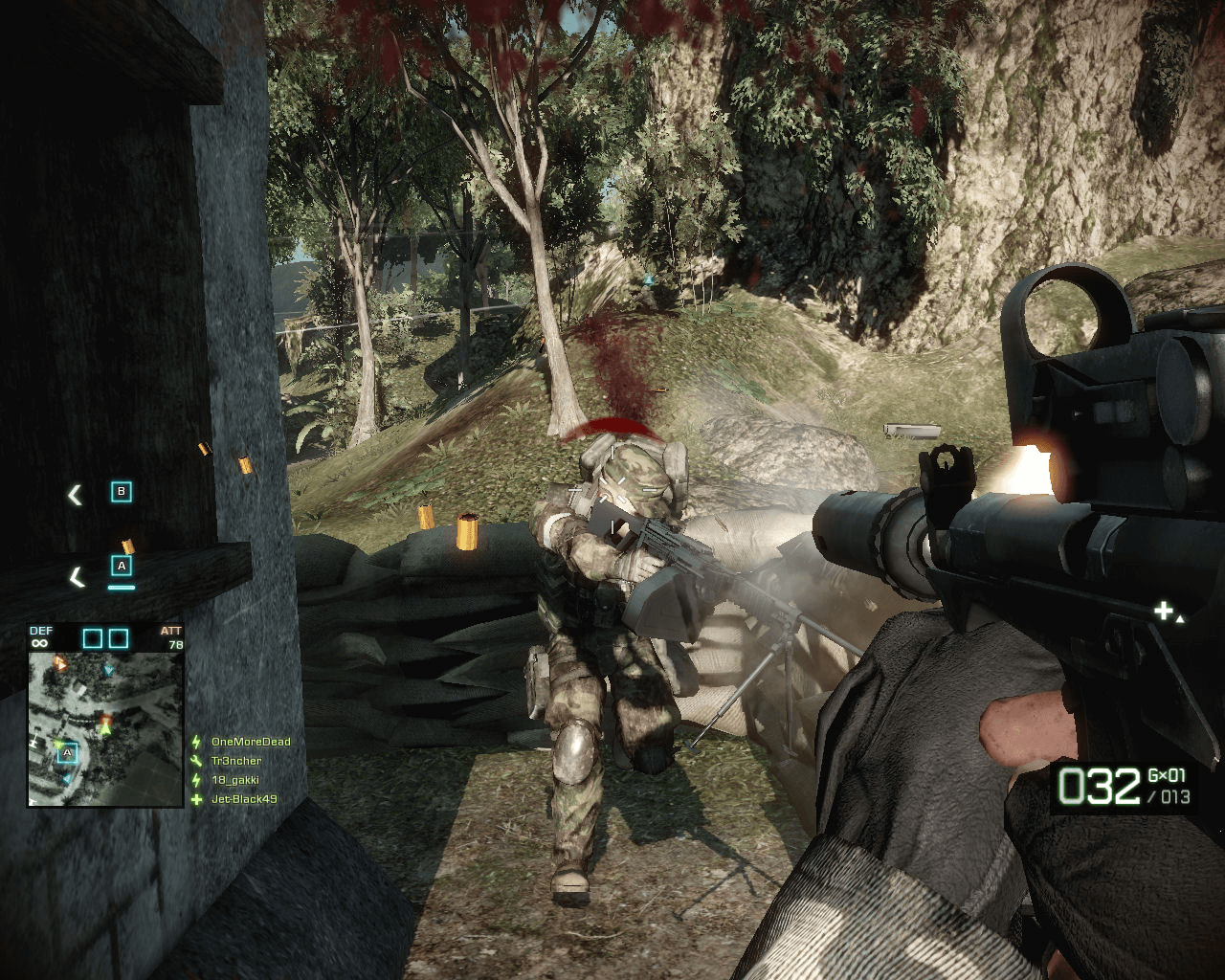
Man, I miss Bad Company 2. This dude was too close to miss, though!
“Man, I miss Bad Company 2. This dude was too close to miss, though!”

Somehow, the impressive looking Battlefield 3 with its more realistic models and animations, added cinematic flare, and a post-Call of Duty 4: Modern Warfare overhaul of infantry movement and gunplay didn’t reel me in when it was released a few years later. I think this is chiefly because I wasn’t gaming that much at the time, and when I was it was still usually focused on more single-player experiences on console. That, coupled with a lot of highly publicized technical issues at launch and that few if any of my friends were playing it, meant I gave it a miss entirely. The story is exactly the same for Battlefield 4 and the odd cops and robbers spin-off Battlefield Hardline. I thought all of these games looked cool, but I was increasingly feeling like the Battlefield series was no longer for me. Looking back, I can’t help but wonder what I might have missed by skipping those games, especially since 3 and 4 are always mentioned as points of comparison when discussing the series these days – I’ll probably at least go back and play through their campaigns one of these days.

Battlefield 1, however, really caught my attention, and it just so happened that I’d built a new PC around the same time as its pending release and was itching to do some legitimate PC gaming, and a lot of my old TPG friends were jumping into it too. Between that, and the fact that the game was actually really good, it was the first Battlefield game since BC2 that I spent any quality time with. It wasn’t perfect – I’d have preferred another World War II title to a Battlefield set in World War I when everyone is anachronistically running around with automatic weapons, and I generally didn’t love the weapons and vehicles as a result. Still, it had more than its fair share of uniquely awesome Battlefield series moments. Similarly to BC2, I wasn’t crazy addicted to it, but it did become my random pick up and play online game for a while there, temporarily unseating Planetside 2 from my rotation.
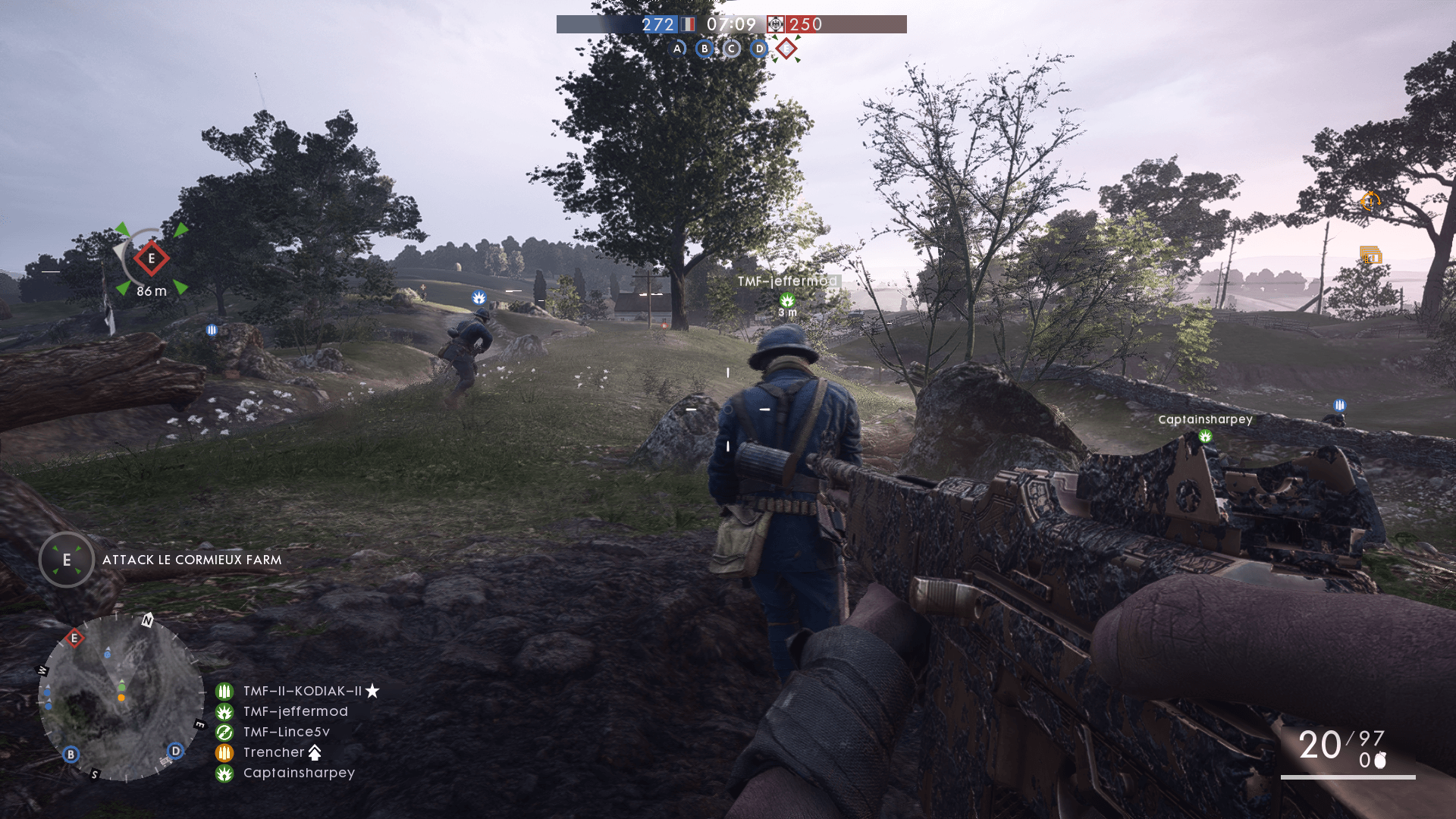
Over the top, boys! Probably seconds away from death in Battlefield 1.
“Over the top, boys! Probably seconds away from death in Battlefield 1.”

Like a lot of people, I was initially very excited for Battlefield V’s long overdue return to World War II, but then very concerned when EA released the reveal trailer featuring a mismatched squad of resistance fighters rather than your typical uniformed grunts, and graphics so bright and colorful that were, compared to Battlefield 1’s often dreary environments, absolutely retina scorching. That, and the marketing of the game focused on a female sniper from the group with what looked (at a glance) to be a bionic arm, which left me scratching my head. No, I’m not going to cry about female characters and minorities like a lot of Battlefield V detractors, but it did make me question what tone DICE were going for with V. It was feeling like it might be more of a less serious, perhaps even alternative history take on World War II, and combined with the news that it would include a Battle Royale mode and some of the other details coming out, such as “Elite classes” hinting at a more hero oriented system versus the generic classes of old, it really made me skeptical of the entire game.

Randomly feeling the urge to play some Battlefield, I actually ended up picking up Battlefield V super cheap during a Steam sale just last year. I played a couple of single player campaign missions as well as put a few hours into multiplayer, and I surprisingly really enjoyed what I played. Mind you, this was after years of patches to fix the game’s issues and dial back a lot of the more controversial changes, but I can’t help but think that this game was mostly a victim of a now seemingly misguided marketing push to make the game more attractive to Fortnite Battle Royale players coupled with the ensuing hate campaign made up of gamers all too happy to leap onto the bandwagon to trash the next big EA game. I’d always intended to go back and finish the campaign and play some more multiplayer before writing about the game, and hopefully I still will one of these days.
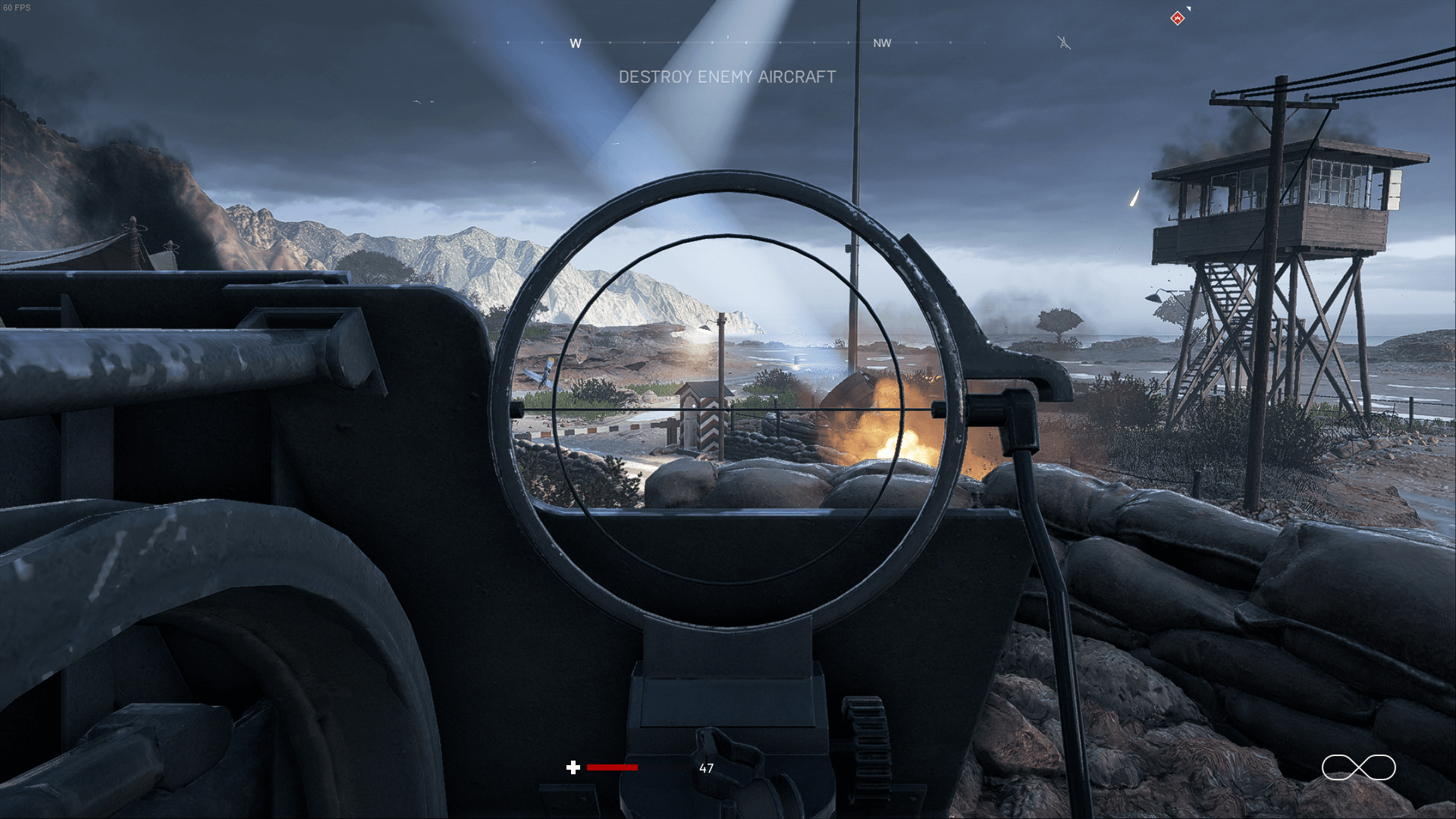
About to mess up some Messerschmitts in Battlefield V's campaign.
“About to mess up some Messerschmitts in Battlefield V’s campaign.”

Somehow even more depressingly, Battlefield 2042 went right over my radar upon its release in 2021. After the somewhat troubled release of Battlefield V and a rather rocky initial reception due to a number of technical, marketing, and gameplay fumbles, including going even further down the hero shooter class rabbit hole with its new “Specialists”, it never really appeared on my radar either. At least, not until it had been patched and expanded so much that opinions on the game finally started to gradually shift, though as mentioned above, that just ended up resulting in me buying Battlefield V instead. Given that it didn’t have any sort of campaign, it’s likely that I’ll never check it out, but never say never!

So that brings us to August 2025, when rumors about Battlefield 6 started to appear, and then early but very positive sneak peak impressions and preview event impressions started to build up in short order, culminating in the announcement of an open beta. I couldn’t really ignore the hype any longer, and I decided to check out the beta, but more on that much later, when I’m hopefully talking about the game we eventually get at retail!

Believe it or not, most of these screenshots, even the really ancient ones, are mine. Apparently I don’t delete things enough!
Digging Holes

Man, Deep Rock Galactic had been on my radar for ages, and worse yet, I’d even owned it for a couple of years now. We’ll get to my excuses later…

You play as a fairly archetypal dwarf (read: loves precious gems and rare ores, drinking, and long walks in dark caverns) who teams up with his dwarven miner buddies to work for the Deep Rock Galactic company. As hinted at by the “galactic” part, this is a sci-fi twist on those fantasy dwarf tropes, which of course means you and your crew have to defend yourselves against a variety of subterranean alien creatures, and with appropriately sick guns and other sci-fi equipment. I mean, I already kind of love dwarves, plus like every Warhammer 40,000 fan who got started back in the first edition, I have an extra special place in my heart for squatty space dwarves. I’ve also talked a bit about my fondness for voxel based mining in games like Minecraft and Astroneer, so yeah, this game sounded right up my alley.

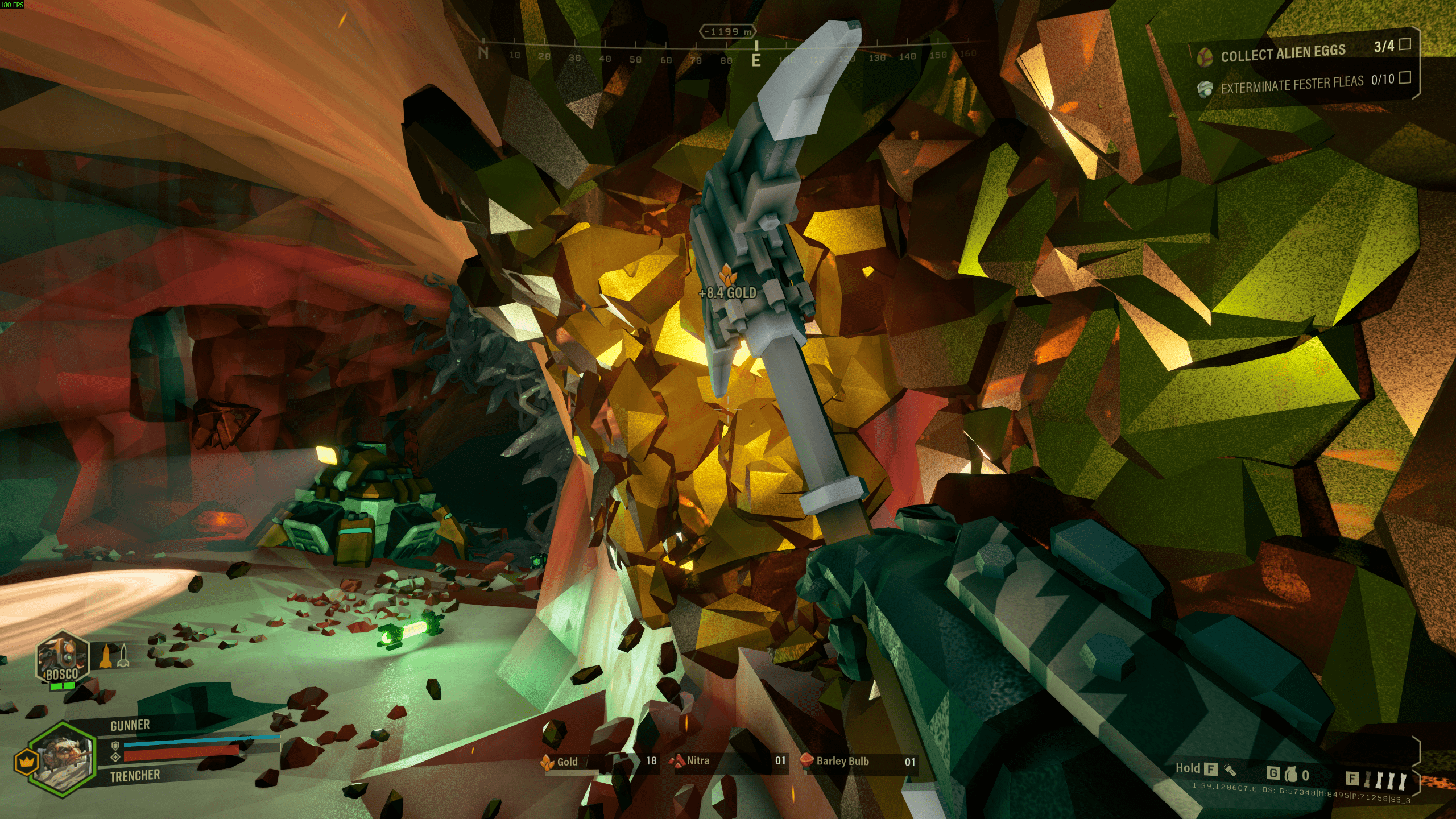
Gold! Man, I love how quick pulling out and swinging your pick axe is.
“Gold! Man, I love how quick pulling out and swinging your pick axe is.”

Continuing with some of the gameplay tropes I mentioned with Helldivers 2, DRG is a session based first-person cooperative game which has you and your crew pick a mission with particular difficulty and set of objectives and get blasted down into a procedurally generated cave system to complete it. Some of the time this is almost pure mining, but even when it isn’t, you’ll always be mining, if only to gather some extra resources and create new routes to move through. As mentioned, there are obstacles to contend with in the form of attacks by the not-so-friendly denizens of these caves, environmental obstacles, navigational challenges, and even the darkness itself. A lot of these obstacles are specifically designed to allow for horde mode style defensive situations – requiring one person to slowly activate a device, or having to guard a device while it completes a process, for instance. Of course, there are random enemy rushes as well, just to spice things up a bit.

Oh, and the game is class-based, with 4 classes: a fast moving scout who is able to grapple around and shoot flares, an engineer who can deploy sentry turrets and build platforms, the gunner who carries massive weapons and can also deploy ziplines, and finally the driller, who has a super badass mining drill that shreds through terrain. In between missions there is a progression system that allows you to upgrade your dwarf’s skills and equipment, purchase cosmetics, etc. This is all done somewhat diegetically via an in-game hub area. Standard stuff, though I don’t mean to say that in a derogatory way, as DRG is definitely one of the games that helped refine this genre.

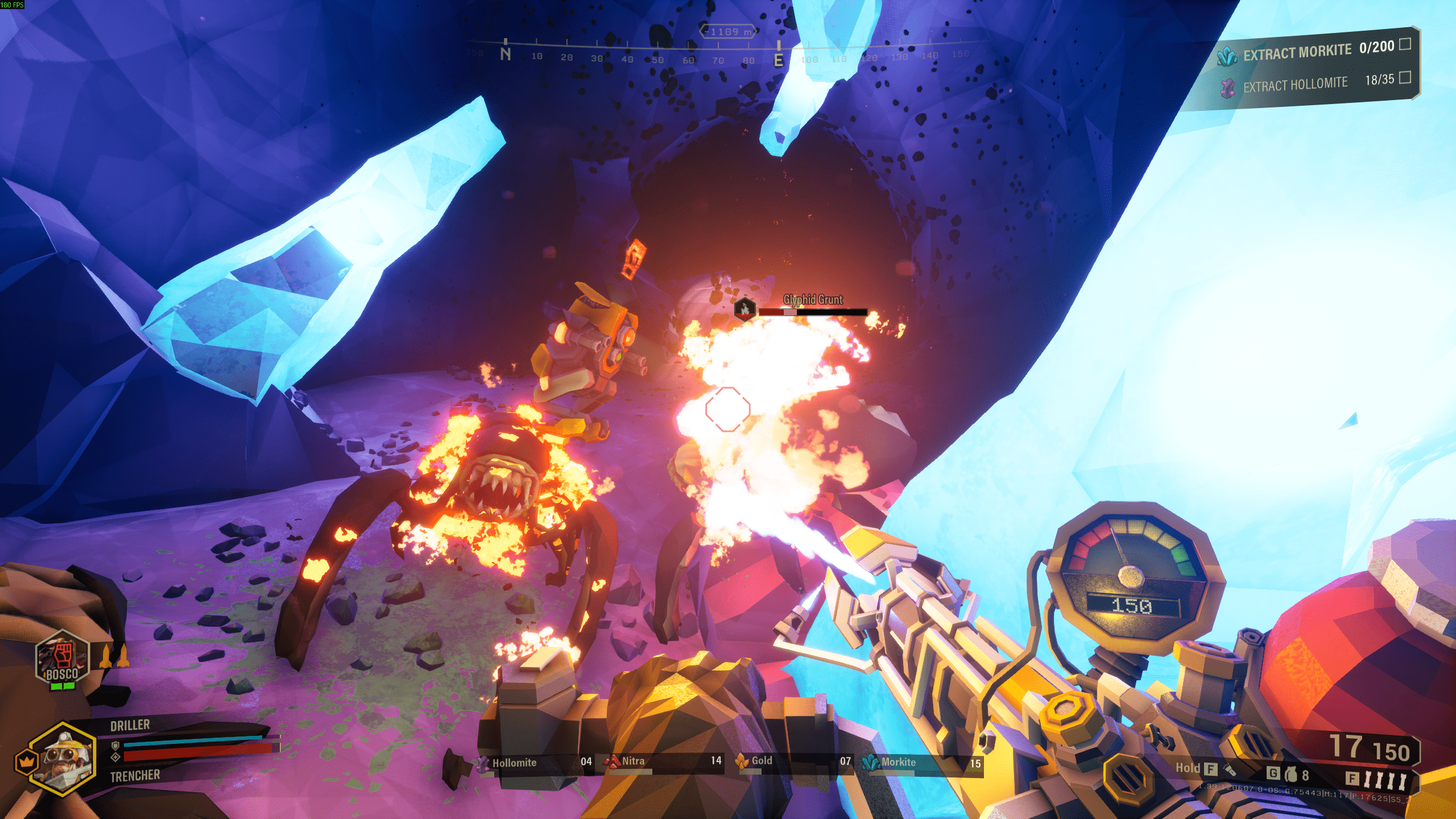
But sometimes you need to clear out a few bugs first...
“But sometimes you need to clear out a few bugs first…”

One odd thing about DRG’s place in the genre is actually its business model. It definitely feels like a “live service game” – it’s frequently updated and its progression systems are designed in such a way that you’ll want to keep playing for months on end, especially with the addition of seasonal battle passes. Yet, the battle passes are totally free, there are zero micro-transactions, and the only DLC is a handful of packs of themed cosmetics that are entirely unnecessary. 🤔

Despite its relatively low fidelity, its stylized graphics and the general level of polish really help elevate it. In fact, one of the things I personally like the most about Deep Rock Galactic, both in terms of presentation and gameplay, is its attention to detail, with a lot of neat and probably totally unnecessary little features, and some immersive and sometimes fun to play with physics. I also love the lighting, with its use of bright colors, often from the numerous luminescent plants and minerals featured in each biome (and more games need throwable glowsticks!) contrasting with the ever present darkness that comes with being god knows how deep below the planet’s surface. In short, the developers went hard!

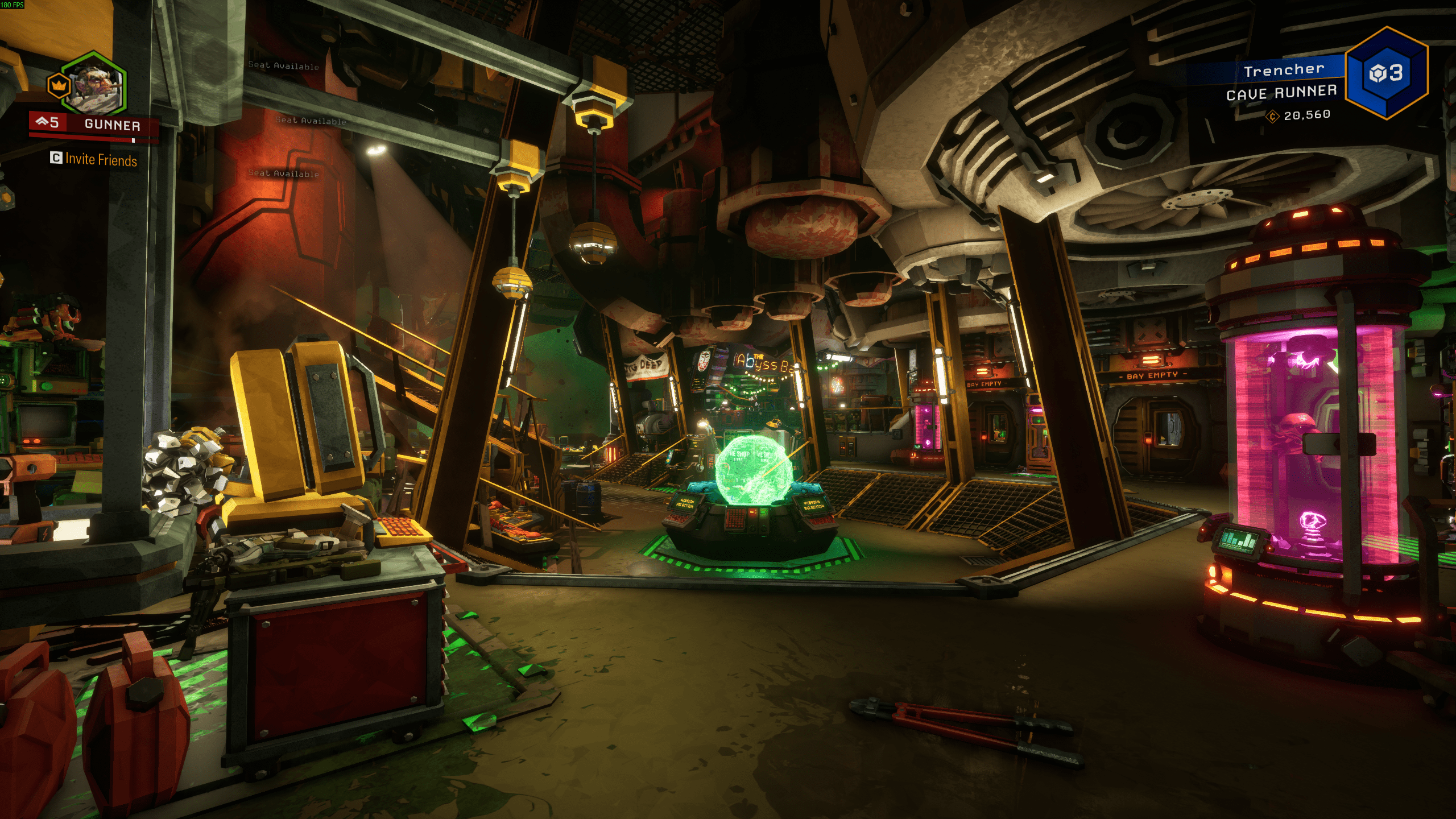
Home sweet home! Back on the space rig hub area.
“Home sweet home! Back on the space rig hub area.”

Another aspect of DRG that definitely deserves a mention is the community. While I haven’t played many games with randoms, judging mostly from encounters on forums, Reddit, Discord, and the like, the DRG community has a highly infectious fun spirit founded on the light-roleplay elements of a mutual love of slamming back a space beer and greedily digging up some precious alien gems while obnoxiously shouting “ROCK AND STONE!” at literally every opportunity. Like Helldivers 2, the fact that the game is 100% PvE and players are pretty much always united in cooperation probably goes a long way towards enforcing this more fun and friendly atmosphere. Regardless of the reason, it feels like a breath of fresh air to encounter such generally positive players.

Unfortunately, my core gaming friends don’t number amongst them, with none of them seeming all too interested in DRG, at least not while I was. I eventually bought a copy when I joined a local gaming Discord community that had regular nightly DRG sessions for a while, though I never actually ended up joining them. It wasn’t until a friend who I’d never really gamed with mentioned that he’d been playing it that I finally dove in. He gave me a crash course on the basics and we completed a small handful of missions together, and while it was fun for me, I got the sense that he had already seen enough of DRG and had really only fired it up for my benefit. I continued on solo, which is a very different experience, but DRG is perhaps even less enjoyable of a solo experience than Helldivers 2 is. It’s totally doable, but the caverns are a little creepier, the enemies a little scarier, and missing all of the casual voice chat punctuated by occasional shouting during those more tense moments takes away from the entire gameplay experience. In any case, it always feels pretty obvious that these types of games were designed around multiplayer when you try to play them alone. Thankfully, DRG gives you an upgradable robot companion to assist you when running solo, which does help on the gameplay front, at least.

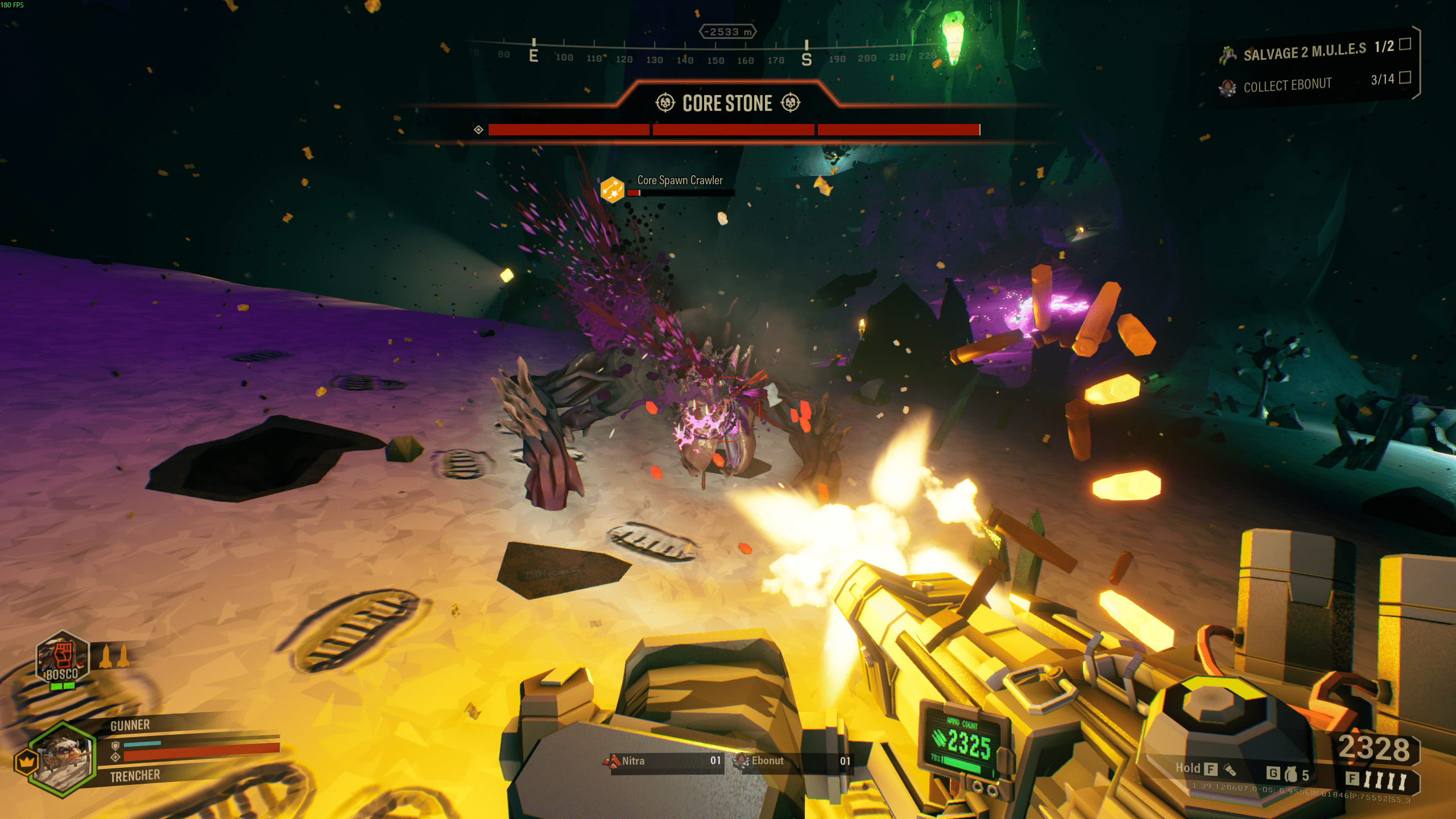
I'm not really sure what this ugly thing is, but it dies just the same.
“I’m not really sure what this ugly thing is, but it dies just the same.”

So, not unlike Darktide and Helldivers 2, I regretfully have to leave Deep Rock Galactic behind before really spending all that much quality time with it, despite how much I really love about the game. If a true sequel is ever released (A spinoff, Rogue Core, is on its way soon!) I may jump in nice and early, crew or not!

Next up is a… *gasp* single player game all about mining, and all from the comfort of your own backyard!

A Game About Digging A Hole is… well, yeah, okay, the premise is the game doesn’t go much further than its title. You buy a new house on the cheap after being told there’s buried treasure there, move in, roll up your sleeves, and get to work. You’ve spray painted a big red X in the middle of your backyard, you’ve got your trusty shovel, and evidently, nothing but time on your hands. No day job? Man, this already feels like an amazing fantasy!

I got turned onto this game by hearing Anthony talk about it on Rebel FM, and the idea of an easy to pick up and play, quick to complete single player voxel based mining game had me intrigued, given that many of these types of games are multiplayer (like Deep Rock Galactic) and/or massive live service game slogs (also like Deep Rock Galactic.) Bought!

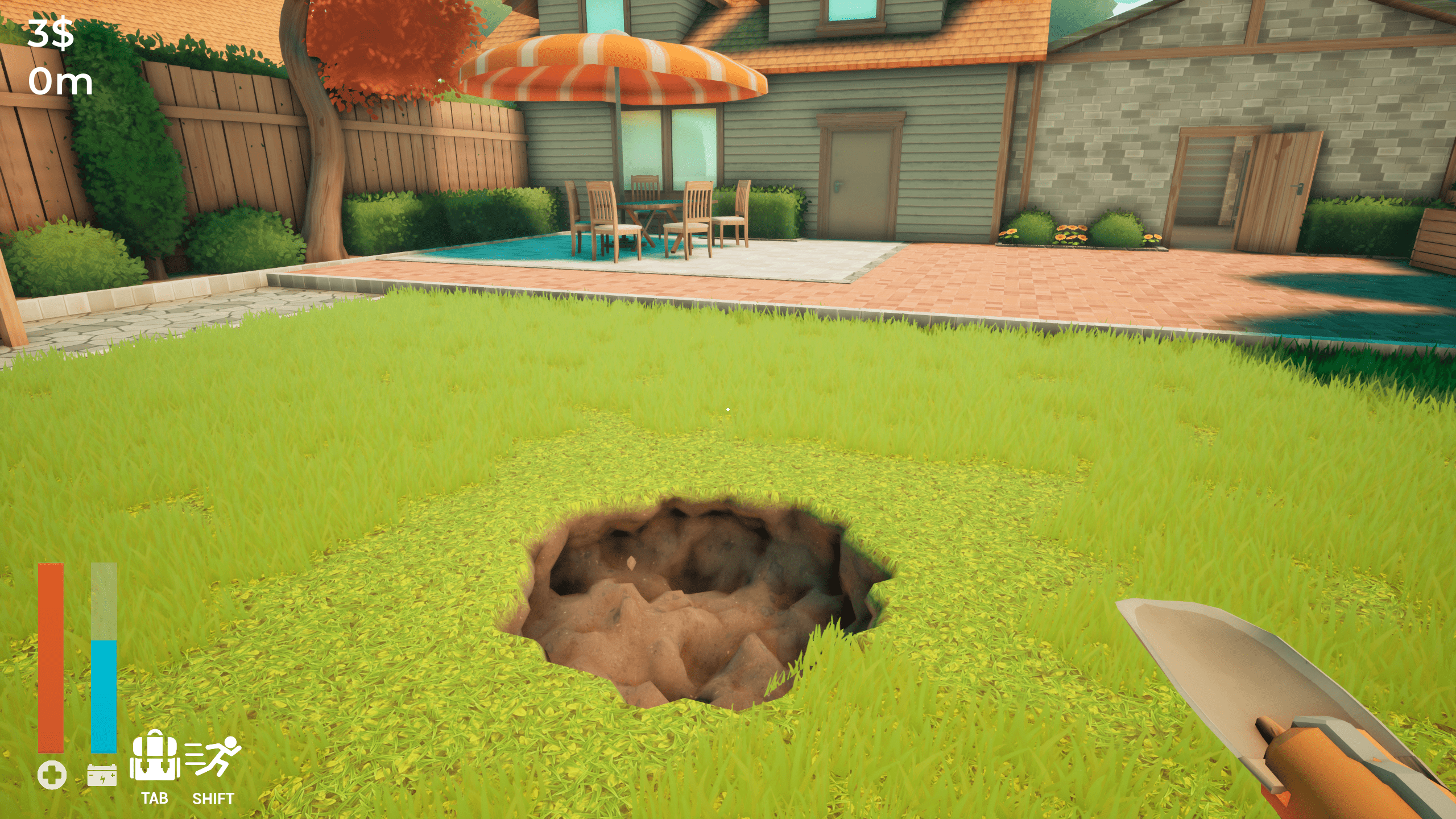
Things start modestly enough...
“Things start modestly enough…”

AGADAH’s gameplay loop is far from complex. You dig… a lot. Your energy depletes as you dig. You find the occasional valuable chunk of ore, gemstone, and other interesting junk and throw them in your inventory. Your inventory fills up and/or your energy starts to run out. You head back into your garage (the command and control of your grand yard destruction project) and sell these rare resources to get money to upgrade your equipment (which is all abstracted for instant gratification, of course.) Then head back out again. Eventually you’ll move from your shovel to a huge mining drill, you’ll get a jetpack to make going up and down the insanely deep hole you’ve dug easier, you’ll be able to upgrade your inventory size and your battery reserves, and even purchase some dynamite to spice things up a bit. Essentially, all things to make your job easier, and each run back down into the hole last a little longer. Of course, the deeper you go, the more dirt you’ll need to shift, the more obstacles you encounter, and the darker it gets. Naturally, this is offset by more and more valuable resources, and thus, more and more money.

It’s a seemingly very chill game that, for me and I suspect quite a lot of others, scratches that same addictive itch as games like PowerWash Simulator. You have an easy, repetitive task, yet somehow it’s just rewarding enough to keep you cleaning every last goddamn surface area on the level, or in this case, digging every last speck of loose dirt from your backyard. It’s also oddly charming, with its simple graphical style and its equally simple gameplay loop that conceals a very well-considered design. One that, as someone who has dabbled in game design myself, I’m jealous of the developer for coming up, especially given that they apparently just casually tossed this game together while on a work break for a few weeks. Anyway, eventually you reach the bottom of the hole and… well, I won’t spoil whether you find your promised treasure or not, but let’s just say the end of the game is definitely worthy of a fun discussion.

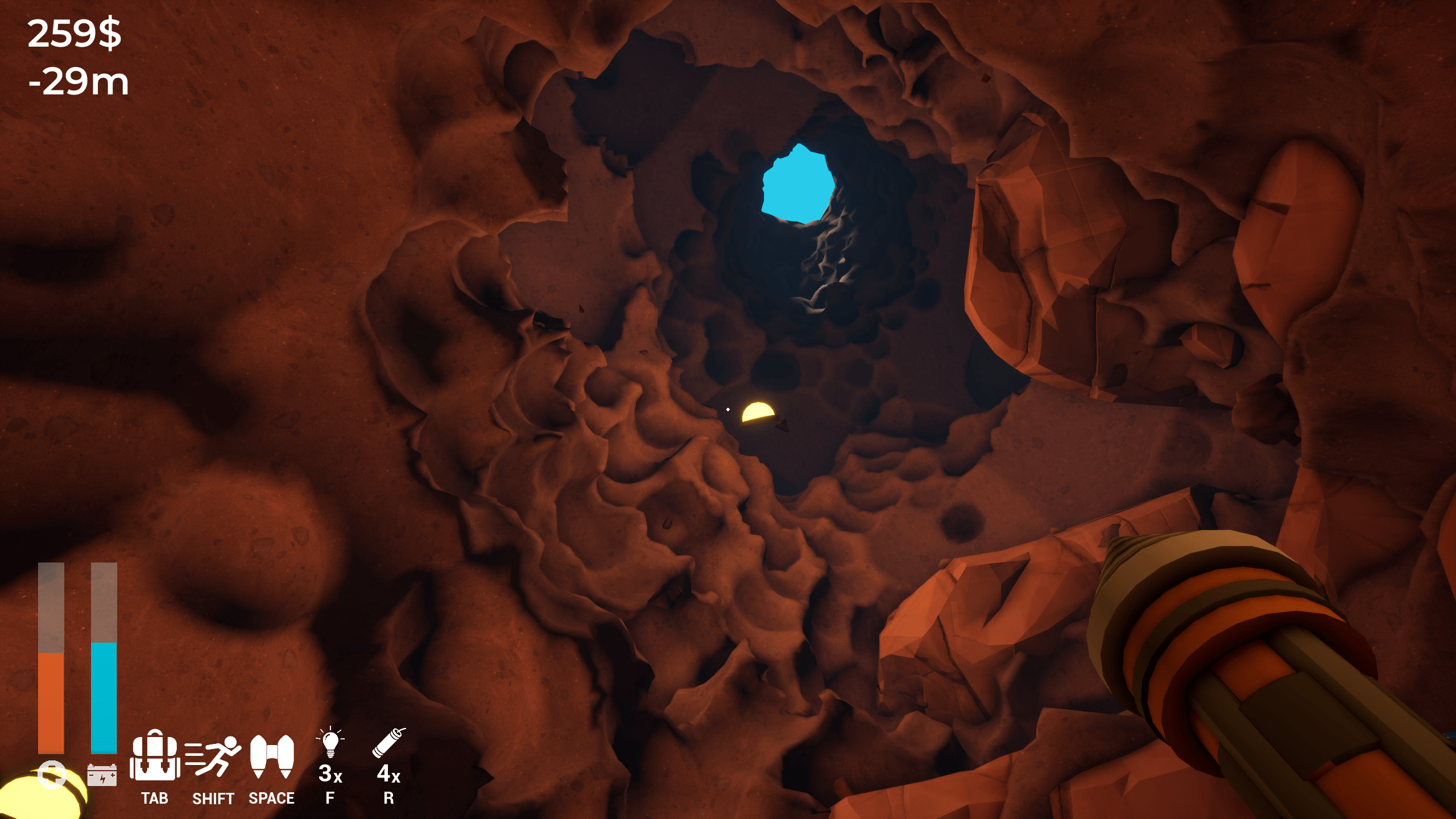
But it's easy to get carried away.
“But it’s easy to get carried away.”

One interesting thing about A Game About Digging A Hole is its achievement system. I didn’t get a single achievement until I beat the game. Indeed, I don’t believe you can get many of them without at least a second playthrough, at which point you’ll discover that not only have you probably already met the requirements to earn some more of them, but you can even track them via an in-game display in your garage. The game hooked me enough that I almost immediately started going into a second playthrough to get some of the achievements I missed without much of a second thought, but then I remembered that I don’t actually care that much about Steam achievements and snapped the hell out of it.

If this sounds at all like something you’d be into, then I’d recommend it. It’s 5 bucks and a few hours well spent.

Helldiving For Fun and Profit

Over the ridiculous number of years since I first started this blog I’ve developed the unfortunate habit of writing very terse impressions, if any at all, of the online games I play. This is especially regrettable given how much time I often sink into them. That’s part of the problem though – when you’re playing an MMO, a live service game, or just an online game you’re particularly hooked on, when is the right time to jump off the treadmill and write something up about it? In the early days of this blog the intent was actually to write about my online sessions themselves rather than focusing on final thoughts about a game, but with so many things competing for my free time combined with the effort it often takes to try to write something up, that quickly fell by the wayside. As such, other than briefly mentioning that it was in fact my 2024 game of the year, I somehow still haven’t talked about Helldivers 2 yet…

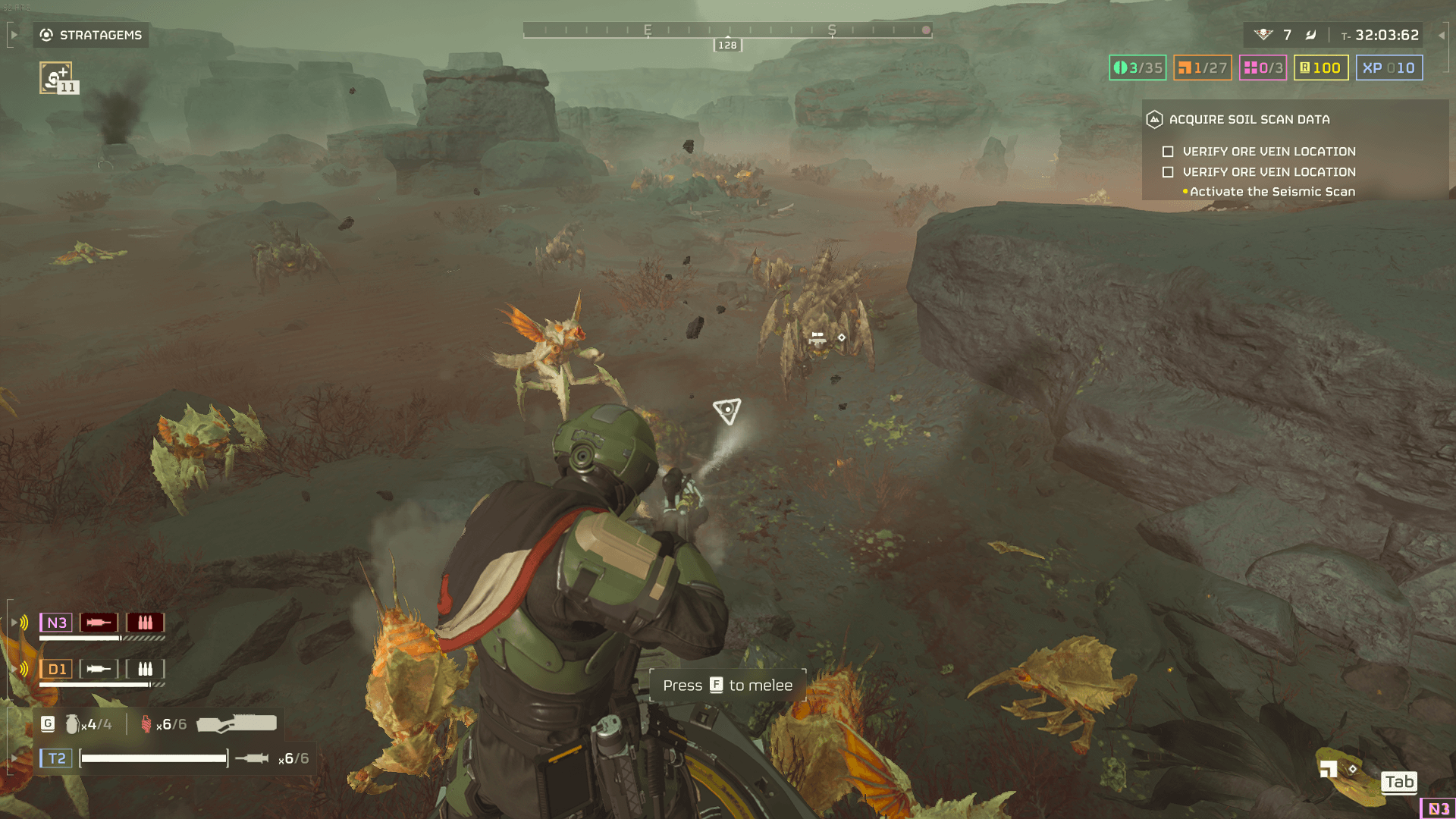
Getting rushed by bugs immediately upon respawn. Yikes!
“Getting rushed by bugs immediately upon respawn. Yikes!”

I first heard about the original Helldivers and how much chaotic fun it could be around the time it launched back in 2015. I was definitely intrigued, but I never actually got around to trying it out. Fast forward to 2024, and owing largely to not really being in the PlayStation ecosystem at the time, the sequel was barely on my radar. I’d read the random skeptical comment about whether Arrowhead had the chops for such an ambitious sequel, but that was about it. Shortly after it launched, however, I stumbled upon a video or two that made the game look utterly amazing and it didn’t take much more before my interest was absolutely piqued. The one problem I had was that this game is, like its predecessor, very co-op focused, and I’ve made the mistake of buying into co-op heavy games without a dedicated friend group to play with more than once in the past, and felt like that was a lesson… eh, mostly learned. Not wanting to admit defeat, I threw some feelers out to a few different friend groups, but as I’d predicted, no one bit. Then, quite randomly, one of my co-workers (who I’d actually never gamed with before) told me he’d just bought it and was loving it so far, and asked if any of us might be interested in playing it with him sometime. I picked it up that very evening.

Let me take a step back and give a quick overview of the game for the uninitiated. Helldivers 2 is a sci-fi online cooperative PvE third person shooter with persistent character progression, and is not unlike something like Vermintide and Darktide or Deep Rock Galactic, a genre which itself seems to have had its roots in the awesome Left 4 Dead series. Thematically, it barrows heavily from the 1997 Starship Troopers movie, but more on that later. The basic premise is that you and your squad are super expendable soldiers dispatched onto alien worlds to perform a variety of nearly suicidal missions on a large, open map, before waiting to be extracted in what can often be a tense final stand. The action is visceral, with huge hordes of enemies, massive explosions, and purposely higher than normal odds of killing yourself and/or your own squadmates in what are often hilarious moments of insane chaos. Yeah, I think that’s pretty much it in a nutshell!

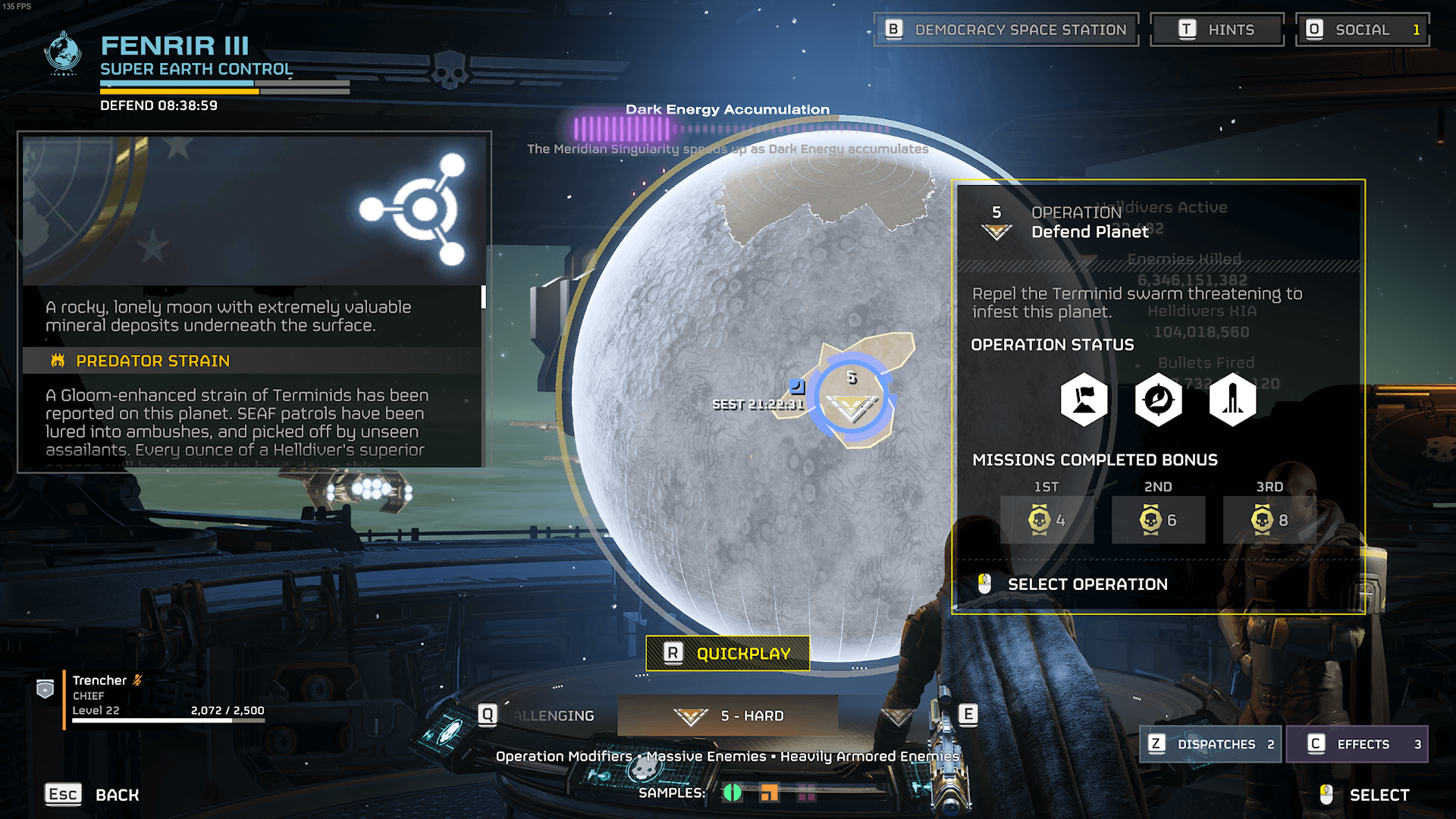
Picking my next mission aboard my destroyer.
“Picking my next mission aboard my destroyer.”

As soon as you launch the game you’re met with an intro movie that pitch-perfectly sets the tone, casting the player as a volunteer for Super Earth’s elite “peacekeeping force”, the Helldivers, whose job it is to spread “managed democracy.” The on-the-nose darkly humorous satire poking fun at western patriotism is, again, more than a little reminiscent of Verhoeven’s Starship Troopers. You’re then thrown into a tutorial where you learn the basic controls and the humorous worldbuilding doesn’t let up. You’re next tasked with christening your destroyer (the ship that serves as each Helldiver’s personal between mission hub) by combining some pre-selected words to come up with your own ridiculous but lore appropriate name (mine is “SES Distributor of Truth”.) By the time you’re on your destroyer and ready to go on your first real mission, you’re already totally indoctrinated in the lore, or at least in the spirit of it. This is a great thing for a co-op game as, like Deep Rock Galactic’s legions of drunkard “Rock and Stone!” shouting space dwarves, most of the player base is aligned with a sense of casual roleplay that adds to the fun and a real sense of community. It’s so effective that Arrowhead probably doesn’t even need to employ the guy who, acting as something of a Dungeon/Game Master, handcrafts elements of the overarching campaign… but please keep him!

After spending a little while exploring my destroyer and the various options in the UI, I was already very impressed with the presentation. Everything felt well-polished and slick, even if I didn’t know exactly what a lot of what I was seeing actually was.

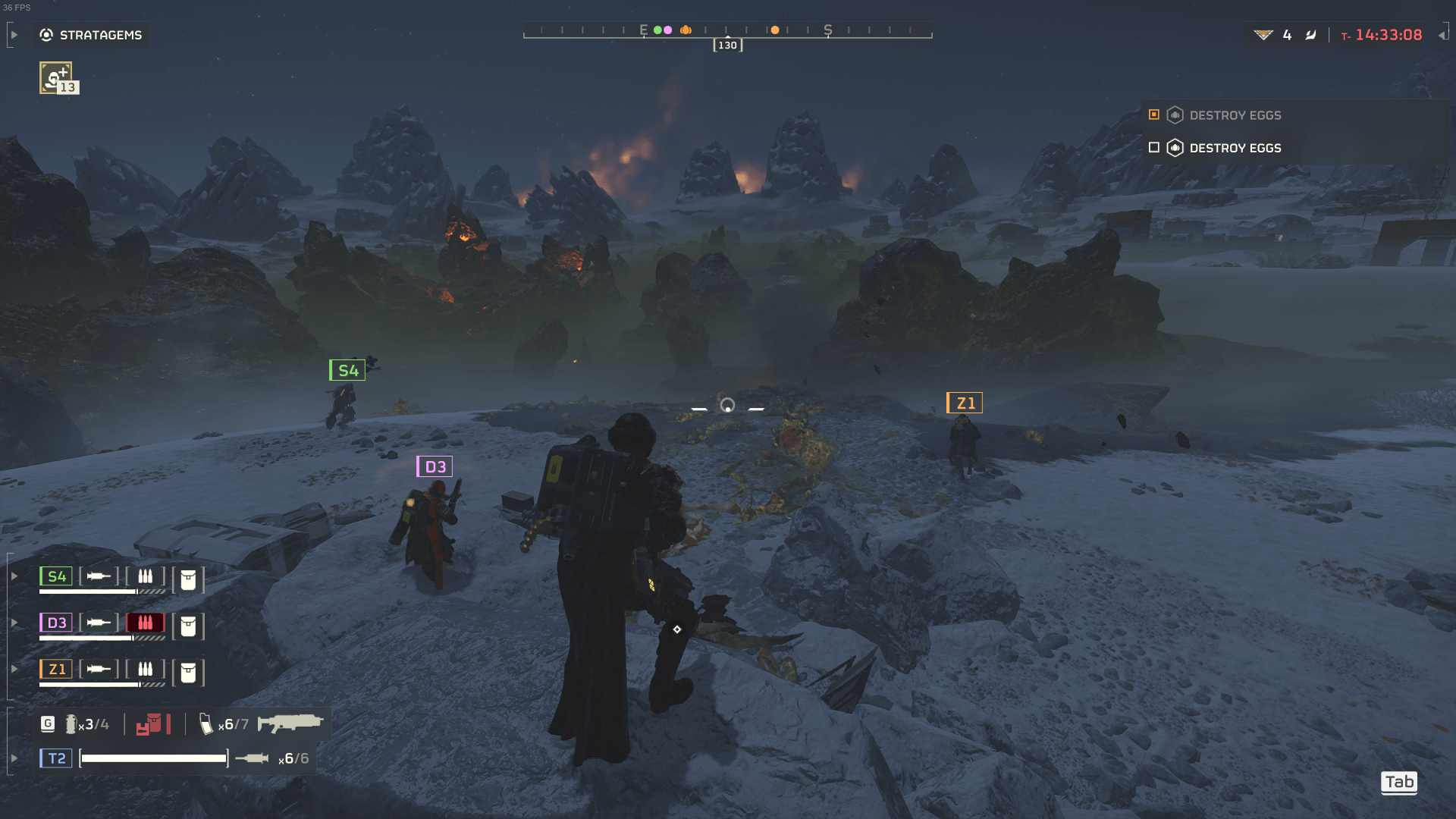
The squad assessing a Terminid nest from afar.
“The squad assessing a Terminid nest from afar. Real far.”

With my work friend not yet online, I decided to hop into a “quickplay” game with randos. My random squad of hapless FNGs landed in a tight ravine under the cover of a fairly dark night and almost immediately began getting swarmed by Terminids, one of Helldivers 2’s enemy factions who are extremely reminiscent of the “bugs” from, once again, the Starship Troopers movie. I had no real clue what I was doing, so I just quietly followed everyone else’s lead, and it was pure fucking chaos. Assault rifle fire lighting up the area, gore and body parts flying, grenades exploding, people dying. Holy shit! At some point I picked up a large machine gun support weapon dropped by one of my comrades who had traded it for something else they found and quickly started to have a lot of fun by hanging back and playing fire support, diving into prone and laying down a hail of bullets with each encounter. After that mission, I figured out how to customize my loadout so I could start bringing my own machine gun with me, and the rest of my afternoon practically disappeared. Now absolutely jonesing for more, I jumped on again for another session that evening, and this time hooked up with my friend. Playing with voice comms and something more closely resembling teamwork only served to add another layer of fun to the game, even if we did have to either play as a duo or rely on randoms to fill out our squad’s third and fourth slots. I was absolutely hooked.

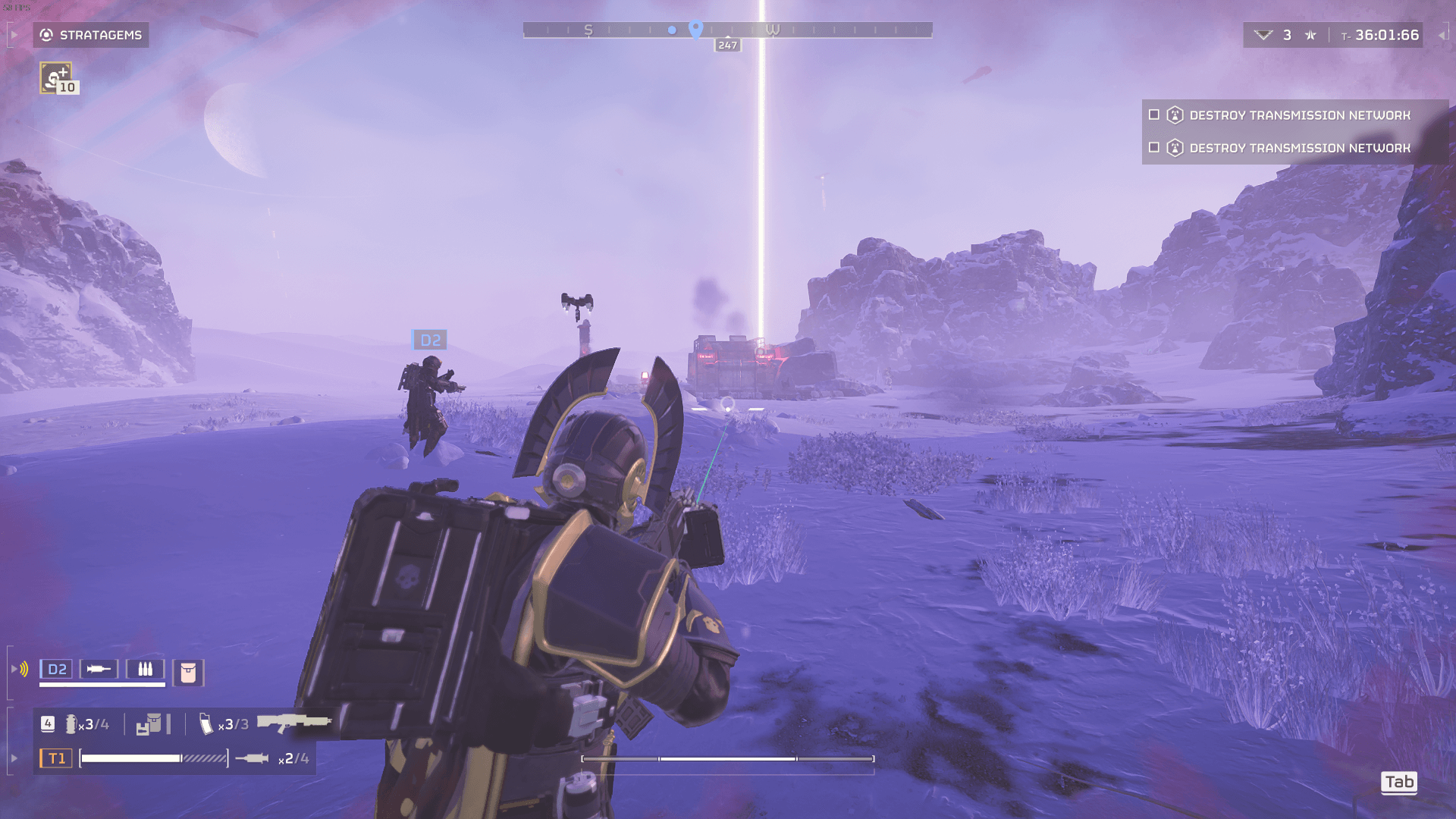
So back to the mechanics, the basic structure of a mission looks something like this: On your destroyer, you head to the mission table and pick a sector, a planet within that sector, and a mission or set of missions on that planet. There’s a number of procedurally generated planets with different biomes, minor hazards, and weather conditions. Mission types depend on the difficulty you select and the enemy you’re facing, which include the aforementioned bug-like Terminids, the Terminator-like robotic Automatons, and the newly introduced very sci-fi, zombie-creating Illuminate. There’s a fair variety of mission objectives, such as destroying enemy facilities, killing specific high value enemy-types, retrieving and/or activating something, but they all ultimately play out relatively similarly. As an aside, I’ve always found it amusing just how so many of these missions, especially the secondary objectives, feel like extremely simple grunt work that SEAF (Super Earth Armed Forces) probably simply needed “a pair of hands” and “boots on the ground” to perform. “Sure, send us on a literal suicide mission simply to go turn a few leavers and press a few buttons to get an otherwise automated mineral extraction site going again? Why not?!” I guess that’s just SOP for the Helldivers, though.

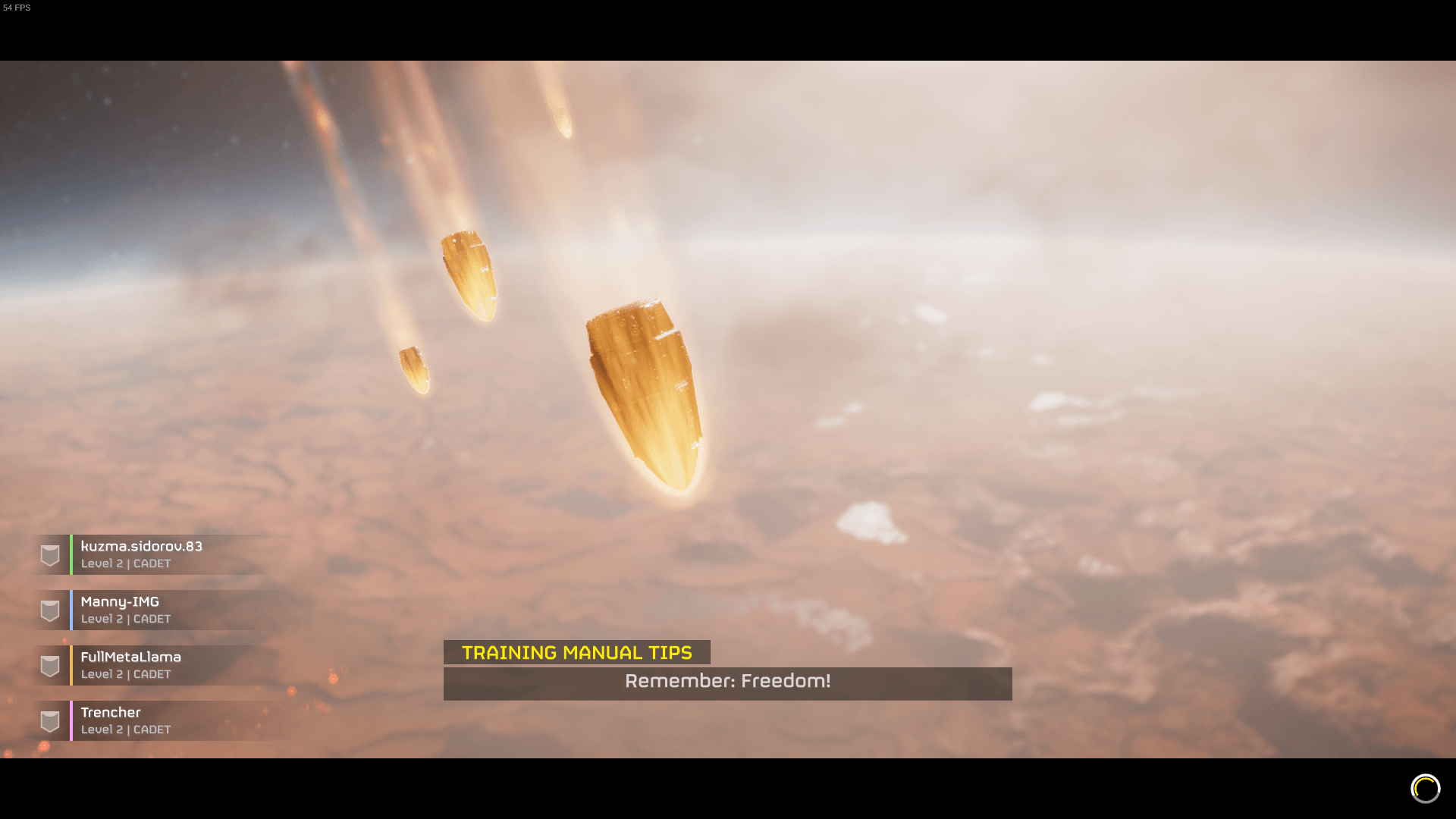
Hellpods shooting down to a planet's surface.
“Hellpods shooting down to a planet’s surface.”

Anyway, you jump into your “Hellpod” and select your loadout of stratagems and a booster, and once the whole team is ready, your Hellpods launch like artillery shells out of a massive cannon onto the planet’s surface. From there, your team has to plot your course from wherever you picked to land to each of your objectives. Typically there’s a fairly easy pattern you can employ, such as a simple clockwise or anti-clockwise loop from one objective to the next, and finally to the exfiltration point. Along the way, you’ll come across secondary objectives, enemy outposts, and points of interest which can sometimes include supplies, support weapons, samples, medals, and even super credits. More on all those later. Of course, those points of interest are often teaming with enemies, and you’ll also have to contend with patrols and even enemies calling in more enemies, leading to sometimes needing to fend off multiple waves of them. Once your main objectives are complete, or if you run out of time, you make your way to the exfiltration point and call down the shuttle, which takes an uneasy 90 seconds or so as your enemies make one last assault, again, usually consisting of several intense waves.

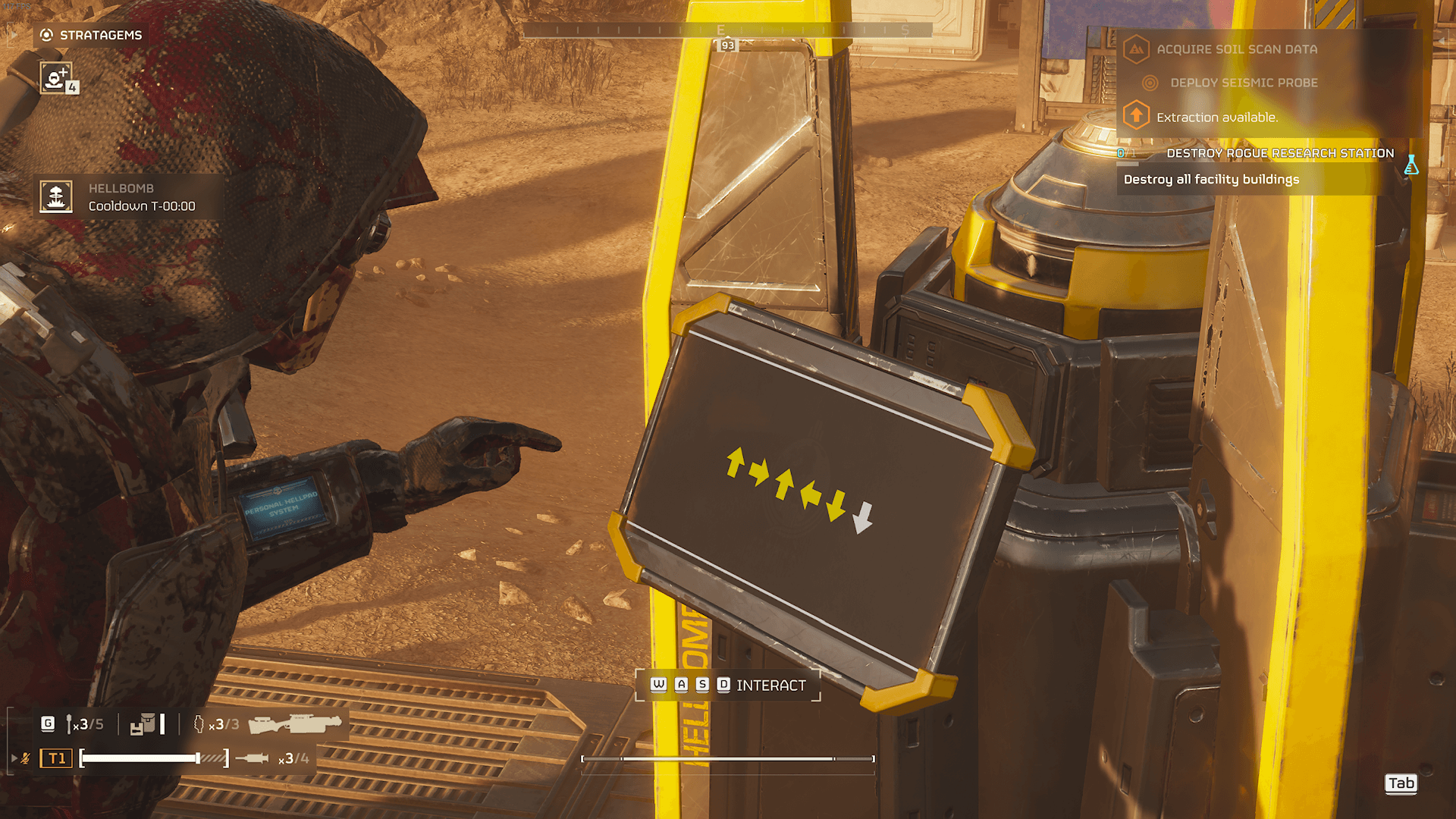
Of course, that’s all incredibly reductive. I didn’t mention how you need to call down special support weapons and equipment (including vehicles) based on the “stratagems” you picked at the beginning of the mission by throwing a beacon down at where you want them to land, or how stratagems have a time between re-use and with all of the Eagle-1 assault ship based stratagems, a number of re-uses between when the Eagle has to return to your destroyer for a lengthier re-arm. I didn’t mention how every stratagem and pretty much every other in-game interactive object requires a QTE-like pattern of quick key/button presses which have to be executed properly. These aren’t difficult, but executing under extreme stress, which is often the case, can lead to a minor fumble with major consequences. I didn’t mention how dying works – that is, if you die, your team mates have to use a reinforcement stratagem they throw down to call you back in, and you have a limited reinforcement budget. You also have the ability to similarly request a resupply so that you and your team can restock on ammunition, grenades, and the all-important healing stims.

Time for a little Dance Dance Revolution!
“Time for a little Dance Dance Revolution!”

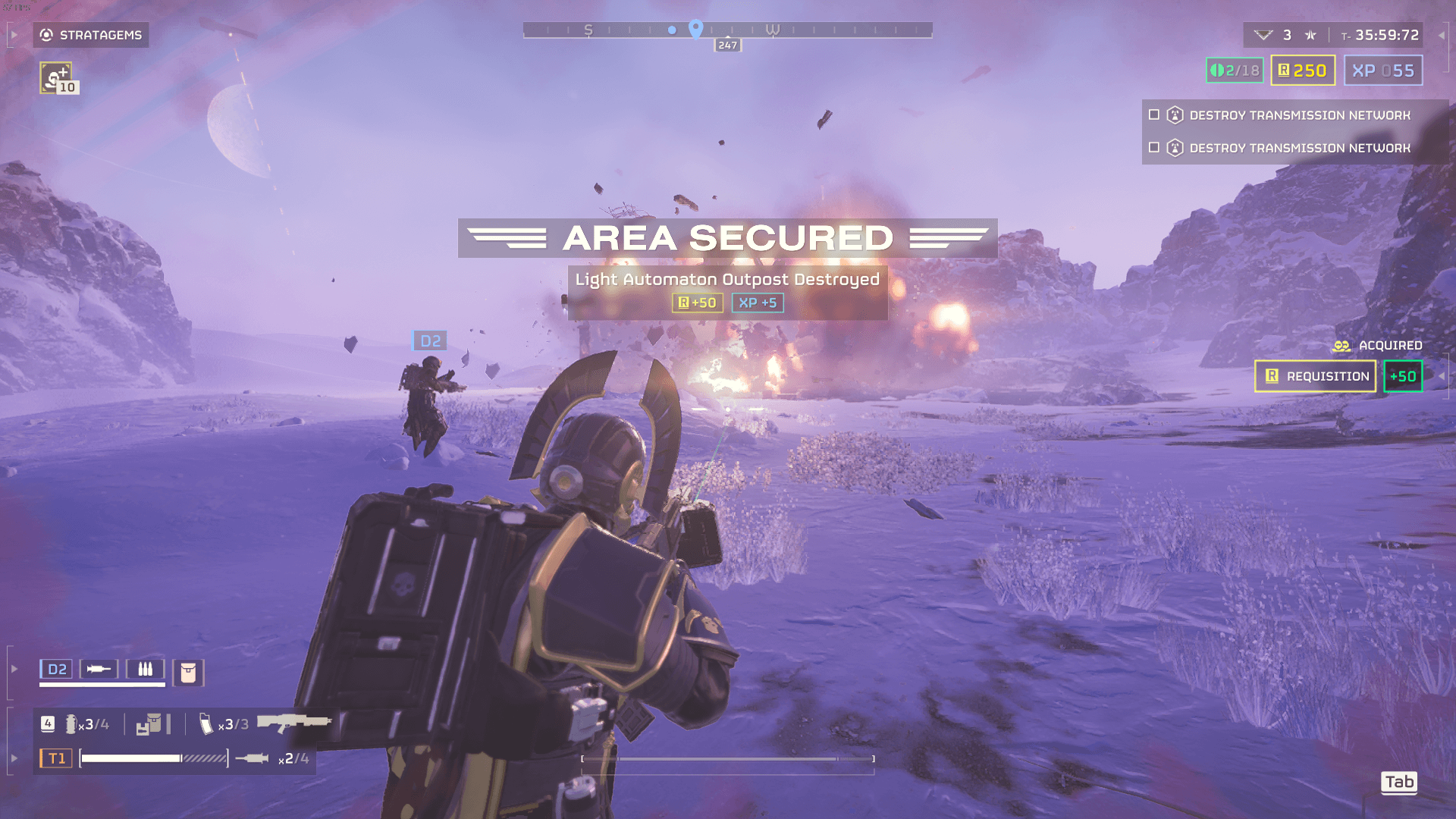
And I didn’t really mention the stratagems themselves. In addition to being able to request a larger support weapon, there are things like defensive drones, shields, and distributable supply packs, and more stationary defenses like sentry drones of various types, minefields, and manable turrets. More importantly, you have one of the standout features of the game in the form of often impressively devastating strikes coming from both orbital attacks launched from your destroyer and airstrikes delivered by the aforementioned Eagle-1. There’s a large variety of these, from attacks meant to devastate a wide area of light targets, such as the Eagle Napalm Airtrike, to those made to hit a single heavily armored target with pin-point accuracy, like the Orbital Railcannon Strike. The moments when a huge strike hits exemplify Helldiver 2’s immersive, often very cinematic graphics, filled with impressive looking explosions, destructible buildings and terrain, and intense particle and lighting effects. Of course, they can also exemplify the game’s reputation for intentionally embracing hilarious accidental “friendly fire” team killing incidents as well. There have been a small handful of other games, such as Mercenaries 2: World in Flames, which had similar air strike mechanics, and it has never not been fun mechanic to me.

In the end, this all comes together to feel like a weird blend of something like a cooperative, PvE version of a Battlefield game (though Planetside 2 might be a closer comparison.) That is to say, a lightly tactical shooter mixed with an array of interesting tools and a huge open-world battlefields which both give players a lot of freedom with when and how to complete objectives and engage in combat, and leads to some amazing emergent moments.

The glorious aftermath of an perfectly executed orbital strike.

The glorious aftermath of an perfectly executed orbital strike.
“The glorious aftermath of an perfectly executed orbital strike.”

Back on your destroyer, you’re shown your mission statistics, the experience points and other rewards you got from the mission, and a rating. Rewards come in several forms. Of course, you gain experience points to level up your Helldiver, though leveling up really only affects some gating around certain stratagems and not much else. There are also Requisition Slips, which are the main currency you’ll be using to purchase new stratagems and ship upgrades, and are awarded fairly generously alongside XP. The ship upgrades also require a much rarer currency, samples. Samples are picked up around the map in missions and have to be carried to the end of the mission and successfully extracted with to earn, which is harder than it sound since they’re also dropped upon death… and if you haven’t figure this out by now, you will die. Probably a lot. These can take a lot more work to grind out, especially given that there are three types which correspond to different difficulty levels, and the two associated with more difficult missions won’t be available at all until you progress up the ladder. Still, ship upgrades are valuable, but they’re also more of a long term progression system. Finally we have War Medals and Super Credits. War Medals are the currency used to purchase items in “War Bonds” which are Helldivers 2’s battle passes. Super Credits are the game’s actual cash equivalent currency, used to purchase items in the “Super Store” as well as the War Bonds themselves.

Helldivers 2 takes a similar approach to Halo Infinite when it comes to battle passes and its purchases. War Bonds contain a number of cosmetic items, such as armor, helmets, banners, capes, and emotes, as well as the occasional new piece of equipment (including weapons) and even sometimes access to special stratagems. Essentially, everything you can progress in the game except for ship upgrades and your character’s level can be found in War Bonds. War Bonds are not time limited, so once you own one you can spend your Medals in whichever ones you want whenever you want, which is handy since you may very well find yourself trying to prioritize going after a few particular items in multiple War Bonds first. The Super Store works like Halo Infinite’s originally did, which is to say it’s unfortunately entirely based around FOMO. You’re presented with a small number of items, mostly just cosmetics, every couple of days. I’m not a huge fan of that system, but there aren’t that many items in rotation, and I’m not nearly as obsessed with cosmetics in this game as I was with Infinite either, thankfully. The inclusion of new weapons and other legitimately game changing items in the War Bonds and the store is a little controversial, as despite being an entirely cooperative game, there are naturally still “flavors of the month” and/or “meta” builds which often include them, but again, this is an entirely PvE game, so it’s not exactly “pay-to-win” in a way anything close to a more competitive game could be.

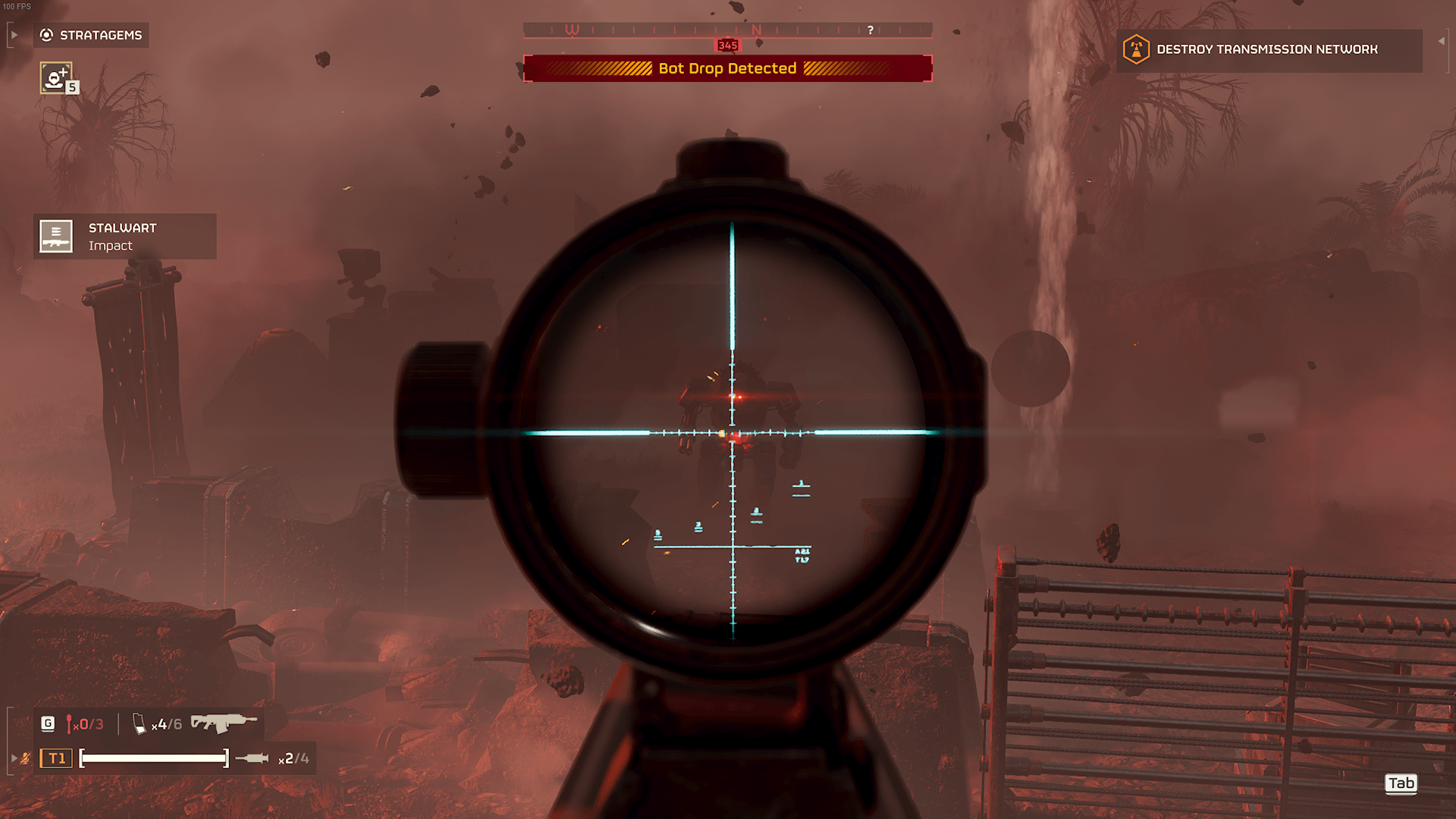
You can optionally aim down sight/scope for extra precision
“You can optionally aim down sight/scope for extra precision.”

Beyond that, your ship lets you customize your character with those aforementioned armor sets, helmets, capes, banners, emotes, and most importantly, your primary and secondary weapons and grenades. These are just parts of your standard loadout, and not linked to the whole picking stratagems thing you do just before each drop, though perhaps just as important. There’s a good variety of weapon types, from assault rifles, shotguns, and DMR primary weapons, to pistols, grenade launchers, and even melee secondary weapons for those who like to experiment with different playstyles (or more likely, amusing “meme builds.”) Oh, and I should also mention that your armor comes in three different varieties, ranging from light to heavy, which trade off speed, mobility, and stamina for protection. Armor sets also includes a passive ability which usually grants the wearer a couple of bonuses, such as increased grenade capacity or reduced fire damage, for example. The basic armor in this game has a pretty cool, unique look to it, though designs for newer armors, as well as the designs of enemies and vehicles borrow liberally from all of the place. Of course, we have obvious Starship Troopers influence, but there’s also a little Halo, Planetside, Earth Defense Force, and perhaps even some Warhammer 40,000 in there as well. It’s not too blatant, and it mostly all gels into something fairly cohesive, and importantly there are no ultra ridiculous immersion-breaking cosmetics either, thankfully.

Progression can move pretty slow if you’re not pouring absolutely tons of time into mission after mission with a full squad. To get more, faster, you’ll want to progress to higher and higher difficulties. These grant more experience points (via a multiplier) and medals, plus access to those higher tiers of samples. The tradeoff, however, is that the mission types change and new enemies appear, including some massive, very difficult to kill ones. The most notable element here is the armor values at play, which ranges between unarmored, light to heavy armored, and tank, with several steps to many of these. To kill enemies with higher armor values you’ll need weapons that can penetrate or otherwise damage these types of armor. This means that as you progress, you’ll also want to develop your loadouts accordingly. For instance, playing solo I could easily wipe the floor on Medium difficulty, but recently moving up to Challenging and Hard and beyond, I ended up replacing my primary weapon with one that could do medium penetration, a secondary that could do anti-tank damage (for emergencies) and stratagems – a support weapon, an airstrike, and a sentry turret – that could all do heavy to anti-tank levels of damage.

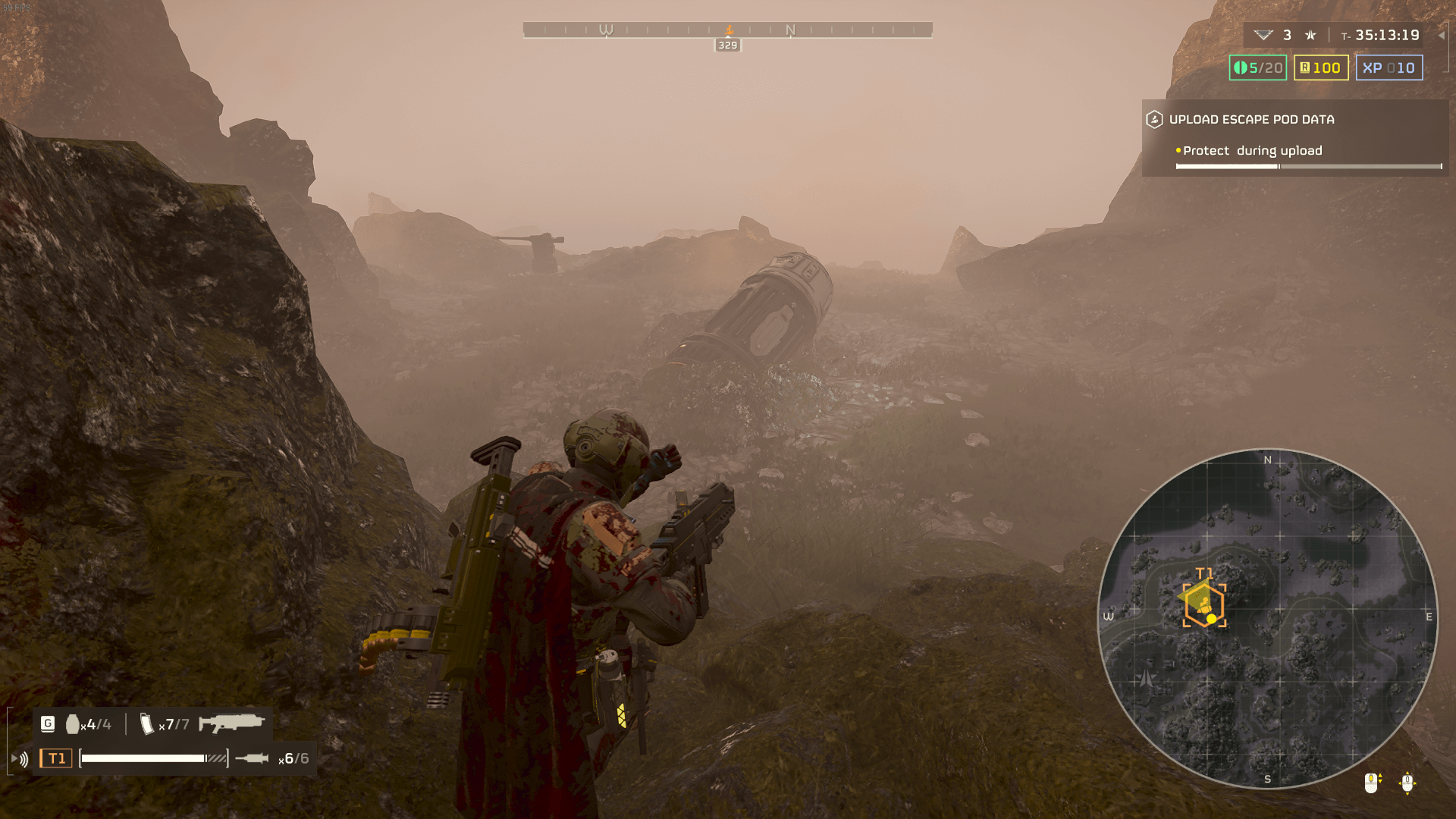
Solo. Checking my mini-map for blips - things were suspiciously quiet.
“Solo. Checking my mini-map for blips – things were suspiciously quiet.”

Speaking of soloing, not only did I regularly play with my work buddy, but one of my old [TPG] chums Zabka (AKA JoeyPants) randomly started joining us too, and soon we had a fairly regular trio with the fourth often being filled by a friend of one or the other, or a rando. It was honestly a blast playing with a dedicated crew again, which was the icing on top of why this was my 2024 game of the year. Unfortunately, my work friend and I eventually stopped finding ourselves in-game at the same time, so we stopped playing together as much, and then Zabka just seemingly dropped off the face of the earth, and next thing I knew I found myself either having to play with squads of randoms again or going it alone. Playing solo in Helldivers 2 isn’t nearly as depressingly unsatisfying as it can be in many of these sorts of co-op focused games, but it’s also quite a bit more challenging given that less people means less stratagems, less eyes on the horizon, less shots coming from less angles, etc. It’s definitely doable, even up to the highest difficulty levels for highly skilled players, but it’s nowhere near as fun to me. As mentioned, I recently found myself hopping on and trying to improve my solo game, which meant quite a few tweaks to my loadout and tactics, but it’s been rewarding to see myself progress this way. This won’t really sustain me though, so sadly, unless any of my friends suddenly develop an interest in Helldivers 2, I’m likely more or less done with the game.

Regardless of whether I keep trudging away at solo dives, start playing with randoms again, find a new squad, or just hang up my cape entirely, I’ve absolutely loved my time with Helldivers 2 so far. If what I’ve described sounds at all enjoyable to you, especially if you have a few friends to play with, I’d highly recommend checking it out.