Surviving Survival Tres

As mentioned in Surviving Survival Part 2, the next thing on my weekly gaming group’s hit-list was Icarus. Icarus is a game I was entirely oblivious to until one of the group recommended we check it out next, as he’d previously played it a bit and enjoyed it. Released in 2021 by Dean Hall of DayZ fame and his studio RocketWerkz, I’m kind of surprised I hadn’t at least heard of it. Looking for more info, I stumbled across a random entertaining video showing a group of friends and their hijinks in the game. It looked interesting, if not perhaps just a little hardcore for our group, as the game is close to a pure “tree-puncher” style open world survival crafting game, and our enjoyment of it was very likely to hinge on how well that difficulty was tuned.
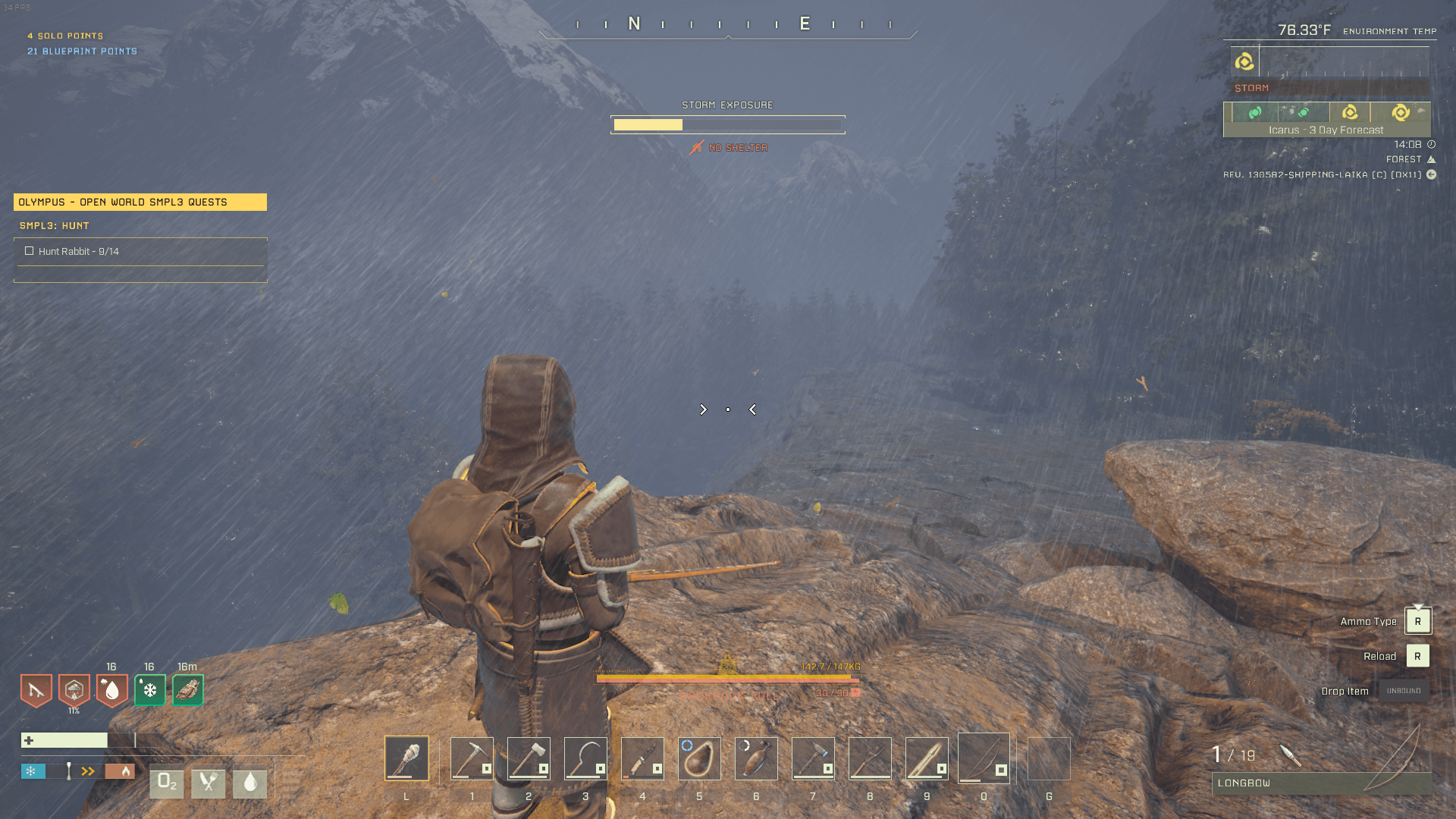
Hunting on a rainy day on Icarus.
“Hunting on a rainy day on Icarus.”

The premise is simple enough. An attempt to terraform a planet (the titular “Icarus”) goes wrong due to the presence of undetected exotic matter, and while the result is not habitable to humans, life evidently found a way. You and your team of disposable prospectors head down to the planet’s surface to collect various samples, run tests, and of course, gather some of these valuable “exotics”, all of which will also require you to become self-sufficient enough to survive the harsh climate for the duration. While the latter aspect is pretty cookie cutter, the former is represented by a series of missions that you can choose on-demand. There are a number of these, many of which are of the “go to this place and do this thing” variety. Usually gather or scan special items, resources or kill/destroy a creature or structure, for example. Completing these will reward you with some of the game’s in-game currencies, which then allow you to purchase supplies that can either be sent down to you, or work as upgrades to your starting gear for future expeditions, rogue-lite style. Those systems are actually pretty neat, and I did appreciate having a bit more structure rather than the experience being totally unguided, though I feel like they could definitely be expanded on quite a bit more. It’s also amusing to think that the United Development Agency sends you down with such meager supplies that your survival journey starts out with you living like a literal caveman, yet are quite capable of offering you a leg up in exchange for some valuable materials. Too realistic!

As mentioned, the teching up (which is done via talent points, earned from performing numerous in-game actions) starts out with you building tools, weapons, and structures out of bone, wood, and stone, but jumps to more and more modern material and equipment as you move between its 4 tiers. Since you’re completely alone on a primitive planet, you pretty much have to craft everything too. It’s fine, and there are even some really neat touches here and there, but man, does it get repetitive damn quickly. But honestly, so does everything else. While the world itself is handcrafted, there is very little of interest here. Yes, it’s fun exploring, finding new caves to clear out, wildlife to hunt or tame, and resources to gather, and some of the missions are quite fun too, but it wears out its welcome fast and begins to feel like a bit of a grind. The relatively nice graphics, which I think look really good at times, can’t really save that from eventually being an issue. I’m not trying to pick on Icarus here, as I think that is a challenge the genre as a whole struggles with, and that balance doesn’t seem like an easy one to strike.
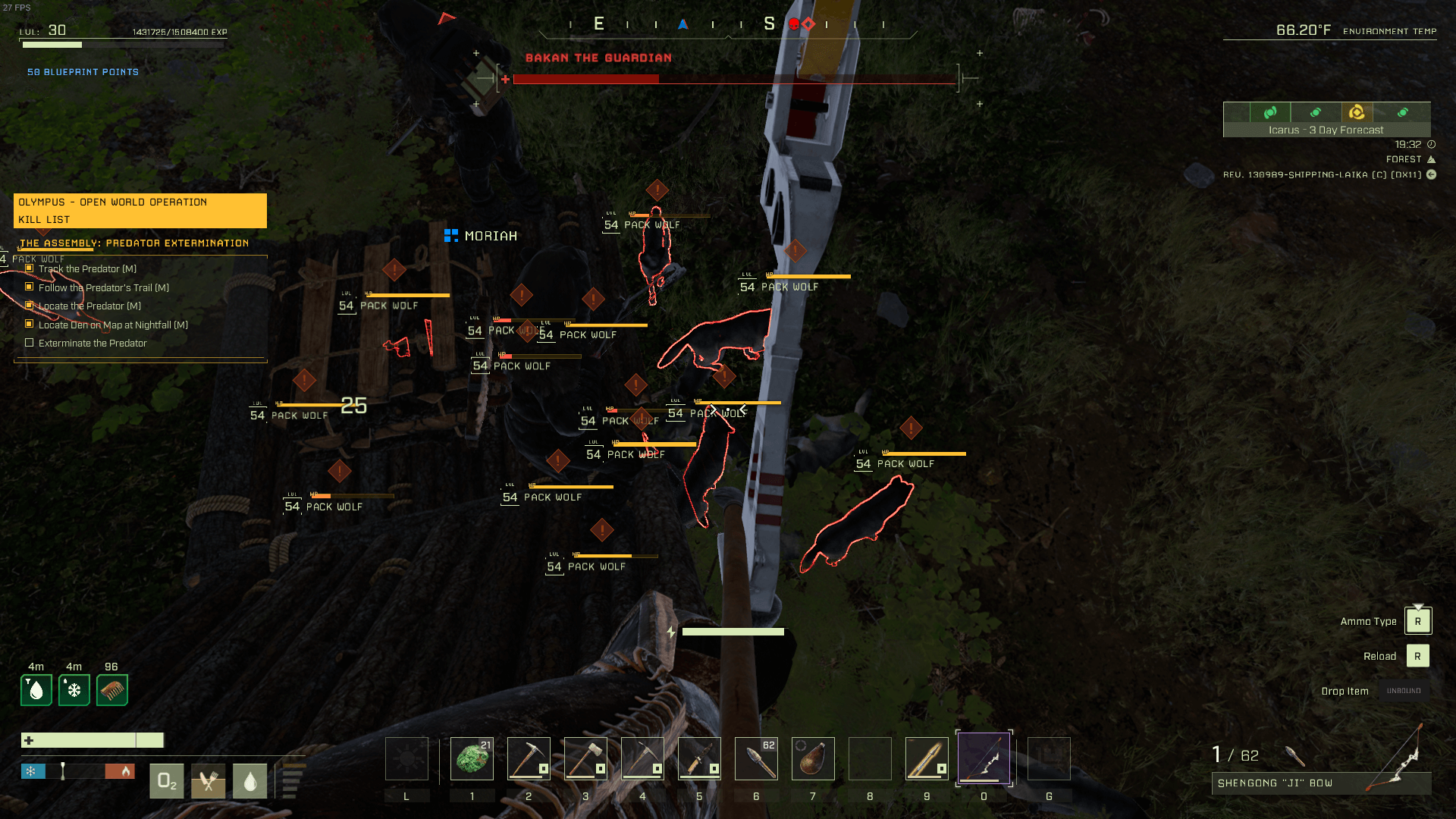
Trapped in a tree-stand by a pack of wolves. Fun!
“Trapped in a tree-stand by a pack of wolves. Fun!”

This, not any perception of difficulty, was the reason why, after 40-some hours, we decided to move on to something new. That said, I really do think if you’re someone who likes a reasonably “pure” survival crafting experience, Icarus should be on your short list of games to check out – you may absolutely love it. It’s a solid game with some unique features, and hey, it’s still getting regular updates with new features and other additions to this day. I could even see enjoying a long solo play-through, if you really like the genre. As for us, it’s definitely possible we’ll come back in the future, though maybe prospecting on a brand new world (which are sold separately as the game’s main DLC strategy.)

I’ll close out Icarus with a little anecdote, a hilarious emergent moment that was so awesome I found myself telling friends at work about it the following day, and was probably a big part of why I was happy to stick it out for so many more hours:
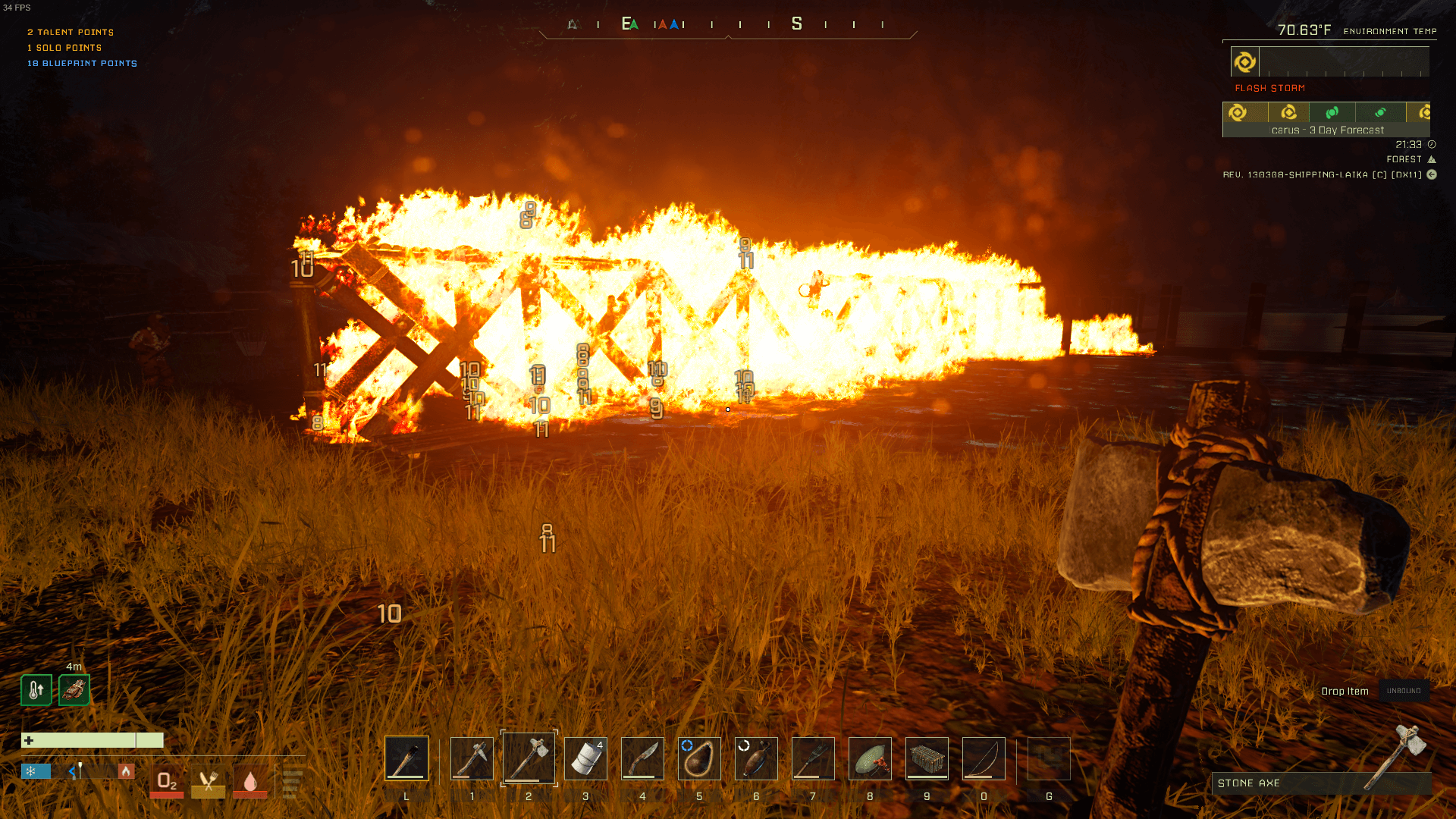
The last moments of our beloved fishing pier...
“The last moments of our beloved fishing pier…”

As part of our very first session, we built our little settlement on the banks of a small lake close to where we initially landed. If you’ve played Icarus, you probably know the one. As the member of our crew who had played before knew he’d want to spend a good chunk of his time fishing, he decided to build a fishing pier to make this a bit easier. At first this started off as a tiny dock, but eventually expanded into a massive pier that reached the middle of the lake, complete with railings and a covered roof, and later an extension to another part of the lake so it could serve as more of a bridge. It was wholly unnecessary, but these kinds of distracting projects can be a key part of the fun of the genre in my opinion. One thing I didn’t mention about Icarus is its dynamic weather system, which can require you to seek shelter from various dangers, depending on the biome you’re in. Right at the end of our session, after our rather impressive pier was totally up and operational, a severe lightning storm rolled in right on top of us. The sustained barrage of lightning strikes ended up catching our pier on fire, and several of us braved the conditions to run out and try to save it, or at the very least, keep the fire from possibly spreading to the rest of our camp. Given that our tech was still effectively tier 1, the best we could do was run into the chaos and try to beat the fire back with primitive “fire whacker” tools. As ineffective as this sounds, it worked okay at first, and we were able to keep the fire from spreading inland, but as it spread, we found ourselves in danger of being cut off and had to retreat. Unfortunately I was stuck in the middle of the pier, surrounded by raging flames, and soon discovered that the railings we’d added for decorative purposes had turned into my prison bars, keeping me from being able to jump off into the safety of the water. In an intense panic, the idea of simply deconstructing them didn’t occur to me, and I finally destroyed one of the floor panels and just barely managed dive into the lake and make it back to shore.

Our session ended with us all standing there watching helplessly as the fire engulfed the entire structure, eventually leaving nothing standing except for some of the timber piles that were below the water line. In terms of our progress, it was a bit of a gut punch, sure, but in the moment? One of the most incredible introductions to a game I can remember experiencing!
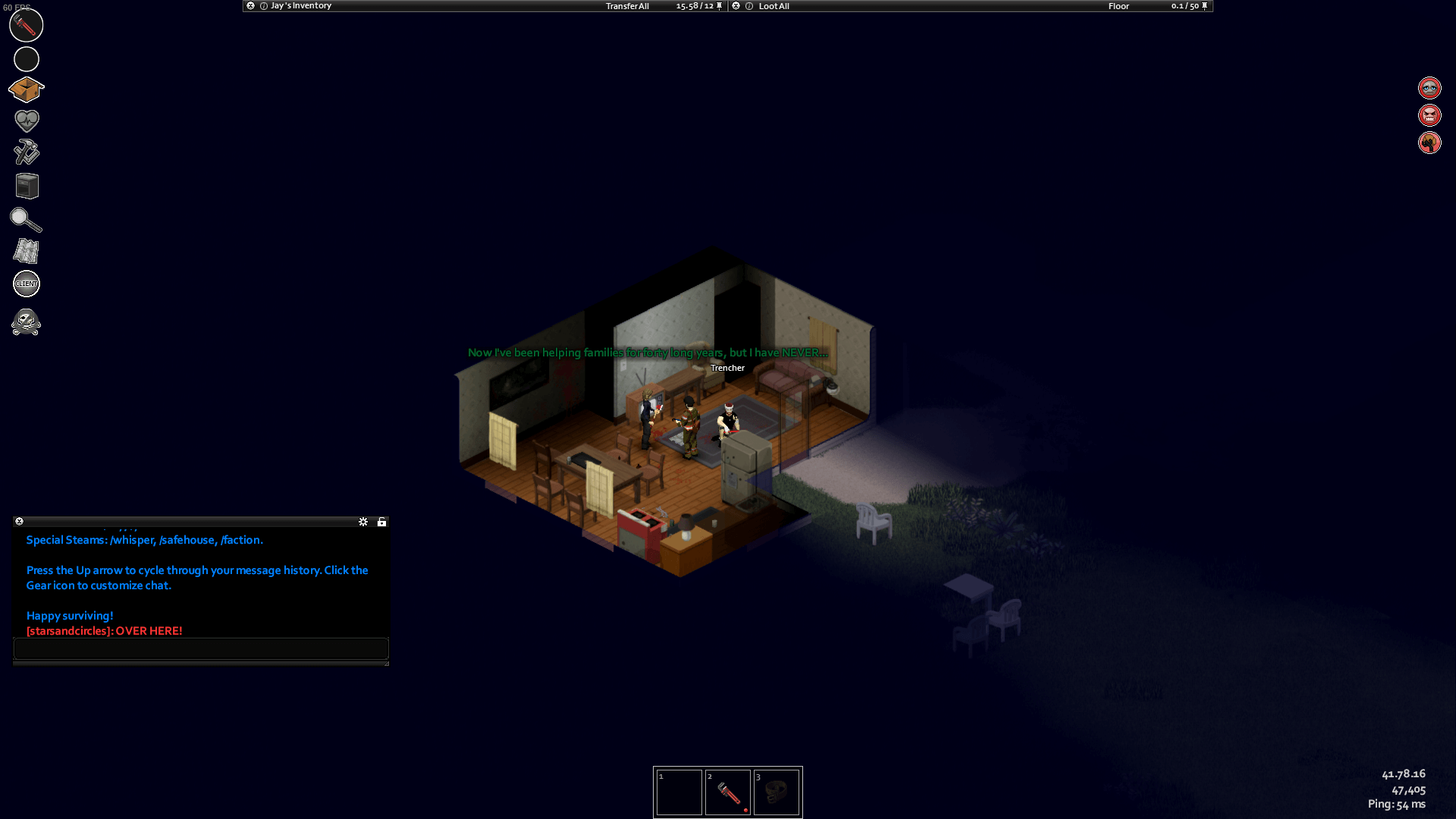
Taking a breather in an abandoned house.
“Taking a breather in an abandoned house.”

Project Zomboid has been brought up frequently in our little gaming group, as it’s one of one member’s all time favorite games. He finally somehow talked everyone into giving it a whirl, so we jumped into a new server he spun up, complete with an impressively massive array of mods to expand numerous systems and add a multitude of new items. If he hadn’t spent so much time curating and optimizing the mod list, I don’t think there would have been any chance we’d have jumped into the deep end like that, but alas, he made it pretty easy for us. It’s a good thing too, as learning the game itself was a big enough drain on our collective energies.

Let me rewind for a moment and talk more about what Project Zomboid actually is. It’s a (stop me if you’ve heard this one before) open world survival game, but as it’s set during a zombie apocalypse, it focuses a lot more on scavenging than progressing your way up through a more traditional gathering, crafting, and base building system. That’s not to say it doesn’t have a ridiculously deep crafting system – it does – but it’s a notable difference after just describing Icarus. It also has a pretty in-depth skill system, including a favorite feature of allowing you to take negative traits to get more points to allocate during character creation, which was greatly expanded by some of the aforementioned mods. On top of all of that, there is a surprising amount of simulation in the game – weird little systems that, while mostly unnecessary, go a long way to add detail to the world which, to me personally, make time spent in the inhospitable world of Project Zomboid so much more immersive. Very cool!
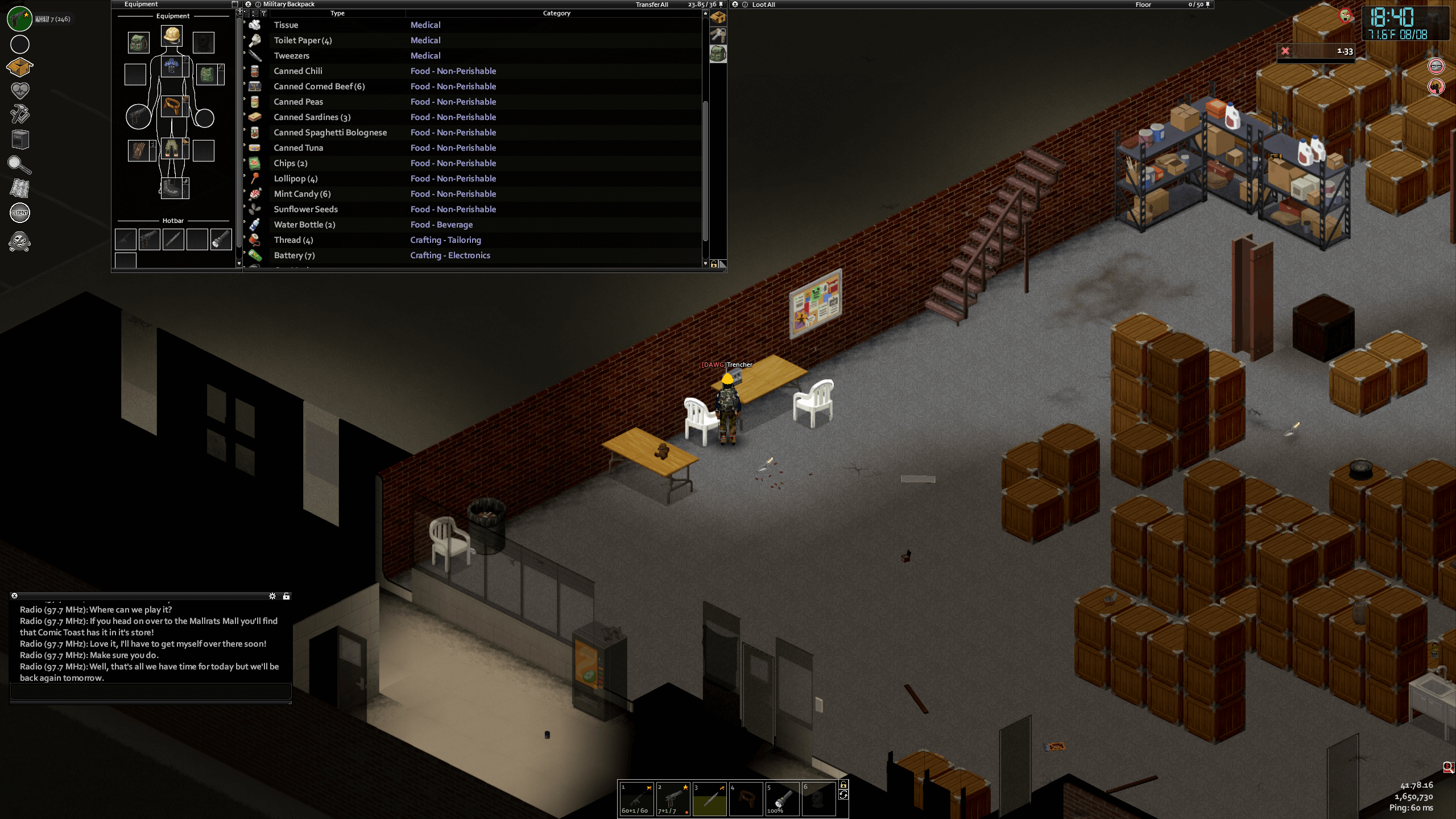
Looting a warehouse.
“Looting a warehouse.”

No, the biggest hurdle a lot of players will have with Project Zomboid is its relatively simplistic isometric graphics. I’m no stranger to getting immersed in an isometric world myself, but I fully expected the others to really struggle with it. Surprisingly, everyone seemed to adapt reasonably quickly. Instead, almost all of the difficulty came from the fact that, especially early on, you’re going to be using melee weapons a lot, and lining up your character with an enemy is quite a bit more fiddly than it really should be, leading to occasionally missing a swing you think you’re perfectly aligned with, for example. One missed hit can cause a fight to quickly spiral out of control, as the next thing you know your character has been bitten, and possibly infected as a result, and now instead of confidently managing the zombie threat around you, you’re suddenly being completely overrun, struggling in a chaotic fight for survival. While yes, when I put it that way that does sound like a cool scene from The Walking Dead or something, when you’re actually playing the game, it can feel incredibly frustrating. Dying when it doesn’t feel like it was your fault is never a fun time, though this became less of a problem the more I started to rely on firearms instead.

While I’m on the subject, the entire health system is quite brutal. Bites happen pretty randomly, even when well protected, and getting infected means you’ll be suffering a slow (well, sometimes quick) demise. This can feel like it comes out of nowhere, though after the first few times you drop dead seemingly randomly, you’ll probably learn to start checking your status a bit more frequently. Thankfully, one of the mods on our server let us loot “zombievoxir ampules” from a rare type of zombie, which could cure the infection instantly, and the hunt for those special zombies was sometimes a pretty enjoyable diversion. Regardless, I liked having some way to cure the infection, which from my understanding does not exist in the base game. The brutality doesn’t stop there though, there are numerous other ways to get hurt or die, and another way that is probably a bit more prominent than it should be, is from car crashes. The roads are littered with hazards and driving really fast is a recipe for disaster. While, unlike a lot of isometric games, you can zoom your view out quite far, there can still be an issue with the engine rendering everything quickly enough to avoid collisions. Getting ejected from a car sucks, naturally, but even minor fender benders can result in a lingering internal injury that you absolutely need to address.
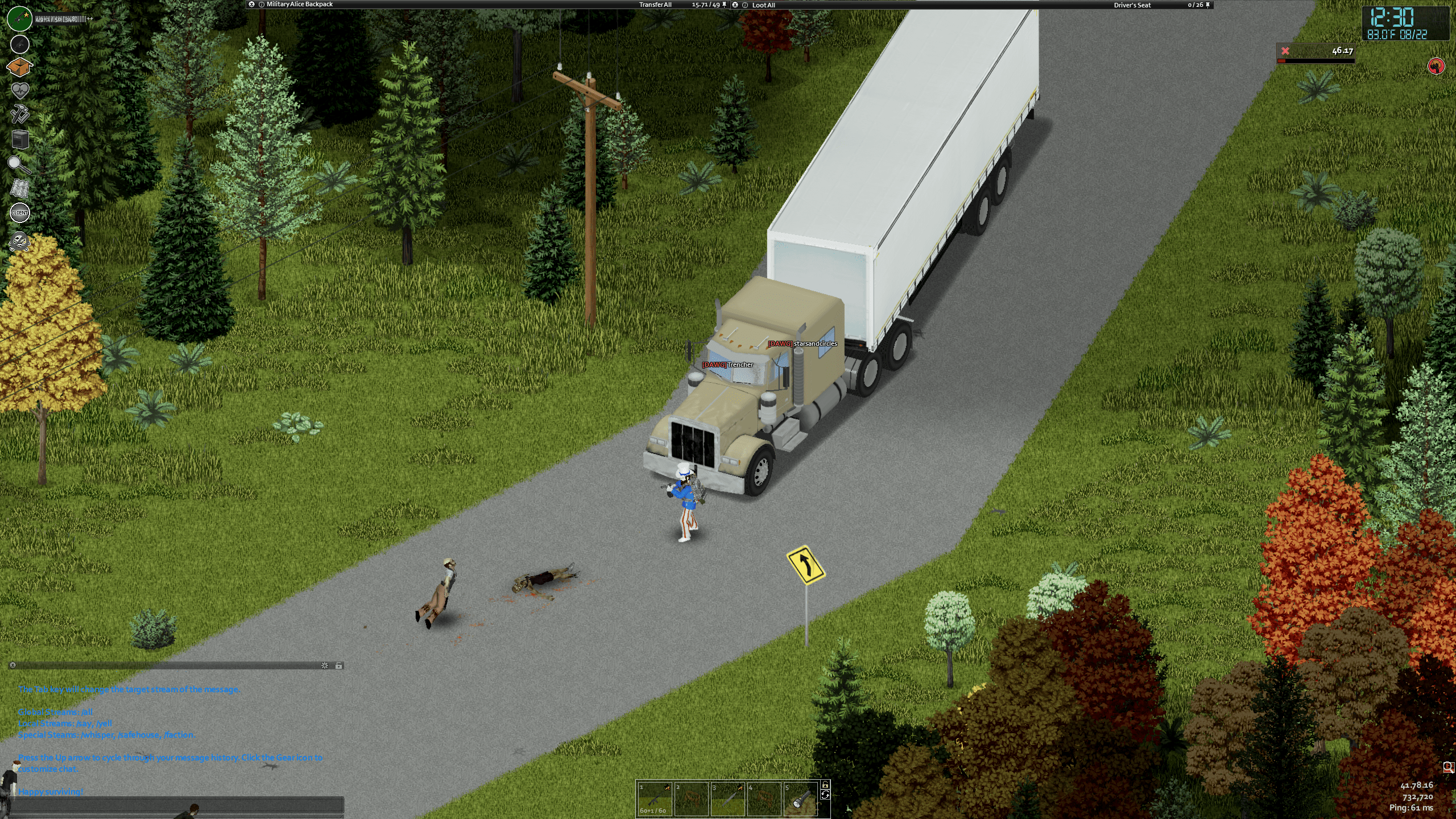
Clearing the road for our convoy... in style!
“Clearing the road for our convoy… in style!”

My last major gripe relates to dying. On one hand, if your character dies, you can simply roll a new one and rejoin the server. Then, with some luck, you can track down your body and at least get your old gear back, though this might require killing the zombie version of your old character first. We also had a mod that awarded extra traits points during character creation depending on how long your previous character survived, which added some nice rogue-lite style progression, and since you were making a whole new character, let you more freely experiment with different builds as an added bonus. On the other hand, one way that skills are learned is via finding and reading books in the world. These don’t actually give you skills directly, but boost the XP multiplier you get while learning them. Unfortunately those bonuses are lost upon death, making the hunt for those books feel like a total waste of time, at least if you’re a newbie who finds the idea of living a long life more outlandish than the possibility of frequent deaths. There are, of course, mods to entirely fix that issue too, we just weren’t using one.

What Project Zomboid really succeeds at is the aforementioned sense of immersion. Somehow its highly interactive environments, numerous detailed functional systems, including some with a fair amount of depth, and the loop of scavenging in a world filled to the brim with useful junk (which I’ve mentioned before on the blog, triggers something in me) really does suck you in quite effectively after you’ve overcome the rest of the game’s idiosyncrasies. All these months later I still have vivid memories of driving our convoy of multiple vehicles around desolate city streets, panicking as a car gets stuck and the horde closes in around us, clearing out nearby towns to stock up on ammo at the local police station, raiding grocery stores for food, hunting down bandits, etc. It doesn’t hurt that the isometric view, ability to pick up and interact with almost everything, and the flexible skill based system reminds me of one of my favorite MMORPGs, Ultima Online.
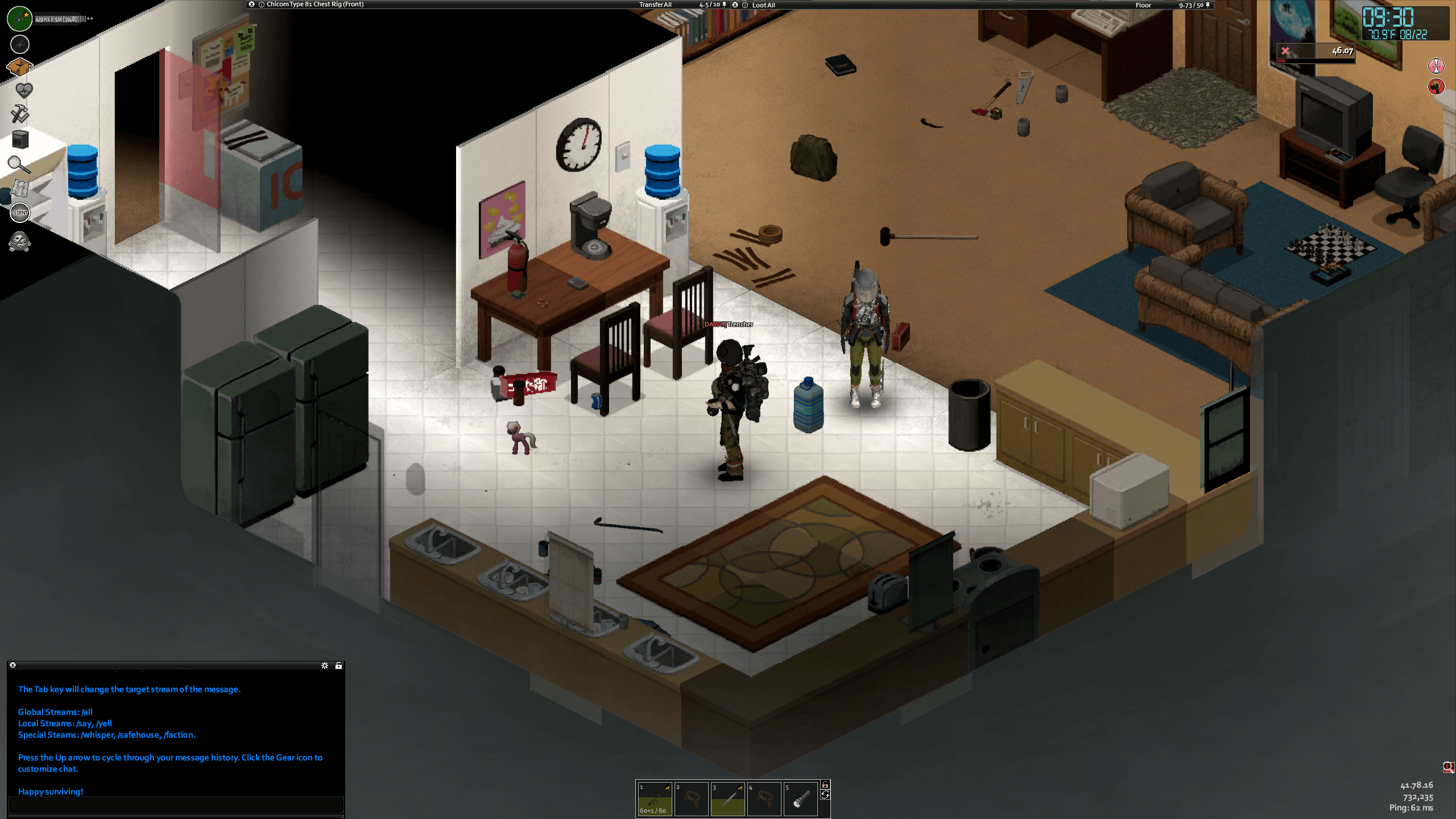
Chilling in the kitchen of our stronghold.
“Chilling in the kitchen of our stronghold.”

In the end, after something like 50 hours played, we moved on simply because we kind of ran out of things to do. Like a lot of these types of games, once you overcome the basic survival mechanics and “figure out” a lot of the other gameplay systems, there’s not much to do except continuing to live in your virtual world. Sure, you can continue to improve skills and get better and better gear, and maybe build the ultimate stronghold, but to what end? PVP is the answer to that question in a lot of more online oriented games (Rust, Scum, DayZ, etc.) but without some stronger late game content to compel you to keep playing, the loop can start to feel repetitive and stale. That’s not to say everyone will feel this way, as the person on our crew who loves Project Zomboid so much? 850 hours played! 😂

We followed Project Zomboid up with a game I’d been wanting to play since its release in late 2023, The Lord of the Rings: Return to Moria. Return to Moria had the misfortune of being another somewhat budget LoTR game, as one released earlier in the year that became a punching bag for every gaming related content creator out there, The Lord of the Rings: Gollum. While I don’t think Return to Moria was unfairly bashed because of the association, at least not widely, between that and its already niche genre, I do think that it was largely ignored by a lot of people who would have potentially really enjoyed it, as Return to Moria lands on my short list of favorite survival games that I’ve played as part of this series.
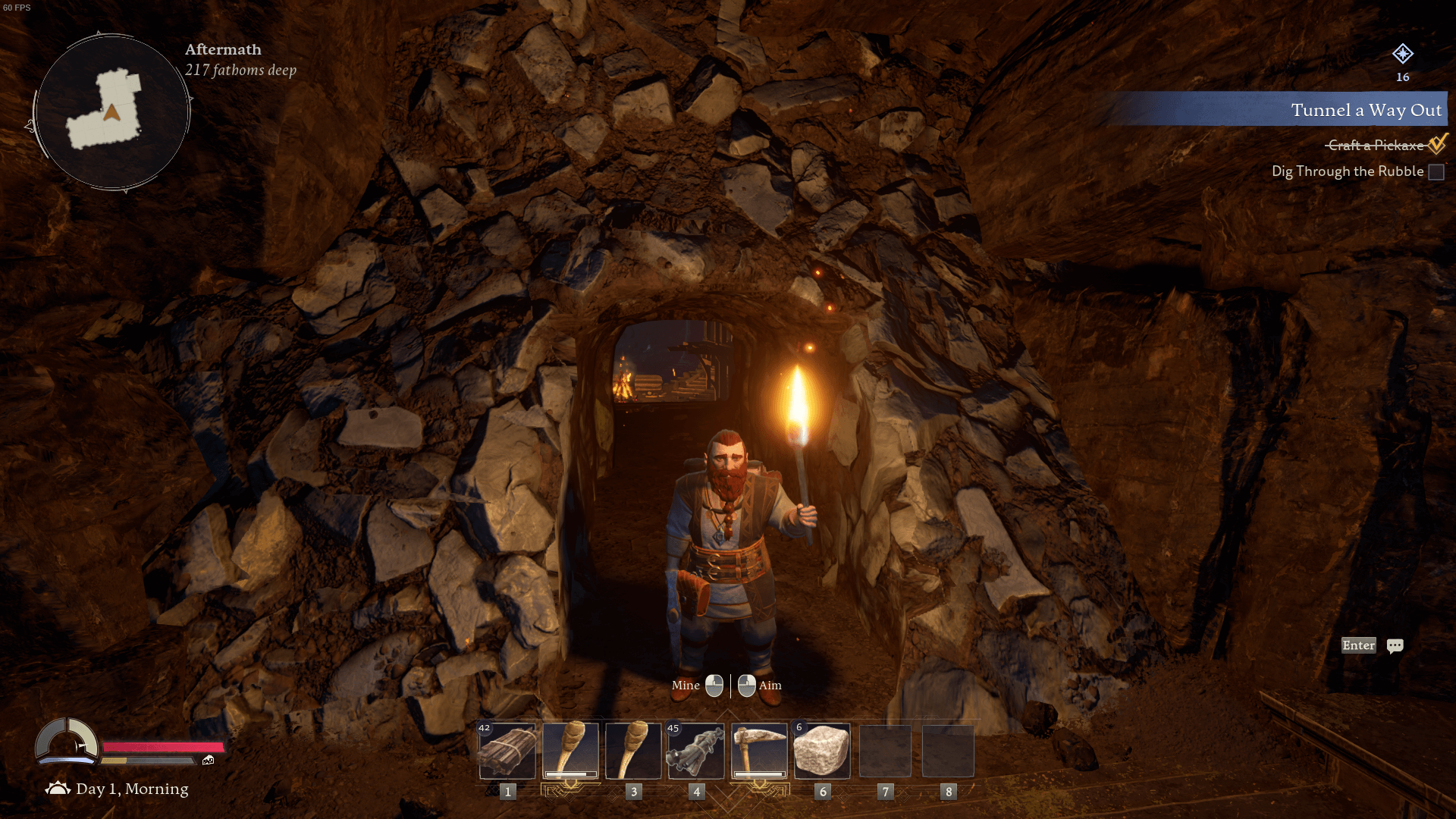
Proud of my very first tunnel...
“Proud of my very first tunnel…”

The basic premise of Return to Moria is that you’re one of Gimli’s company of dwarves seeking to reclaim the once great city of Khazad-dûm and its ancestral riches after the events of The Lord of the Rings and Sauron’s defeat. Yes boys, it’s time to start cranking out Mithril again! Unfortunately you (and if playing co-op, your companions) get stuck inside of Moria during the initial excavation, separated from the rest of the company. You’ll need to explore through the sprawling, ancient structure, which might have been creepy enough if it were simply abandoned, but of course, it’s filled with spiders, orcs, bats, and everything else you might suspect if you’d read the books or seen the movies. On top of that, this is a survival crafting game! You’ll need to build structures and workbenches to make better equipment, repair them after use, cook and brew buff-granting food and drink, etc.
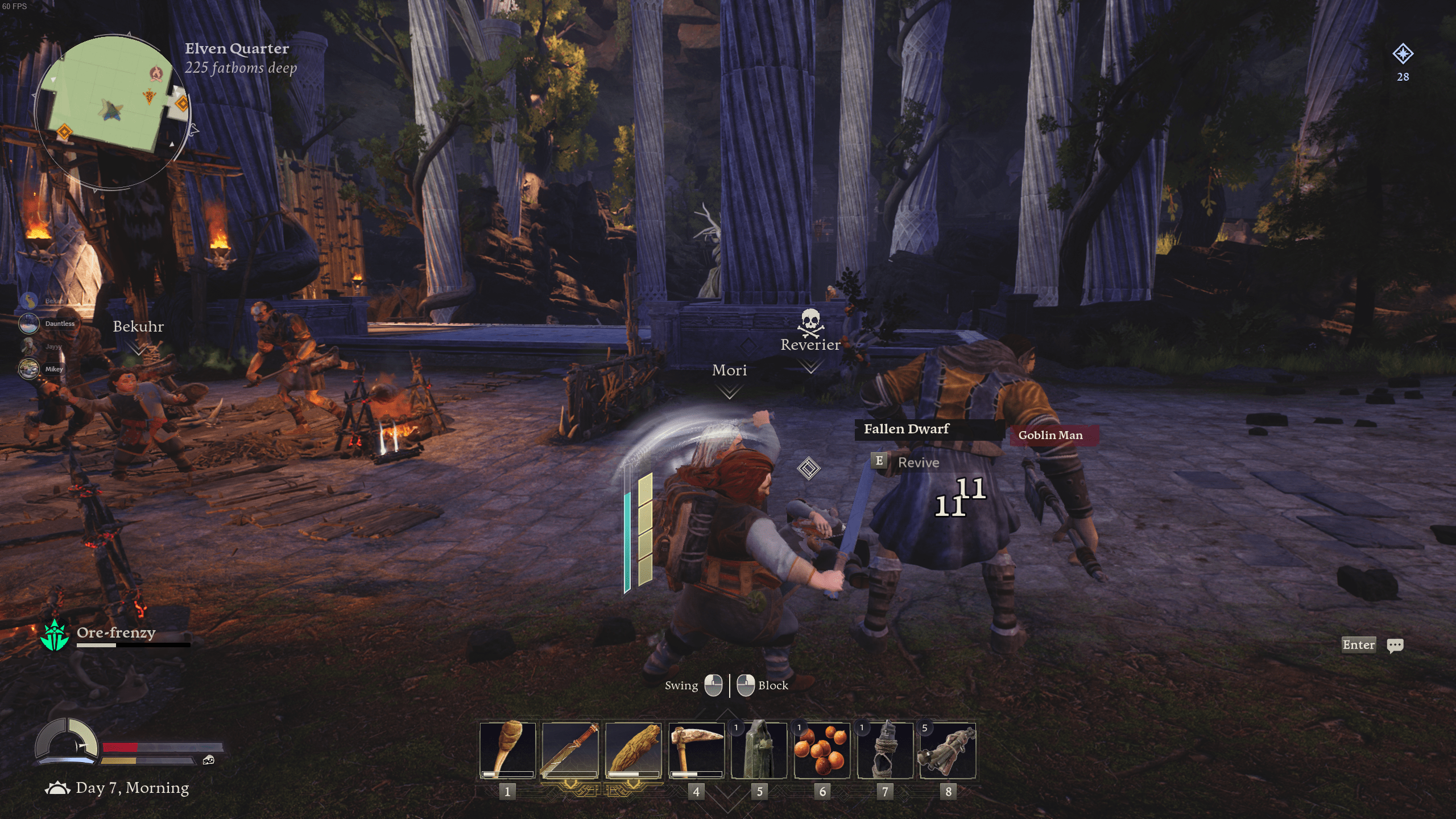
Fighting Goblin Men in the beautiful Elven Quarter.
“Fighting Goblin Men in the beautiful Elven Quarter.”

Right off of the bat, Return to Moria has a level of visual presentation and polish that is uncommon in these kinds of games. While its stylized graphics might not be to everyone’s tastes, it looks great overall. It sounds good too, even bringing John Rhys-Davies back from the movies to voice Gimli, even if that is a bit more like a cameo than any sort of lead role. Early reviewers often pointed out how your own character spoke here and there, and you can even select an all-dwarven dialect voice when creating your character. There’s a lot of nice little touches too, like your dwarves (optionally) singing when mining, which they can do together when playing with others – that never stopped being enjoyable!

Probably the main reason the game was such a success for us was that, not unlike something like Grounded or Abiotic Factor, while it was more or less an open world (with a little gating here and there to control jumps in difficulty) it has a guided, linear path through the story. In this case, as you can probably guess by the story setup I mentioned above, it guides you through various parts of Moria and eventually, with any luck, out of it. One downside is that, like Abiotic Factor, since it is guiding you all around, you might be naturally inclined to take a somewhat nomadic approach to base building, though also not unlike in Abiotic Factor, we built our final base in a place that was reasonably walkable to most mid-game areas, and by the late game we’d unlocked the ability to teleport between “Mapstones” which are static teleportation targets scattered around a small selection of notable places. Absolutely canon-destroying, but fast travel can be invaluable in these types of games. I’m glad we did, as the game also has base invasion events which, while not as intense as a game like 7 Days to Die, does at least give you a reason to fortify your base and think about your design a bit more.
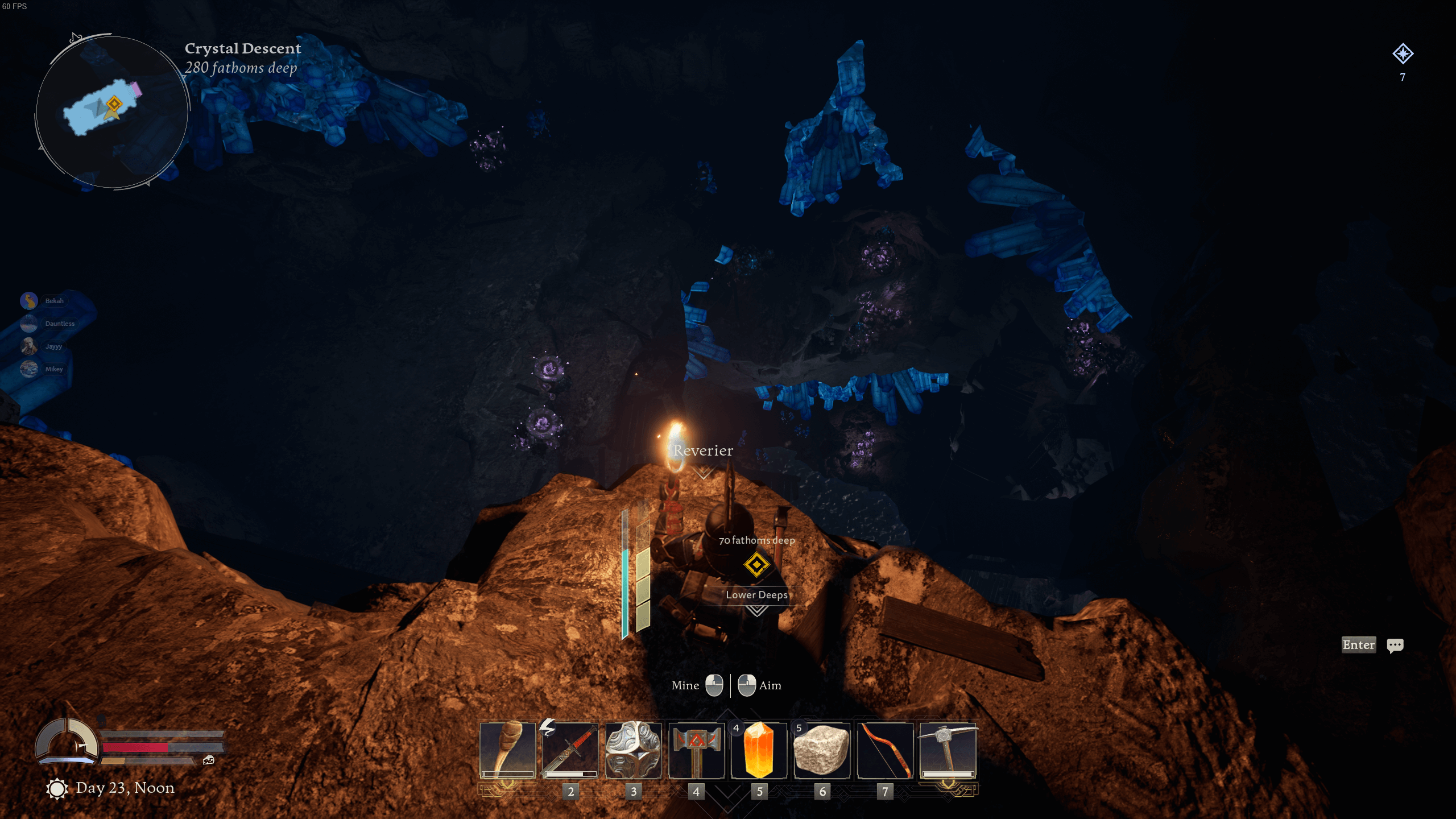
It's a long way down, and we need to climb it...
“It’s a long way down, and we need to climb it…”

Wandering through Moria, which ranges from dreary indoor corridors to massive underground cities, epic chasms, and wide open areas that almost feel like being outdoors, mining for ore and gathering materials, and slaying quite a lot of orcs along the way is pretty damn fun. Combat feels something like a very simplistic take on the now ubiquitous Dark Souls style combat – lots of blocking and rolling, but not much else. It’s a little tricky at first but you’ll likely get comfortable with it quite quickly. To be clear, it is definitely a bit more exploration and combat heavy than a lot of these kinds of games. It probably reminds me most of Enshrouded in that respect, but that’s definitely not a bad thing. Naturally, there’s a lot of verticality in exploring, and as implied, there’s quite a lot of variety here too. Also, I really love the very Norse inspired designs of the weapons and armor here. Oh, and while randomly dolling out compliments, and the lightning system is quite cool too.

There are some negatives, naturally. Some of the enemy designs definitely look a little off, though thankfully that’s not really an issue with the ones you’ll be running into most often, nor your dwarves. The in-game map UI? I fucking hate it. It chops up every major area (or zone) into a small block, and completely fails to give a clear idea of the scale nor any sort of detail, but only a vague idea of how these areas are connected. It looks more like something the designers would have used to show high level zone connectivity and flow than something useful to us players. These map issues compound another problem, which is that your next steps and/or how to achieve them aren’t always obvious. There were at least a couple of steps in the campaign which had us confused and discussing where to go and what to do next. While you could argue that figuring this out ourselves is part of the challenge, it didn’t feel like an intentional design decision, but rather a UX issue.
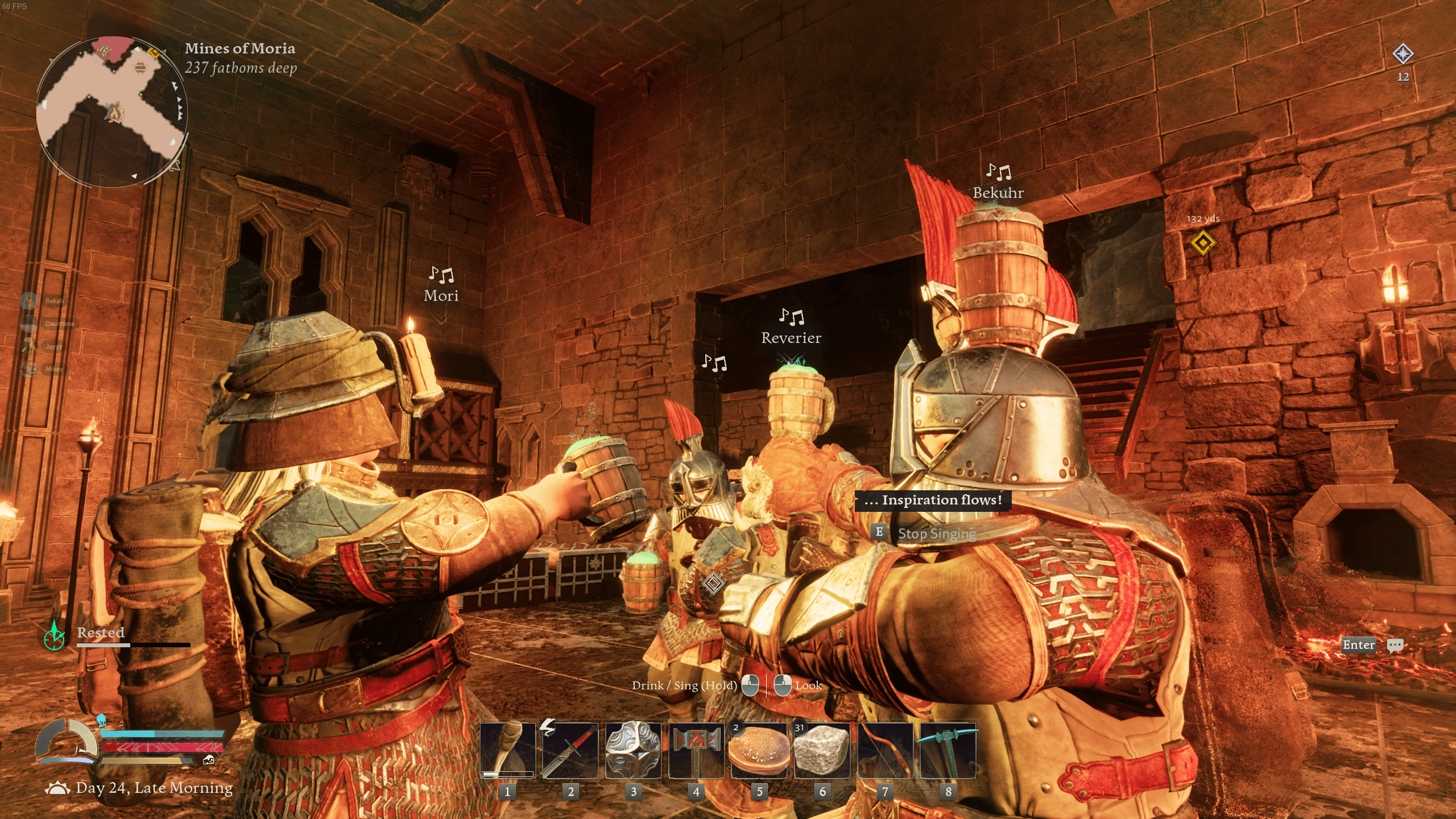
Frequent drinking breaks are mandatory!
“Frequent drinking breaks are mandatory!”

Another thing that I found annoying were the buffs. There are numerous ways to get your characters temporary buffs, most of which stack, so while it’s advisable to fully apply these effects to yourself before heading out on an expedition, I swear these things feel like they wear off a minute after you walk out of your front door. This issue is even more pronounced when using fast travel, which makes the whole system feel almost pointless. Seriously, why have these reasonable developed systems for us to invest in if they’re not actually useful? This feels like an odd balancing issue that would have been fixed ages ago if this were more of an MMO or live service game.

A much smaller gripe is that I wish there was more of, well, everything in the game – weapons, armor, utility items, enemies, etc. There are plenty, don’t get me wrong, but, especially when it comes to tiered weapons and armor, I’d love even more variety here, particularly when it comes to “masterwork” items which are legendary items that you’re only able to ever carry one of, and even have their own special slot. There are very few of these – some utility items, a couple of weapons, and a shield – but these are also tiered, and sometimes it’s hard to choose between them. I mean, would I rather have a permanent light source attached to my backpack, an amazing pick axe, or an awesome weapon? All three, please! You can take this one as more of a compliment though – I want more because I like what is there so much!
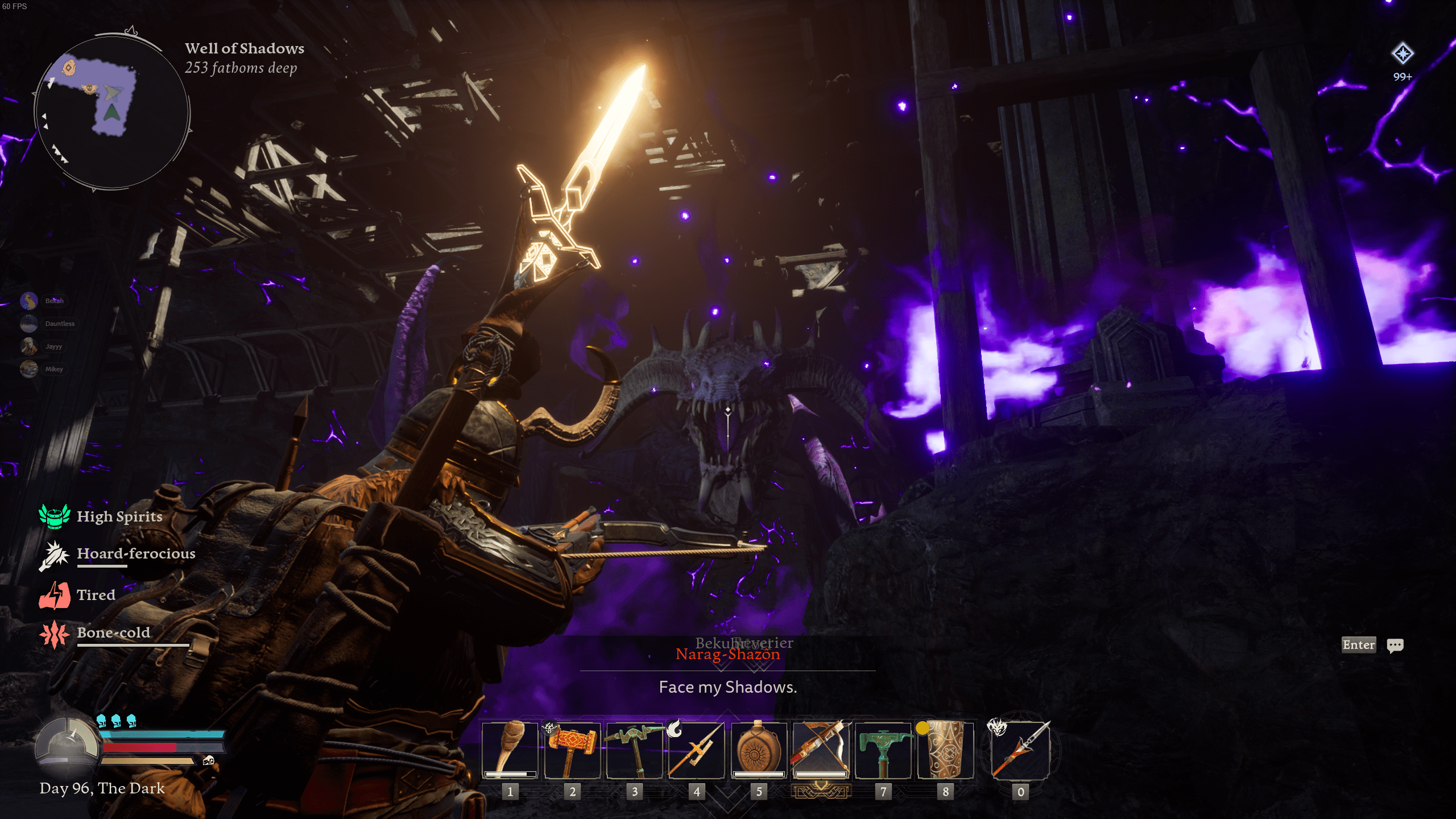
Well, it worked in The Hobbit!
“Well, it worked in The Hobbit!”

I can only nitpick about this game so much though. I loved it, and I think my group did as well, despite some confusing and/or challenging parts. I mean, we saw it through to the end, which is rare enough for this series, right? Like with Project Zomboid, I have some vivid memories of my time with Return to Moria, from challenging boss fights against an Orc Warchief that we were probably not quite ready to face, our first run in with a Troll, climbing down the Crystal Descent for the first time, and later, being confident enough to explore the Darkest Deep as a group all immediately come to mind. Unfortunately the linear structure of it means it’s unlikely that we’ll ever go back to it now that we’ve beaten it, though I could see myself returning to it solo in the future, or jumping in with a different group, certainly, especially since they’re apparently not done putting out content for it. Excellent game!

Apologies for the lack of good Icarus and Project Zomboid screenshots. I promise they’re more exciting than I made them look. With PZ in particular, I assume I was far too busy trying to not to get ripped apart limb from limb by the zombie hordes to get any good screenshots.
Metal Gear Mania 2025 – Metal Gear 2: Solid Snake

Like most in the West, I didn’t know Metal Gear 2: Solid Snake even existed for the longest time. Instead, we had the NES exclusive Snake’s Revenge. It comes up in just about every piece about the game these days, but there’s a fun anecdote about how Snake’s Revenge actually led directly to the development of Metal Gear 2. In brief, Kojima was not involved with or apparently even aware of the development of Snake’s Revenge until he had a chance run-in with a former teammate who mentioned being assigned to the team working on it. Learning of its existence inspired Kojima to immediately start thinking about how he’d design a true Metal Gear sequel. This quickly escalated, with Kojima seeking and being given the greenlight from Konami to actually make it. While amusing, if even a little true, it’s quite revealing about the development of both titles.

Metal Gear 2 - bigger and badder.
“Metal Gear 2 – bigger and badder.”

And that’s about it for me talking about Snake’s Revenge. Beyond Kojima not being involved in its development and it being in no way canon, Snake’s Revenge being the potential second game in what would become a long running series brings its entire status as a Metal Gear game into question. That is, regardless of whatever merits it might have had, it’s clearly not the direction that Kojima would have taken the series, making it a bit more of an evolutionary dead end than even later non-canon entries in the series would be, in my opinion. While I admit that I’m a little curious about the game, I have to trim the fat somewhere. Apologies, Snake’s Revenge fans!

As for the actual Metal Gear 2, after its Japanese release in 1990 it stayed an MSX exclusive without even so much of an official English translation. Like the MSX version of the first game, a port of Metal Gear 2: Solid Snake eventually made it to the West in 2006 as bonus content for Metal Gear Solid 3: Subsistence. This was later included with the HD Collection and that version is included with the recently released Metal Gear Solid: Master Collection Vol. 1, which is how I played it. Like the first game, this is actually a port of an older mobile port, but looking at a list of the differences between this and the original version, I mostly see improvements, so here’s hoping this is a decent enough representation of the original game to base my impressions off of.

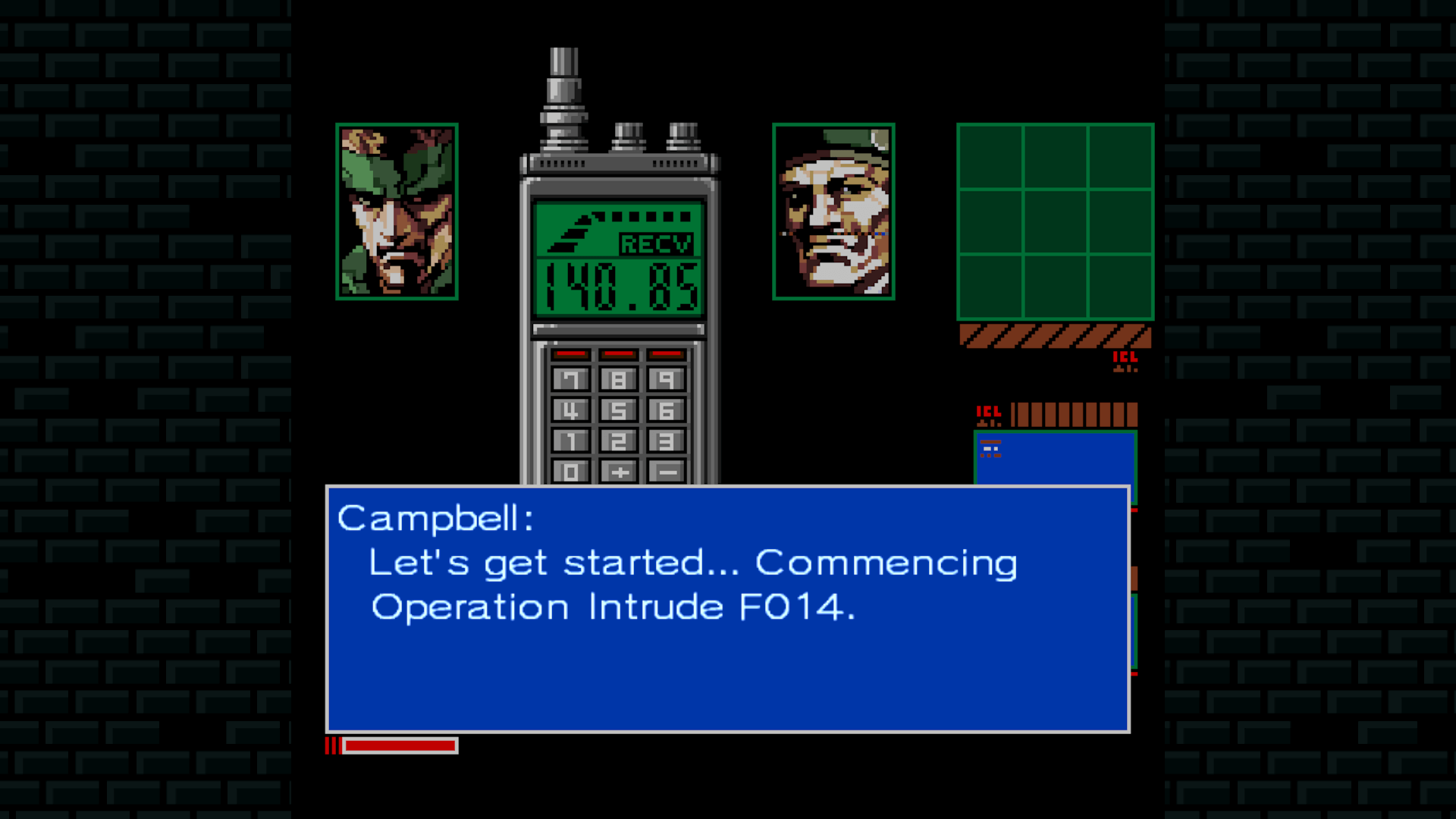
The new radio interface, the new boss, and the new assignment.
“The new radio interface, the new boss, and the new assignment.”

Loading it up, MG2 immediately feels like a substantial upgrade from Metal Gear. The game opens with a lengthy intro sequence showing some really nice, colorful artwork and setting up the plot of the game, all while a banging chiptune track that is far more intricate and varied than anything in the first game blasts away. This continues as you enter the game, with better sprites, animations, sound effects, and a continuation of the excellent soundtrack. You’ll also instantly recognize that the UI is more complex, hinting at what is overall a much more complex game with more items, more dialog, a bigger and more varied map, and more interesting puzzles and other gameplay systems. Not unlike something like the leap between Super Mario Bros and Super Mario Bros 3 on the NES, despite both being MSX2 games, MG2 feels like a full generation beyond its predecessor. Kojima and his team were clearly swinging for the fences here.

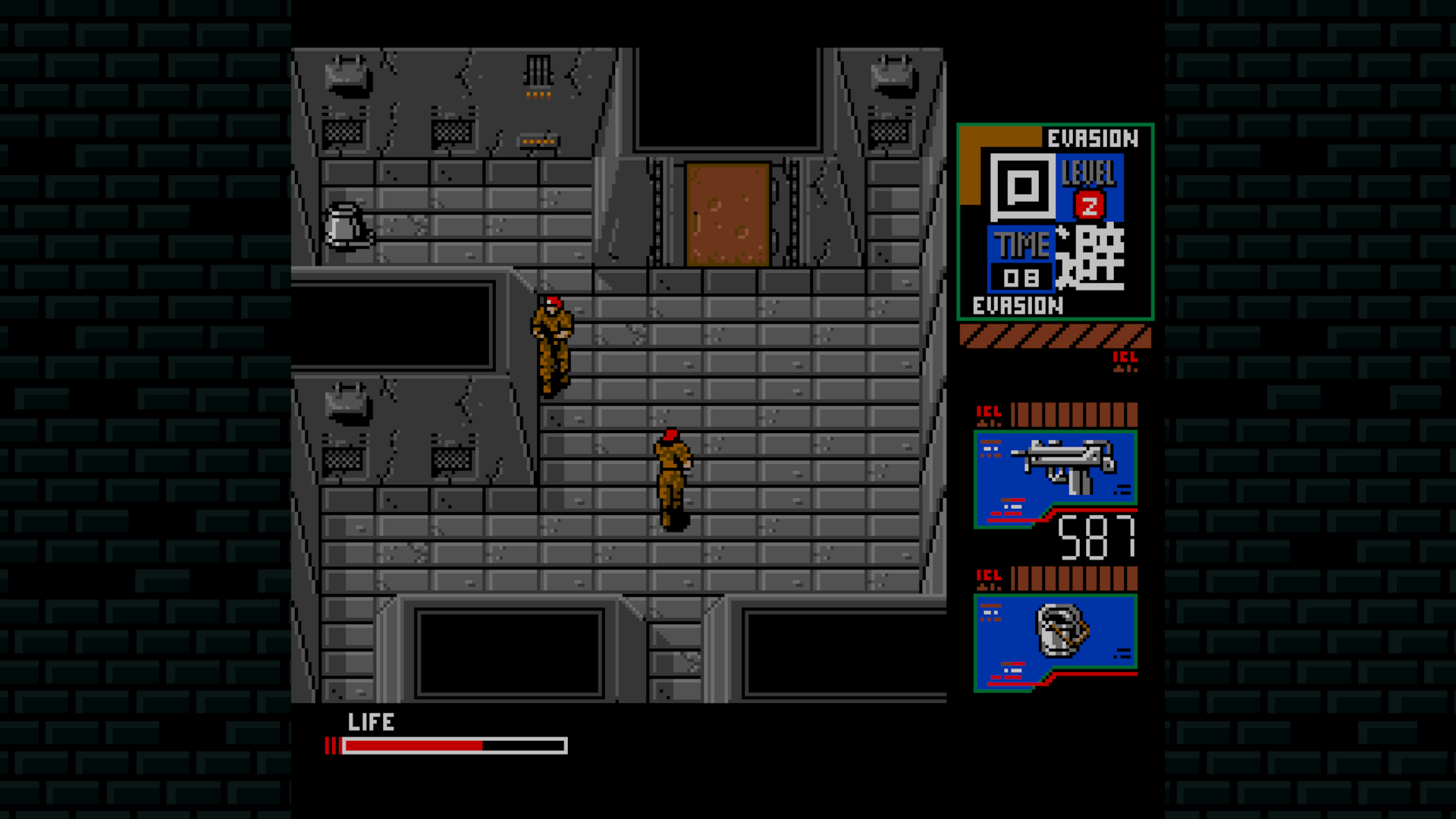
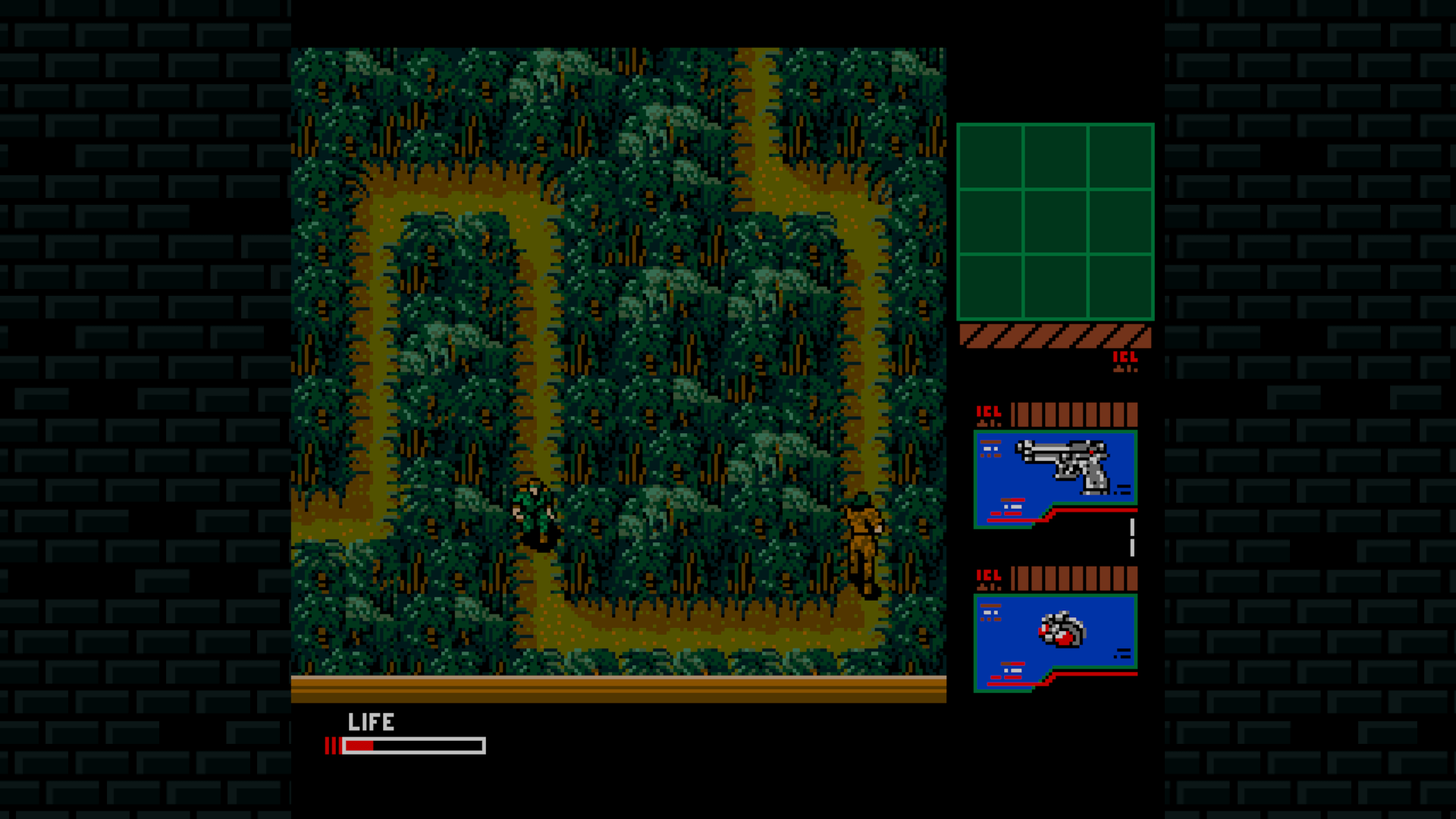
At the top of the expanded features list is stealth. Guards now have a cone of vision and will move their heads to look around when stationary. Their patrol paths also seem to be a little less simple, making avoiding guards a bit trickier than in Metal Gear. The alert and evasion phases are distinct now, too. If you’re spotted, guards will enter alert mode during which they’ll aggressively hunt you, with additional guards popping out of every available door. Seriously, I groaned every time they came out of the back of a cargo truck that was empty just moments ago! When in this mode, it’s almost impossible to hide, rather you need to lose the guards or otherwise get rid of enough of them first. Oh, and alerts are no longer room-based, either, so simply leaving the screen isn’t going to cut it. This new alert mode was probably my biggest source of frustration with MG2. That is, practically every alert, no matter where you are, how many guards are in the room, or the manner in which you were spotted, results in the same ridiculous swarm of guards, and by the end of the game, this was damn tedious to deal with. When you finally do, you’ll enter evasion mode in which guards will carefully search for a bit. A handy display in the UI shows the phase and a countdown timer, with a design seemingly swiped from one of my favorite animes, Gunbuster, incidentally. Assuming you can stay hidden and outlast the timer, they’ll give up and you’ll be back in the default infiltration mode.

Step aside cardboard box, the bucket is peak stealth action gameplay!
“Step aside cardboard box, the bucket is peak stealth action gameplay!”

There’s also a mode similar to evasion mode that is triggered by a guard hearing a suspicious sound, during which they’ll go to its source to try to figure out what made it. Yes, that means there is a more developed sound component to stealth now, with certain types of ground surfaces making noise when you walk on them. You can also purposely make noise by, for instance, punching a wall, which lets you manipulate the guard positions to more easily sneak by them or take them out. To avoid making noise on accident, there’s a new crouching and crawling mechanic. This is an extremely important addition to Snake’s repertoire, and utilized everywhere, with just about every room having multiple places you can crouch behind or crawl into or under to conceal yourself. You also have some familiar tools returning from Metal Gear like the suppressor and your old friend the cardboard box. The box is now slightly riskier though, as guards will pop a few shots off at it if they walk up on it. Then there is perhaps my favorite new item, the bucket, which works the same as the cardboard box but it’s bulletproof, though it does come with the tradeoff of making noise if you walk while wearing it. Given how utterly silly the animation of Snake walking around almost entirely covered by a giant metal bucket is, I’d say it’s worth it though. Finally, there’s the camouflage mat, which lets you deploy a piece of hidden cover to hide under just about anywhere you want.

Last but not least, I can’t talk about all of that without bringing up what is perhaps the biggest addition to both the overall stealth system and the UI, the mini-map. This is the obvious predecessor to the “Soliton Radar” that appears in a lot of the later entries in the series, showing a top down view of the screen Snake is on as well as the 8 screens around him, complete with enemy and other character positions and live moment updates. Incredibly useful when planning your routes, I got used to using it almost immediately, as if I’d also had it throughout my run of the first game too. The only real downside to having such a powerful new item in your toolkit is that you don’t have it all the time – it gets jammed during alert modes, with the neat little alert phase display temporarily replacing it. Honestly, I was usually too busy frantically murdering tons of guards during alerts to worry about it that, though.

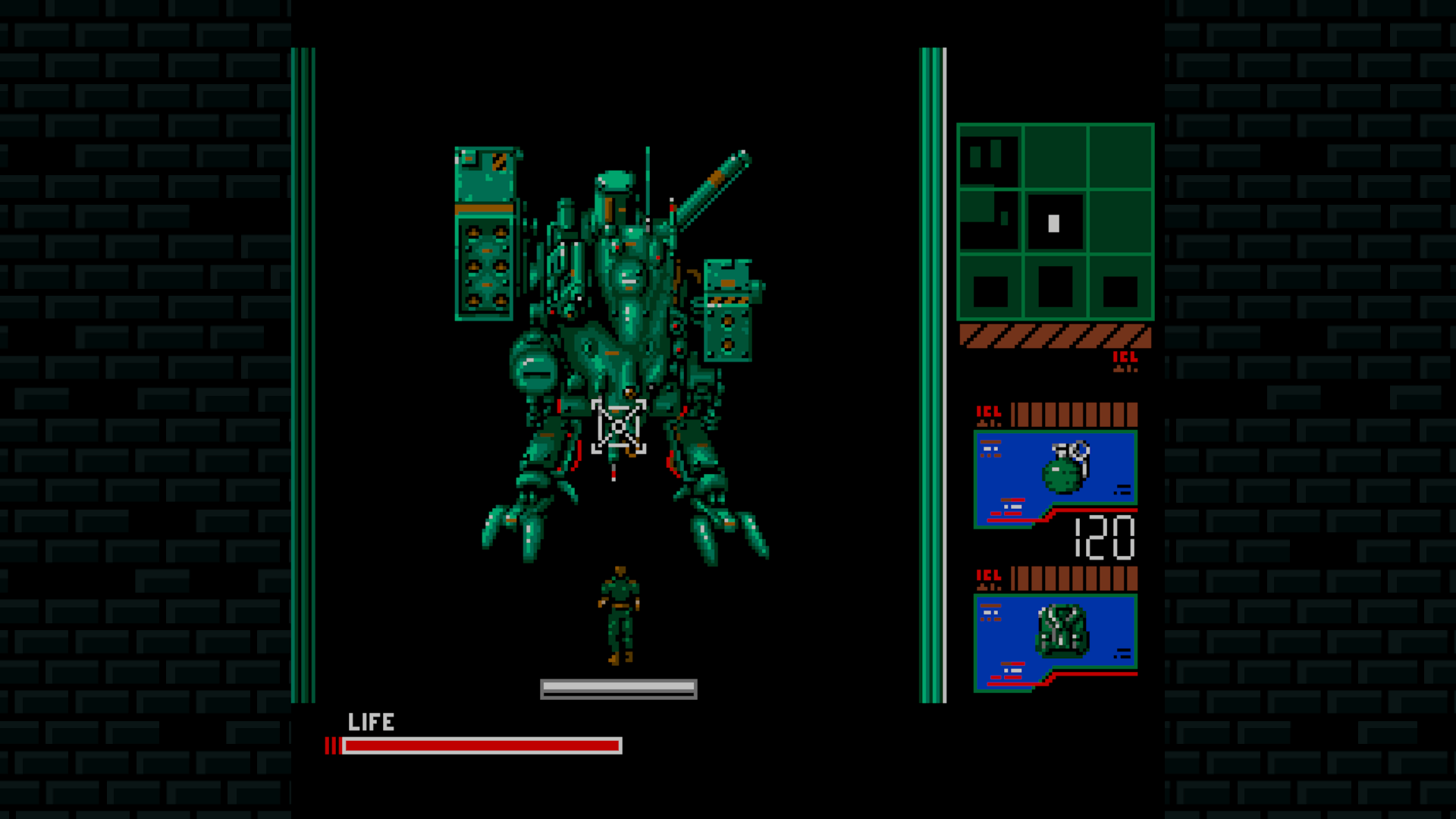
The Metal Gear D is, appropriately, highly vulnerable to a grenade to the dick.
“The Metal Gear D is, appropriately, highly vulnerable to a grenade to the dick.”

MG2 retains the Zelda like item gating gameplay of the first game, but with more items and more complexity all around, I personally got a lot less of that Metroidvania vibe this time around. It just feels a bit less intentionally designed, and I think the game suffers just a little as a result, despite just about every individual element being improved. For instance, while keycards are still an annoyance, you can now trade them up for combined versions, reducing the 9 you have by the end of the game to 3, and they also feel a bit less randomly assigned to doors to boot. Fast travel has undergone some improvements, whether you’re hiding in a box and hitching a ride on a conveyor belt, into a cargo truck, or floating through the sewers, it all works so much better. It also seems that using weapons as a gate around boss fights is mostly eliminated. There are some bosses that are easier with certain weapons, sure, but aside from the Hind D fight (yes, another one) I’m struggling to think of another example. Speaking of weapons, I found myself using melee a lot less this time, as I really didn’t want to risk triggering the aforementioned annoying guard swarms. In fact, by the end of the game I was taking full advantage of the slow projectiles (also making a return from the first game) to “pre-fire” shots at guards before they’d round corners or otherwise enter my field of view. Cheesy but kind of satisfying.

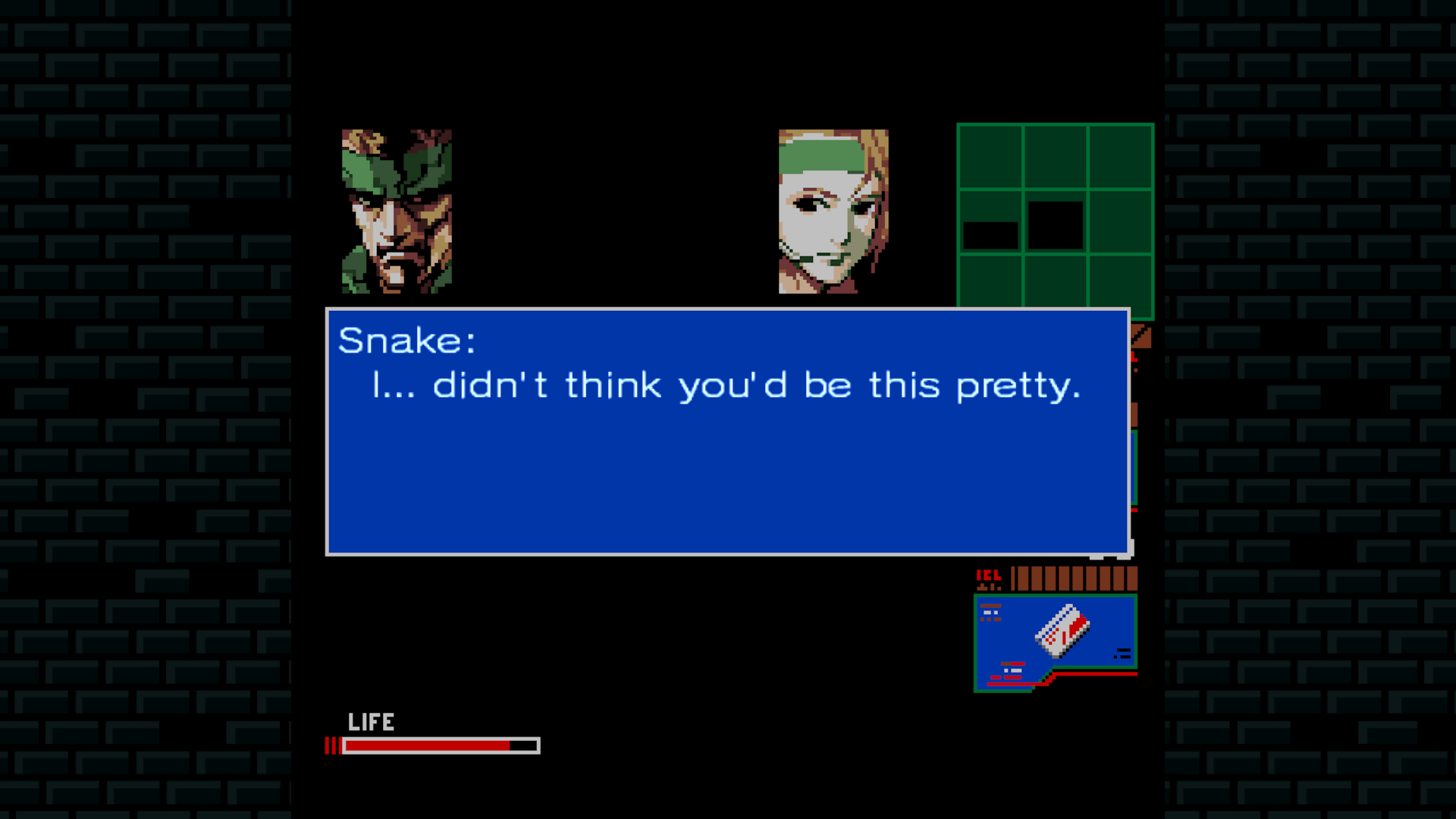
Another massive upgrade comes with the radio, which much more closely resembles the codec calls found in later Metal Gear games. Radio conversations happen more often, between more people, are much lengthier and better written. Hey, they’re also two-way now, so Snake finally has a little bit of a personality! People also actually answer their damn calls now too, making the radio much more useful in general. While there are a few little non-radio conversations, and you occasionally run into war orphans wandering around Zanzibar Land who impart similar one-liners, there are no more POWs to give you clues, so the majority of your hints and other guidance will come from these calls. I do wish more of those conversations were more useful, though. Master Miller almost exclusively says generic stuff and I swear I missed Kasler’s initial call or something, as I didn’t know his frequency until later in the game. The radio has one more function exclusive to the modern port – they replaced the original character portraits (hilariously swiped from stills of famous actors) with more stylized artwork by Yoji Shinkawa. While the intent was more likely to avoid legal trouble, the effect is that the game now looks more like a cohesive part of the greater series beyond.

Snake, if you need a cold shower, you already know where the women's restroom is.
“Snake, if you need a cold shower, you already know where the women’s restroom is.”

This feels like a good time to talk about the story. Expand the box below for a spoilerific though fairly terse synopsis of the game’s plot.

Story Synopsis - Spoilers!1999. On the verge of a global energy crisis, biologist Dr. Kio Marv develops OILIX, a new way to synthesize high-grade petroleum. Soon after his discovery is publicized, Dr. Marv is kidnapped by agents of Zanzibar Land, a small nation that has recently gained attention on the international stage due to aggressively seizing nuclear weapons from neighboring countries, attempting to gain unmatched power as the rest of the world dismantles its nuclear programs to enter a new era of peace. Colonel Roy Campbell, FOXHOUND’s new commander, brings Solid Snake out of retirement for Operation Intrude F014, a daring covert operation to infiltrate Zanzibar Land and rescue Dr. Marv, and with him the secret of OILIX. Once on the ground, Solid Snake gains the assistance of Holly White, a CIA agent posing as a journalist. During the course of the mission, Snake rescues Dr. Madnar, the scientist behind Outer Heaven’s robotics programs. Dr. Madnar had been forced to resume his work and is well underway with mass producing a new model of the Metal Gear walking tank for Zanzibar Land. Snake also learns that his former commanding officer turned mercenary leader of Outer Heaven, Big Boss, is leading Zanzibar Land. While Snake continues his search for Dr. Marv, the group encounters ex-FOXHOUND agent Gray Fox, now loyal to Big Boss, who recaptures Dr. Madnar and blocks Snake’s pursuit. Eventually reaching the base’s main prison complex a different way, Snake locates Dr. Marv’s cell but finds him deceased, having succumbed to torture. Holly radios Snake to let him know that not all is as it seems with Dr. Madnar, who is also being held here, and that he actually returned to Big Boss’s side voluntarily. As Snake turns to confront Dr. Madnar, Dr. Madnar attacks him from behind, forcing Snake to incapacitate him. Assembling clues that Dr. Marv left, Snake recovers the OILIX data from a clever hiding spot and begins his exfiltration. Snake once again encounters Gray Fox, and after an explosive showdown, disables Gray Fox’s Metal Gear D, leaving the two to have a final hand-to-hand fight to the death. Having just defeated his former comrade, Snake is taunted by Big Boss, who he quickly tracks down. Big Boss tries to convince Solid Snake to join his cause, explaining his goals for Outer Heaven and Zanzibar Land – to give soldiers like him a means to survive on their own terms rather than be used as pawns by uncaring governments. Snake refuses the offer, and Big Boss attacks him. Unarmed, Snake moves from hiding place to hiding place, but is able to cobble together an improvised weapon, eventually catching Big Boss by surprise. With Big Boss dead and the OILIX data in hand, Snake rendezvous with Holly and the two are airlifted out of Zanzibar Land.


Certainly, themes of nuclear disarmament and a crisis around fossil fuel shortages were reasonable to speculate on in the late 1980s, and the game as a whole feels a bit more “near-future” than the first did. Beyond that, it’s hard not to feel like MG2 is something of a remake of the first game. Sure, some of the story details are different, but the structure is very, very similar, and a lot of specific gameplay elements return as well. There are also returning characters, starting off with the seemingly random addition of Outer Heaven resistance leader Schneider, who I’d assumed was dead. It all feels like a bit of a soap opera, but I know that’s just the tip of the iceberg for this series. Despite how Zanzibar Land might just be Outer Heaven v2.0, I did appreciate that MG2’s vastly expanded script gave our main antagonist a chance to actually explain his motives a little bit more. It frames the whole “mercenary state” thing much more clearly. On the other hand, Snake’s attempts to hit on women, particularly Holly, felt awkwardly out of place to the point where I actually found myself laughing at them. Really, while there are still some silly bosses with silly names, other than some fun references to video games and the MSX in particular, there are no fourth wall breaks and most attempts at humor are somewhat subdued to the point where it wasn’t always obvious if the writing was intentionally quirky, or genuinely kind of weird. I mean, you can’t tell me Running Man doing a mad sprint around a building to prove how amazingly fast he is, only to come back panting after a single lap isn’t damn funny. 😂

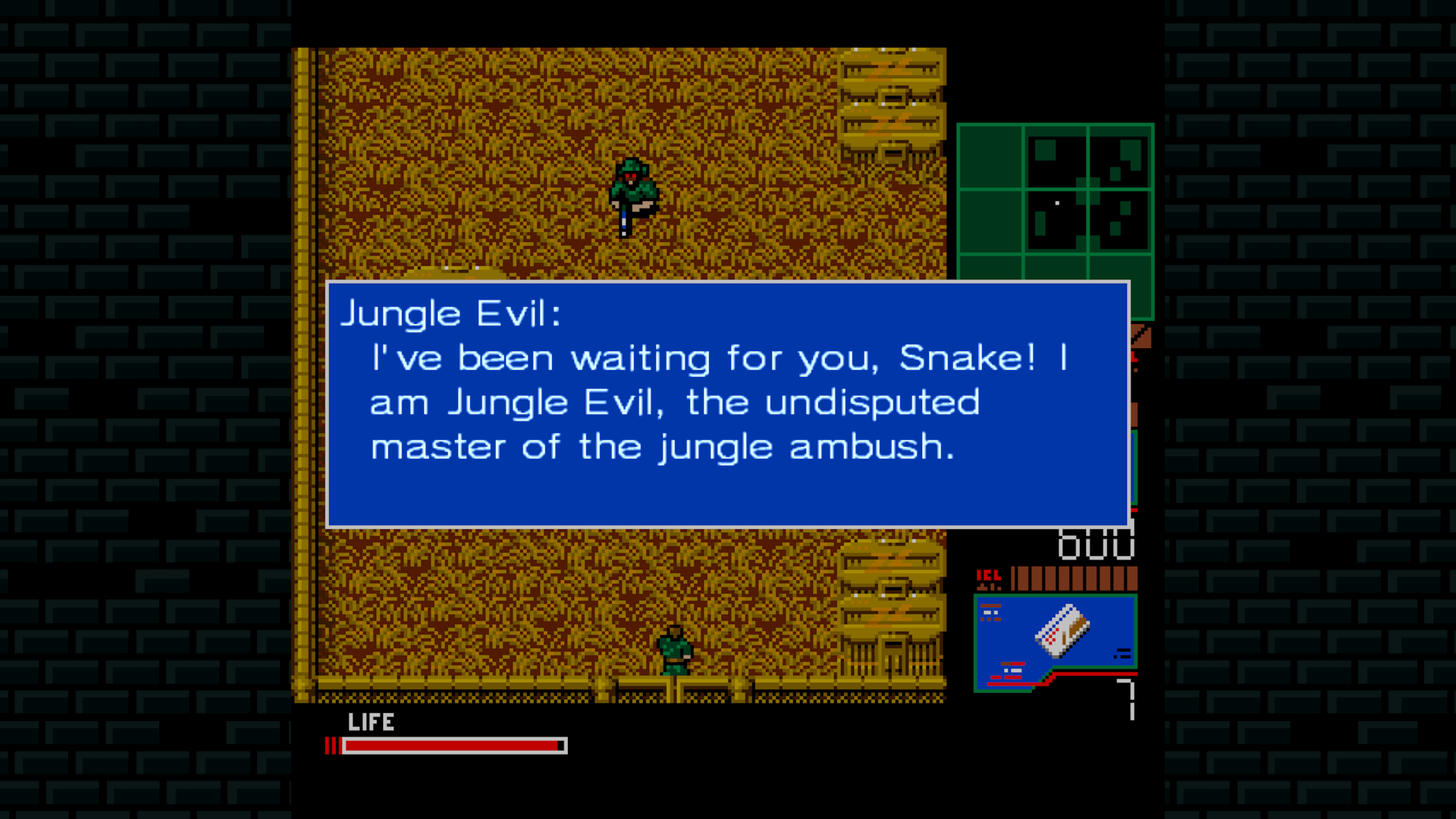
Honestly, I *do* dispute his ability to ambush given that he announced his presence.
“Honestly, I *do* dispute his ability to ambush given that he announced his presence.”

With boss fights being less about gating progress around certain weapons, they now have more traditional boss fight mechanics. Nothing all that tricky, but more varied and funner than what we got in Metal Gear, certainly. Besides my aforementioned burnout with alerts, I think the most difficult aspect of the game is its structure. As mentioned, that satisfying Metroidvania-like formula is just a little off. Hints given via the radio or by the occasional war orphan are usually less direct than those in Metal Gear, which isn’t necessarily a bad thing, but it does make the game feel less linear and more prone to trial and error and arduous backtracking. There is also a lot more light puzzle solving this time around, and some of the puzzles get pretty wacky. How about finding and hatching an egg that turns into an owl, which you’ll need to equip so it hoots, fooling a guard into thinking it’s night time, and for some reason they turn off a perimeter security in this particular area at night? Nope, none of that makes any goddamn sense, does it? There are also rather wickedly designed areas, like the infamous jungle which requires tailing a guard who is constantly checking behind him, and if you lose him for even a second the jungle turns impassable and you’ll need to go back to the beginning and try all over again. The swamp is perhaps an even worse offender, as it’ll outright kill you if you stray too far off the hidden path for more than a few seconds, and the path is long and windy, but of course!

If you do die, save game checkpoints are aligned to specific areas, but it’s perhaps even less clear where those checkpoints actually are. In Metal Gear they were usually the last elevator you entered, but in MG2 they seem to be tied to loading screens… except for when they aren’t. Honestly, after I got further into the game I just avoided the issue altogether by abusing my Xbox’s Quick Resume feature and trying my damnedest not to die. Sometimes easier said than done, as you can no longer stock up on endless rations and ammo by leaving and reentering rooms like you did in Metal Gear, and if you trigger alerts way too often like I did, you’ll end up needing those rations. I played on “easy” difficulty again and discovered one big advantage of it – if you die too many times in a row, you’ll respawn with full ammo and rations on your next continue. I got into at least one situation near the beginning of the game when I was still figuring things out where this really helped me. Overall, it’s not a hard game, but it has potential to be longer and more taxing than Metal Gear was. Unless you get a particular amount of joy from playing this old school, draw your own maps and trial and error your way through puzzles style of game design, I’d recommend you at least use some notated maps, as with the first game. Unlike the first game, however, I might also throw in a walkthrough too. I used a spoiler free walkthrough as a reference here and there, but I absolutely abused the hell out of the maps themselves. While I know I would have gotten more satisfaction from figuring everything out myself, I’m sure it would have also taken twice as long and been a lot more frustrating along the way.

Fuck this fucking jungle section!
“Fuck this fucking jungle section!”

I think the biggest advantage of the more complex and varied gameplay of MG2 is the possibility for the kind of emergent moments you’d expect out of a more open game. As an example, there was one section of the map that I kept going back to where there was no way to get past a guard without getting spotted. After just dealing with triggering an alert several times, I figured out that I could knock on the outside of a wall he was near and he’d walk over to it. He could still just barely see me if I tried to creep by him, but I could then blast the Zanzibar Land national anthem cassette tape to make him spring to attention, facing straight ahead, letting me get by him unseen. For an example of a funnier emergent moment, I almost fell off of my couch when I accidentally killed a war orphan while attempting to blow up a wall with C4 – I just assumed children would be invulnerable so I wasn’t too concerned when he wandered up, but… hey, 1990 was a more innocent time! 😅

While I had some mixed feelings on Metal Gear 2, all in all, there’s no denying that it is a much more impressive game than its predecessor. It really improves on virtually every aspect of the first game, and while it might have taken me a bit of time to adjust to the added complexity, in the end I had a lot of fun with it. I’ll have to get further into these playthroughs to be able to really judge MG2’s place in the series, but at this early point I’d definitely recommend Metal Gear fans give it a go.

Next, we move on to the game that kicked off a love of the franchise for so many people, Metal Gear Solid

A (Personal) Battlefield Retrospective

Fresh off of somehow managing to dump 8 or 9 hours into the recent Battlefield 6 open beta, with all of the claims of it being something of a “return to form” after the lackluster performance of the last two games, I started to wonder exactly what that “form” is, or at least what people really mean when they say that sort of thing. While it may mean something similar to a majority of people, it’s totally subjective, I’m sure, and that conclusion has led me to reflecting a lot on my own time with the Battlefield series.

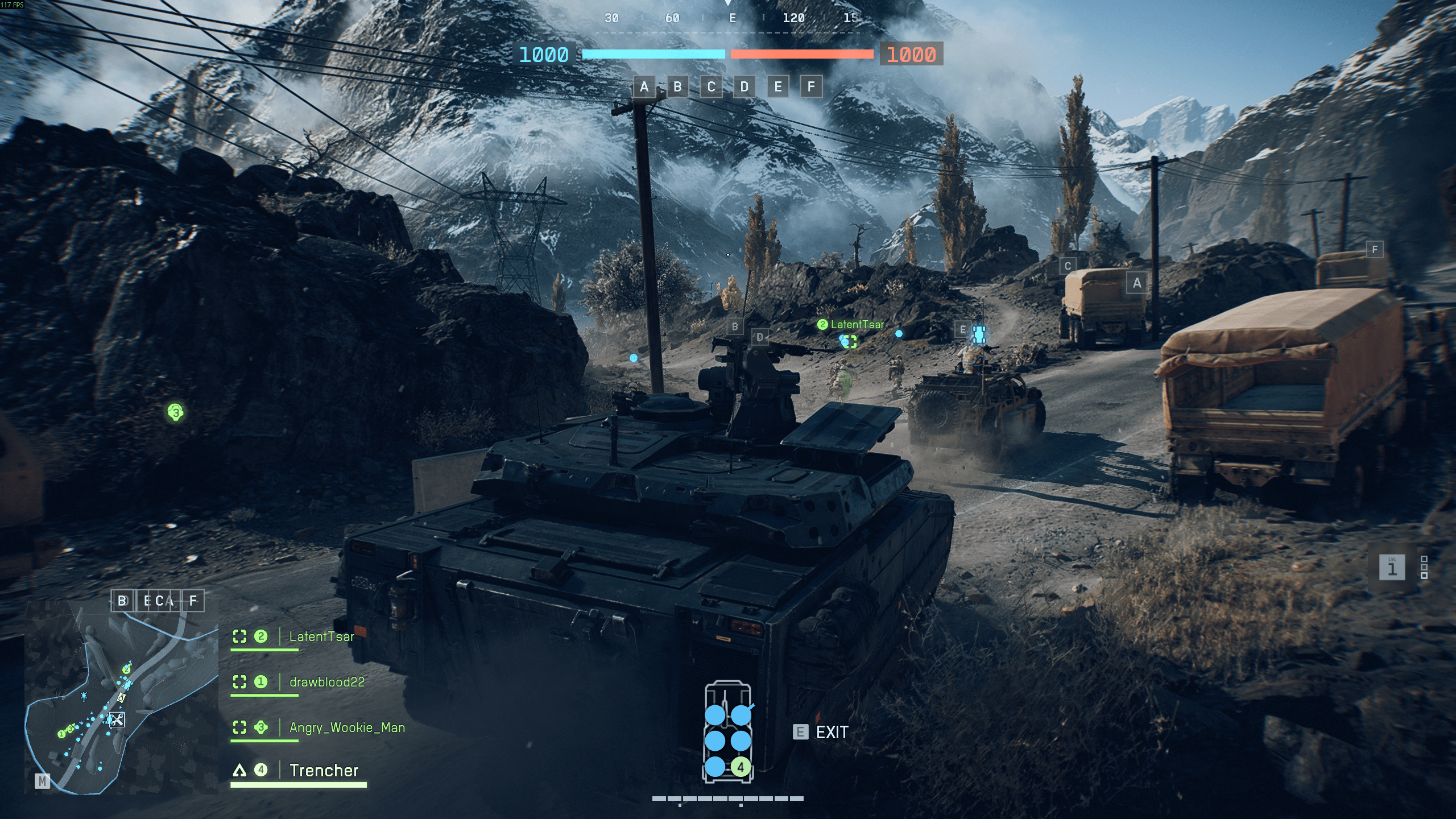
Hitching a ride to the frontline in the BF6 open beta.
“Hitchting a ride to the frontline in the BF6 open beta.”

While I’ve mentioned it once or twice here over the years, I’ve never gone into my absolute adoration for Battlefield 1942. One fateful day a co-worker who I occasionally ran into, and probably the only gamer I knew of at that place, was telling me all about how he’d just started playing this new “Battlefield” game and was talking about how you could do anything from crew a tank, fly a plane, or even captain a battleship in these massive, crazy online battles. This sounded a lot like World War II Online, which I’d been intrigued by but was always intimidated by due to its reputation for having clunky, simulation-like controls, but he assured me that it played more like a typical first person shooter. I was skeptical but curious. After doing a bit research I concluded that I just had to try it out, and picked up the game in something around November 2002. It was apparently a good recommendation, as I put an unspeakable amount of time into its multiplayer between 2002 and 2003, and even recruited a lot of other friends and co-workers to the cause. While I played a ton of mostly asynchronous “door” games like Legend of the Red Dragon on dial-up BBSes, Doom modem to modem, and Quake on the Internet in the 90s, apart from the very different Ultima Online, BF1942 was the first online game I was utterly obsessed with.

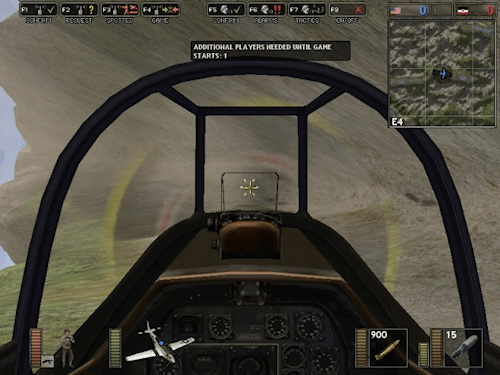
I was partial to infantry roles and focused on *gasp* playing the objectives, which in its default Conquest game mode, was kind of the point. I’m not a total dork though – I always enjoyed abusing tanks when one happened to be available too, of course. I also remember going out and buying a new flight stick so I could better handle the game’s relatively simple but fun to fly aircraft, and while I was never the best pilot out there (to this day, there are some people that have legitimately scary levels of skill when it comes to flying in these games) I more or less mastered the bonus Coral Sea map and would consistently clean house on it. F4U Corsairs and Zeros winding around those hilly islands is a core gaming memory for me, and I even made my own dog fighting map, filled end to end with huge mountains and massive valleys to make those kinds of pursuits even more fun. It also inspired me to take one of my first stabs at video editing, putting together a video of me dog fighting on Coral Sea in the pre-YouTube days. Unfortunately I’d have to strip out the sick Iron Maiden soundtrack if I were to upload it anywhere, plus the video quality is likely beyond abysmal by today’s standards.

Flying through a canyon (sideways) in my crappy BF1942 map.
“Flying through a canyon (sideways) in my crappy BF1942 map.”

Probably reading about it on a Battlefield forum or a gaming news site, I ended up joining a semi-private tournament community called Battle for Europe. The basic idea behind BFE (and the other communities I’m about to mention) was actually kind of simple – add a persistent, progressive campaign around Battlefield 1942’s already huge battles. The fact that the game included maps representing battles all around World War II and players could pick from axis and allied forces meant all you’d need to do is organize regular matches, keep track of losses and victories, and tie it all together with a Risk-like campaign map. It was a great idea, though it might sound quaint these days since persistent player progression is now fairly standard, and while the Battlefield series may not have any sort of long term campaign progression, other games like Foxhole and the aforementioned World War II Online have done this to varying degrees too. (Editor’s note: For posterity, it’s worth noting that BFE was probably better known for applying this concept to other World War II games released around that time such as Day of Defeat and Call of Duty, and ran for several years after this.)

The battles themselves were absolutely epic! We filled out the 64 player slots on our server, plus extra observers, and had a ton of people on standby. How did we account for having more than 64 people in the community who wanted to play? Easy! We made the matches last as long as possible and ran these battles all day. Literally hours on end, with the idea that players could tag in and out, ultimately supporting a lot more players, and across multiple timezones to boot. As a whole our player base represented a wide variety of skill levels, though of course most of the types of people who’d join a dedicated community like this were at least above average, and the battles would be correspondingly vicious. While not quite a “milsim” or realism community of the sort that would later become popular with a variety of military shooters, we also had a player ranking system in which players could advance, as well as take on particular roles which, given the limited number of vehicles and need for a well balanced roster, was also a must. Leadership was especially vital if your side actually wanted to win, and I soon found myself being promoted to a squad leader, and then to an NCO role where I was in charge of something like 50 players. Speaking of, strategy was an interesting aspect of these long matches, as unlike a typical clan versus clan league or tournament match, there was way more than enough time for the other side to figure out exactly what you were doing and adjust to it, which made active leadership all that more important.

Creeping up to an enemy spawn in a BF1942 WGO match.
“Creeping up to an enemy spawn in a BF1942 WGO match.”

The reasons were a bit hazy at the time, never mind today, but there was a growing air of discontent around much of the BFE BF1942 community leadership, and as is often the case, there were people who had their own ideas of how they could do the whole thing better waiting in the wings. Several of the more vocal community members banded together to leave BFE and “roll their own” calling it War Games Online. With many of those involved being people I liked and respected, I was asked and accepted to come along for the ride, thus becoming one of the founders and administrators of this new community. I also signed up to help with the development of our new site which we had some pretty cool ideas for, such as an interactive campaign map. While this would take some time, we went ahead and launched our first campaign as something of a proof-of-concept. I still have fairly visceral memories of at least one intense and chaotic match on one of the semi-asymmetrical Road to Rome maps, which were new at the time. Sadly the whole thing went a bit pear shaped pretty quickly due to the head of our new community suddenly stepping down. As he wanted to maintain the WGO name, the rest of the leadership council spun it off into yet another new community called Global Conflict. I was starting to play Battlefield 1942 less and less by this point thanks to other distractions (namely Planetside) and I bowed out very early into GC’s life. While I ultimately had very little influence on what Global Conflict would become, it lived on through various games and is still around in some form today, which is very cool to see.

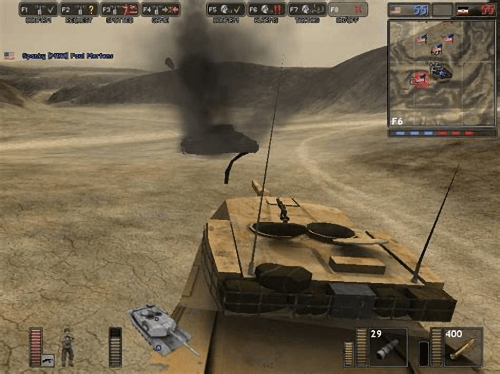
All that, and I didn’t even mention the fantastic Desert Combat. Desert Combat was a massive total conversion mod that introduced a ton of new weapons, vehicles, and maps to the game, shifting its focus from World War II to a now very familiar modern setting. While I never played it in any organized way, I spent a huge amount of time with it, and have especially fond memories of huge, immersive tank battles in desert maps, and there was absolutely nothing like hunting ground targets in an A-10 or SU-25 on the classic BF1942 map El Alamein. (Editor’s Note: Like many old games and mods, even ones as popular as Desert Combat was, there’s little detail online about it, though I stumbled upon this excellent series of posts about the game that I can’t help but to share – Part 1, Part 2, Part 3, Part 4)

I loved tank battles in BF1942 but there was nothing like Desert Combat.
“I loved tank battles in BF1942 but there was nothing like Desert Combat.”

Another reason that Battlefield 1942 (and Desert Combat) is important to me is that it is a rare example of my dad really getting into a game. My dad’s taste in games has always been totally enigmatic to me. Simply put, certain seemingly random games over the years have really grabbed him, but attempts to understand his tastes and turn him onto other, similar games has usually been met with a lukewarm response at best. He’d always been a World War II nerd, and as I was still living with my parents at the time, I showed him BF1942. Not only did he think it looked cool, but he watched me play round after round, eventually asking me to let him play, which then became a regular thing. This was kicked into overdrive when I showed him Desert Combat, and one evening coming home from work to find him on my PC playing a match. My dad barely touched computers, so the fact that he figured out how to get online, start up Battlefield, and get into a match all by himself was kind of shocking to me. Some time later I built a new computer for my brother which came with the added bonus of enabling my dad and I to play together. With one of us driving/piloting and one of us gunning DC’s various helicopters, planes, and tanks, mowing down endless hordes of bots was a hell of a lot of fun.

Around the time my excitement for Battlefield 1942 started to wane Planetside came into my life and in most ways supplanted it, though there was a brief time some months later when I got a little burnt out on Planetside and decided to go back to Battlefield 1942, even trying out for a semi-sweaty clan called The Devil’s Brigade. They had kind of a template for how they’d assess potential new recruits, running me through various exercises that involved things like attacking a small bunker with multiple clan members defending it, and inversely, attempting to defend solo as they relentlessly attacked it. While my skills probably peaked before quitting to play Planetside, I was still pretty decent at the game, and it was actually kind of a thrill to be tested like that. I recall doing so-so overall, though I wasn’t exactly sure how well I was supposed to do in these scenarios, and I got quite a few kills against other members of the clan that I thought would be sure to impress, and sure enough, I was accepted. They seemed like a cool group of guys and I was really looking forward to playing with them, but I also felt like I owed my loyalty to my existing friends in my Planetside outfit, The Praetorian Guard, more than any potential new ones there, resulting in having a change of heart and regretfully bowing out of TDB before putting much time in with them at all.

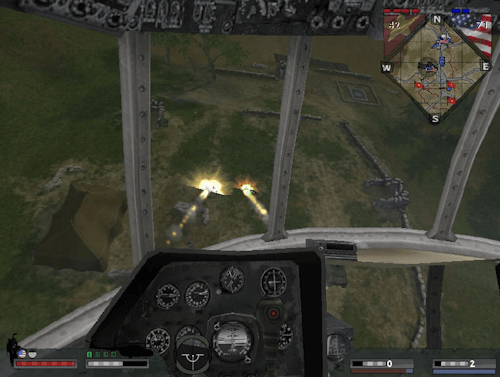
Choppers were freakin' everywhere in Battlefield Vietnam.
“Choppers were freakin’ everywhere in Battlefield Vietnam.”

After TPG’s original stint as a Planetside outfit slowed down, we were constantly dabbling in various other games together, sometimes in a fairly organized way, but often times we’d just all just squad up and hop into public games, not really employing all that much teamwork or anything. When Battlefield Vietnam was released in 2004 I and several others in the clan were hyped enough for it to pre-order it or otherwise grab it on launch day, and we played it together as a semi-disorganized group quite a bit. Unfortunately there was something about Battlefield Vietnam that just didn’t gel right for me. I don’t know what it was – the map designs, the asymmetrical armies, the particular combination of vehicles and weapons, the helicopter controls when compared against DC’s, subtle changes to the engine, or maybe some odd mix of all of those? Of course, I know it’s one of the more fondly remembered older titles in the series so I’m not claiming to be in the right here, but I really only kept playing it to play with my friends, with a dwindling hope that maybe something would eventually click.

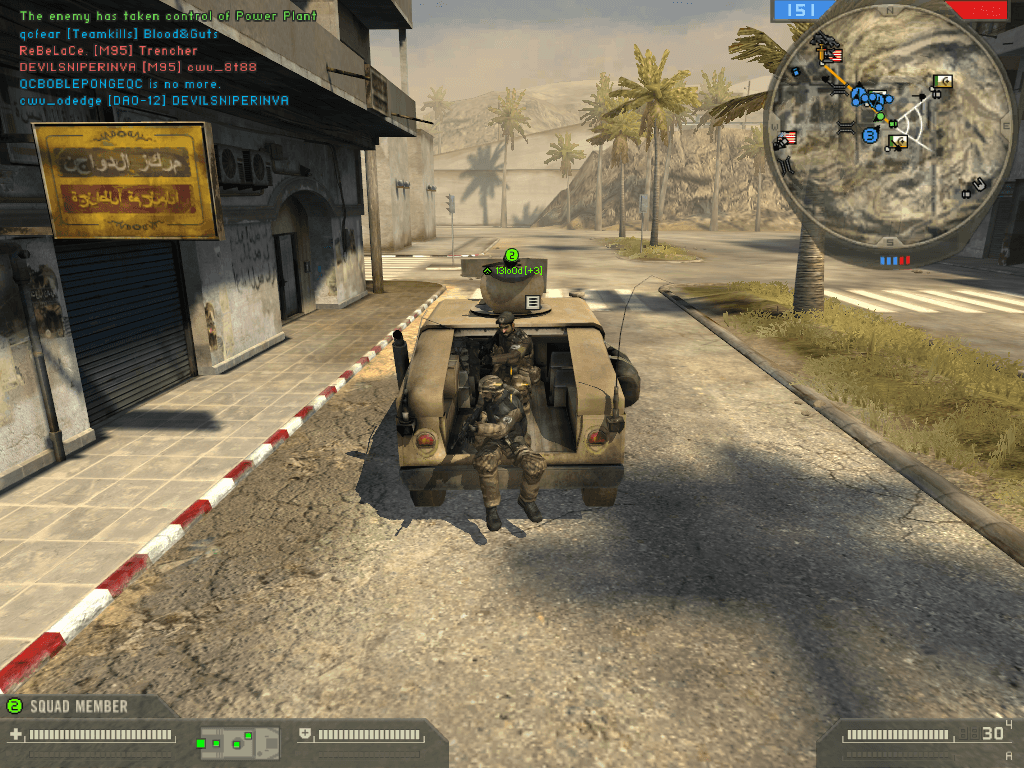
Hitching a ride with my old TPG buddy Blood in BF2.
“Hitching a ride with my old TPG buddy Blood in BF2.”

It’s a similar story with Battlefield 2. I was extremely hyped for an official DICE take on what we got earlier with Desert Combat, especially since the guys who made DC would be helping out, and there were a lot of undeniably cool enhancements to the engine and the gameplay in general, including a new squad system, persistent player progression (which would be a staple of the series from that point on) and the introduction of the RTS-like commander mode that saw one person on each team giving orders, dropping supplies, and otherwise attempting to direct and assist the fight from afar. When the Battlefield 2 demo built around the Gulf of Oman map dropped, a few of us played it like absolute madmen and really, really dug it. When the full game was released, most of the core members of TPG dove in as well, though it ended up not hooking me to anywhere close to the level I expected it to. Looking back now, I honestly don’t remember why that was – perhaps it was a similar situation as with Battlefield Vietnam, though I also have some vague recollections of having some technical issues with the game that might have kept me from playing as much as I wanted to. As an aside, I did briefly return to BF2 years later to play with some of its bigger mods, as mentioned here.

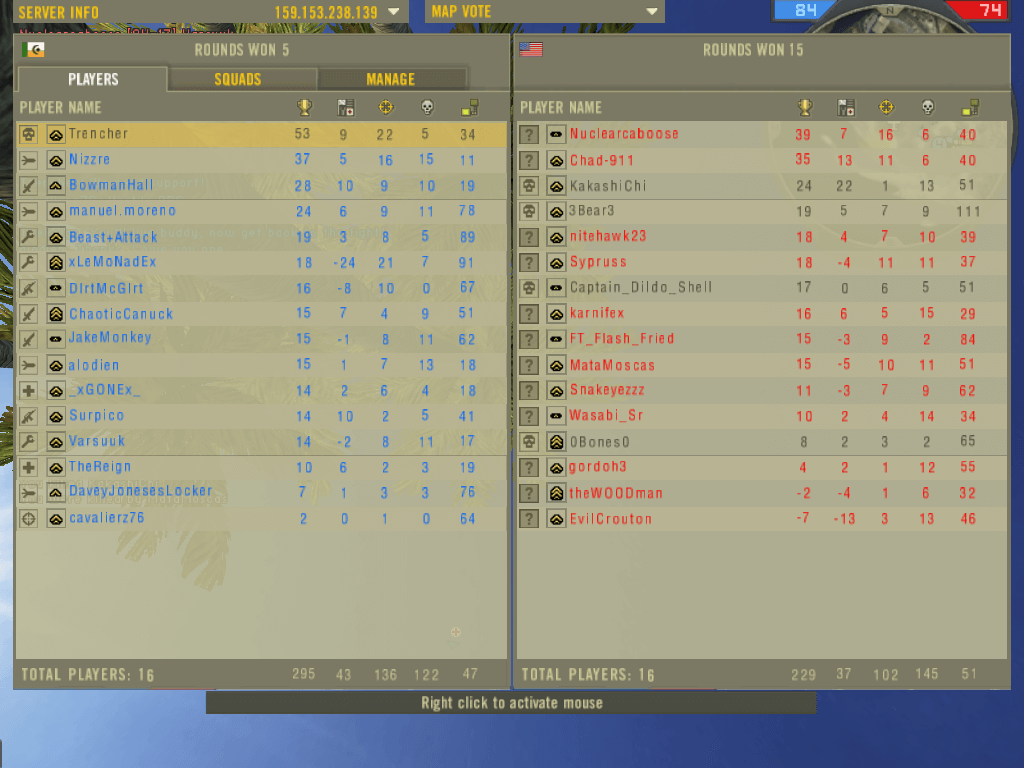
Look, proof that I didn't totally suck at Battlefield 2!
“Look, proof that I didn’t totally suck at Battlefield 2!”

I skipped the BF2 follow-up/spin-off Battlefield 2142, despite the fact that, given my love of the similarly sci-fi heavy Planetside, you’d think I would have been all over it. In fact, to this day I’ve still never played it. Not long after this, I started cutting way back on PC gaming and focused a lot more on console gaming, particularly single player games. I’d played the demo of Battlefield 2: Modern Combat on my Xbox 360 after watching a friend play it and thinking it looked pretty cool, but skeptical of Battlefield’s place on console, it wasn’t until Battlefield: Bad Company’s single player campaign that I gave it a fair shake. I dabbled with its multiplayer as well as its Xbox Live Arcade spin-off Battlefield 1943, as mentioned here, but I was a little late to the party on that one, and my Battlefield 1942 skills didn’t survive the transition to being played on a controller in any case. I fully intended to play through BC’s sequel’s campaign as well, though it wasn’t until I found out that it had become the flavor of the month online game for a lot of my old TPG friends that I picked it up on PC and joined in.

Battlefield: Bad Company 2 felt like something of a return home for me. The maps were smaller and less chaotic, with smaller player counts, yet perfectly balanced the map sizes, player counts, available vehicles, and all kinds of nifty new counters. It also focused on the more linear Rush mode over the series staple Conquest, which worked really well with that particular formula. Throw in a simple player progression and weapon unlocks system, and the awesome Destruction 2.0 and, man, it was a ton of fun. While BC2 was much more of a fun diversion for me than an obsession like with Battlefield 1942, I racked up a good 20 hours or so of multiplayer and have a lot of fond memories of playing it. I do still need to go back and play that campaign one of these days, though! As a quick aside, I recall being intrigued by the launch of Battlefield Heroes, a title that often gets left out of these kinds of retrospectives, but alas, I never actually got around to trying it. I thought it looked kind of neat though.

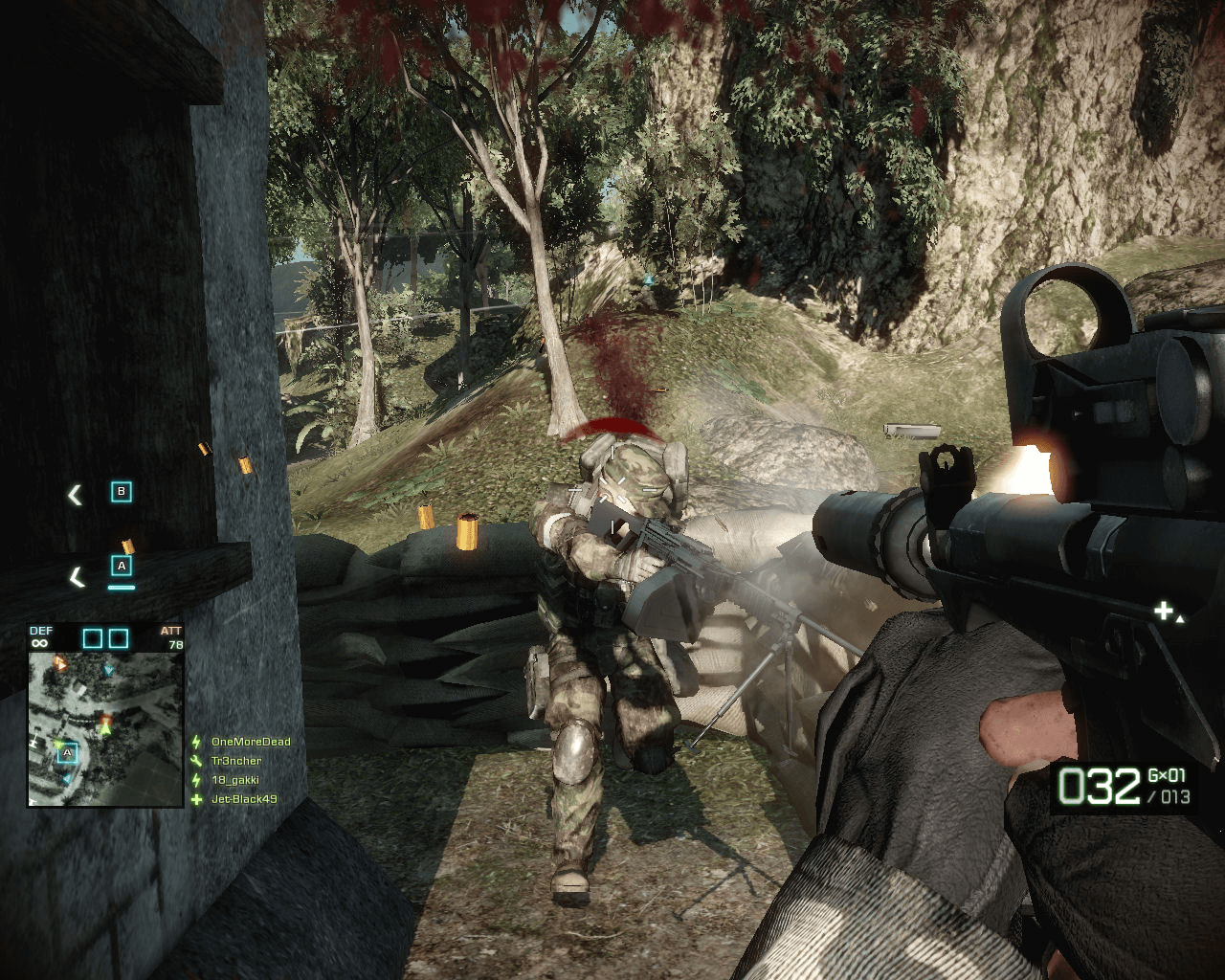
Man, I miss Bad Company 2. This dude was too close to miss, though!
“Man, I miss Bad Company 2. This dude was too close to miss, though!”

Somehow, the impressive looking Battlefield 3 with its more realistic models and animations, added cinematic flare, and a post-Call of Duty 4: Modern Warfare overhaul of infantry movement and gunplay didn’t reel me in when it was released a few years later. I think this is chiefly because I wasn’t gaming that much at the time, and when I was it was still usually focused on more single-player experiences on console. That, coupled with a lot of highly publicized technical issues at launch and that few if any of my friends were playing it, meant I gave it a miss entirely. The story is exactly the same for Battlefield 4 and the odd cops and robbers spin-off Battlefield Hardline. I thought all of these games looked cool, but I was increasingly feeling like the Battlefield series was no longer for me. Looking back, I can’t help but wonder what I might have missed by skipping those games, especially since 3 and 4 are always mentioned as points of comparison when discussing the series these days – I’ll probably at least go back and play through their campaigns one of these days.

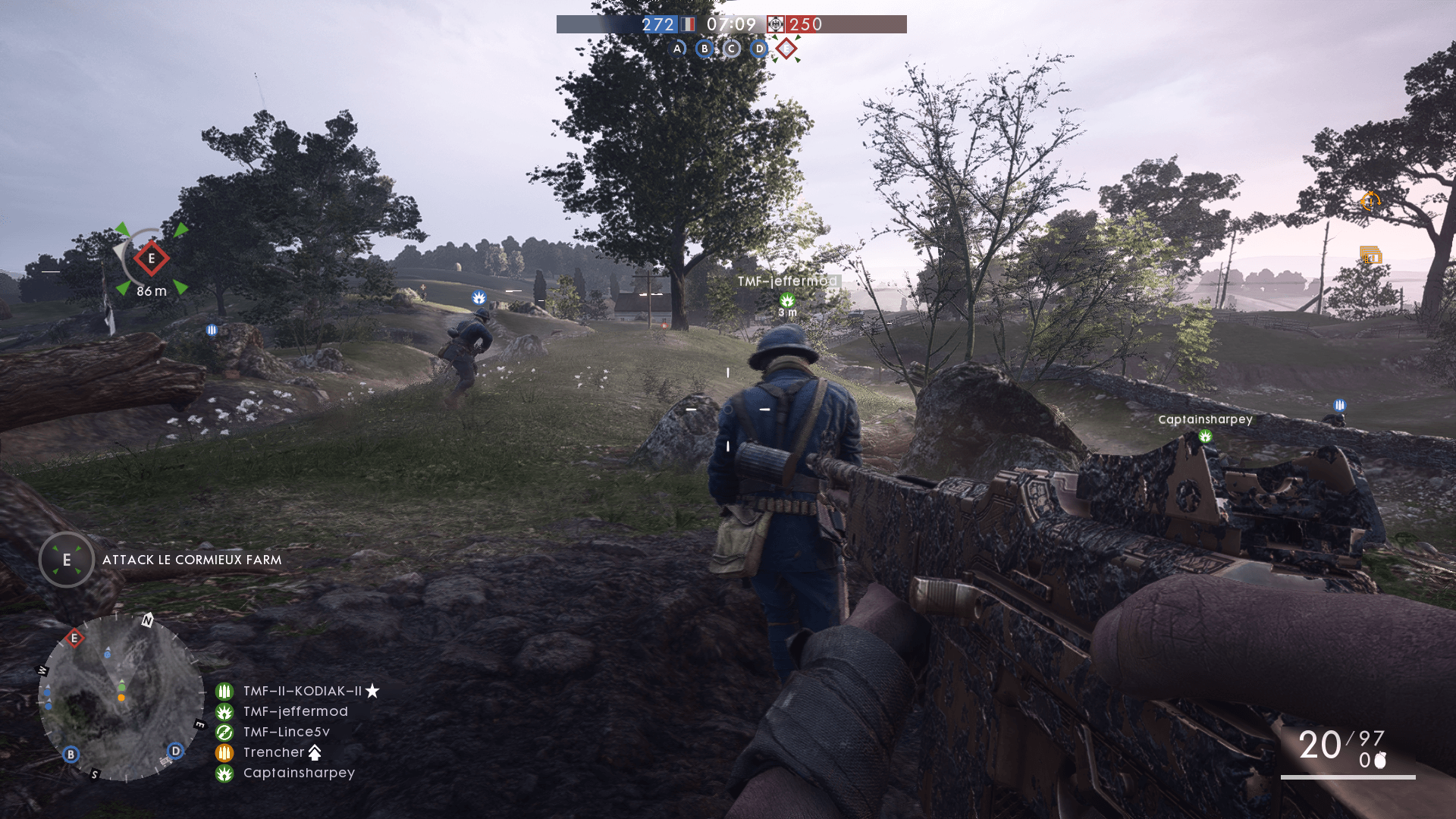
Battlefield 1, however, really caught my attention, and it just so happened that I’d built a new PC around the same time as its pending release and was itching to do some legitimate PC gaming, and a lot of my old TPG friends were jumping into it too. Between that, and the fact that the game was actually really good, it was the first Battlefield game since BC2 that I spent any quality time with. It wasn’t perfect – I’d have preferred another World War II title to a Battlefield set in World War I when everyone is anachronistically running around with automatic weapons, and I generally didn’t love the weapons and vehicles as a result. Still, it had more than its fair share of uniquely awesome Battlefield series moments. Similarly to BC2, I wasn’t crazy addicted to it, but it did become my random pick up and play online game for a while there, temporarily unseating Planetside 2 from my rotation.

Over the top, boys! Probably seconds away from death in Battlefield 1.
“Over the top, boys! Probably seconds away from death in Battlefield 1.”

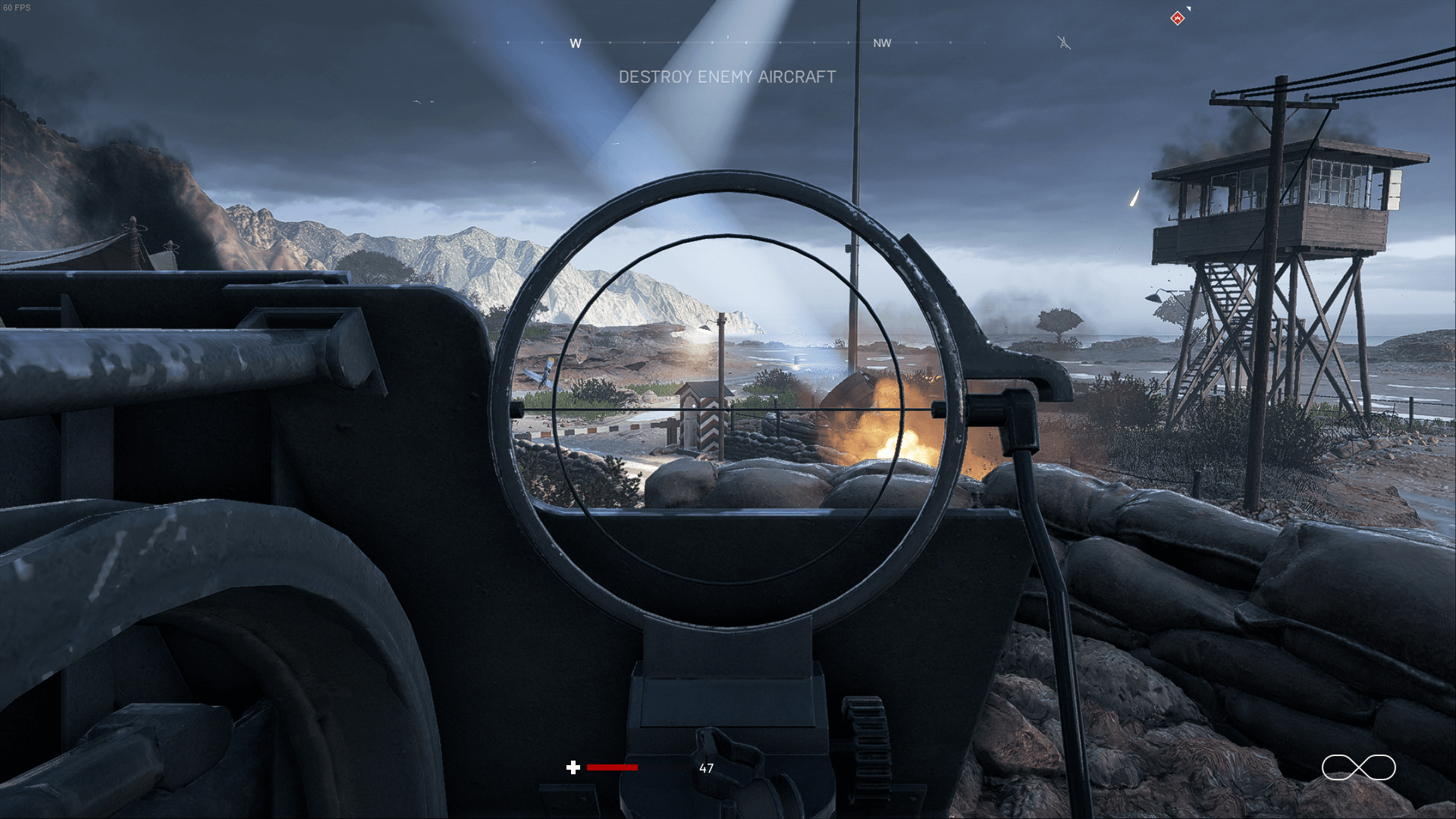
Like a lot of people, I was initially very excited for Battlefield V’s long overdue return to World War II, but then very concerned when EA released the reveal trailer featuring a mismatched squad of resistance fighters rather than your typical uniformed grunts, and graphics so bright and colorful that were, compared to Battlefield 1’s often dreary environments, absolutely retina scorching. That, and the marketing of the game focused on a female sniper from the group with what looked (at a glance) to be a bionic arm, which left me scratching my head. No, I’m not going to cry about female characters and minorities like a lot of Battlefield V detractors, but it did make me question what tone DICE were going for with V. It was feeling like it might be more of a less serious, perhaps even alternative history take on World War II, and combined with the news that it would include a Battle Royale mode and some of the other details coming out, such as “Elite classes” hinting at a more hero oriented system versus the generic classes of old, it really made me skeptical of the entire game.

Randomly feeling the urge to play some Battlefield, I actually ended up picking up Battlefield V super cheap during a Steam sale just last year. I played a couple of single player campaign missions as well as put a few hours into multiplayer, and I surprisingly really enjoyed what I played. Mind you, this was after years of patches to fix the game’s issues and dial back a lot of the more controversial changes, but I can’t help but think that this game was mostly a victim of a now seemingly misguided marketing push to make the game more attractive to Fortnite Battle Royale players coupled with the ensuing hate campaign made up of gamers all too happy to leap onto the bandwagon to trash the next big EA game. I’d always intended to go back and finish the campaign and play some more multiplayer before writing about the game, and hopefully I still will one of these days.

About to mess up some Messerschmitts in Battlefield V's campaign.
“About to mess up some Messerschmitts in Battlefield V’s campaign.”

Somehow even more depressingly, Battlefield 2042 went right over my radar upon its release in 2021. After the somewhat troubled release of Battlefield V and a rather rocky initial reception due to a number of technical, marketing, and gameplay fumbles, including going even further down the hero shooter class rabbit hole with its new “Specialists”, it never really appeared on my radar either. At least, not until it had been patched and expanded so much that opinions on the game finally started to gradually shift, though as mentioned above, that just ended up resulting in me buying Battlefield V instead. Given that it didn’t have any sort of campaign, it’s likely that I’ll never check it out, but never say never!

So that brings us to August 2025, when rumors about Battlefield 6 started to appear, and then early but very positive sneak peak impressions and preview event impressions started to build up in short order, culminating in the announcement of an open beta. I couldn’t really ignore the hype any longer, and I decided to check out the beta, but more on that much later, when I’m hopefully talking about the game we eventually get at retail!

Believe it or not, most of these screenshots, even the really ancient ones, are mine. Apparently I don’t delete things enough!