My little co-op group occasionally takes breaks from the open world survival crafting games we normally focus on to play other things. Sometimes this is due to finishing one game and not having the time to properly dive into the next one that session, and sometimes it’s as more of an palate cleanser. As with Cleaning, Climbing, and Crime, I’ve got 3 more such games that we played relatively recently to cover.
MIMESIS is another “friend slop” game looking to capitalize on becoming a flavor of the week hit. While I don’t know how successful they were, the game is definitely interesting. At the risk of being offensively reductive, I’d describe it of combing the simple controls and pleasantly stylized graphics of something like the previously discussed Peak (but let’s be honest, thousands of other games too) with the basic gameplay conceit of an older and briefly very popular friend slop classic we haven’t discussed here before, Lethal Company. In a sentence, you and your group are sent into a creepy abandoned facility to scavenge while being harassed by whatever supernatural or at least paranormal entities lurk in the dark.
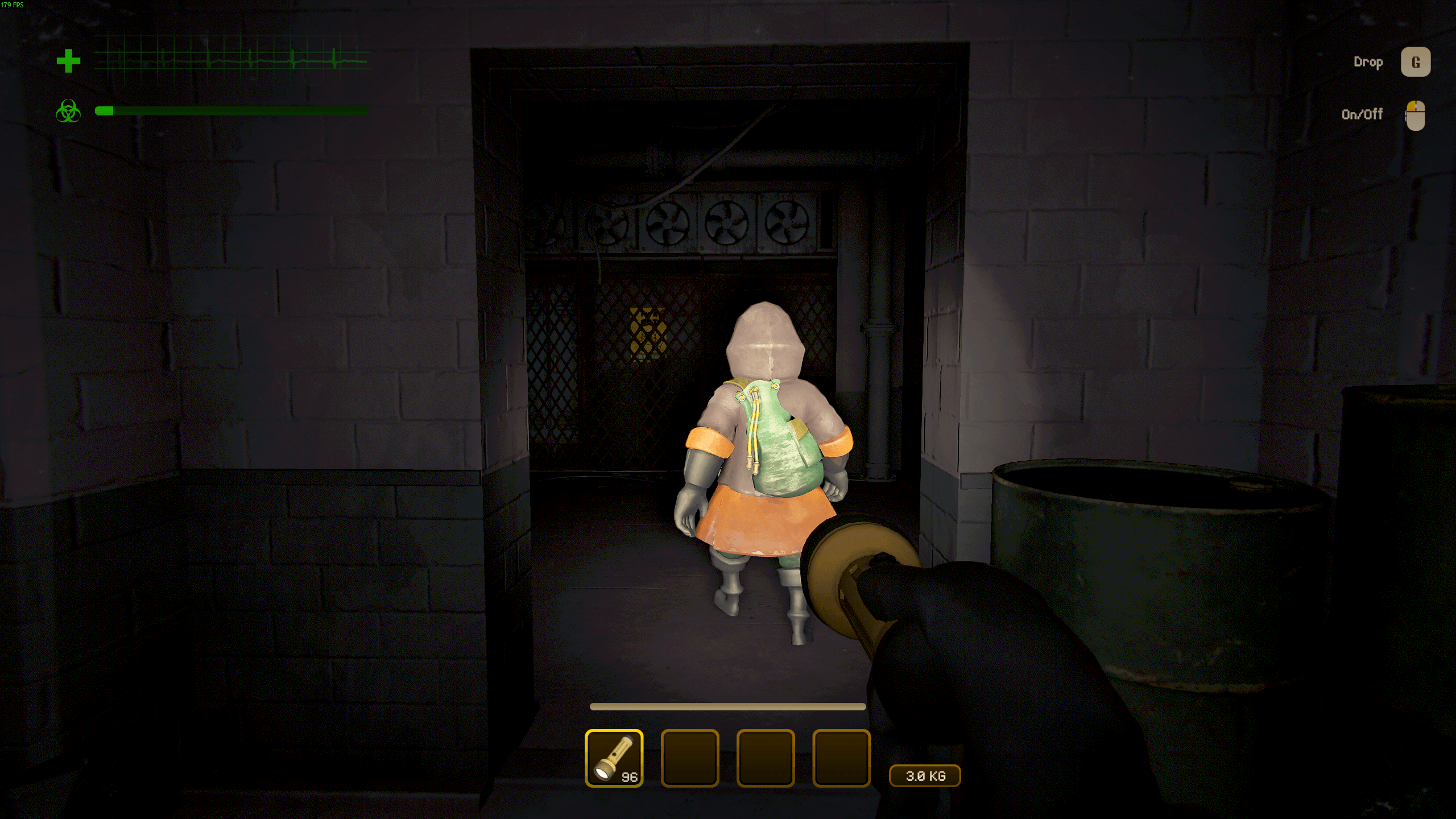
“Get used to this view.”
What sets MIMESIS apart is the clever way these “entities” are implemented. There’s something similar to Left 4 Dead’s AI Director going on, attempting to adapt to player behavior to for a varied and dynamic feeling experience regarding when, how, and what new entities and other events are deployed. In MIMESIS’s case, this also almost always includes a (usually gradual) escalation from the scares coming exclusively from the tension of being in a dark, maze-like environment and knowing that shit is eventually going to pop off, to utter chaos as you and your teammates end up getting split up, being chased by all kinds of terrible shit, and not knowing who is friend or foe.
That last part is key here, as there’s also a system in which some of these entities assume the identities of players, alive or dead, including attempting to mimic their behaviors and even repeating voice lines they said (which means for the best experience you should definitely be using the in-game voice chat.) In our age of LLM based AI this could get pretty sophisticated, though I don’t think what MIMESIS is doing is really is all that technically interesting. Instead, it often felt like dumb luck when just the perfect voice line was repeated at just the right time. In any case, it is highly effective in making people paranoid and thoroughly creeped out, and when things did get chaotic, it was some of the funnest, most hilarious moments I’ve had online in quite a while. Surprisingly, some of my favorite moments were after being killed and spectating on the remaining players à la something like Counter-Strike, only it’s much more entertaining to watch your remaining teammates frantically run around bumping into one obstacle after another, especially when that leads to interacting with your doppelganger(s) without a clue that you’re actually dead.
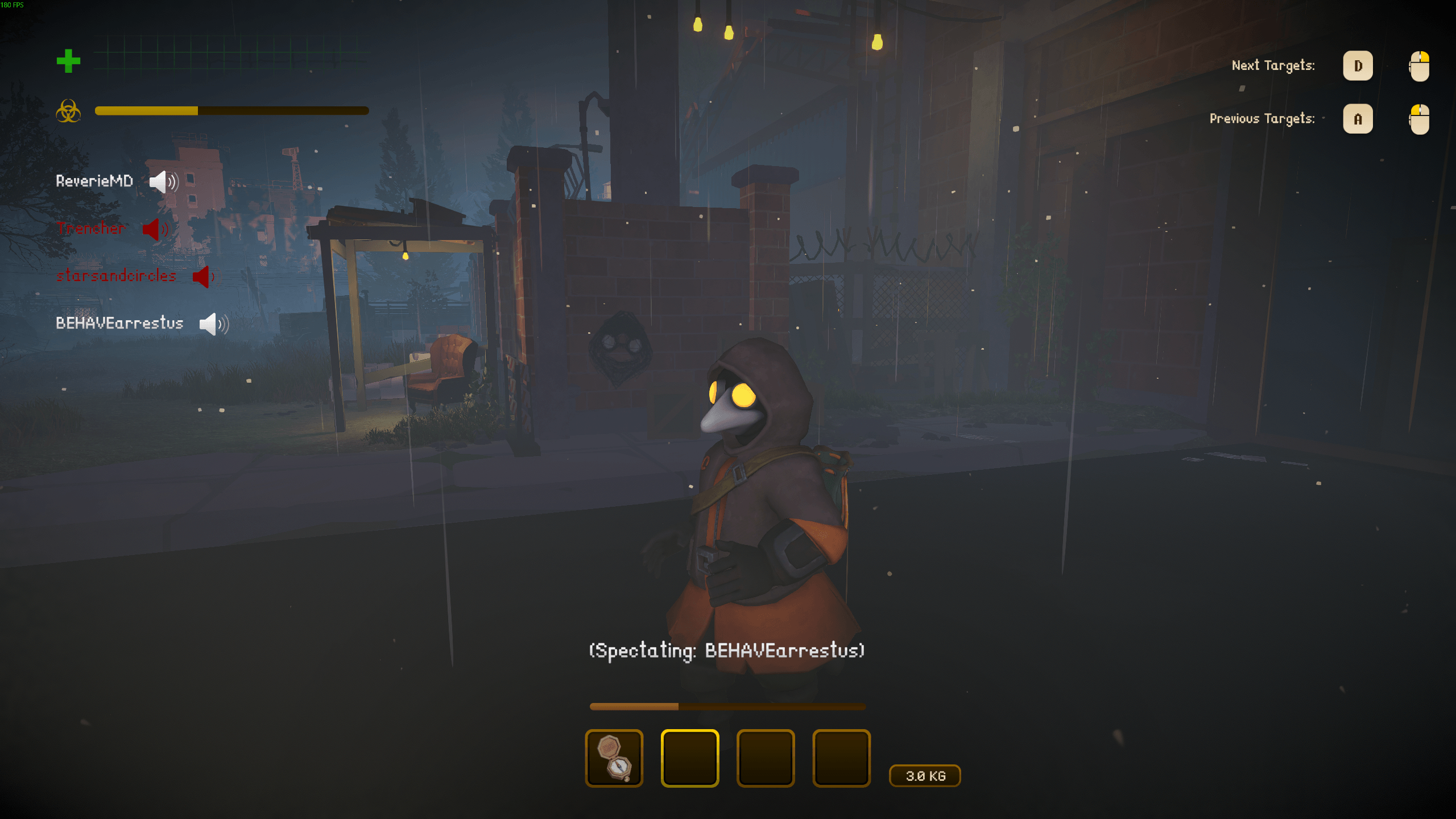
“Spectating another player as escape to outside.”
Naturally, there is a little hub area where you and your group can return to deposit your loot in between runs, buy some equipment and make other upgrades that persist to some degree, but this is an aspect of the game I can’t really speak to as after just a handful of runs across a couple of sessions, we all felt like we’d experienced what the game was about, had some fun, and were ready to move on. While I could see some groups sticking it out for much longer, it takes just the right game for our group to commit to something longer term.
Speaking of which, the next game is another “friend slop” game, and one we played for even less time. Super Battle Golf, as its name might suggest, is perhaps hard to even call a cooperative game. That is, it’s essentially a basic cooperative golf game, except all players go at the same time instead of taking turns, and you’re essentially racing against each other to see who can complete the hole first. As if that wasn’t chaotic enough, there are all kinds of funky items including Mario Kart like power ups you can find scattered around to make things that much more insane. There’s nothing like lining up the perfect shot to be suddenly run down by a golf cart, or similarly disrupting someone else by nailing them with a homing missile just as they’re about to take their swing.
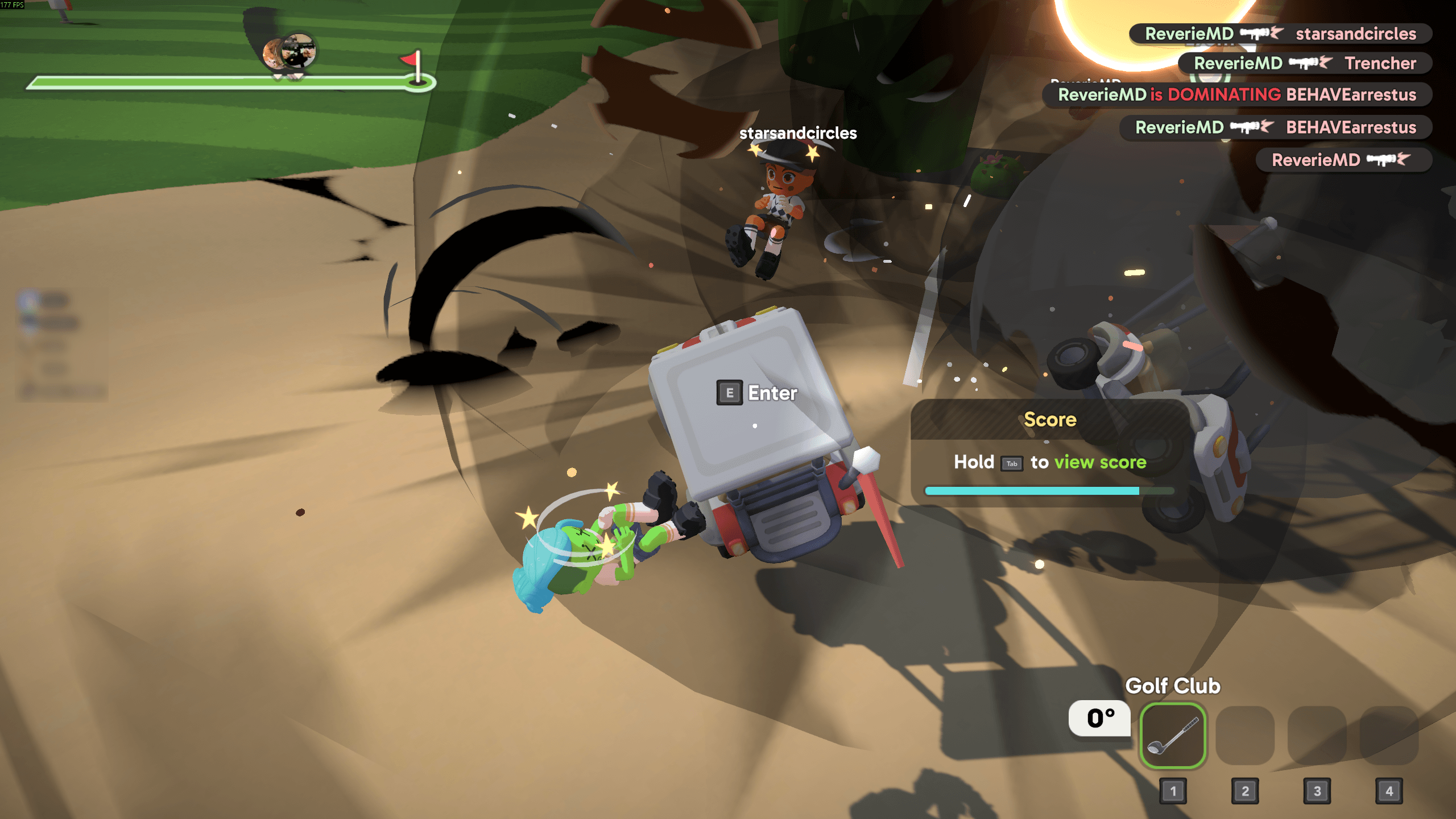
“The exact moment a rocket slams into a couple of golf carts. FORE!”
Super Battle Golf was definitely fun to screw around in, but had even less of a hook to keep us playing long term than games like MIMESIS or Peak, so screwing around for about 2 hours or so was all our time with the game amounted to. Still, it’s one I could see randomly going back to when we need to kill an hour or two. In fact, we choose this one due to having a fifth person join us that night and not wanting to toss them into the middle of a longer or more complex game. Objective achieved!
And now for something completely different, For the King II. One of our group had played through the first For the King game with a different group of friends and was itching to try the sequel. I thought it looked pretty neat, and it was definitely a different type of game than our usual survival games OR the kind of quick friend slop experiences we just covered. Instead, to me, it feels very much like it is based on some of the popular cooperative board games which had been making waves in the last 10 or so years. In particular, having only really played a little bit of the Jaws of the Lion version, it reminds me quite a lot of Gloomhaven, though there have been tons of vaguely similar fantasy RPG inspired board games over the years, such as the venerable Dungeon! and classics like HeroQuest.
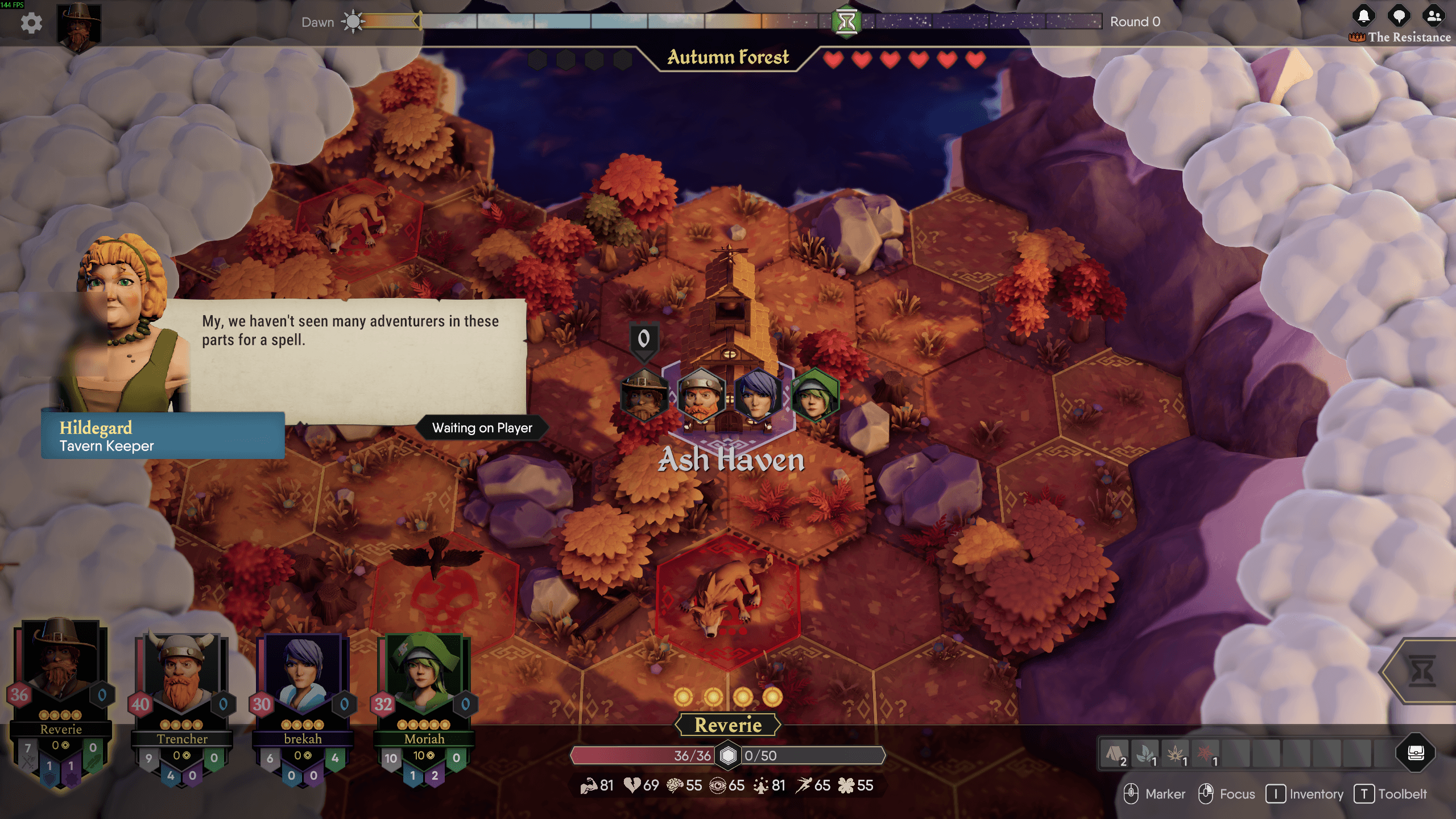
“The world map as we kick off a new adventure.”
To describe that in a little more detail, the gameplay is something like this: Each player picks a character/class archetype and some starting traits and equipment and then get thrown onto a hex based world map where they take turns moving to trigger fights, visit towns, and investigate events and other points of interest. At the same time, each adventure (essentially a mini-campaign based on a single world map) has its own story with its own victory conditions, and because of the magic of video games, this can feel reasonably dynamic, with NPC dialogs and plot events triggering, etc. Oh, and I almost forgot to mention that in something of a rogue-lite twist, your characters do not persist between campaigns, but you’ll unlock new traits and equipment, points of interest, and even new classes which you can use in your next campaign.
As an aside, the class system is pretty interesting, as it mostly only dictates a few special abilities and your starting stats. The rest of your abilities are determined by the traits you pick during creation, and the weapons and other equipment you equip along the way. This means while it might be optimal to have a high intelligence, magic aligned character use a magic wand or staff, you can kind of do whatever you want.
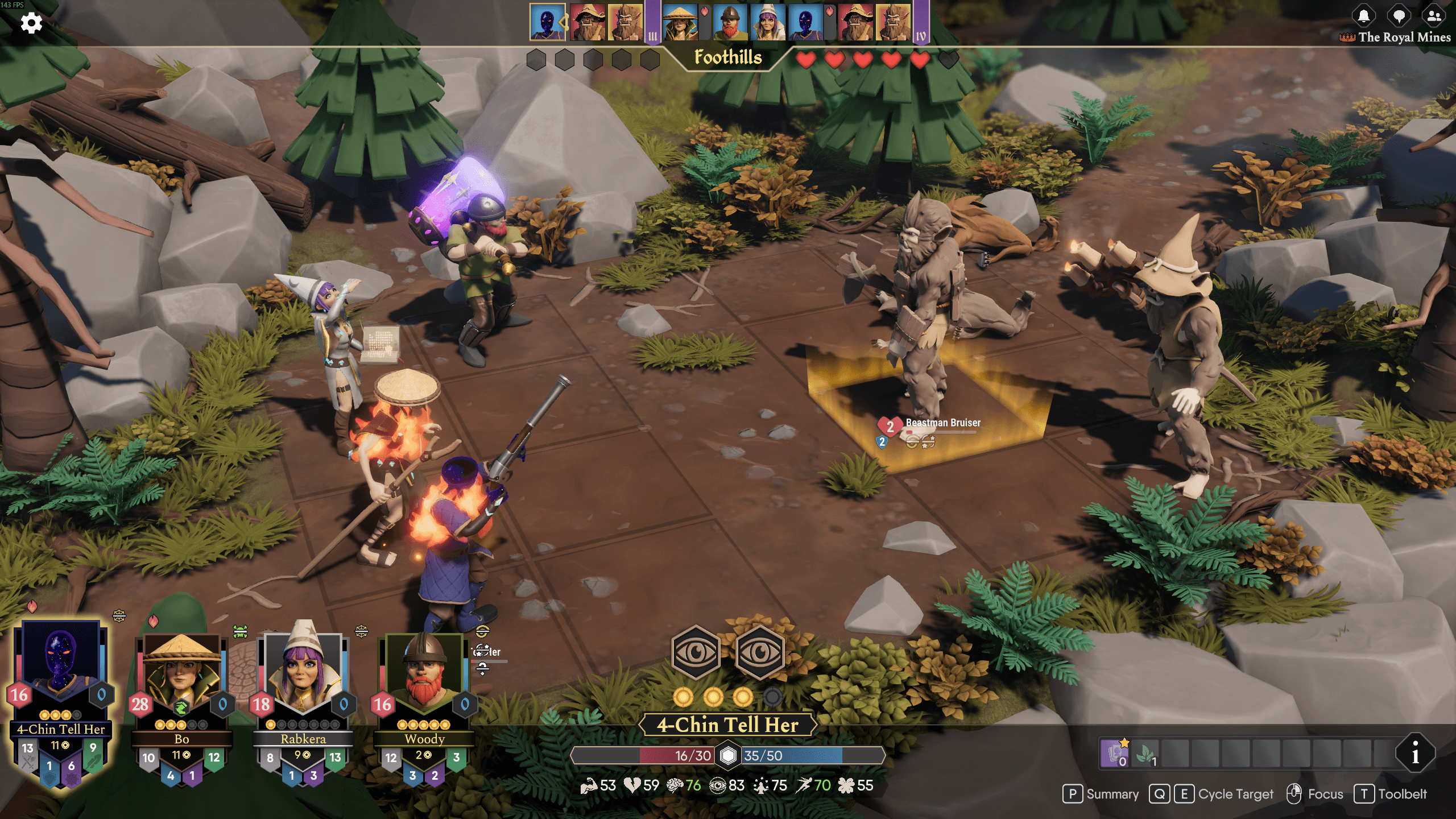
“Strikingly familiar turn based tactical combat.”
The combat in For the King II resembles that more of a traditional turn-based JRPG in which your group and the enemies you’re fighting are placed on a grid and cycle throw and initiative based sequence. Like those JRPGs, it can feel a little tactical, with positioning and choosing when is the best time to deploy what attacks, abilities, and items, being a big part of the equation. There are also dice rolls governing a lot of the aspects of this, though they’re not presented as obviously as some games. In fact, in many ways I was surprised how little For the King II actually leans into its obvious board game inspiration; it almost seems like its trying to hide it.
Most of these fights take place on the world map and need to be purposely triggered unlike the infamous random encounter trope most often associated with JRPGs, though there are also scenarios in which you might need to defeat multiple waves of enemies. There are also dungeons, which are similar but much longer and involve moving from room to room. Most of these rooms are fights, though there are sometimes other events, choices on which path to take, and opportunities to heal and rest between rooms.
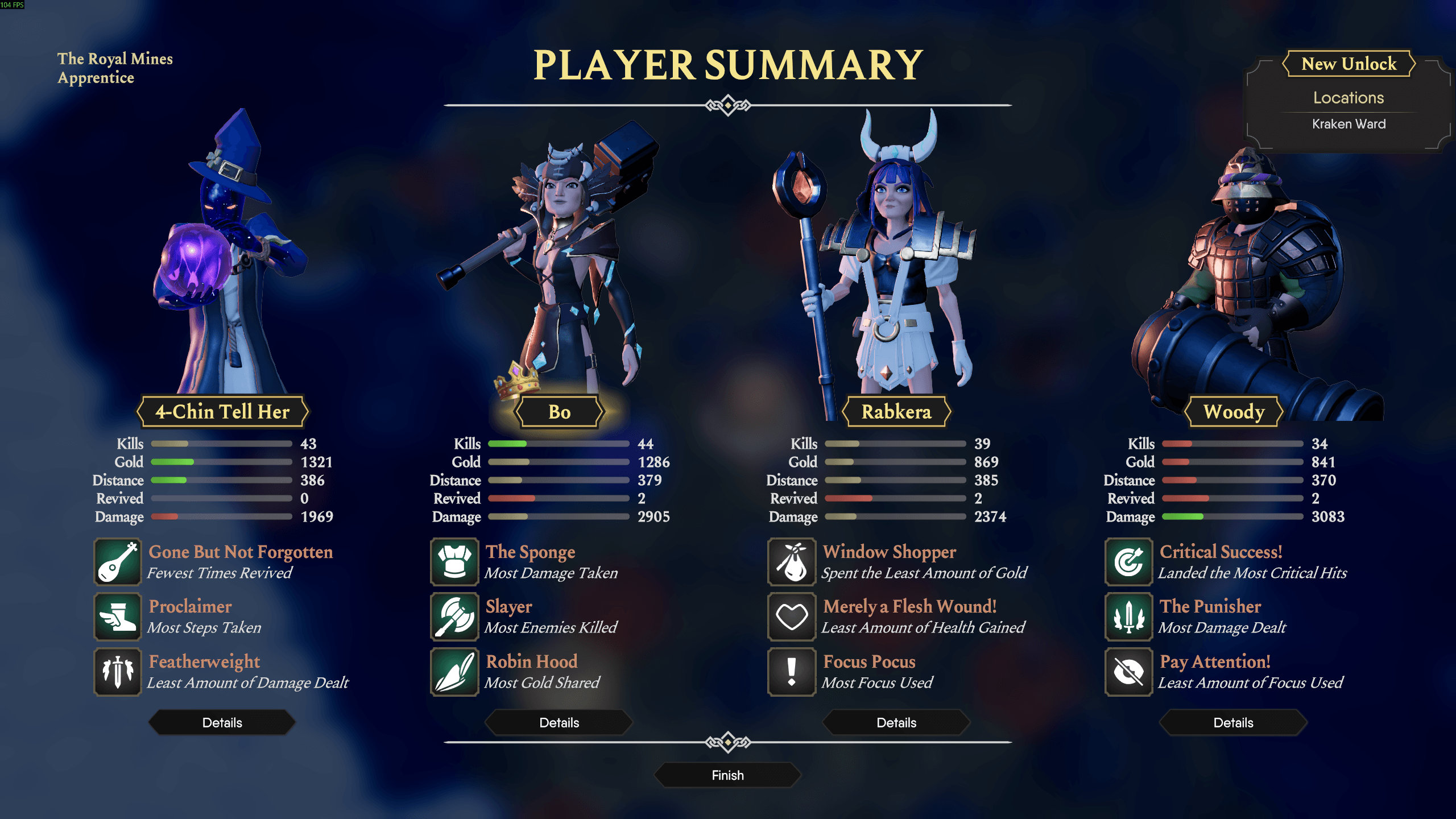
“The stats screen that comes with the successful completion of an adventure.”
I didn’t mention the aesthetics of the game yet, and I really should. The first For the King had a “mid-poly” style that looked quite nice. For the King II drops the mid-poly style and goes much harder into the cartoony style that was hinted at in the first game, while also further refining the overall look with some nice effects and polish. Overall, while relatively simple and certainly stylized, I think it looks quite nice.
There was a little frustration from my group around For the King II, but once we understood the gameplay mechanics a bit more (another thing it borrows from board game adaptations is its fairly unintuitive gameplay systems and atypical UI choices) and had experimented a little with different characters/classes, we started to have a lot more fun. If I recall correctly, we failed the first adventure twice, and then sailed through it and two or three more of them, clocking in something like 30 hours of game time. Personally, I had a lot of fun with the game and wouldn’t mind coming back to it, even if just by myself, though I think as a group, repetition had started to set in and we were ready to move on to something different.
Interestingly, the next game we tried ended up being similar in a lot of ways, but we’re still playing that one, so more on that later!