I don’t recall how it ended up on our list, but the next game my little weekly co-op group dove into was Atlas. Atlas is closely related to Ark: Survival Evolved in numerous ways, from its studio being founded by Ark’s founders, to some shared tech and gameplay systems. Instead of dinosaurs, Atlas is pirate themed. Pirates! While I haven’t played a ton of pirate theme games, I’m certainly not immune to the allure of the idea. Sid Meier’s Pirates is a bonafide classic, I got sucked into the idea of (and quickly bounced off of) Pirates of the Burning Sea way back in the day, and I’ve almost caved and jumped into Sea of Thieves numerous times now, for example. Glossing over user reviews, there was actually very little negative criticism about the game itself, instead the harsher reviews usually focused on the controversial way the game had been abandoned. That really didn’t affect us as we were going to host our own server and treat it like any of the other cooperative survival games we’d been playing.
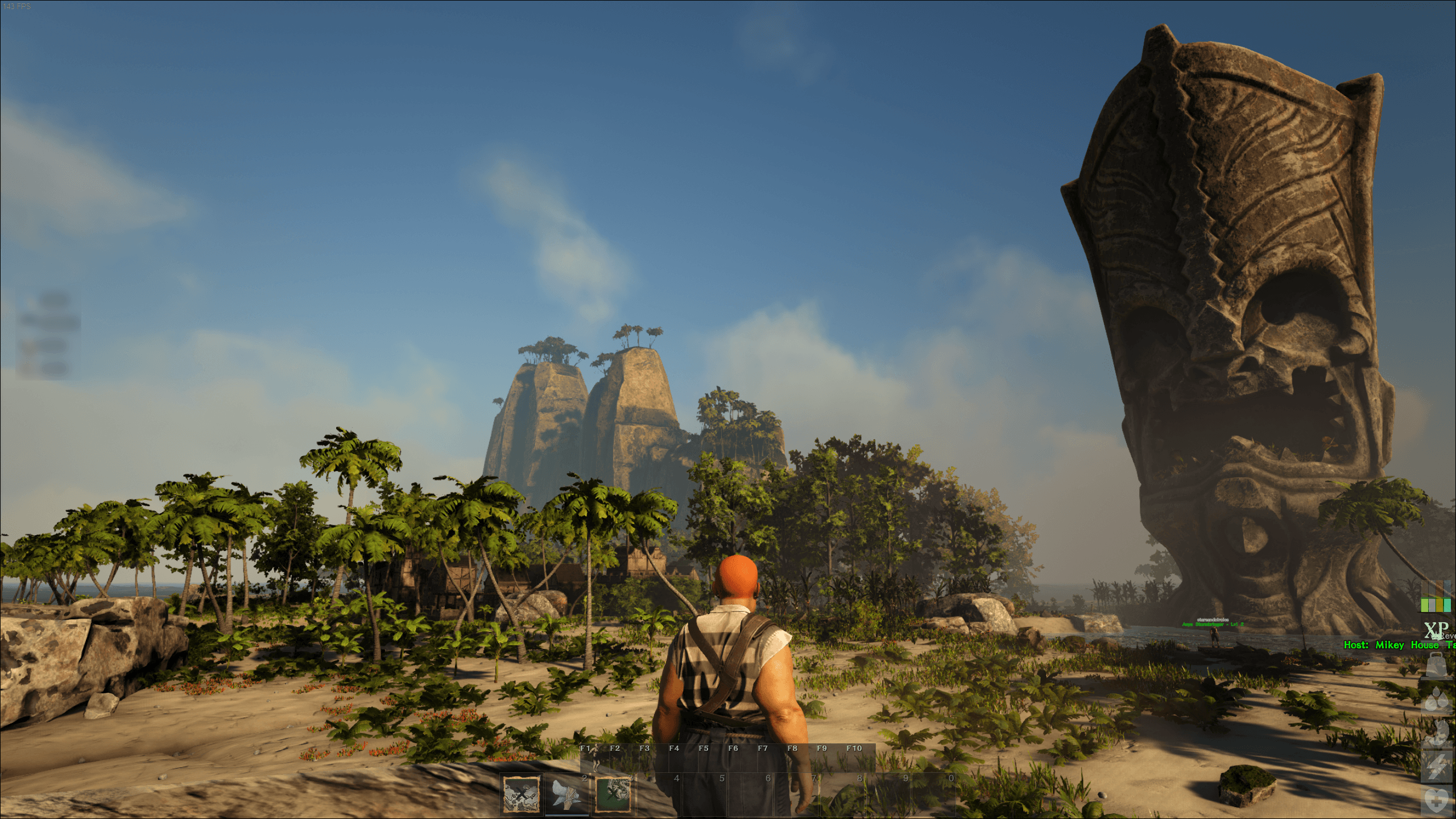
“Easter Island, eat your heart out!”
Except, it was pretty evident from our first few hours in the game that this was actually much more of an MMORPG-like experience than I realized. While the character creator was pretty neat, we were then dumped on a small island where we each had to do a bunch of tedious tutorial quests related to gathering x of y, running between NPCs, and killing groups of mobs; you know the drill. While progress seemed quite slow, it’s well documented that I’m a sucker for MMORPGs and the fact that we somehow accidentally got our co-op group into one was pretty exciting for what that could mean for future games if we actually enjoyed it. Eventually we managed to wrap things up on the starter island, get our first ship, and head into the high seas. Yaaaarrrrr!
Figuring out how to sail our ship was kind of fun, and the mysteries of the open sea, from storms and sea creatures to shipwrecks and floating loot, and at one point being chased by an incredibly intimidating undead pirate ship, was all pretty exciting. The first few islands we stopped at were literal copies of the starter island, which was… weird. Getting a little further away, we finally stopped at a legitimately new island and started to explore. This led to more gathering and crafting and some new stuff to fight, but honestly wasn’t much different than what we saw on the tutorial island. We then raised anchor and, maneuvering around more scary looking enemy ships marked on the map, set down onto yet another island. Exploring was kind of fun, but again, more of the same with not much in the way of new materials to gather, animals to hunt, or enemies to fight.
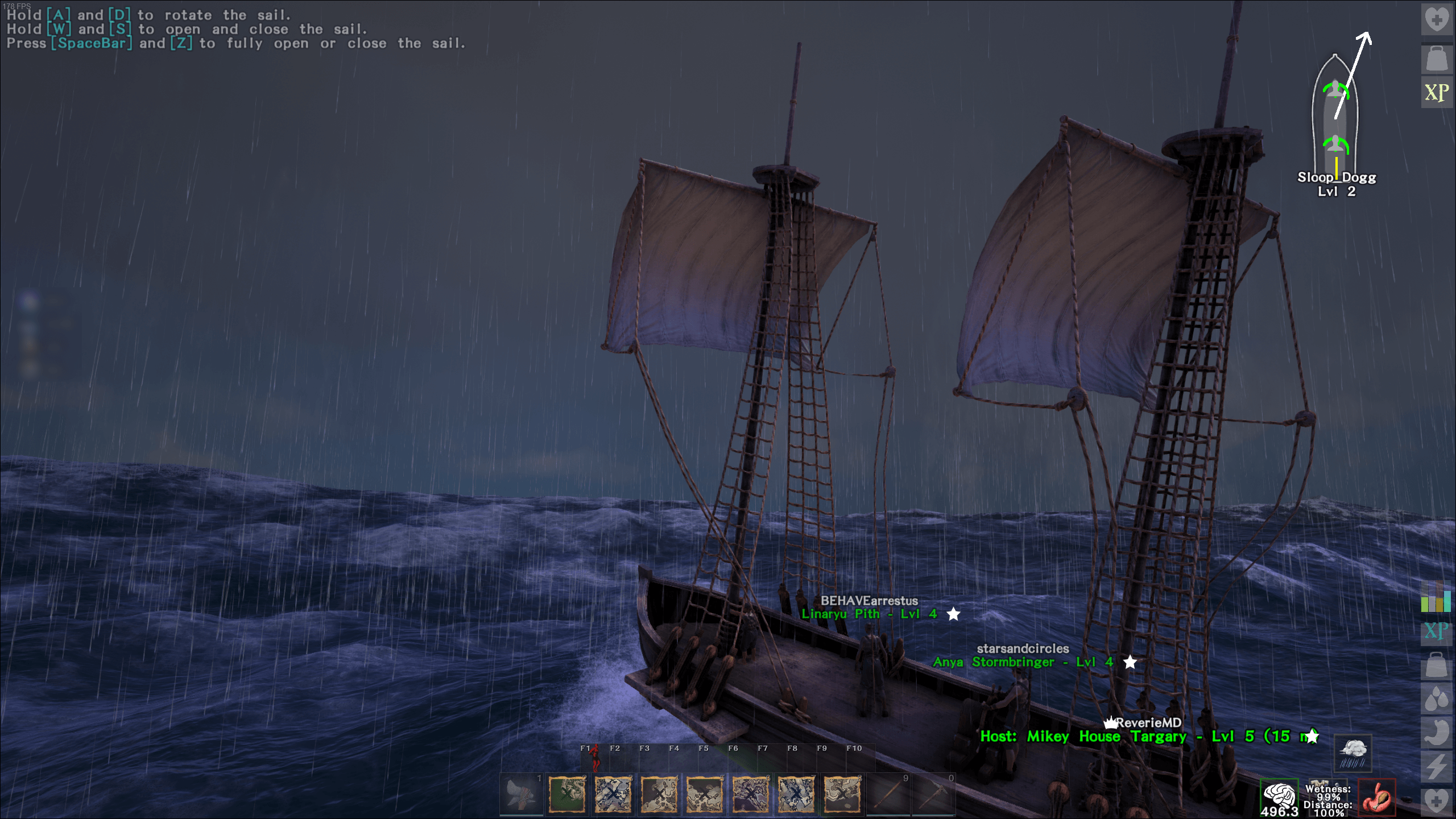
“Braving a storm at sea in Atlas.”
After only about 9 hours in the game, 2 of my group had decided they’d seen enough. Our time with Atlas wasn’t horrible, by any means, but the repetitive grind, occasional sharp spikes in difficulty, slightly janky feel, and lack of much a unique identity or any other hook to keep us playing soured the experience just a bit too much. Interestingly, since then Windrose, which looks a lot more like the type of game I thought Atlas was going to be, has hit early access with a lot of buzz. Maybe I can convince the crew to get back together and go a-plundering at some point in the future?
Next on the list is The Planet Crafter. The Planet Crafter was another game I wasn’t really familiar with, and with its simple conceit and cartoony graphics, honestly didn’t really sound all that interesting to me. You’re some sort of engineer who arrives on a planet’s surface and needs to manage oxygen, food, and water to survive, harvesting and crafting to build better and better technology along the way. Sound familiar? *yawn* In fact, that description makes it sound almost identical to Icarus which I talked about in Surviving Survival Tres. Except, as entertaining as it can be to be stupidly reductive, The Planet Crafter actually turned out to be one of the best survival games we’ve played together.
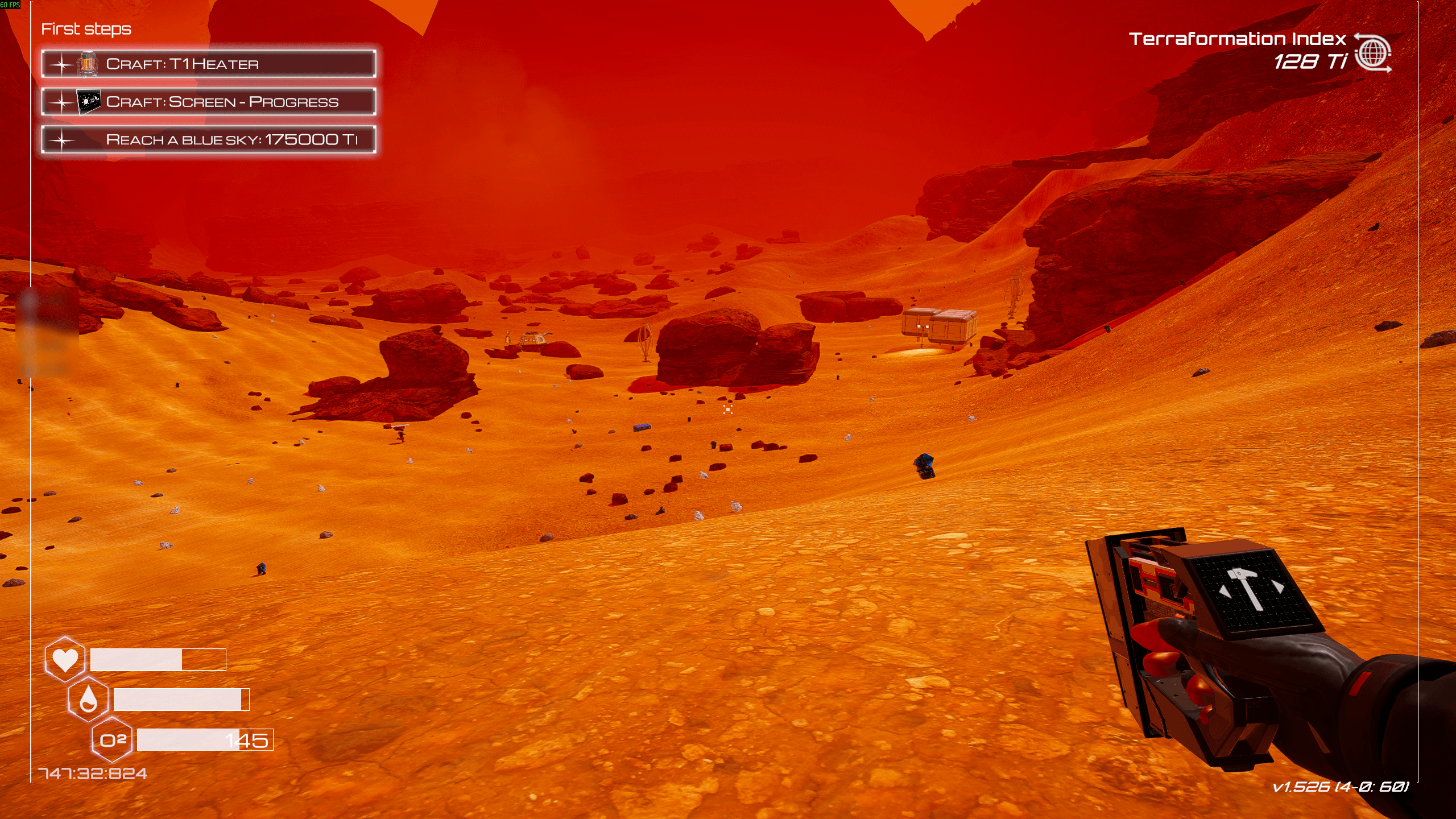
“On the surface of Prime, not too long after landing.”
Upon closer examination, intriguing wrinkles in that simple conceit start to show. You’re not just some engineer, you’re actually a criminal who was sentenced to do this work. Interesting. What work? Terraforming the planet! Yep, unlike the aforementioned Icarus, the terraforming hasn’t already been completed – that’s your job, buddy! Not only that, but they didn’t send you down to the planet’s surface with no resources just because like the assholes in Icarus, but something went wrong and your decently equipped lander/habitat unit actually crashed, so your survival is at least somewhat out of necessity.
While all of this is pretty neat, where the game really shines is its systems. It manages to distill the basic “tree-puncher” formula down to the point where almost everything is done with a single mouse click. At first this feels kind of unintuitive, but soon you’ll be locked into the mindset and almost never have to wonder how to perform any action in the game. It’s fantastic! The whole terraforming thing is also a pretty interesting twist on your typical survival game. Much of the tech you’ll be building contributes to the pressure and heat you’re outputting, gradually transforming the barren planet to one with a blue sky and clouds, which leads to rain, which leads to the water level rising, which leads to moss and trees, which leads to insects, and then fish and eventually mammals. It’s super cool, and working towards that goal turns the game into feeling something more like a cross between Astroneer and Satisfactory. I rate both of those games highly, so this is no small praise.
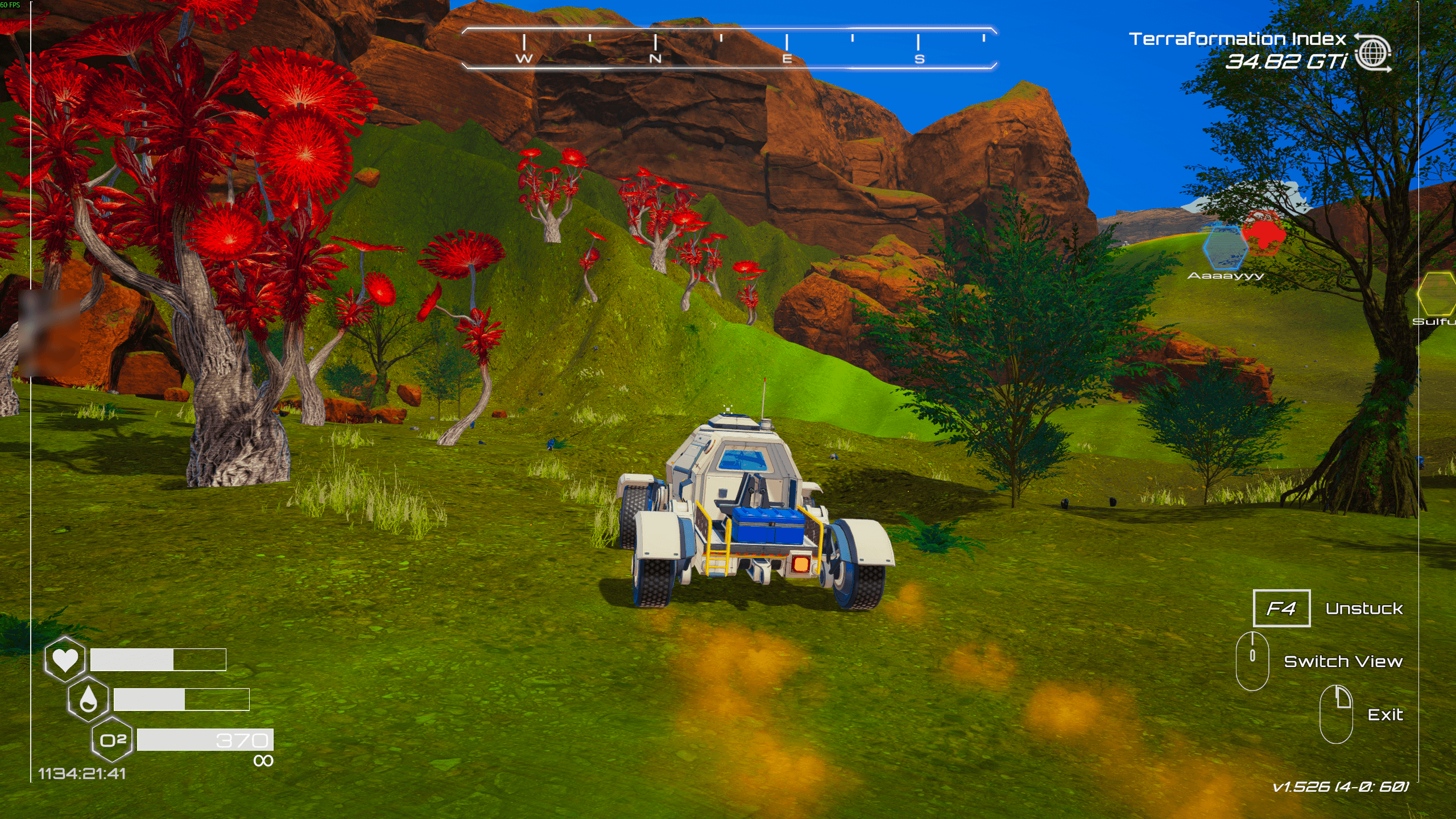
“Many hours later, the world is looking much more hospitable.”
There’s also a focus on exploring more of the map to find new resources, as well as finding more and new tech by exploring shipwrecks, abandoned habitats from previous terraforming attempts, and long buried alien temples. There’s even something of a story to go along with all of that. This is somewhat similar to exploring in those two games, but much more of a necessity, and well balanced between being risky and being fun and rewarding.
Just like in Satisfactory and a lot of these kinds of survival games, I spent a lot of my time exploring. Unlike those games, so did the rest of the group. I think that speaks volumes.
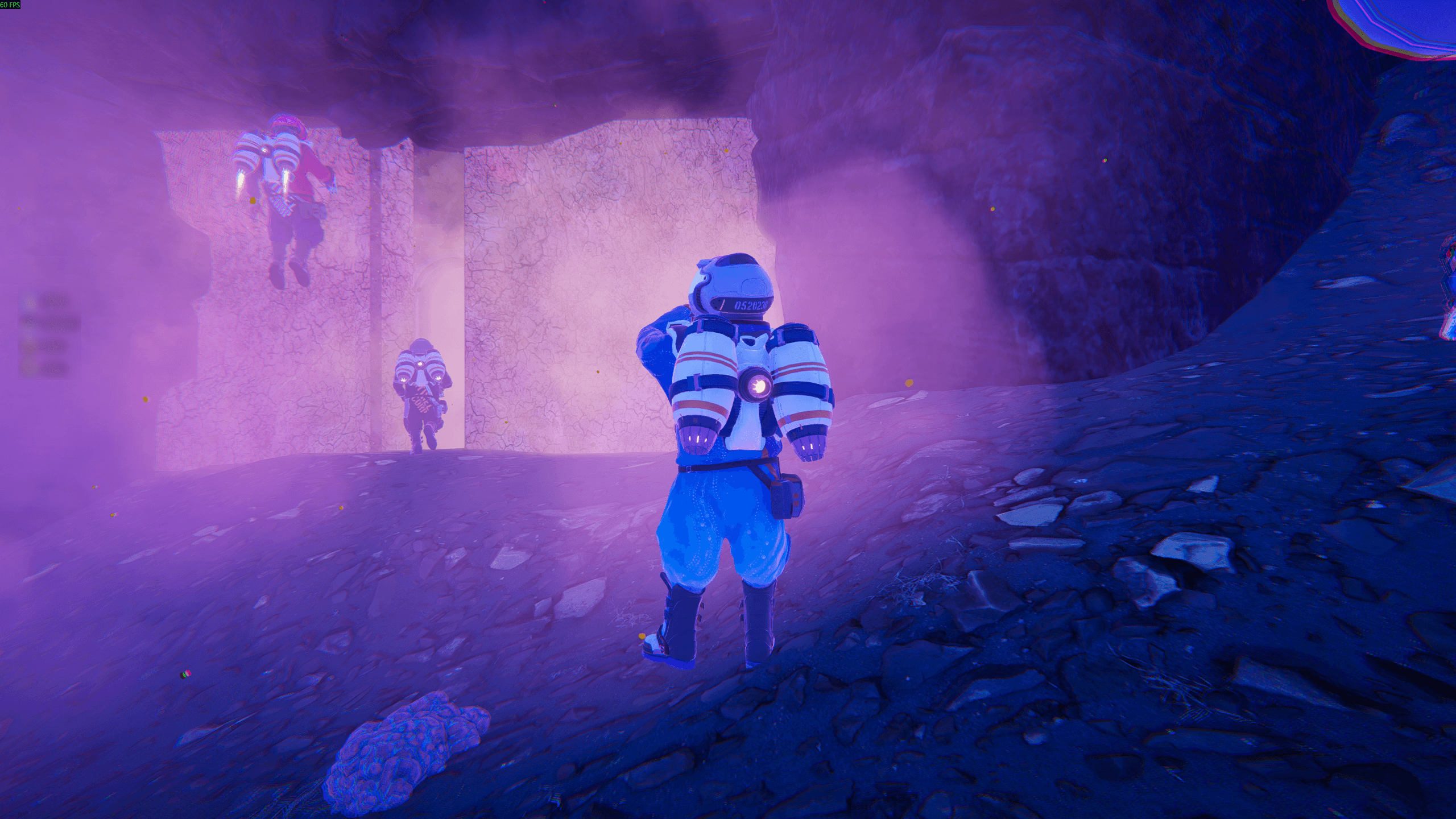
“The crew and I about to enter an ancient temple.”
We completed terraforming the planet you start on (Prime) before taking off and heading over to the moon Selenea which started the cycle all over again, only with twists in what material was and wasn’t available from the get go, including some new things, and a limited ability to move items and resources between our original planet and the moon. While we didn’t finish terraforming it, the fact that we even played so much more of the game after “finishing” one playthrough says a lot about how much we enjoyed The Planet Crafter, and I could definitely see us coming back to it at some point in the future.
Next up was a game I’ve already mentioned in this series, Enshrouded. I’m happy to report that between a lot of patching since the last time we played it, adding more content and a lot of quality of life improvements, and playing with our full group this time, it finally hit more like I’d originally imagined it would.
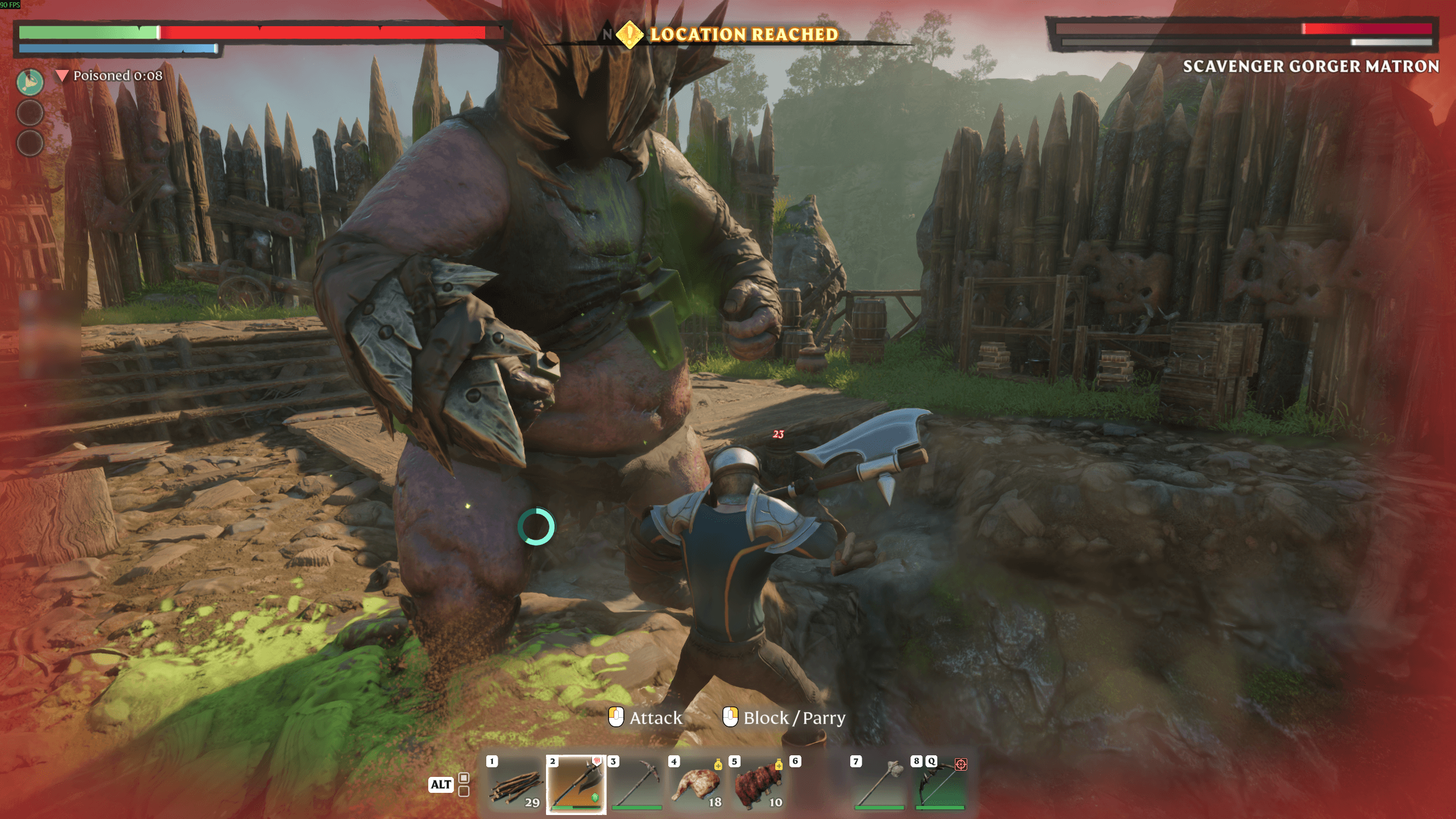
“Soloing an apparently evenly matched mini-boss.”
One of the first things I noticed when jumping into the game this time was the graphical overhaul it received. I believe the models, textures, and animations are still mostly the same, but at some point it got a lighting rework which made the game look so much nicer. I think it might also run a little better to boot, but that could be my imagination.
There are so many more survivor NPCs to recruit to your base, making it feel much more lively, and necessitating a settlement approach to construction even more than before. Of course, most of these new NPCs bring new recipes to craft and new quests to complete. In fact, that relates to one of my few complaints about this playthrough – there are way too many quests, and they don’t chain together like in a well designed RPG, rather your quest log is just stuffed with random tasks to complete all over the map, and every time you cross one off it feels like 3 more pop up. I’m perhaps exaggerating a little, but it did feel kind of overwhelming and tempted us to simply not worry about them that much. That said, when things got slow and we started to feel a little bored, crossing one or two off of the list was an easy way to remedy that.
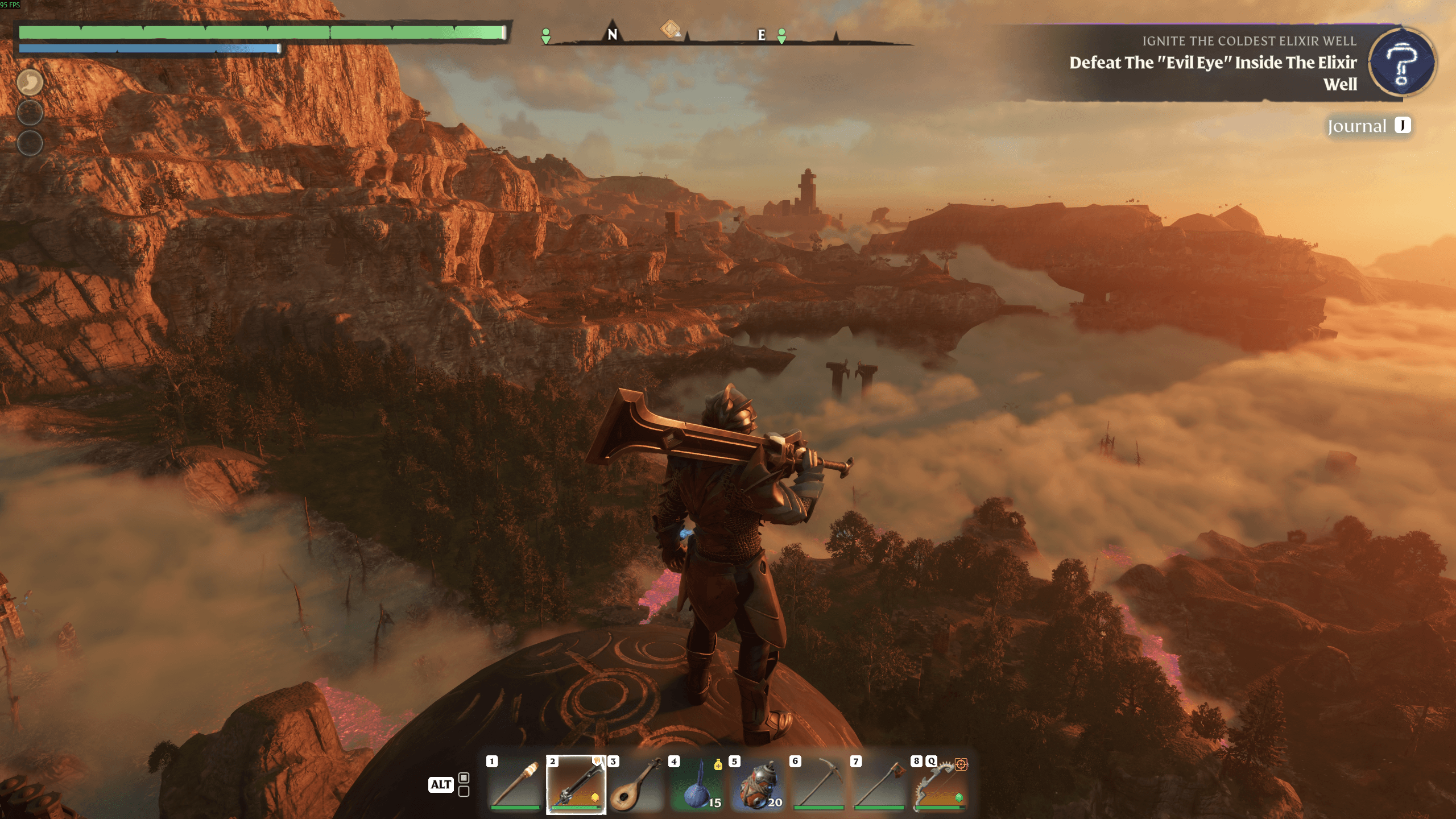
“Man, Enshrouded is full of incredible views!”
That was more of an issue later, but one thing that endangered our playthrough early on was the difficulty of the combat. I’ve previously described the game as more of an action-adventure game along the lines of a modern Legend of Zelda game, but its take on combat might be more inspired by the Dark Souls series and the like. Stamina management is important, as are blocking and rolling and dodging in and out of combat to avoid what otherwise can be fairly punishing attacks. Thankfully this is much more of an issue for the first few levels of the game, as between obtaining new and better gear and selecting new skills as you level up, combat gets considerably easier as you progress.
At this point the game is still in early access so I’m not sure it actually has anything resembling an “end” quite yet, though we did explore almost the entire map including maxing out our skill points and defeating what is, at least at the moment, its biggest and hardest boss, the Fell Dragon Youngling at the Howling Peak. This was easily the most poorly tuned and frustrating part of the entire game, and we hit our heads against that particular challenge for large portions of at least two different sessions, and probably would have quit over it if we weren’t hard-headedly determined to get beyond it, even if it wasn’t actually blocking any of our progress.
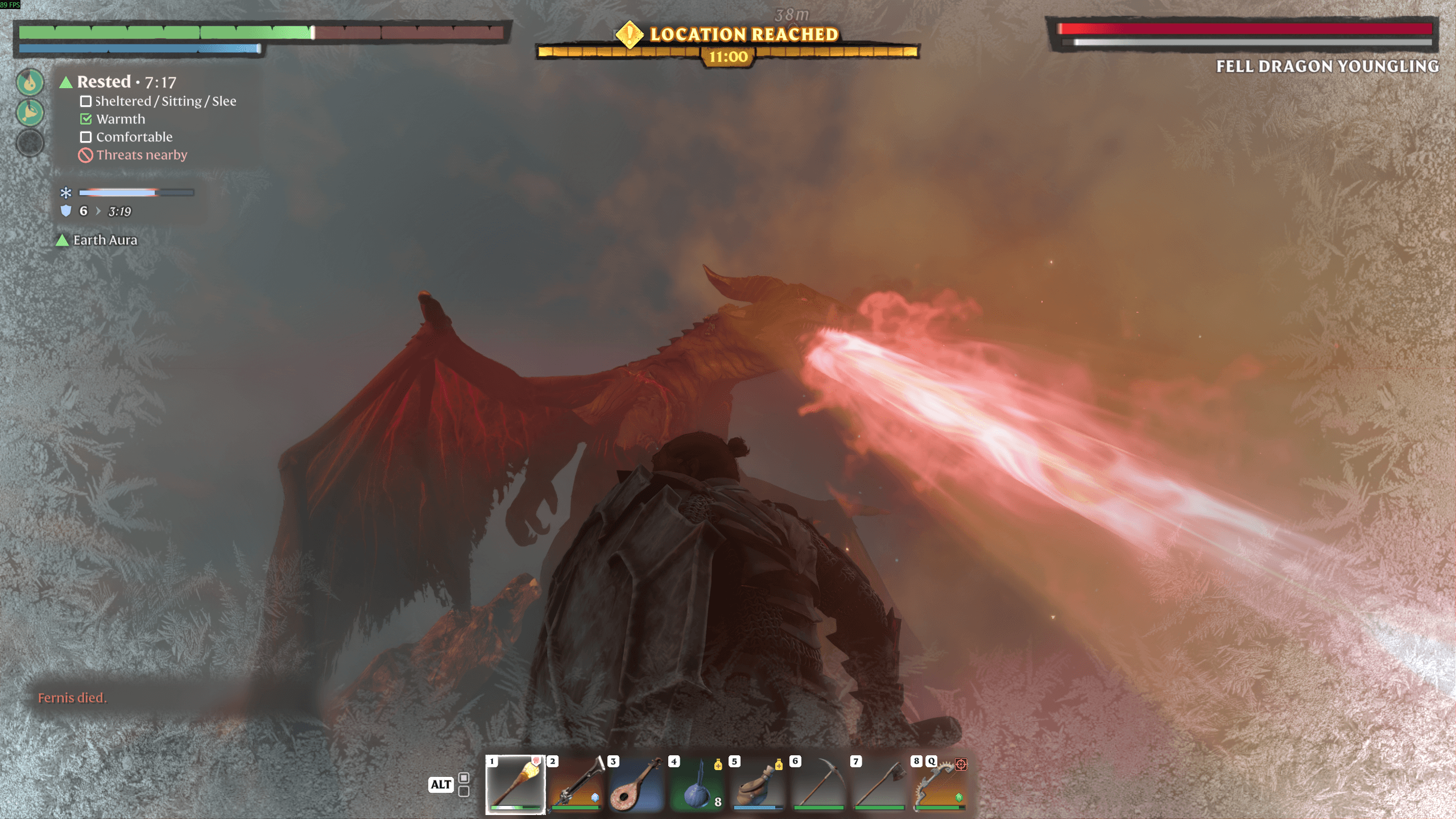
“On the other hand, finally slaying this fucking thing felt great.”
We finally quit the game when we felt like we’d more or less exhausted the more notable content, and between the three playthroughs I’ve done I have about 127 hours in game. My first two were probably in the single digits, so yeah, we definitely put our time in! While it was dicey at first, in the end I think Enshrouded has earned a spot amongst the best co-op survival games we’ve played thus far. It might not be my absolute favorite, as some more unique experiences edge it out, but it’s a great game, and I’ll be keeping an eye on it when it finally reaches 1.0 (projected to be quite soon) and beyond.
Finally, on a much less positive note, is Nightingale. This is another game that I’d heard nothing about but ended up on our radars somehow, and we all picked it up during a Steam sale. I was feeling a little down on the idea of jumping into yet another boiler plate tree-puncher, after all, we’ve played quite a few of them, often one after the other, but once we started playing the game and learning its systems, it was growing on me.
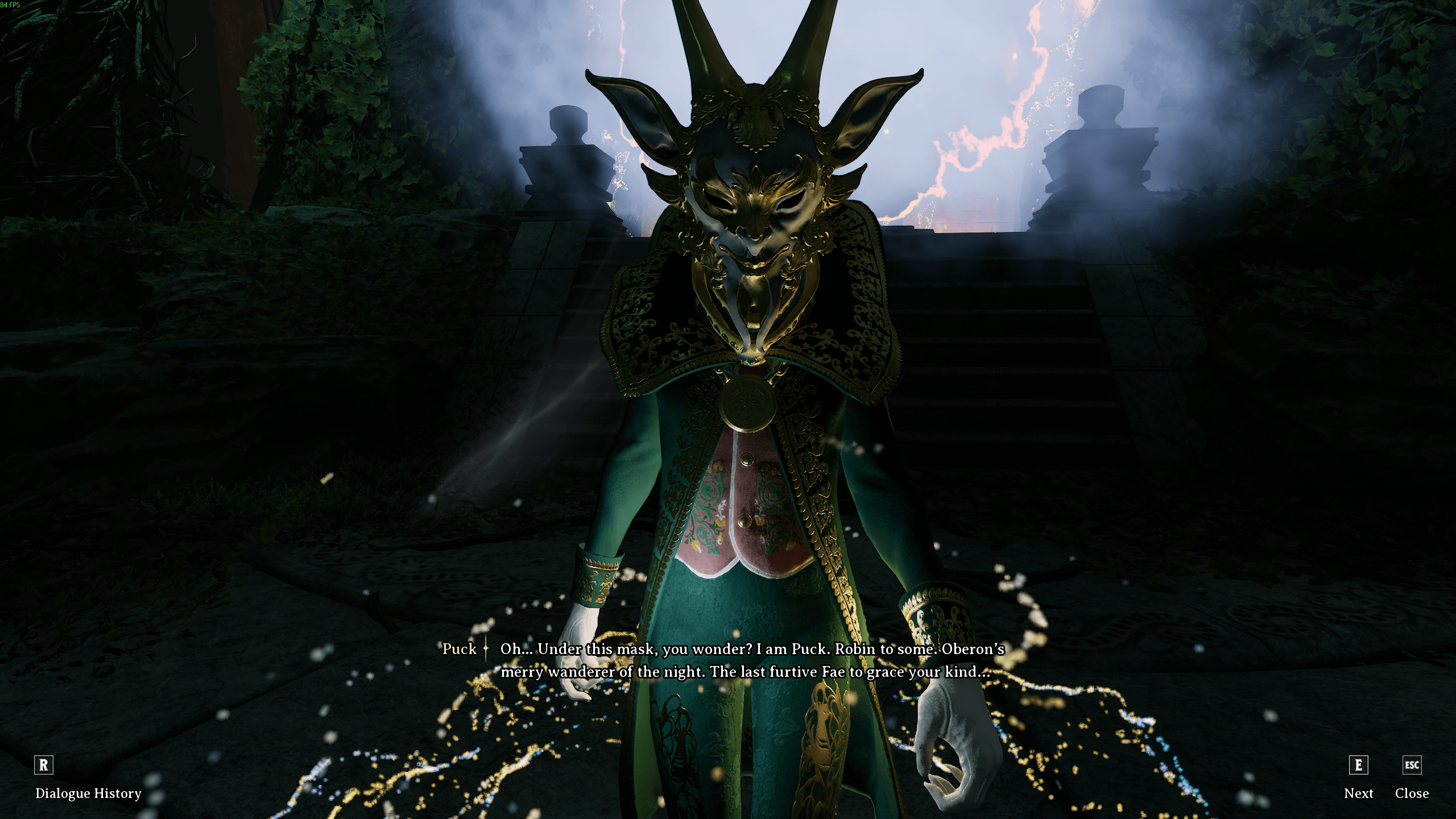
“Puck is always around to creepily advise you on your next steps.”
To back up for a second, Nightingale has kind of an interesting theme, mixing Victorian-eque gaslamp setting with fae mythology and magic, and more than a little interdimensional travel. It looks gorgeous much of the time, and its systems are fairly interesting, albeit it apparently pivoted from being an MMORPG to a more traditional open world survival game at some point in its development. I don’t know much about its history, but I get the distinct impression that, not unlike Atlas, some shit went down, and as a result, the game just didn’t quite hit as hoped. I don’t believe it’s been abandoned yet, but it definitely seems to have lost just about all of its early access momentum and hype, sadly enough.
So we jumped into the game and started trying to figure out what the hell we were doing. The fact that it took a little while to figure out some of the systems at hand was actually a positive, since it meant it wasn’t quite as cookie-cutter as I’d feared. We traveled all over the first realm completing quests and exploring points of interest before finally moving on to the next one. In the next one, we set up a new homestead to serve as our base of operations, and then spent quite a while gathering, crafting, and otherwise teching up before moving on to knocking out quests and otherwise clearing the map. Unfortunately, the latter task felt a lot like what we’d done in the previous realm, which gave me some concern about the gameplay getting too repetitive if we continued to play it so methodically.
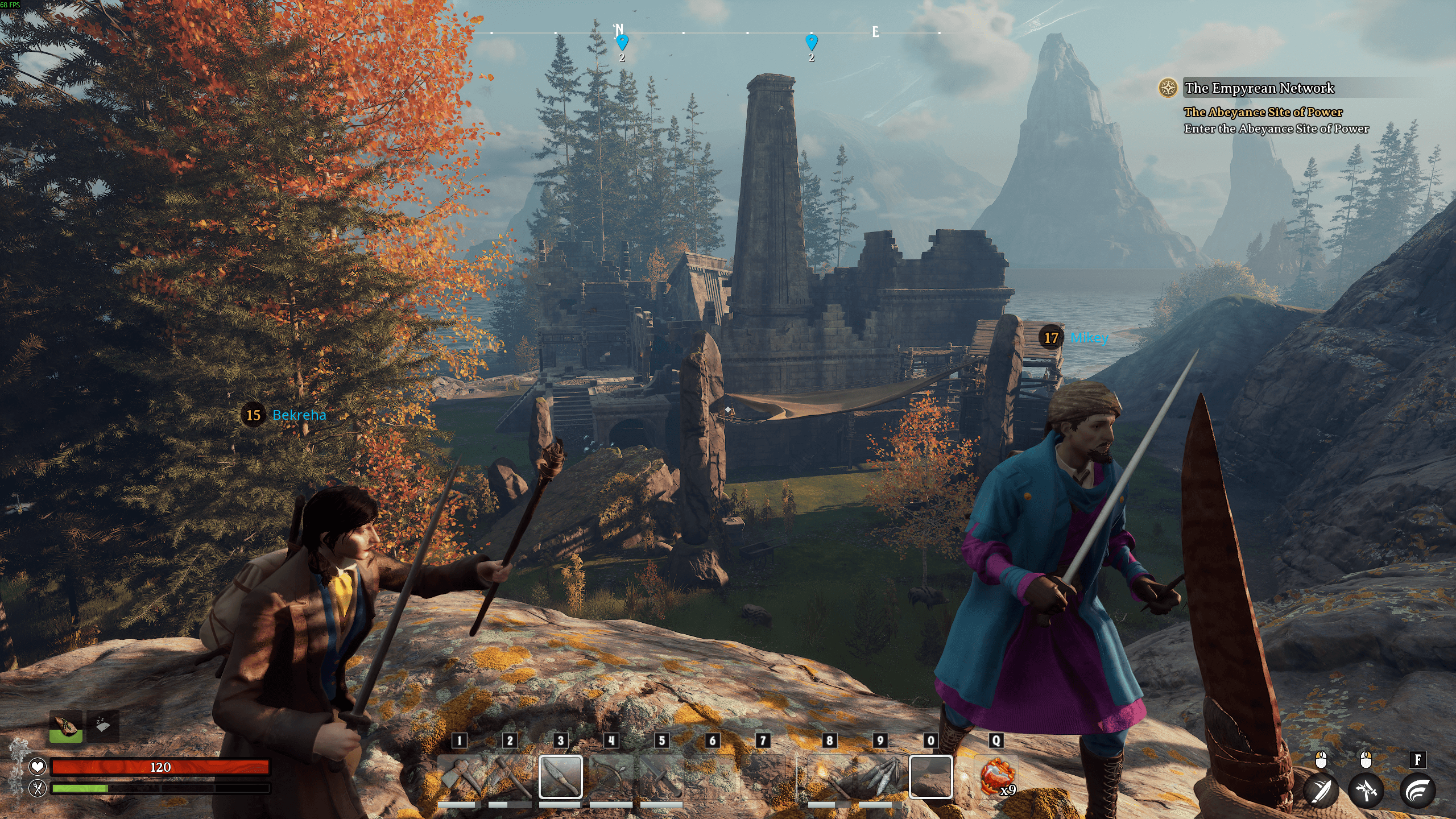
“Exploring the mysterious realms of Nightingale.”
At some point we got a quest to try out a new ability to more freely travel from realm to realm by opening our own portals, which brought us to yet another new, though much smaller realm. This one was quite different, and the promise of all of these unique realms was starting to be evident. Once we cleared it and went back to continue where we left off on the second realm, however, we made a startling discovery: our homestead and everything we’d had stored in it was totally gone; the map was back to its original state. While we still had our character progress, losing all of this work, including some special quest rewards, took the wind right out of our sails. While we found reports of similar issues evidently caused by bugs from years back, it still isn’t clear to me if we could have somehow screwed something up in the way we traveled back to this realm, or if it was indeed some kind of bug. In any case, after fruitlessly looking for some solution to restore our progress, we collectively gave Nightingale the middle finger and moved on. Major bummer!