Tag Archives: Xbox Series X|S

Metal Gear Mania 2025 – Metal Gear

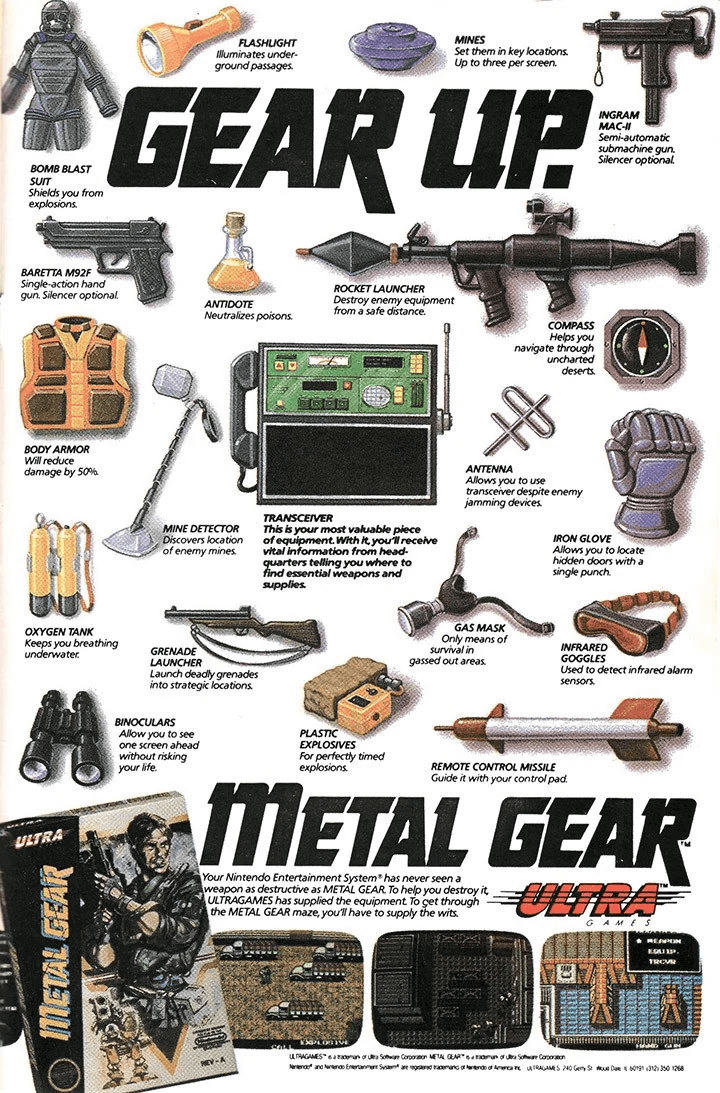
Growing up in the 80s, I associate the original Metal Gear with a single equipment laden advertisement which was plastered on the back covers of every other Marvel comic book published for what seemed like years. As a kid obsessed with military and spy gadgets, man, this ad triggered something in me. I’d spend extra time looking it over just about every time I came across it and I distinctly remember doodling some of the gear from it in my notebooks at school. Despite this though, I never actually played the game. While new console games were something of a rarity in my household, I did borrow them from friends and eventually talked my parents into renting them for me somewhat regularly, so I have no idea why I never got around to checking out Metal Gear or its weird unofficial sequel, Snake’s Revenge. 🤔
Alright, here we go!
“Alright, here we go!”

I suppose it’s common knowledge these days that Metal Gear was originally developed for the Japanese MSX2 personal computer in 1987, but most Americans know it from its Nintendo Entertainment System port later the same year. Sadly, that version deviates from the original in mostly negative ways, and these days playing the original MSX version is almost always recommended for anyone without specific nostalgia for the NES version. Thankfully the MSX version is now easy to come by, as a port of it (actually a port of an earlier mobile port) was originally included in the Metal Gear Solid 3: Subsistence release, which then found its way into the HD Collection and other, subsequent collections, including the current Metal Gear Solid: Master Collection Vol. 1 release, which is where I played it. I was curious about the technical differences between this port and the original version, but outside of some minor aesthetic differences (i.e. the color palettes used on some screens) the biggest changes appear to be in the further overhauled translation of the text, adaption of the game’s controls to modern controllers, and the additions of an “easy” difficulty and a boss rush mode. While I’m sure there are also changes to more fundamental things like the enemy AI, there’s at least nothing too worrisome on the surface.

First, a bit about presentation. Graphically, the MSX2 appears to have been on the higher end of 8-bit gaming consoles and personal computers, with graphics that aren’t too dissimilar from those of the NES or the Sega Master System. While I don’t think it’s going to win any awards, the sprite work isn’t bad at all, color palettes are tastefully used, and overall, despite being a bit simple, I think it’s aged well. There’s not much sign of the series’s later art style, with Snake just looking like some generic soldier, and while the Metal Gear TX-55 does look a bit more Japanese, it still looks nothing like future Metal Gear designs. The sound isn’t too shabby either, though both its music and sound effects strike me as extremely reminiscent of some of my favorite NES titles. Given that they were both Konami games this might not be a total coincidence, but some of the audio work here gave me flashbacks of banging my head against Teenage Mutant Ninja Turtles for hours on end as a kid. The biggest let down here is the music, which isn’t bad, but most of the tracks seem to be fairly short loops and there aren’t nearly enough of them so they quickly become extremely repetitive.
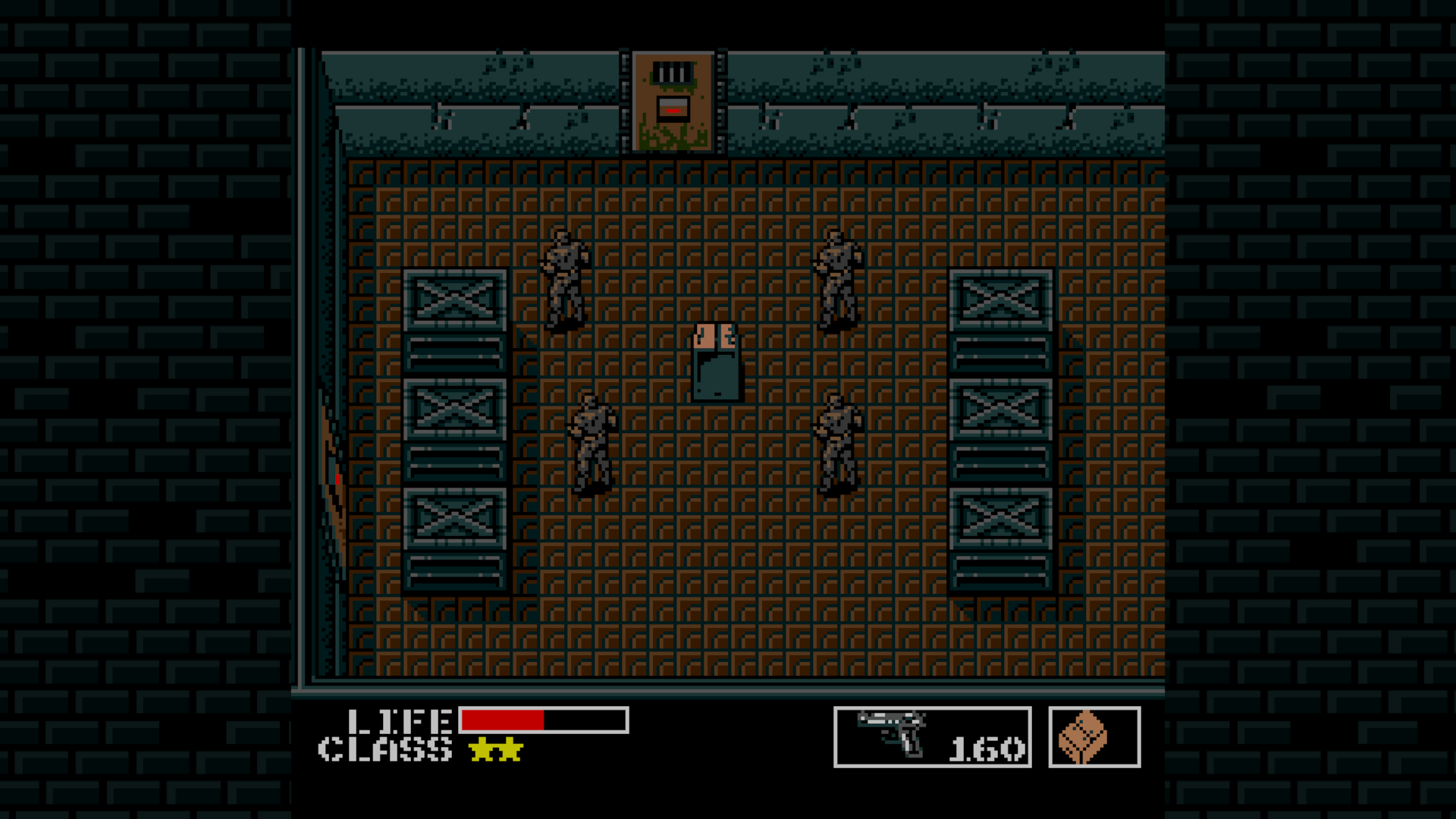
This is what peak stealth action gameplay looks like!
“This is what peak stealth action gameplay looks like!”

The game begins with Solid Snake having infiltrated Outer Heaven with nothing on him but a pack of cigarettes. As this place is essentially a rogue state occupied almost entirely by mercenaries, naturally it’s absolutely teaming with armed guards, so we have little choice but to immediately get acquainted with Metal Gear’s stealth mechanics. While far from the first, Metal Gear is one of the more notable early contributors to what would eventually become the stealth genre, so it’s interesting to see what features were present at this early point. Basically, in their default state, guards can only see in a straight line in whatever direction they’re looking, and they have no other methods of detecting you outside of being alerted by something else – another guard, a gunshot, or some other kind of alarm, and only on the same screen. This means you can safely stand right next to one if they’re looking the other way. They do turn to face different directions and even move around, and they almost always appear in groups of 2 or more, but as they move on set paths, it’s usually quite easy to study their patterns for just a few seconds and plot a safe course around them. You also quickly find the infamous cardboard box which makes it so that guards won’t alert unless they see you actually moving in front of them. Why they’re not more suspicious of a gigantic cardboard box suddenly appearing near them is anyone’s guess though. In any case, I was actually surprised to see that this silly series-long trope started all the way back here!

If a guard does see you, they’ll sound an alert which will make all of the guards in the screen absolutely freak the hell out, frantically searching for you and shooting indiscriminately. It turns out that escape is just as important as evasion is here – for a basic alert of this kind, simply changing screens will reset the guards. There’s another, rarer type of alert that works more like the alarm states found in later stealth games, though. If a double exclamation point appears above a guard’s head instead of a single one then the enemies will follow you from screen to screen for quite a while, unless, of course, you kill them all. Yep, combat is always an option. Snake can sneak up on an enemy and throw a few punches at them to take them out. This sounds risky, but each punch will stun the guard just long enough to throw the next, and they won’t alert their comrades while stun-locked either. It’s highly effective. Naturally, you will find weapons, though they have the downside of alerting the entire screen at once when fired. A bit later into the game you’ll find a suppressor which is automatically attached to both the handgun and the submachine gun, eliminating this negative altogether. Suppressed or not, you can blast your way through rooms only risking that you may catch a stray bullet or two in the process, and the only real effect is a lower rating after you beat the game (another feature that I believe was added in the HD Collection port.)
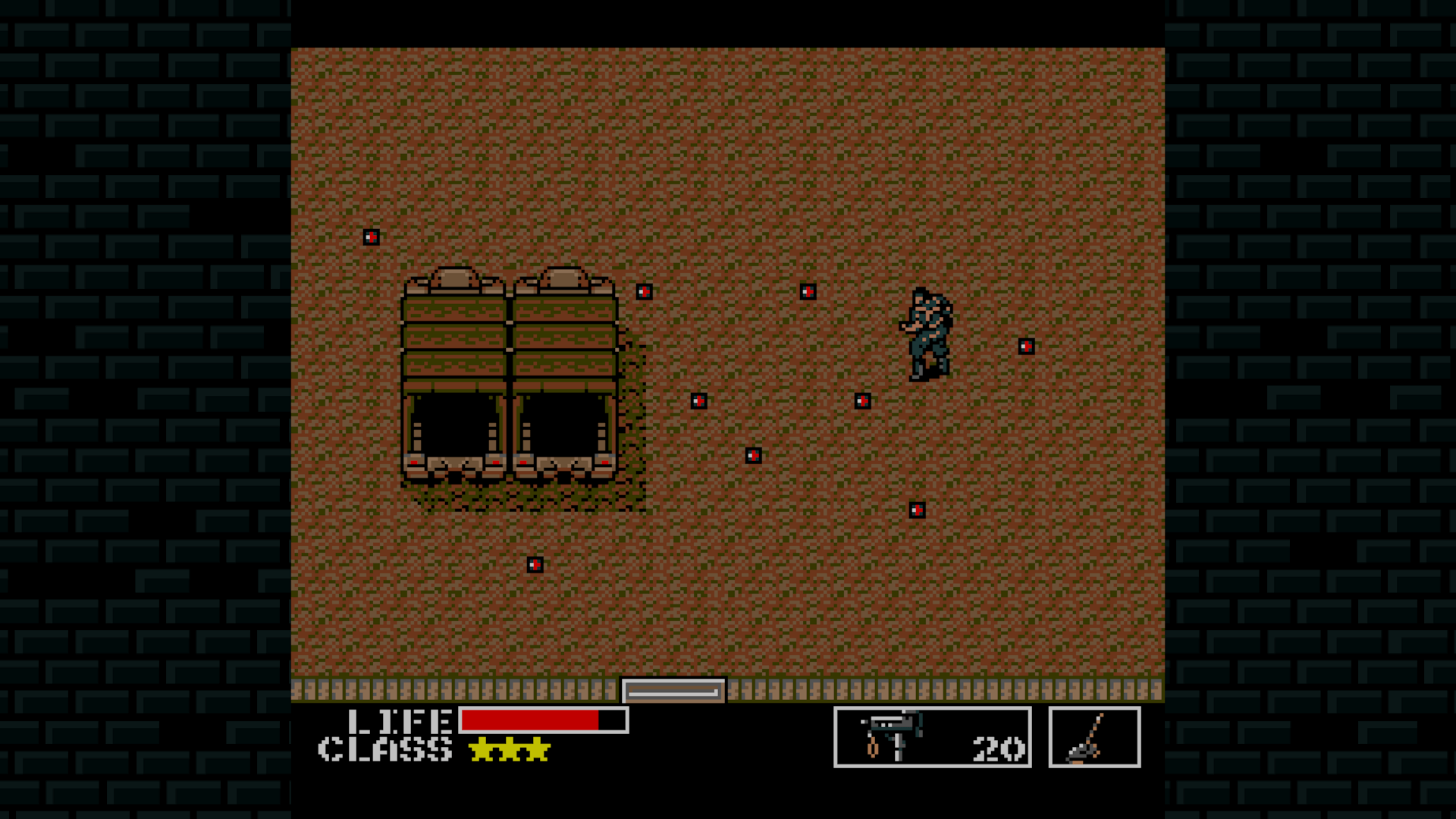
Equipping the mine detector reveals the otherwise invisible land mines in the desert areas.
“Equipping the mine detector reveals the otherwise invisible land mines in the desert areas.”

Stealth aside, I was surprised with just how close Metal Gear comes to aligning with the characteristics of a “Metroidvania” style platformer, or more accurately, a Zelda like action-adventure game, being absolutely chock-full of item/ability gating. That is, you’re in what is essentially an open world, but many rooms and areas require finding and using the correct item to access. The most cookie-cutter of these are door keys in the form of numbered keycards, though many are more thematic, like using an oxygen tank to swim through deep water, a mine detector to skirt otherwise hidden land mines, or infrared goggles to see and avoid laser traps. You generally find new items in these new areas or by defeating bosses that drop them, with many bosses themselves being gated by requiring a specific type of weapon to defeat. You’ll also frequently need to backtrack to previously inaccessible areas, though there are a few shortcuts, such as the cargo trucks you can stowaway on, that help ease this. With layer upon layer of gating and the fact that there’s almost always hints about where to go next or how to solve a particular puzzle, like most games of the above mentioned genres, progression actually feels reasonably linear.
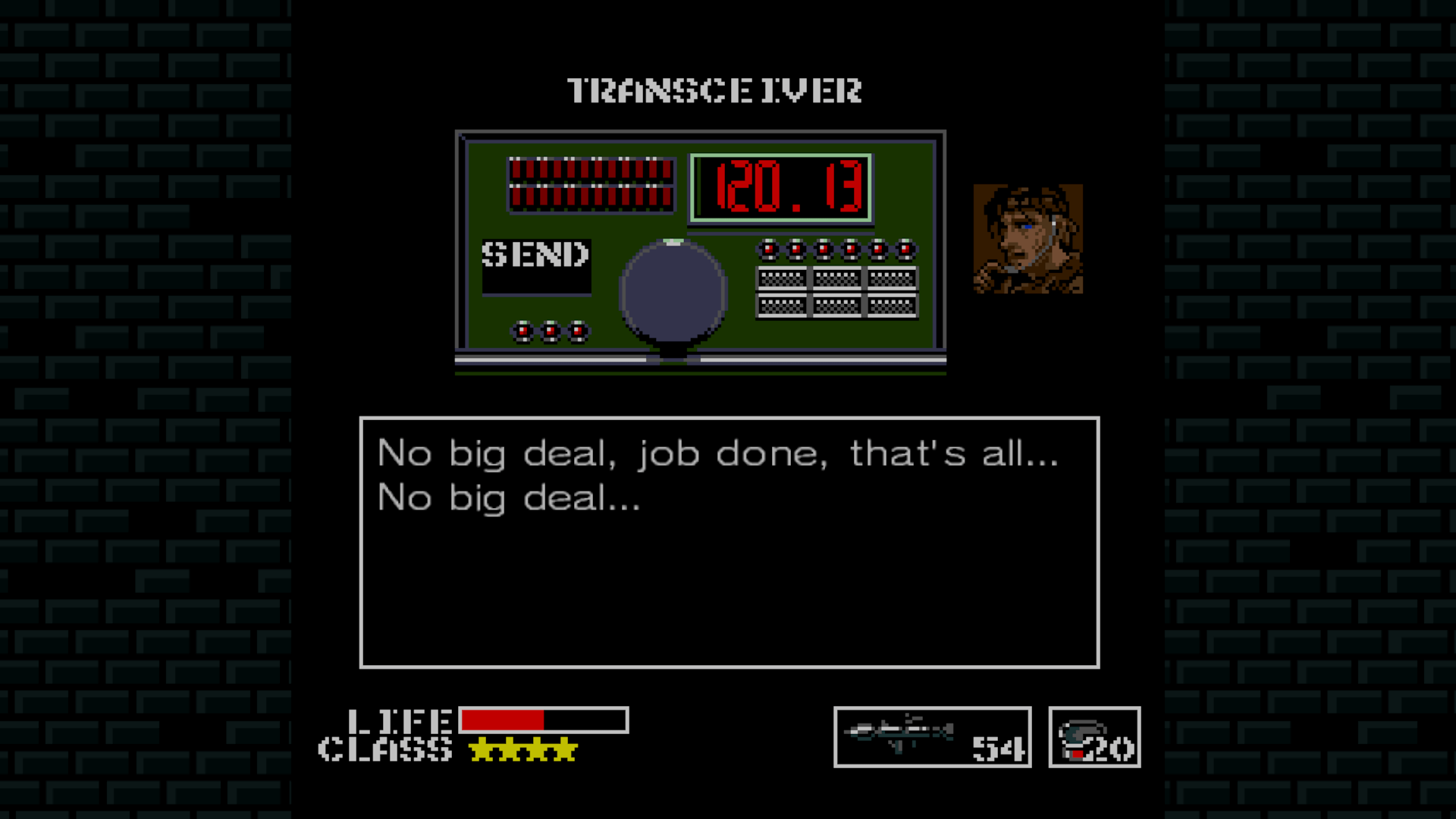
Some of Snake's only characterization is this incredibly awkward sign-off. Love it!
“Some of Snake’s only characterization is this incredibly awkward sign-off. Love it!”

Speaking of those hints, exposition comes in two flavors. First, by way of what would become a major feature of the series, your transceiver, AKA your “codec”. Upon entering specific rooms you’ll be called by your commanding officer, Big Boss, along with various allies, and they’ll direct you to your next mission priority or otherwise give you some information on how to proceed. You can also make outbound calls, with whether or not you get an answer also seemingly tied to specific locations on the map. I rarely ever got responses, and when I actually did, they were usually quite terse, so this didn’t feel worthwhile enough to keep experimenting with. The second is by interacting with prisoners. Most of these come in the form of the generic POWs scattered throughout the game’s map, typically behind locked doors. Rescuing POWs not only usually supplies you with some sort of a often useful info, but the more of them you rescue, the more your in-game rank goes up, which in turn boosts your health pool and the quantity of consumables you can carry. Gotta collect ’em all!
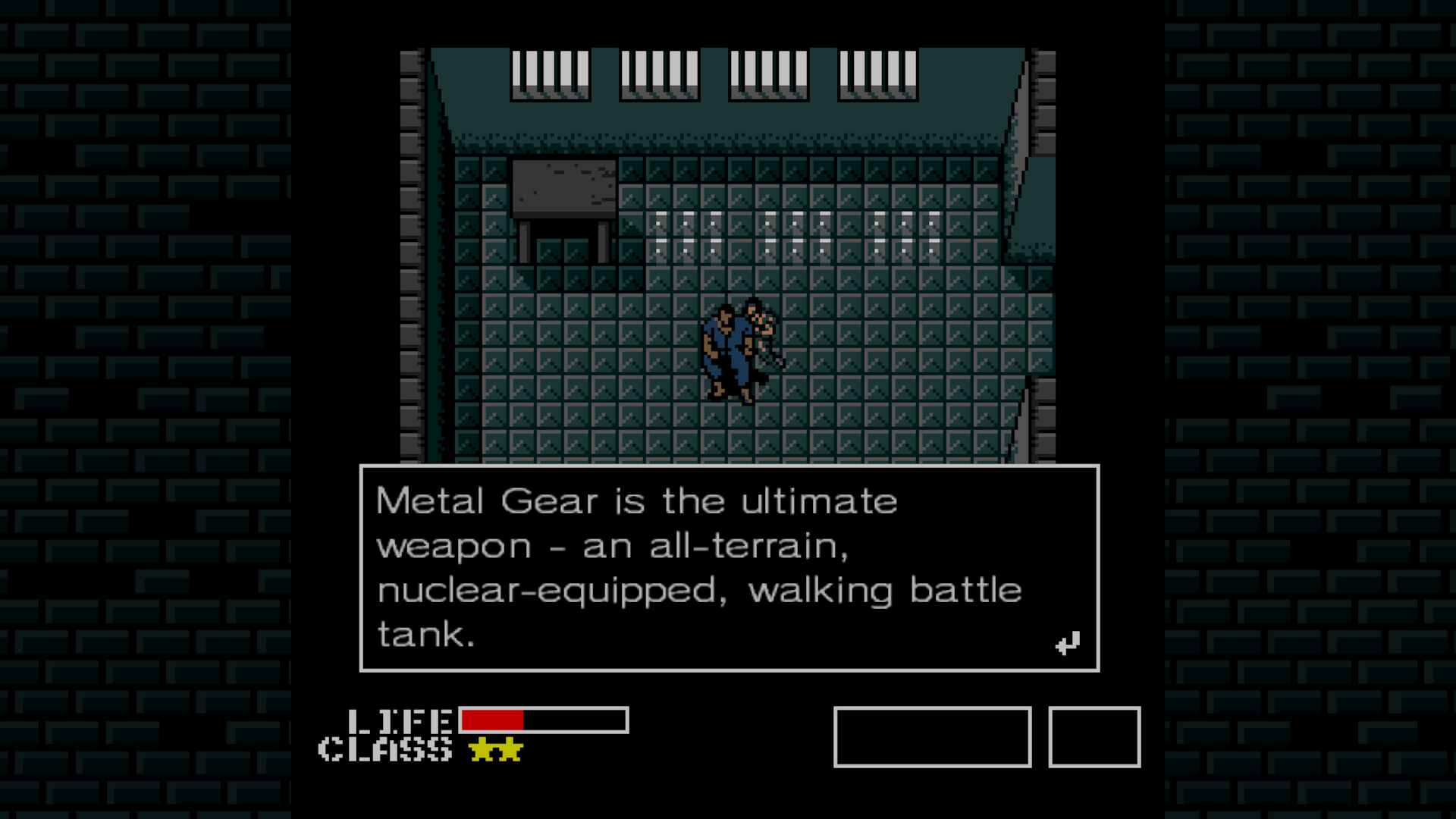
Thanks for the details Grey Fox! I'm sure we'll never see you again...
“Thanks for the details Grey Fox! I’m sure we’ll never see you again…”

While we’re here, let’s talk about the story itself. Unlike what I did with Halo Fest 2020, I’m going to talk about each game’s story in its own entry, just to make things a little less confusing. That said, I will be experimenting with a spoiler tag system, so please let me know in the comments if this does not work for your browser of choice! As I did last time, I will try to be somewhat reductive with these summaries, skipping unimportant side stories and irrelevant details. They’ll also be kept mostly to what is explained in the game or its manual, which is especially notable with the Metal Gear series since release order of the games and their in-game chronology do not align at all.

Story Synopsis - Spoilers!1995. The United States Army black ops unit FOXHOUND deploys their newest recruit, Solid Snake, to Outer Heaven, a militant breakaway state in South Africa rumored to be building a weapon of mass destruction. Solid Snake’s mission, named Operation Intrude N313, is to locate and rescue Gray Fox, one of the unit’s top agents with whom contact was lost during a previous attempt to infiltrate Outer Heaven. Successfully entering the heavily fortified base, Snake is guided via radio by his commanding officer and handler Big Boss, and utilizes intelligence provided by local resistance members to eventually locate Gray Fox, who is being held in the base’s dungeons. Gray Fox reveals that Outer Heaven is building “Metal Gear”, a bi-pedal super tank capable of launching a nuclear attack from anywhere in the world. Luckily, Metal Gear has not been fully completed, and its creator, Dr. Madnar, is being held nearby. With further help from the Outer Heaven resistance, Snake is able to locate Dr. Madnar who, having been forced to develop Metal Gear against his will, gives Snake its location along with the details of a vulnerability that will allow him to destroy it. As Snake heads across the desert to another part of the complex, Big Boss’s communications become increasingly agitated, even insisting that Snake abort the mission altogether. Undaunted, Snake heads deep into the underground facility where he finds the prototype Metal Gear TX-55 and successfully sabotages it, though he inadvertently triggers a self-destruct countdown in the process. As Snake attempts to escape, he’s confronted by Big Boss himself, who is revealed to be a double agent, and is actually the leader of Outer Heaven and its mercenary forces. Big Boss admits that Snake’s mission was never supposed to succeed and the two face off in a tense showdown. Underestimating Snake, Big Boss is killed, and Snake continues his hasty withdrawal, narrowly escaping the massive explosion that engulfs the entire base. As Snake radios to request an exfiltration his signal is interrupted by Big Boss who, somehow surviving both their confrontation and the ensuing destruction of Outer Heaven, vows revenge.


While its story is relatively basic, like many of Metal Gear’s systems and other gameplay elements, the foundation laid here in terms of characters and themes will influence the rest of the series to come, with some of it even retconn’d in very interesting ways in way, waaaay later games.
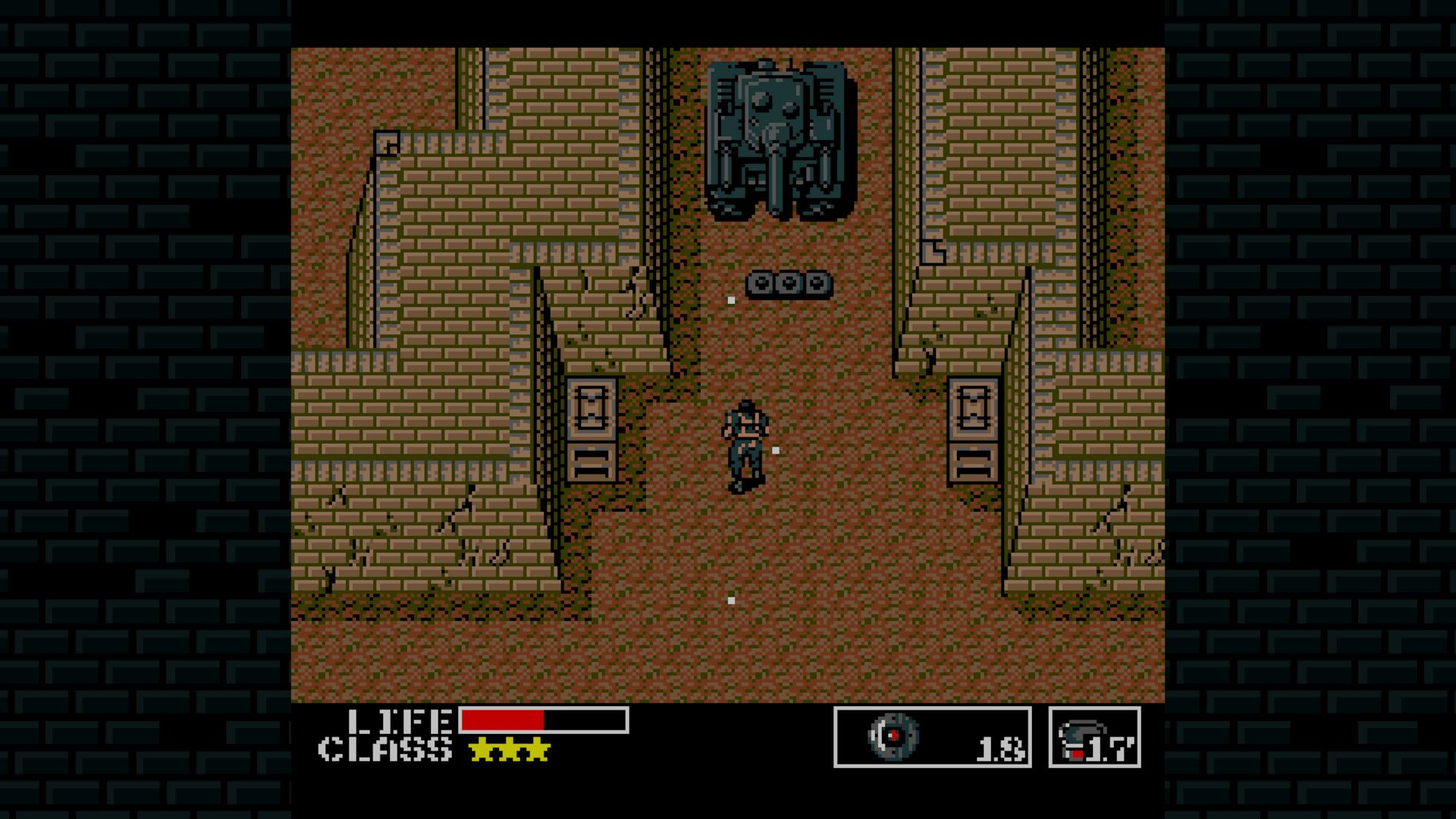
The only way to defeat the tank boss is to lay mines in its path, dodging bullets and shells.
“The only way to defeat the tank boss is to lay mines in its path, dodging bullets and shells.”

I mentioned boss fights. Metal Gear’s bosses are reasonably varied, ranging from your typical boss screens where a single boss with a special attack or other ability needs to be defeated to rooms/areas with single, large boss sprites that don’t move or move very little, and these almost always require a specific weapon to defeat. For example, only the grenade launcher will take down the Hind-D and only land mines can destroy the tank. At times this felt a little arbitrary, if not downright illogical. For example, I found myself frustratingly questioning why I couldn’t use land mines to take down the bulldozer when just moments ago I destroyed the very similar tank boss with them. Bosses often have some pretty silly names, both in the original and the updated versions. For instance, one boss is called “Coward Duck” (renamed Dirty Duck) who I can only guess was inspired by Marvel’s Howard the Duck. There’s also the fan favorite Machinegun Kid, perhaps an early hint at the recurring theme of child soldiers, but more likely just silly. For better or worse, funny names and occasional poorly translated text aside, there’s not much else in Metal Gear’s first outing that hints at Kojima’s quirky humor, nor any of the more fantastic elements found in later games. I mean, I guess one of the bosses (actually a pair of androids tellingly called “Arnolds” in the original version) does appear to be based on The Terminator, and there is one very obvious fourth wall break late in the game too, but all in all, it’s fairly grounded.

While I admit I played on the “easy” difficulty, I didn’t find any of the boss fights too hard either. Instead, most of my deaths came from things like accidentally killing hostages during the Dirty Duck fight, or accidentally touching the tank boss when trying to lay mines in front of it, and of course the occasional trap I wasn’t quick enough to avoid. As mentioned, there are fairly direct hints to help guide you to the next step of the game that you’ll definitely find if thoroughly exploring, rescuing every POW, etc. You can also stock up on consumables like rations and ammo by reentering the room you find them in, which definitely helps make things easier. Oh, and did I mention that bullets and other projectiles are kind of slow? Yep, you can dodge them much of the time. They also don’t do a ton of damage, so face-tanking many scenarios is absolutely an option. While I don’t think you need a walkthrough for this game, with all of the similar looking rooms and corridors, and the numbered keycards with little logic to what door requires what card, it can definitely help a hell of a lot to play with a notated map. Throw in the small number of hidden destructible walls and the pit traps that suddenly appear in some places, particularly near the end of the game, and I’d highly recommend it. I don’t think I’d have enjoyed my time nearly as much without using one myself. The save system is also worth a mention. At a glance it looks like Metal Gear lets you save anywhere, but it actually uses something more like a modern checkpoint system (originally a password system, I believe) with your manually saved games just starting you back at the most recent checkpoint, which is usually the last elevator you entered. Once you’re aware of that, though, it’s easy enough to work with.
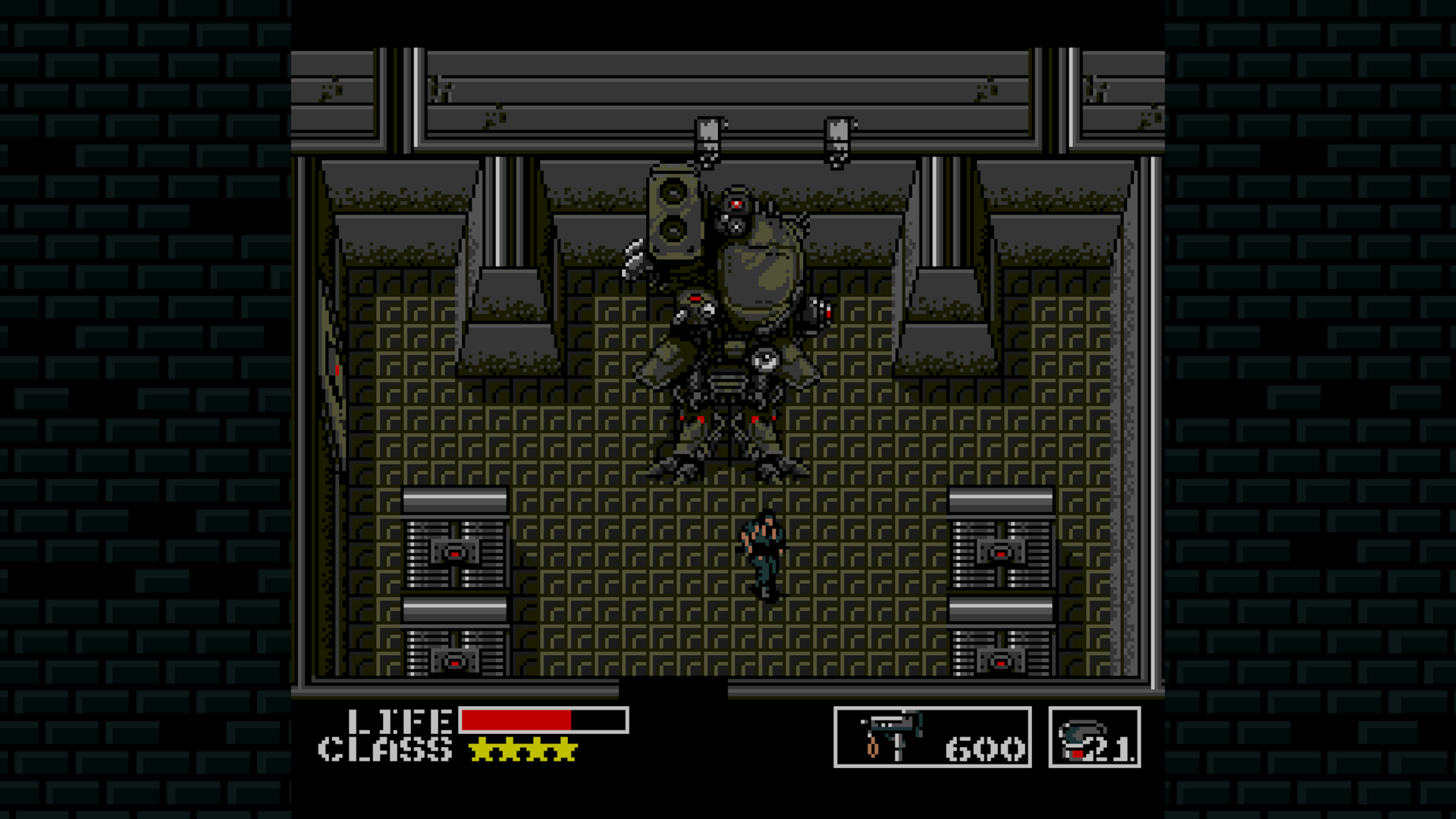
The titular Metal Gear TX-55. Pretty cool, even if it doesn't actually work.
“The titular Metal Gear TX-55. Pretty cool, even if it doesn’t actually work.”

I was happy to see that also included in the Metal Gear Solid: Master Collection Vol. 1 was the NES version of Metal Gear along with Snake’s Revenge. I’d always assumed that while the NES version might have taken some liberties here and there (most infamously, the game doesn’t culminate with Snake destroying the titular Metal Gear) and deviated in some other ways, as ports often did back then, it was still basically the same, good game. I popped into it not long after beating the MSX game and completing a playthrough of the boss rush mode, only to get my ass utterly handed to me, never making it out of the added introductory jungle area despite multiple restarts. There are numerous differences, but I suspect that the biggest culprit was the fact that the brief invincibility frames you get after being hit are gone in the NES version, so even a single basic guard can practically insta-kill you if close enough to land a barrage of shots. Not fun at all!

In the end, Metal Gear was actually quite a surprise to me. While it still remains to be seen how much I’ll like the next game, I figured these first two, early titles would be massive slogs, and that I’d get little value out of playing them beyond being able to claim I was reasonably thorough with this series retrospective. Instead, I actually really enjoyed it and I’m eager to jump into the next game. Tellingly, I think if I had played Metal Gear all the way back when I was drooling over its advertisements as a kid, I would have liked it, even if the NES version might have required a bit more stubborn persistence and maybe some Nintendo Power maps to crack.

On to our next game, Metal Gear 2: Solid Snake!

Note: Screenshots taken from the HD Collection / Master Collection version, which is why there are big, weird borders on either side. I thought about editing the borders out but decided to leave them be for consistency.
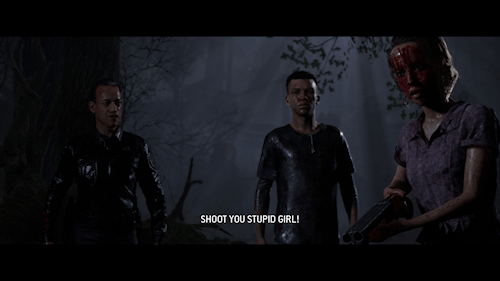

Politicians and Other Psychopaths

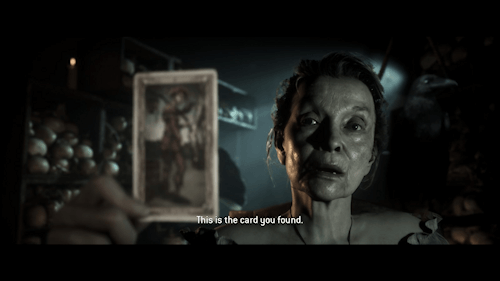
Returning to something more traditional for my partner and I, the good old narrative heavy modern take on the adventure game, which we’d played so many of together over the years, we played our very first ever Supermassive Games title, The Quarry. Supermassive is probably best known for its PlayStation exclusive Until Dawn, and from what I gather, there are quite a lot of similarities between the two games – I’d even read that The Quarry was the product of an aborted attempt to make an Until Dawn 2. For better or for worse, since I’ve yet to play Until Dawn, I won’t be tempted to fill this entire review with those kinds of fun comparisons. They’ve also got the Dark Pictures Anthology series, which I gather consists of similar, though smaller and generally less ambitious games that each tackle different horror subgenres.

In true horror movie style, it doesn't take long for shit to get real.
“In true horror movie style, it doesn’t take long for shit to get real.”

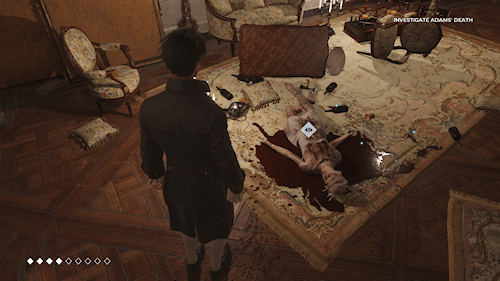
Like those titles, The Quarry is also a horror game. I went into it somewhat blind, and was pleasantly surprised by having my assumptions about what the game was about quickly challenged – judging it by descriptions I’d read and trailers I’d seen, it looked like your stereotypical Friday the 13th style slasher affair. You know, a bunch of teens at a summer camp in the woods getting picked off one by one by a deranged psychopath, that sort of thing. It is that, but, being vague so that others might have the same experience as I did, it also, almost immediately, introduces monsters, witches, and weird Southern family tropes, which kept me guessing about where the story was actually going (at least for a little while) while being appropriately creepy throughout.

I have to say that The Quarry, overall, looks fantastic. The graphics are fairly realistic to the point of occasional moments of “uncanny valley” when it comes to those trickier to nail things like facial animations. Even more so because of their preference to base character faces on their actual voice actors, including some you’ll likely recognize – David Arquette’s character was featured heavily in promotional material, for instance. Overall though, the game looks really, really good. For the most part, the UI, hell, the entire presentation of the game, is also really nice and quite polished. Being that this was my first Supermassive game, I didn’t quite know what to expect in terms of quality, but this definitely feels a million miles away from your stereotypical low budget PC-only modern adventure game. Oh, and the audio here is all great too – the effects, music, and voice acting are very good, and more importantly, they’re all used really effectively too. On a technical level alone, most of my hesitation about jumping onto the Supermassive bandwagon quickly disappeared.

Choices are usually binary and often timed.
“Choices are usually binary and often timed.”

Gameplay-wise, The Quarry feels like a weird melding of your minimally interactive modern FMV or “interactive movie” games, like Late Shift, your old school, very interactive point and click adventure games, and the middle ground, something like Telltale’s Walking Dead series, for example. I think it works quite well, providing opportunities for puzzle solving and even action sequences as well as dialog choices and other decision making, while leaving a ton of room for setting the scene or advancing the narrative via long cutscenes. Interestingly, you’ll be jumping between playing each of a group of camp counselors, and the co-op mode lets you assign who plays which specific characters, and even lets you divide up the entire cast to different players via the online “Wolf Pack” mode. My partner and I divvied up the characters based on their profiles and swapped the controller as needed, which, in terms of who gets to play for how long, was more than a little random at times, but was fun and more tonally consistent than having to take turns making sometimes contradictory decisions as the same character.

YESSS! A game the ridicules me for missing useless collectibles!
“YESSS! A game the ridicules me for missing useless collectibles!”

I’m still of two minds over whether this is a actually bad thing, but sometimes these major branching moments didn’t come about by an obvious decision. For example, early in the game there was an action scene where, if we had reacted quickly enough, we could have killed a character which would have had a huge effect on the rest of the story, and the fact that this was based on a semi-twitchy, high pressure scene definitely caught us by surprise. Oh, and speaking of which, yes, major characters can die or be affected in very big ways that have ramifications throughout the rest of your playthrough, which was one of the charms of Telltale’s adventure games as well, and feels cranked up to 11 here. I understand this was also the case with Until Dawn and most of Supermassive’s other adventure games, and while this could be criticized as being gimmicky, personally, I’m a fan.

I can’t say I absolutely loved every character or every story beat, plus the ending felt a little sudden, which sadly isn’t an uncommon issue in these types of games. In this case though, I could definitely see myself playing through it again one of these days, especially given all of the fun extras and collectibles and the insane amount of deviation and branching your choices and actions can bring about – apparently there are 186 variations of the ending available. As I said, insane. In the end, we enjoyed it enough to buy the entire first season of the Dark Pictures Anthology the next time it was on sale. ‘Nuff said!

Next up, wanting to play an actual cooperative game on PC that wasn’t yet another tree punching survival game, I came across the We Were Here series of asymmetrical co-op games. Now, we’ve played a few co-op focused games, most notably the Hazelight ones, but reviews made We Were Here sound like it was much more likely to test the strength of our relationship. Now that’s true horror! 😅

A creepy castle filled with creepy puzzles.
“A creepy castle filled with creepy puzzles.”

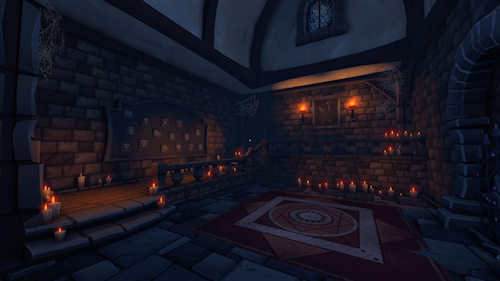
The setup is simple: Without much further explanation, you and your partner are walking with a larger group through a frozen wasteland and split off to check out and then take refuge in a mysterious castle. The next thing you know, you’re both waking up to discover that you’ve been split up. One player takes the role of the “librarian” whose primary job is to, confined to a small area, reference books and other useful objects spread throughout. The other player is the “explorer” whose job it is to, well, explore. That mostly involves navigating from room to room and investigating the mysteries therein, which ultimately lead to the way to the next area, like multiple relatively simple escape rooms chained together. Each player is given a walkie-talkie near the beginning to communicate with one another (using in-game VOIP, a feature I always really like even though I usually eventually end up abandoning for out-of-game voice chat) and from then on, the game is on.

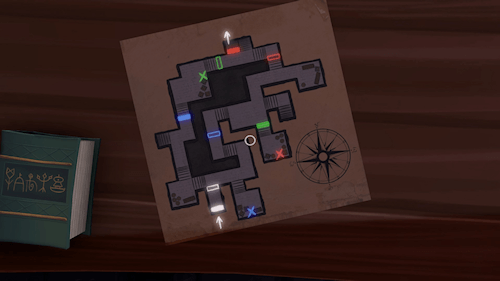
Naturally, communication is key to solving these puzzles – the explorer might need to describe symbols or pictures to the librarian, or vice versa. That communication needs to actually be good too, as a lot of the things you’re asked to describe are intentionally extremely similar, so the players need to be detailed to avoid mistakes. There are also puzzles that involve one person helping the other person navigate through mazes, and as typical as that sounds, a lot of these scenarios have some pretty clever twists. Look, I grew up in the UK in the 80s and 90s and watched a ton of Knightmare, so I was more than up for the challenge. (If you know, you know!)

Guiding the Explorer around a maze as the Librarian.
“Guiding the Explorer around a maze as the Librarian.”

While obviously done on a budget, the presentation is pretty good, featuring the same kind of low polygon, colorful, stylized graphics I mentioned learning to love with Firewatch when describing a lot of other games recently (I really need to find a term for this style…) and yet it manages to be quite creepy a lot of the time too. It’s definitely a vibe, and your mileage may vary, but it works for me.

Interestingly, the whole thing only lasts a couple of hours, though you’ll likely want to switch roles and play it a second time, especially if you’re into achievement hunting. Still, the game is often free, and as such, makes a perfect demo for the rest of the series. That strategy certainly worked on us – we were impressed with it enough to immediately turn around and purchase the sequel, We Were Here Too, which I’m sure I’ll talk about here eventually.

Finally, we’ve just completed our playthrough of The Council. The Council is an episodic narrative heavy adventure game developed by Big Bad Wolf, who are probably best known for their later take on the Vampire: The Masquerade universe with Swansong in 2023. I don’t know too much about Swansong, but it appears to use a lot of the same gameplay mechanics as The Council, though it has significantly worse reviews. Hmm. 🤔 This might just be a result of The Council attracting more of a niche, adventure game loving audience than Swansong, which probably attracted a lot of players hoping for a sequel to the cult classic Vampire: The Masquerade – Bloodlines, which it clearly is not.

If you think these guys are ugly, you should see Sir Gregory Holm!
“If you think these guys are ugly, you should see Sir Gregory Holm!”

I distinctly recall having some hesitations about this game when first coming across it on the Microsoft Store, but my partner was very intrigued and its reviews were surprisingly positive, so we eventually purchased it. It’s funny, we played them far enough apart that I didn’t really compare it to The Quarry while playing it, but now writing this compiled review, I can’t help but to weigh them against each other, at least a little, given that they’re in the same genre of gameplay. On the surface, this does not bode well at all for The Council, but in some ways, The Council is actually much more interesting.

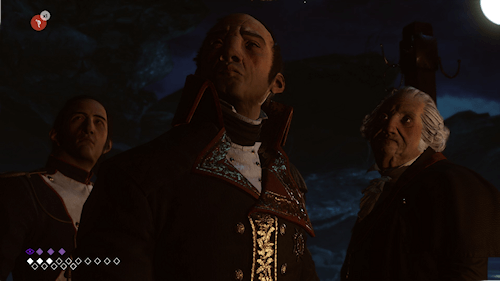
The main reason for my hesitation was the visual presentation. Screenshots and trailers made this game look almost comically bad looking. You have a variety of historical figures, like Napoleon Bonaparte and George Washington, with ugly, stylized character models, and hey, there’s some kind of a murder mystery or something afoot too? Seriously, what the fuck is this game?! While I have to stand by that initial impression of the graphics, particularly the character faces, as being bizarre, sometimes exaggerated to the extent of being grotesque, overall, I actually came to enjoy the style once I got used to it. This will no doubt be a divisive point though – I’d expect a lot of people will absolutely loath them. That said, the scenery, particularly inside of Lord Mortimer’s mansion, where you’ll be spending the majority of the game, was well executed. Really, the only technical issues with the visuals are around the character animations, which range from “eh, decent I guess” to utterly abysmal. Well, actually, the bottom of that range would be “not there at all” as we did encounter a few bugged moments where characters weren’t animated at all while their dialog played. All but one of these instances were brief enough to not take us completely out of the game though, thankfully.

Flashback to classic adventure games.
“Flashback to classic adventure games.”

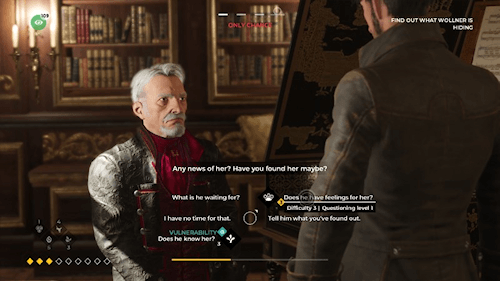
The bulk of my impressions were around the gameplay though. On the surface The Council seems to follow a Telltale-like take on the adventure game – a lot of dialog choices, decisions which appear to branch the storyline, and plenty of cutscenes. I’d say that there’s a lot more free roaming and even the odd inventory puzzle in The Council, and there are no real QTE scenes since there are no real action scenes, so this edges it a bit closer to the traditional point and click adventure game of the 90s. Where this gets interesting is that there is a layer of almost RPG-like mechanics on top of all of this: a skill-based system complete with experience points to advance those skills, traits that affect them, and using skills requires spending limited “effort points.” I was initially skeptical…

To go into that all in just a bit more detail, many of your dialog choices and some of your special actions in the game are tied to specific skills. Using these skills requires you to have the skill, of course, and the use of a set amount of effort points, which is reduced depending on what level your skill is at. You level these skills up as you gain experience from chapter to chapter, and there are also books that you can read in limited quantities each chapter, and traits which can sometimes grant you skill points as well. Interestingly, you will still see the options to use these skills even if you don’t have them, which can help guide you to where you might want to allocate skill points later, or in a subsequent playthrough, though every skill gets its turn sooner or later. Your pool of effort points grows as you level up, but can also be affected by items – you’ll find consumables that let you restore some of your points or even make your next skill use free. There’s also one that removes your alterations, which negatively affect the number of effort points you need to use a skill.

The Council's dialog system is surprisingly complex.
“The Council’s dialog system is surprisingly complex.”

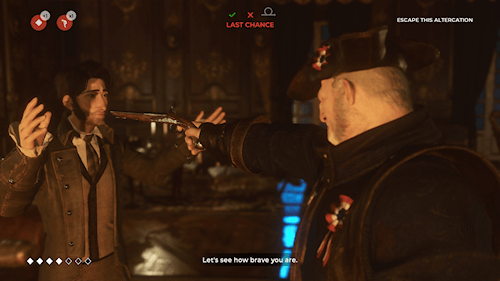
The dialog system also has a few other surprises. First, there are “confrontations” which are special dialog events in which you need to choose the correct options in order to convince someone of something or win an argument, that kind of thing, and your success or failure will often cause a decision-like branching of the story. These all felt a lot more tense than normal conversations, even if the stakes weren’t particularly high. Confrontations are particularly affected by that character’s specific vulnerabilities and immunities to certain skills, which are usually discovered the hard way by choosing the wrong dialog option, though there’s another consumable that will temporarily reveal them to you. Finally, we have “opportunities” which are as close as The Council gets to Telltale’s QTEs – moments where you can, if you’re quick enough, move your cursor to an interactive hotspot that appears briefly, usually over part of the character you’re talking to’s face or body. These unlock special dialog or actions, often revealing new information, including vulnerabilities and immunities.

Overall, some of these systems were a bit bewildering at first, but in the end I think they work surprisingly well, and add a nice gamey component to the otherwise rather simple dialog system that most of these sorts of games employ.

Finally, there’s the story itself. If you’re the type of person who likes ancient and old world conspiracy theory along the lines of something like the Da Vinci Code, you might be as drawn in as I initially was. Right off the bat we have something of a “whodunit” mystery, all kinds of mysterious characters and related subplots, and a backdrop of political intrigue complete with secret societies attempting to pull the strings of events across the entire world. I constantly found myself wanting to learn more about what was really going on here, at least until the rather heavy-handed main reveal (something of a twist) comes in a later episode. While I found that twist, which brings in a supernatural element, and especially my character’s reactions to it to be a little silly, by then I was invested enough to say “fuck it” and just roll with it.

Like I said, confrontations can feel a little tense...
“Like I said, confrontations can feel a little tense…”

Unfortunately, the end of the game was a bit of a let down. There was a final confrontation which just… well, it just suddenly ended. As the game summed up how bad of a job we’d done in the last chapter and the post-game character wrap-up started to play, it took my partner and I a full 30 more seconds to realize what had just happened before we looked at each other and let out a simultaneous “OOOOOOooooooooohhhhh!” It was jarring enough that we did something we never do in these kinds of narrative games – loaded up our last save, corrected a mistake we made (an easy to miss but vital item we didn’t pick up) and went through it again, this time achieving a much better, even if it was similarly abrupt, ending. This does speak of one of the game’s strengths though, in that, not unlike The Quarry, there is a good amount of deviation and branching that can take place here, with over a dozen distinct endings. In fact, there was one major decision in the second to last chapter of the game that really had us debating amongst ourselves about which way to go, which should suggest it was an interesting and impactful one if nothing else.

That sums up The Council pretty well. Despite the weird, somewhat janky graphics and the plot that goes to some unexpected places, then ends faaaarrrr too abruptly, I enjoyed the game, especially its take on the narrative adventure mechanics, which has me suddenly much more curious about Vampire: The Masquerade – Swansong, a game that hadn’t really been on my radar even a little bit before.

Unfortunately my dumb ass didn’t take enough screenshots of any of these games, and some of the ones I did take contained spoilers, so instead I’ve opted to steal them from various random places on the net.

Cloudbursting

I know it’s been ages since I’ve posted. I’ve been in a bit of a limbo when it comes to gaming for a while now, with several games I’ve been working through at a glacial pace that I really want to finish before moving on to anything new, all of which will be covered here once I complete them. For now though, let me tell you about a new toy of mine.

A few months back I got the itch to start looking at handheld PCs. I have a friend with a Legion Go and at least a couple with Steam Decks. In reality, I probably have very little actual use for one, and I have a history of regrettable purchases related to handheld consoles and the like. I simply don’t play them. Still, it was a fun hole to fall into: consuming innumerable videos, Reddit threads, and Steam Community posts on the subject, and spinning off into unexpected areas, like the vast array of cheap yet impressive emulation focused handhelds that have flooded the market in recent years. In the end, despite the numerous advantages of the Windows based handhelds, given the price, my 20 years of investment in Steam as a platform, store, and community, and various other (mostly minor) quality of life things, I was fairly settled on the Steam Deck OLED.

That said, the one thing that kept coming up was the other platform, store, and community I’ve invested heavily in over the years – Xbox. While I consider myself a PC gamer first and foremost, I also do a ton of console gaming as a means to get away from my PC for a while, relaxing on my couch in front of a nice, big TV. I mostly reserve console gaming for single player games, with more traditional PC genres like FPSes and strategy games, and lets not forget MMOs and other online games, being played on PC. That said, when it comes to my (massive) backlog, I intend to play a great deal of those games on Xbox. I already own many of them, for one, but I also somehow still hold the tiniest flickering flame of the once great torch I carried for building up my Xbox achievement score. One obvious solution was streaming from my Xbox to my Steam Deck over my local network. Could it be done? Well, absolutely! There are third party apps that can do it quite well, apparently.

Playing Halo Infinite on My Stoop
“Playing Halo Infinite on My Stoop”

The more I thought about it, the more this became one of the most likely ways I’d use my Steam Deck and, frankly, it seemed a little overbuilt (and overpriced) for that purpose alone. I’d also read about how Xbox games wouldn’t use the full screen due to the Stream Deck’s odd 1280×800 resolution which got me thinking that the ideal would be a handheld with a 1080p screen so that The Xbox Series X (or PS5, for that matter) could stream to it full screen in their most commonly used resolution.

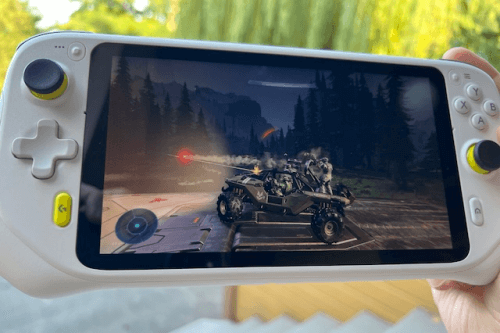
That’s when I ran into the Logitech G Cloud. Now, I’ve heard of this thing before. I’m sure it was mentioned on at least one of the gaming podcasts I regularly listen to because of their supposed partnership with Microsoft for the G Cloud to be something of an Xbox competitor to Sony’s first party solution to this problem, the PlayStation Portal. I’m not sure that’s quite how it ended up, but the more I learned about it, the more interested I became. Here’s a quick rundown:

  • Built and supported by Logitech, who are far more experienced with hardware and much more reputable than the majority of players in the space, outside of the major ones like Asus, Lenovo, and Valve, of course. Accordingly, it feels relatively high quality when it comes to build and materials.
  • The controls are quite good. The layout closely resembles the standard Xbox controller. The analog sticks are decent, the buttons and triggers feel good, it has a subtle but fully functional rumble, etc. Input lag is close to non-existent too. About the only complaints I’ve heard is that the D-pad leaves a bit to be desired, not being great at registering diagonals, and some people hate the deadzones in the analog sticks.
  • Additionally, the whole thing is very ergonomic. Most every reviewer mentioned how good it feels to hold. It’s also really light, which is an advantage none of the big boys have. You could definitely hold this thing above your head while laying in bed without giving yourself an unplanned arm workout, and that is one of the use cases I had in mind.
  • Another point of comparison that is often brought up is battery life, and the battery life of the G Cloud, being basically a glorified Android tablet, and one that is mostly streaming rather than running games locally, is stellar.
  • Being an Android device, it has a lot of flexibility in terms of available apps, customization, etc. Of course, Logitech provides a custom interface which simplifies and consolifies the whole thing somewhat too. One of the most likely use cases for a device like this, outside of streaming, is loading it up with emulators, and there’s quite a few available for Android. This thing might not be the most powerful handheld by any means, but it’s enough to emulate most consoles up to PS2 quite well.
  • As mentioned, while it’s not OLED, the screen is quite nice. 1080p native, relatively large at 7”, vibrant. It can also get bright enough to allow you to play outside on a sunny day.
  • The biggest negative is perhaps the price, which is typically $300. Given the price of handhelds, and Sony’s Portal being only $200, I think that’s a little high given its capabilities and intended use. That said, it regularly goes on sale for $250 or less, and finding them used is fairly easy as well.

I’d suggest TechDweeb’s video on the G Cloud for a better summary. The fact that a dude who probably literally owns every handheld available is so enthusiastic about this thing speaks volumes.

So, I got one! Being an iPhone and iPad user for ages now, it was a bit of a mindfuck setting up a new Android device, but beyond that, it was easy to get going. I tested out Microsoft’s Xbox streaming app, which worked fine, though it only runs at 720p. I also tested out Microsoft’s Cloud Gaming app, which worked far better than I’d have expected, despite also having a similar 720p limitation. Now, I honestly don’t have that much interest in cloud streaming, but given how well it works, I could see myself using it if I were on a relaxing vacation where I had a lot of downtime, assuming I had a good WiFi connection and an even better Internet connection, of course.

Finally, I bought myself XBXPlay from the Google Play store which is a third party take on the normal Xbox streaming app, but supports 1080p and has a lot more options for tweaking your experience. It works incredibly well. While it’s a bit of a bummer I had to go to a third party for a superior solution, I have no complaints. I can now play Xbox Series X (and all of the previous Xbox One, Xbox 360, and Xbox games it supports) while my SO is tying our main TV, in my bed when I just need to relax, or outside on my porch on a nice day. With the Xbox’s remote startup and shutdown, I could also open some ports in my firewall and stream remotely too, if I wanted to. Very cool.

Now, I haven’t dabbled with PC streaming at all yet, but in theory I should be able to get similar performance by using Steam Link or perhaps better yet, Moonlight + Sunshine. The truth is that I don’t have the same use-cases for PC streaming. Generally, if I want to play a PC game I just go on my PC, which is rarely tied up. I don’t play a lot of PC games using a controller; if I’m super compelled to use one, I’m probably just going to play the console version of the game. I’m sure one of these days I’ll have some reason to diving into it. I’d imagine getting an MMORPG to work on this thing could be fun, for instance.

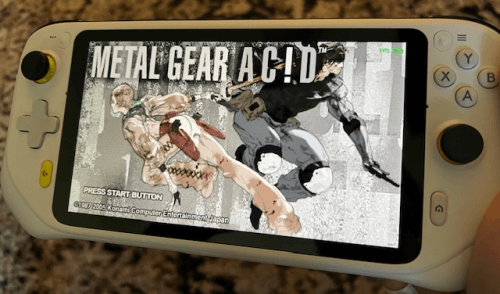
Metal Gear Ac!d, anyone?
“Metal Gear Ac!d, anyone?”

To expand a tiny bit on the subject of it being an Android device, as mentioned, it’s powerful enough for a lot of emulation, but it’s not up to the task of anything super intensive, like more demanding PS2, GameCube, or Vita games and beyond. It’s also not going to be able to smoothly play later, more demanding Android native games. Now, given this thing’s widescreen format combined with its apparently lacking d-pad, I can’t see myself emulating a lot of 8-bit and 16-bit classics on it either, even though it’s otherwise totally up to the task.

There’s a sweet spot that I found incredibly intriguing though – the Sony PlayStation Portable. The PSP had a 16:9 widescreen display and it had an analog stick (the infamous “nub”) as its main input, so it seems like a perfect match for the G Cloud. The G Cloud is also powerful enough to emulate it using the awesome Android PSP emulator, PPSSPP, being able to 4x upscale most games to its 1080p native resolution. I went from not being aware of or all that interested in many PSP games, to spending days on end cramming a 64 GB SD card with almost its entire library of games, and let me tell you, the PSP had a ton of interesting ports and genuine exclusives, especially to someone who has very little experience with the PlayStation ecosystem like me. Now, I honestly don’t know when I’ll actually get around to playing any PSP games, but this does at least mean I’ll be adding Metal Gear Acid and Acid 2, along with MGS: Portable Ops to my upcoming Metal Gear retrospective playthrough.

In conclusion, success! My original Xbox local streaming use-case seems to have been thoroughly satisfied, and the bonus use-case of opening up a whole new world of games with a high quality PSP emulation experience is also a total win. That said, I should mention that there are indeed other competitors in this space (Android handhelds with similar form factors) such as the Ayn Odin and Odin 2, the Anbernic RG556, and the Retroid Pocket RP4. Some of them are much cheaper, and some of them even more expensive, but more powerful. While I’m happy with my G Cloud for now, this is a space I’m going to keep an eye on for the future… you know, unless I just end up buying a Steam Deck. 😉