Tag Archives: Cooperative

Surviving Survival Part 4

I don’t recall how it ended up on our list, but the next game my little weekly co-op group dove into was Atlas. Atlas is closely related to Ark: Survival Evolved in numerous ways, from its studio being founded by Ark’s founders, to some shared tech and gameplay systems. Instead of dinosaurs, Atlas is pirate themed. Pirates! While I haven’t played a ton of pirate theme games, I’m certainly not immune to the allure of the idea. Sid Meier’s Pirates is a bonafide classic, I got sucked into the idea of (and quickly bounced off of) Pirates of the Burning Sea way back in the day, and I’ve almost caved and jumped into Sea of Thieves numerous times now, for example. Glossing over user reviews, there was actually very little negative criticism about the game itself, instead the harsher reviews usually focused on the controversial way the game had been abandoned. That really didn’t affect us as we were going to host our own server and treat it like any of the other cooperative survival games we’d been playing.
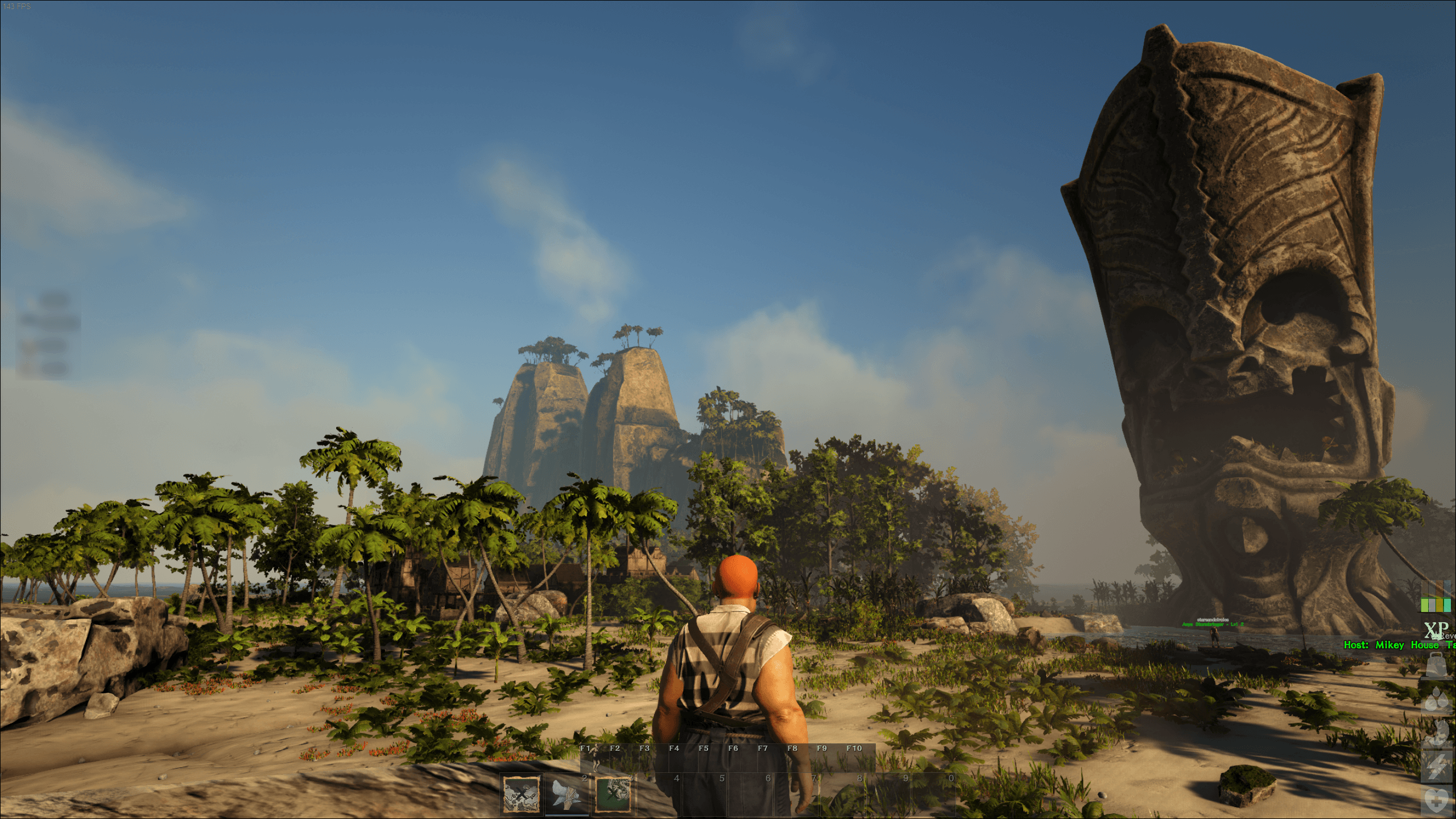
Easter Island, eat your heart out!
“Easter Island, eat your heart out!”

Except, it was pretty evident from our first few hours in the game that this was actually much more of an MMORPG-like experience than I realized. While the character creator was pretty neat, we were then dumped on a small island where we each had to do a bunch of tedious tutorial quests related to gathering x of y, running between NPCs, and killing groups of mobs; you know the drill. While progress seemed quite slow, it’s well documented that I’m a sucker for MMORPGs and the fact that we somehow accidentally got our co-op group into one was pretty exciting for what that could mean for future games if we actually enjoyed it. Eventually we managed to wrap things up on the starter island, get our first ship, and head into the high seas. Yaaaarrrrr!

Figuring out how to sail our ship was kind of fun, and the mysteries of the open sea, from storms and sea creatures to shipwrecks and floating loot, and at one point being chased by an incredibly intimidating undead pirate ship, was all pretty exciting. The first few islands we stopped at were literal copies of the starter island, which was… weird. Getting a little further away, we finally stopped at a legitimately new island and started to explore. This led to more gathering and crafting and some new stuff to fight, but honestly wasn’t much different than what we saw on the tutorial island. We then raised anchor and, maneuvering around more scary looking enemy ships marked on the map, set down onto yet another island. Exploring was kind of fun, but again, more of the same with not much in the way of new materials to gather, animals to hunt, or enemies to fight.
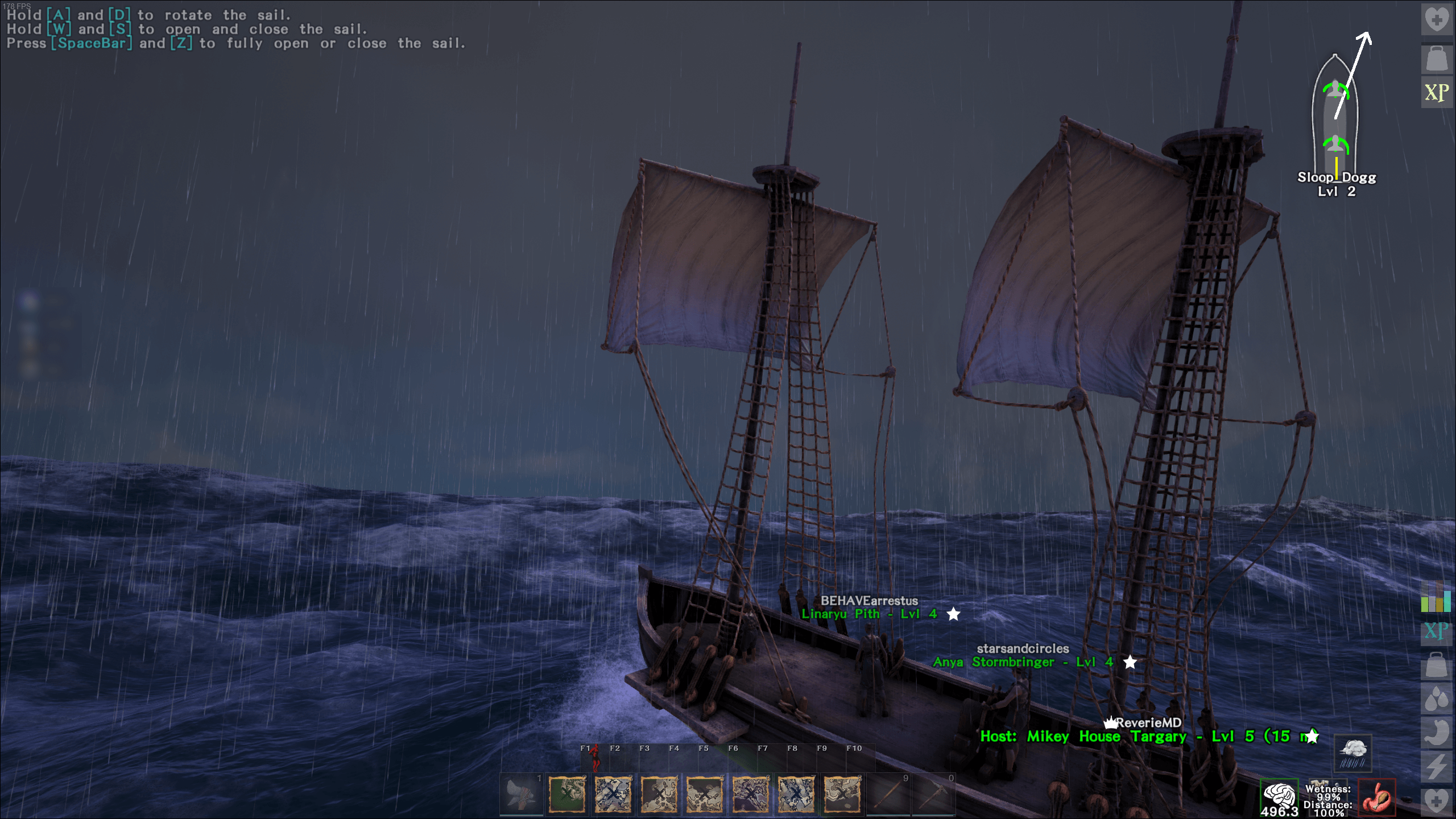
Braving a storm at sea in Atlas.
“Braving a storm at sea in Atlas.”

After only about 9 hours in the game, 2 of my group had decided they’d seen enough. Our time with Atlas wasn’t horrible, by any means, but the repetitive grind, occasional sharp spikes in difficulty, slightly janky feel, and lack of much a unique identity or any other hook to keep us playing soured the experience just a bit too much. Interestingly, since then Windrose, which looks a lot more like the type of game I thought Atlas was going to be, has hit early access with a lot of buzz. Maybe I can convince the crew to get back together and go a-plundering at some point in the future?

Next on the list is The Planet Crafter. The Planet Crafter was another game I wasn’t really familiar with, and with its simple conceit and cartoony graphics, honestly didn’t really sound all that interesting to me. You’re some sort of engineer who arrives on a planet’s surface and needs to manage oxygen, food, and water to survive, harvesting and crafting to build better and better technology along the way. Sound familiar? *yawn* In fact, that description makes it sound almost identical to Icarus which I talked about in Surviving Survival Tres. Except, as entertaining as it can be to be stupidly reductive, The Planet Crafter actually turned out to be one of the best survival games we’ve played together.
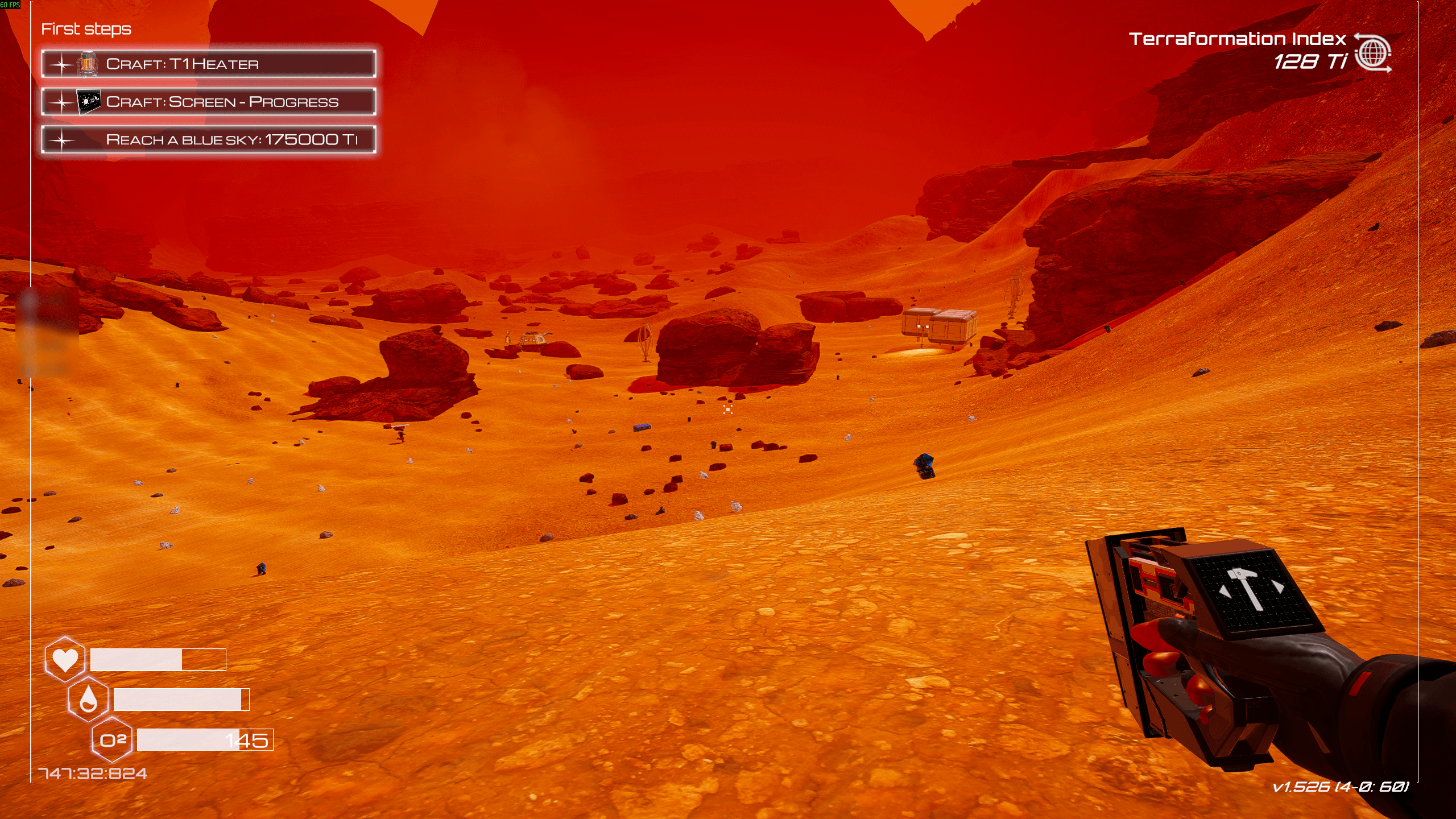
On the surface of Prime, not too long after landing.
“On the surface of Prime, not too long after landing.”

Upon closer examination, intriguing wrinkles in that simple conceit start to show. You’re not just some engineer, you’re actually a criminal who was sentenced to do this work. Interesting. What work? Terraforming the planet! Yep, unlike the aforementioned Icarus, the terraforming hasn’t already been completed – that’s your job, buddy! Not only that, but they didn’t send you down to the planet’s surface with no resources just because like the assholes in Icarus, but something went wrong and your decently equipped lander/habitat unit actually crashed, so your survival is at least somewhat out of necessity.

While all of this is pretty neat, where the game really shines is its systems. It manages to distill the basic “tree-puncher” formula down to the point where almost everything is done with a single mouse click. At first this feels kind of unintuitive, but soon you’ll be locked into the mindset and almost never have to wonder how to perform any action in the game. It’s fantastic! The whole terraforming thing is also a pretty interesting twist on your typical survival game. Much of the tech you’ll be building contributes to the pressure and heat you’re outputting, gradually transforming the barren planet to one with a blue sky and clouds, which leads to rain, which leads to the water level rising, which leads to moss and trees, which leads to insects, and then fish and eventually mammals. It’s super cool, and working towards that goal turns the game into feeling something more like a cross between Astroneer and Satisfactory. I rate both of those games highly, so this is no small praise.
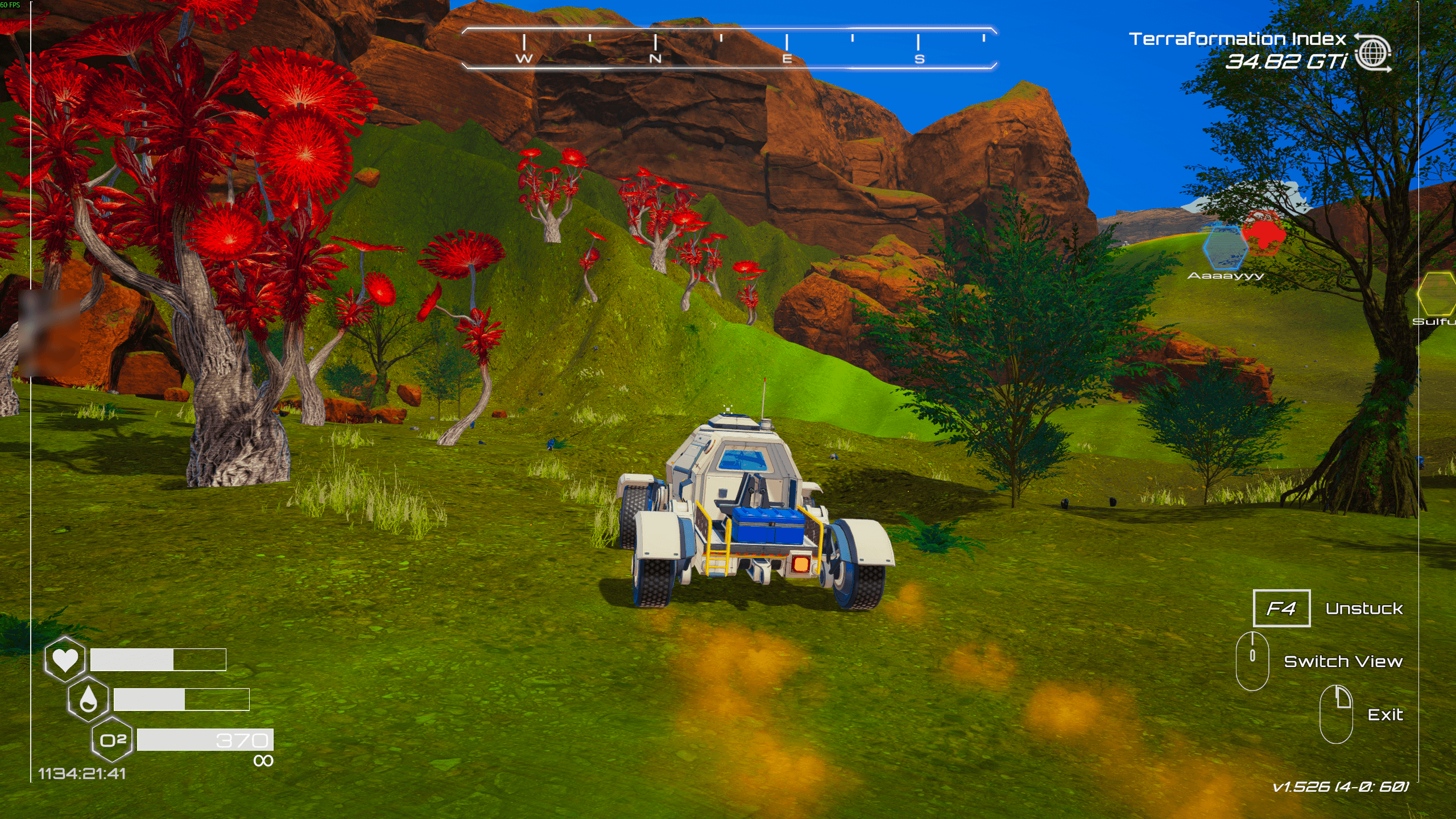
Many hours later, the world is looking much more hospitable.
“Many hours later, the world is looking much more hospitable.”

There’s also a focus on exploring more of the map to find new resources, as well as finding more and new tech by exploring shipwrecks, abandoned habitats from previous terraforming attempts, and long buried alien temples. There’s even something of a story to go along with all of that. This is somewhat similar to exploring in those two games, but much more of a necessity, and well balanced between being risky and being fun and rewarding.

Just like in Satisfactory and a lot of these kinds of survival games, I spent a lot of my time exploring. Unlike those games, so did the rest of the group. I think that speaks volumes.
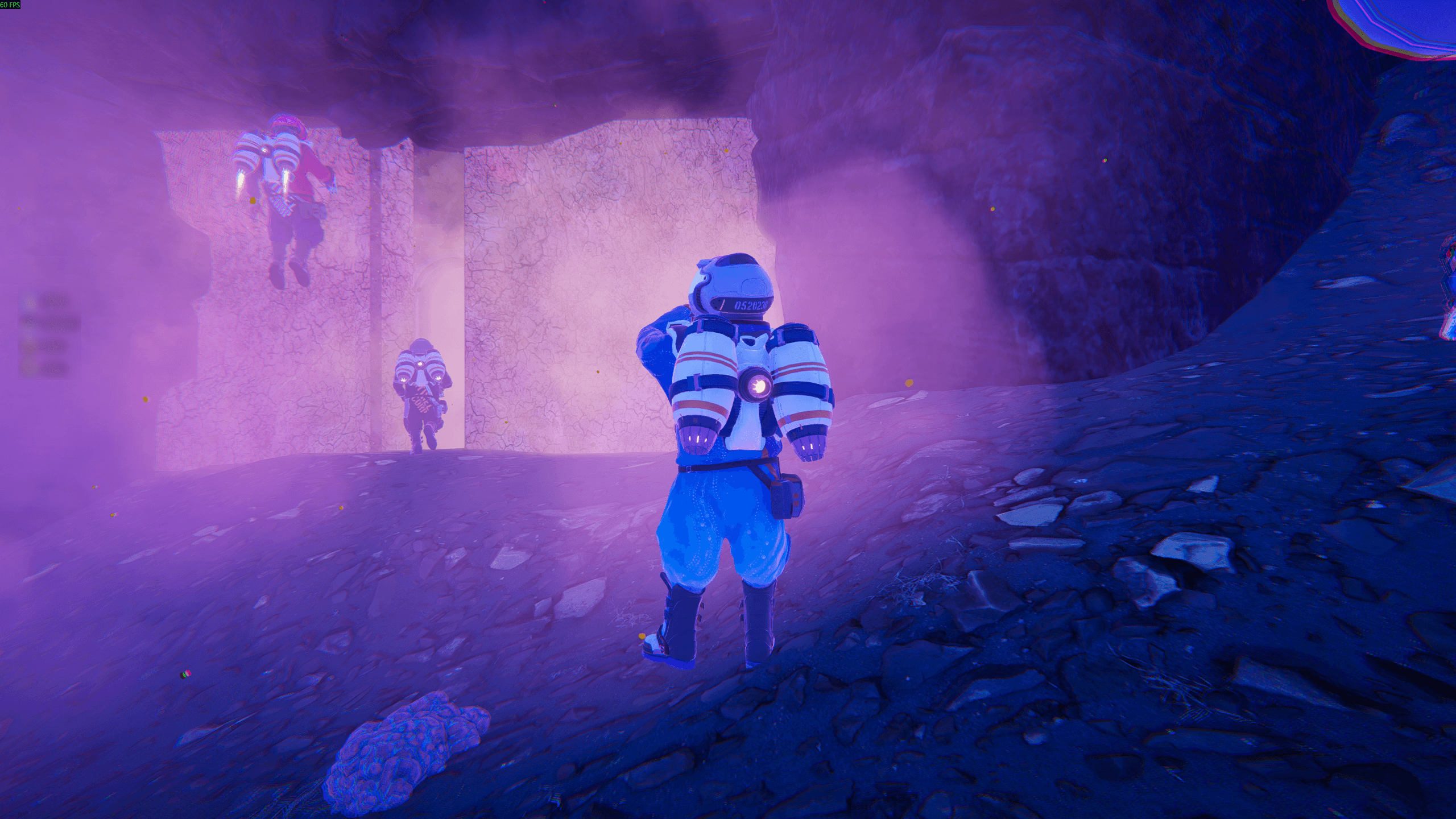
The crew and I about to enter an ancient temple.
“The crew and I about to enter an ancient temple.”

We completed terraforming the planet you start on (Prime) before taking off and heading over to the moon Selenea which started the cycle all over again, only with twists in what material was and wasn’t available from the get go, including some new things, and a limited ability to move items and resources between our original planet and the moon. While we didn’t finish terraforming it, the fact that we even played so much more of the game after “finishing” one playthrough says a lot about how much we enjoyed The Planet Crafter, and I could definitely see us coming back to it at some point in the future.

Next up was a game I’ve already mentioned in this series, Enshrouded. I’m happy to report that between a lot of patching since the last time we played it, adding more content and a lot of quality of life improvements, and playing with our full group this time, it finally hit more like I’d originally imagined it would.
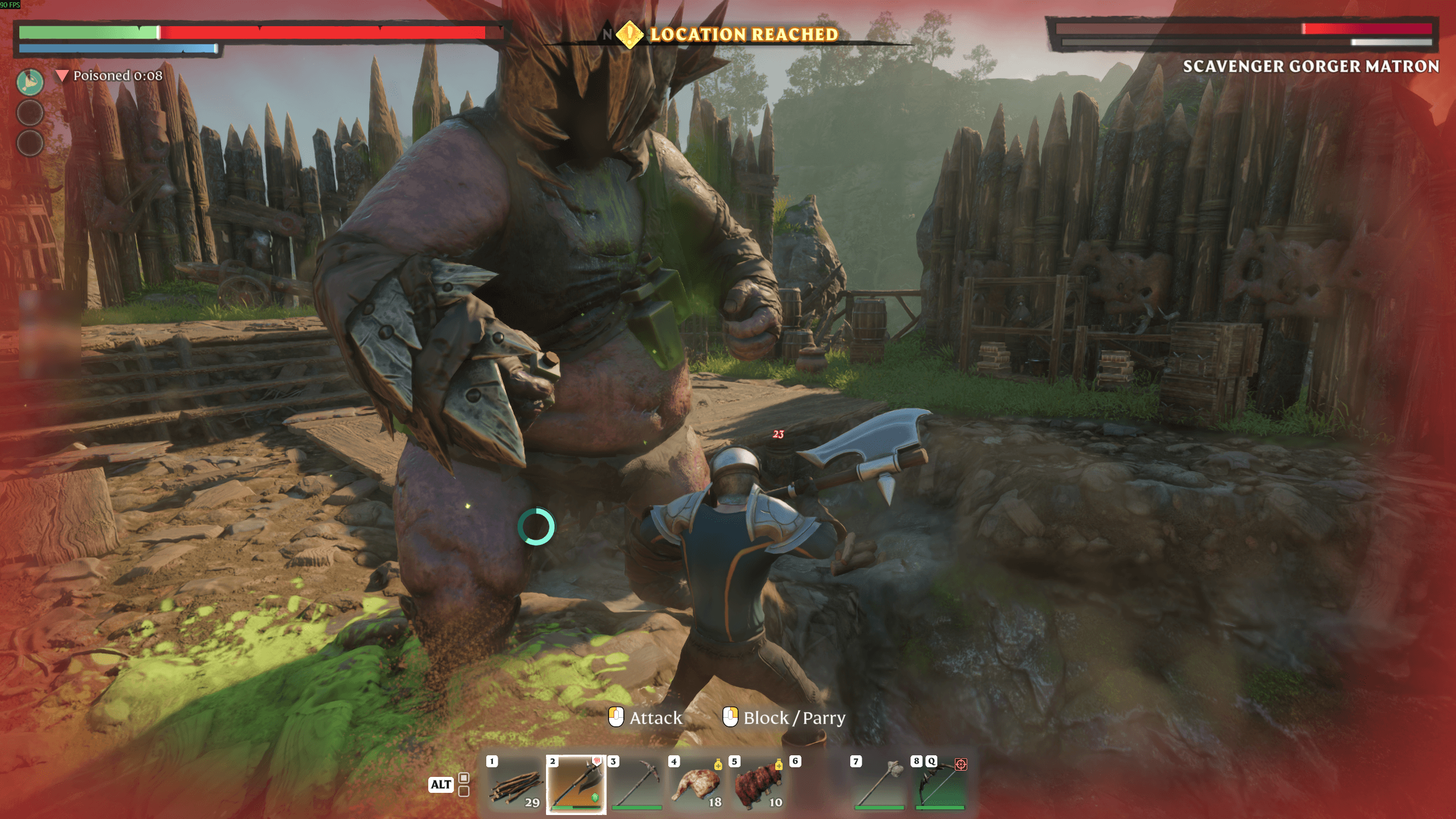
Soloing an apparently evenly matched mini-boss.
“Soloing an apparently evenly matched mini-boss.”

One of the first things I noticed when jumping into the game this time was the graphical overhaul it received. I believe the models, textures, and animations are still mostly the same, but at some point it got a lighting rework which made the game look so much nicer. I think it might also run a little better to boot, but that could be my imagination.

There are so many more survivor NPCs to recruit to your base, making it feel much more lively, and necessitating a settlement approach to construction even more than before. Of course, most of these new NPCs bring new recipes to craft and new quests to complete. In fact, that relates to one of my few complaints about this playthrough – there are way too many quests, and they don’t chain together like in a well designed RPG, rather your quest log is just stuffed with random tasks to complete all over the map, and every time you cross one off it feels like 3 more pop up. I’m perhaps exaggerating a little, but it did feel kind of overwhelming and tempted us to simply not worry about them that much. That said, when things got slow and we started to feel a little bored, crossing one or two off of the list was an easy way to remedy that.
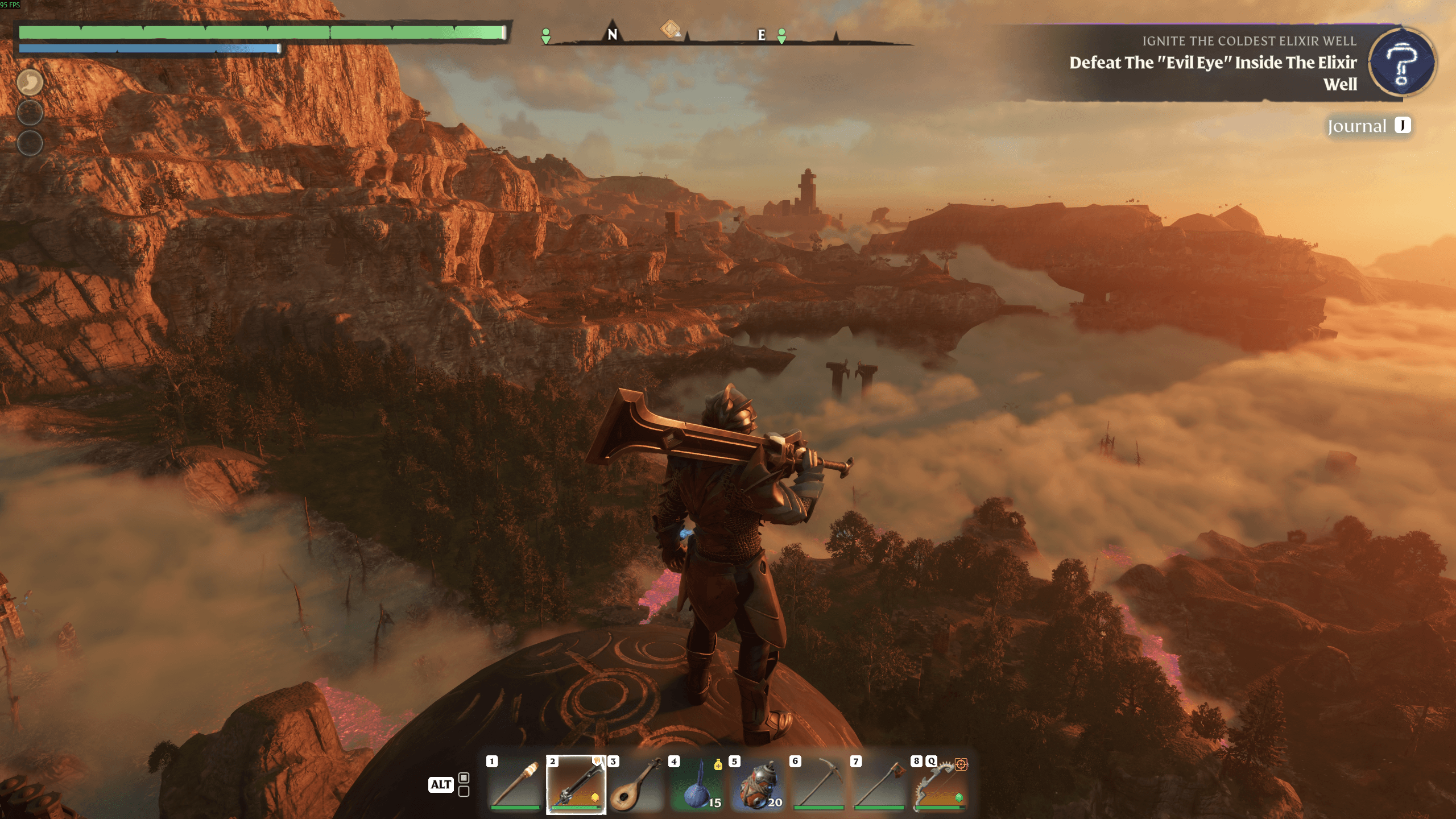
Man, Enshrouded is full of incredible views!
“Man, Enshrouded is full of incredible views!”

That was more of an issue later, but one thing that endangered our playthrough early on was the difficulty of the combat. I’ve previously described the game as more of an action-adventure game along the lines of a modern Legend of Zelda game, but its take on combat might be more inspired by the Dark Souls series and the like. Stamina management is important, as are blocking and rolling and dodging in and out of combat to avoid what otherwise can be fairly punishing attacks. Thankfully this is much more of an issue for the first few levels of the game, as between obtaining new and better gear and selecting new skills as you level up, combat gets considerably easier as you progress.

At this point the game is still in early access so I’m not sure it actually has anything resembling an “end” quite yet, though we did explore almost the entire map including maxing out our skill points and defeating what is, at least at the moment, its biggest and hardest boss, the Fell Dragon Youngling at the Howling Peak. This was easily the most poorly tuned and frustrating part of the entire game, and we hit our heads against that particular challenge for large portions of at least two different sessions, and probably would have quit over it if we weren’t hard-headedly determined to get beyond it, even if it wasn’t actually blocking any of our progress.
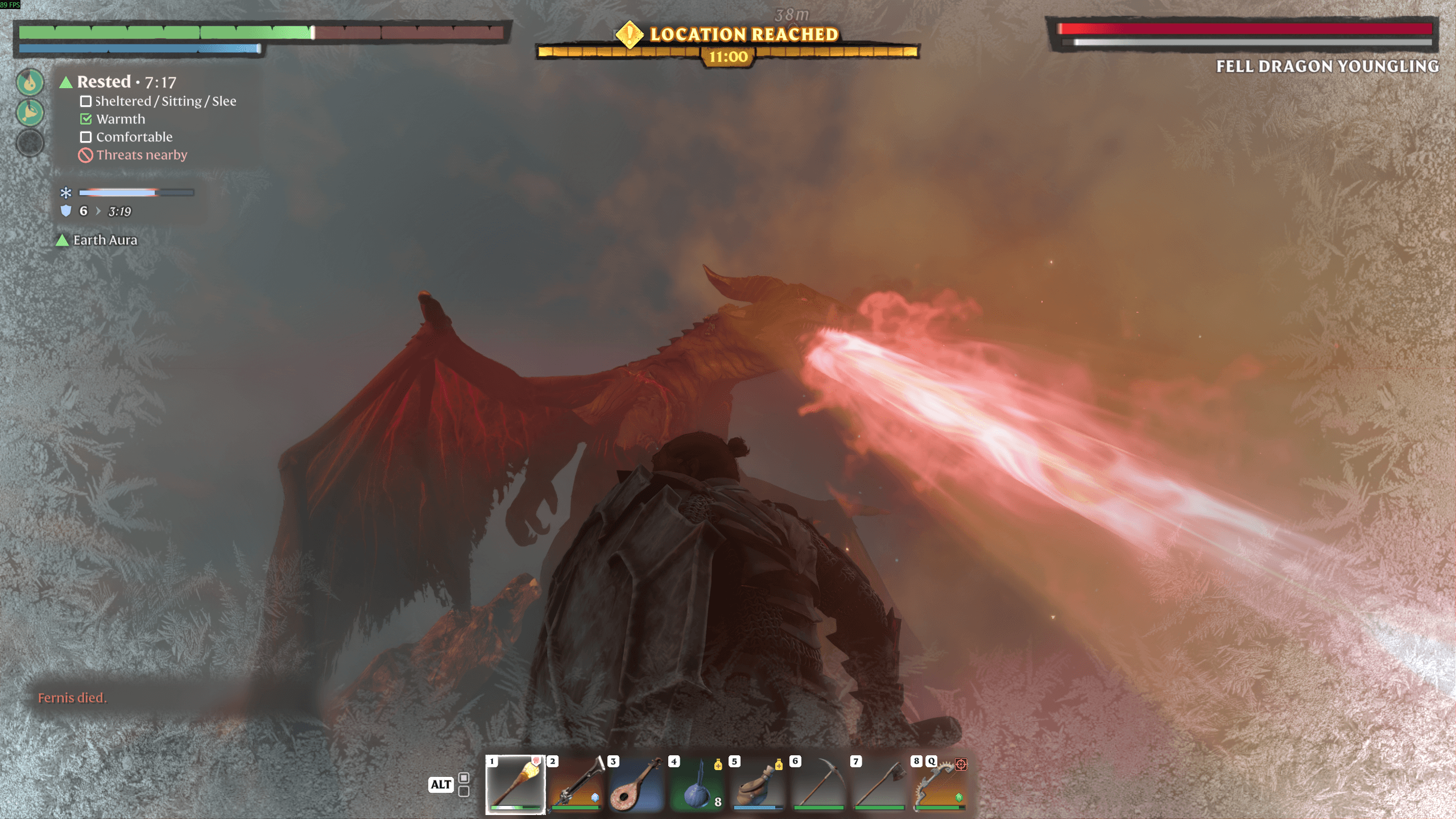
On the other hand, finally slaying this fucking thing felt great.
“On the other hand, finally slaying this fucking thing felt great.”

We finally quit the game when we felt like we’d more or less exhausted the more notable content, and between the three playthroughs I’ve done I have about 127 hours in game. My first two were probably in the single digits, so yeah, we definitely put our time in! While it was dicey at first, in the end I think Enshrouded has earned a spot amongst the best co-op survival games we’ve played thus far. It might not be my absolute favorite, as some more unique experiences edge it out, but it’s a great game, and I’ll be keeping an eye on it when it finally reaches 1.0 (projected to be quite soon) and beyond.

Finally, on a much less positive note, is Nightingale. This is another game that I’d heard nothing about but ended up on our radars somehow, and we all picked it up during a Steam sale. I was feeling a little down on the idea of jumping into yet another boiler plate tree-puncher, after all, we’ve played quite a few of them, often one after the other, but once we started playing the game and learning its systems, it was growing on me.
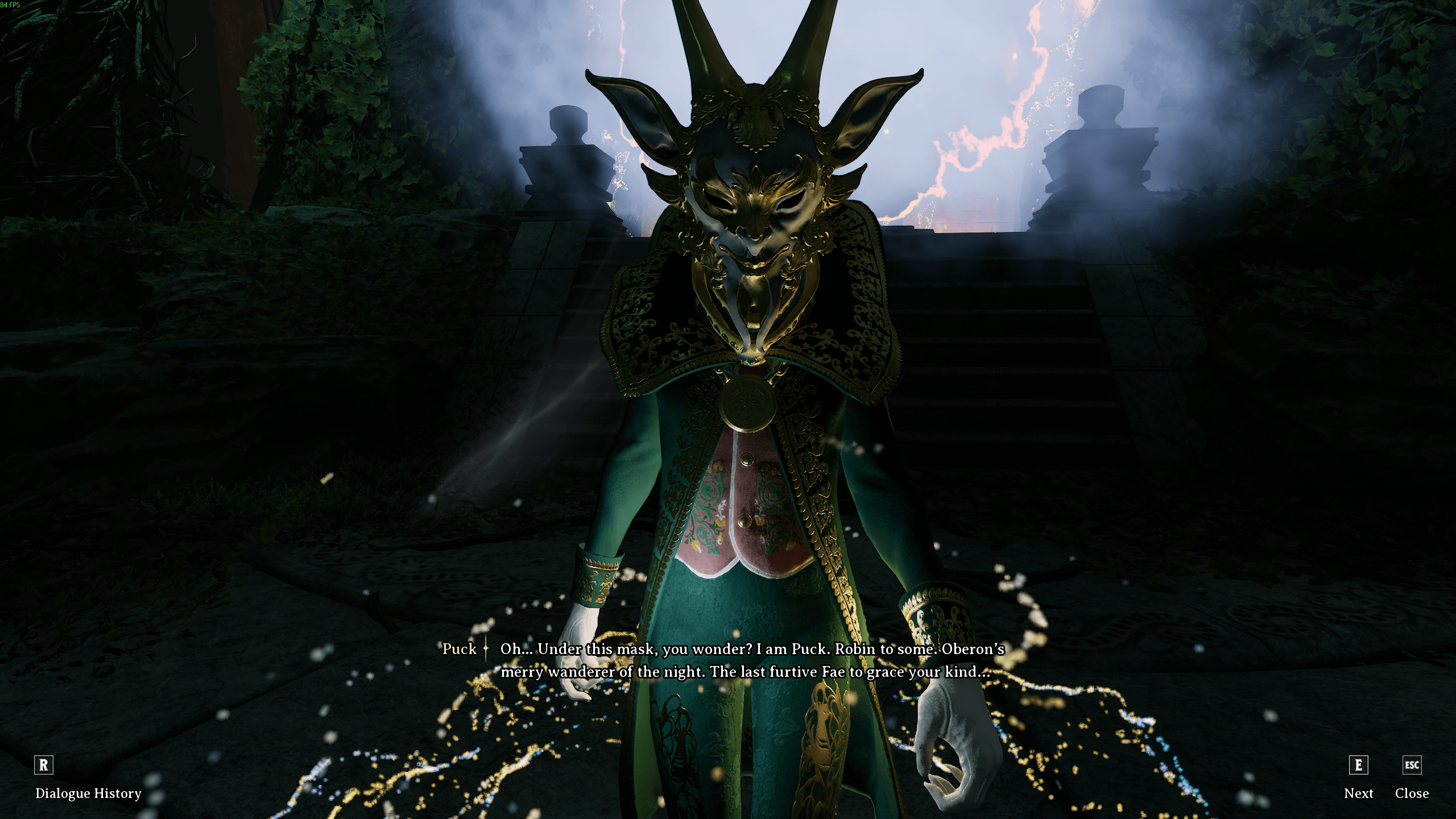
Puck is always around to creepily advise you on your next steps.
“Puck is always around to creepily advise you on your next steps.”

To back up for a second, Nightingale has kind of an interesting theme, mixing Victorian-eque gaslamp setting with fae mythology and magic, and more than a little interdimensional travel. It looks gorgeous much of the time, and its systems are fairly interesting, albeit it apparently pivoted from being an MMORPG to a more traditional open world survival game at some point in its development. I don’t know much about its history, but I get the distinct impression that, not unlike Atlas, some shit went down, and as a result, the game just didn’t quite hit as hoped. I don’t believe it’s been abandoned yet, but it definitely seems to have lost just about all of its early access momentum and hype, sadly enough.

So we jumped into the game and started trying to figure out what the hell we were doing. The fact that it took a little while to figure out some of the systems at hand was actually a positive, since it meant it wasn’t quite as cookie-cutter as I’d feared. We traveled all over the first realm completing quests and exploring points of interest before finally moving on to the next one. In the next one, we set up a new homestead to serve as our base of operations, and then spent quite a while gathering, crafting, and otherwise teching up before moving on to knocking out quests and otherwise clearing the map. Unfortunately, the latter task felt a lot like what we’d done in the previous realm, which gave me some concern about the gameplay getting too repetitive if we continued to play it so methodically.
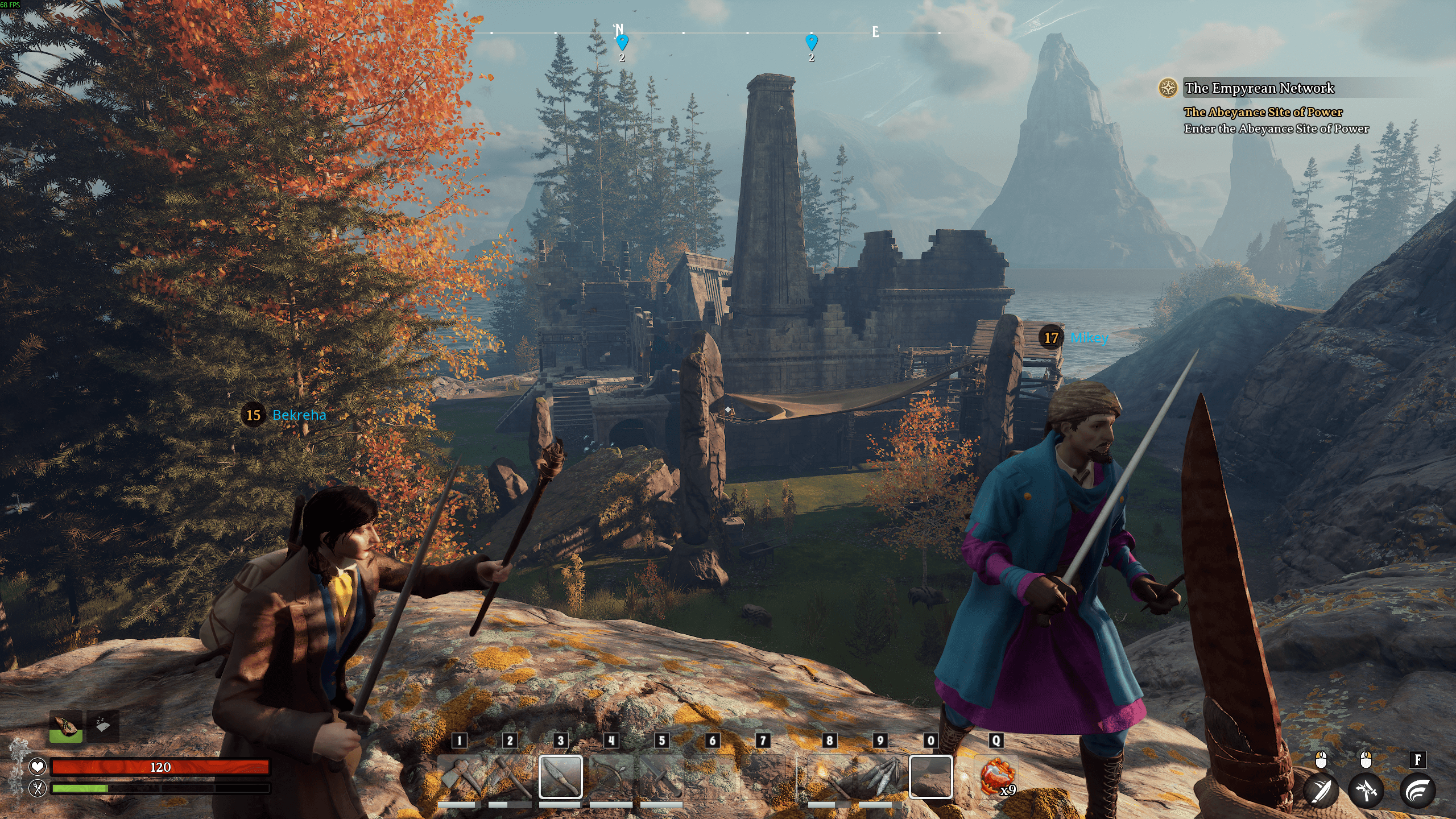
Exploring the mysterious realms of Nightingale.
“Exploring the mysterious realms of Nightingale.”

At some point we got a quest to try out a new ability to more freely travel from realm to realm by opening our own portals, which brought us to yet another new, though much smaller realm. This one was quite different, and the promise of all of these unique realms was starting to be evident. Once we cleared it and went back to continue where we left off on the second realm, however, we made a startling discovery: our homestead and everything we’d had stored in it was totally gone; the map was back to its original state. While we still had our character progress, losing all of this work, including some special quest rewards, took the wind right out of our sails. While we found reports of similar issues evidently caused by bugs from years back, it still isn’t clear to me if we could have somehow screwed something up in the way we traveled back to this realm, or if it was indeed some kind of bug. In any case, after fruitlessly looking for some solution to restore our progress, we collectively gave Nightingale the middle finger and moved on. Major bummer!
Cleaning, Climbing, and Crime!

As a follow-up to Surviving Survival Tres, my group also snuck in some lower commitment co-op games in between some of the sessions of those games. We mostly did this if completed a game early and weren’t ready to quit playing for the night and/or hadn’t quite made up our minds on what our next longer game would be. The first of these games was Viscera Cleanup Detail.

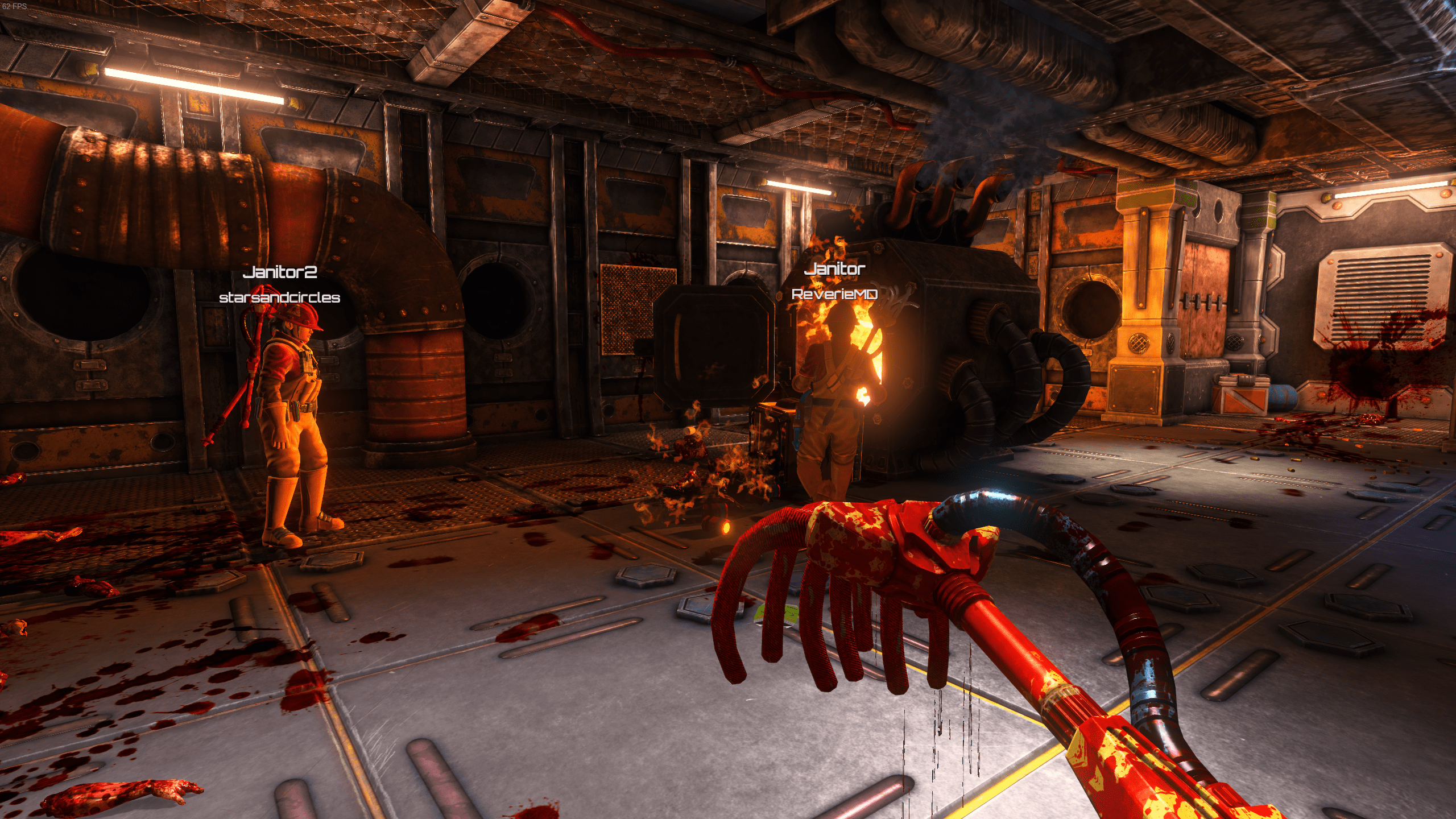
I’ve been wanting to play VCD for quite a long time, after first hearing people rave about it on my favorite podcasts when it was still in early access, something like ten years ago. It had a reputation for being a scrappy little indie game that both helped invent the now hugely popular genre of games that capitalize on repetitive and comfortable yet somehow addictive activities (see Powerwash Simulator and half of the other “simulator” games on Stream) as well having a pretty amusing narrative conceit: ever think about the carnage and wreckage left in the player character’s wake in shooters like Quake and Doom? No, probably not, but these guys did! They also thought about the poor bastards that have to clean it all up. That’s VCD in a nutshell. You, and assuming you’re playing cooperatively (you should be!) your companions are essentially space janitors who have to bring order to the utter chaos left in each of these spaces. My boy Roger Wilco never had it so bad…

Welp, it's another day in the office...
“Welp, it’s another day in the office…”

These days repetitive task games, as well as games that give players purposely inaccurate controls and/or wonky physics for laughs, feel, eh… kind of quaint. Both gameplay tropes have been iterated on so much over the succeeding years that I can’t help but feel that VCD has aged kind of badly in comparison. Despite how much I love the concept of VCD, I was caught off guard by how much it leaned into the latter in particular – I was hyped to clean the ever loving hell out of some gore-strewn space station corridors, but I really wasn’t expecting the game to fight me so much in the process. Worse yet, given the game’s age, I was also never quite sure whether this was all very intentional or if these systems were just… bad. I have to imagine the former, since the game also gleefully puts other weird roadblocks in your way, such as randomly malfunctioning equipment. Regardless of intent, it feels a bit outdated and clunky by today’s standards and, honestly, while there were some hilarious moments in the 90 minutes or so I played it, I found myself more frustrated than amused most of the time.

I may go back to it one of these days just to give it a fairer shake, but I left the whole thing a little disappointed.

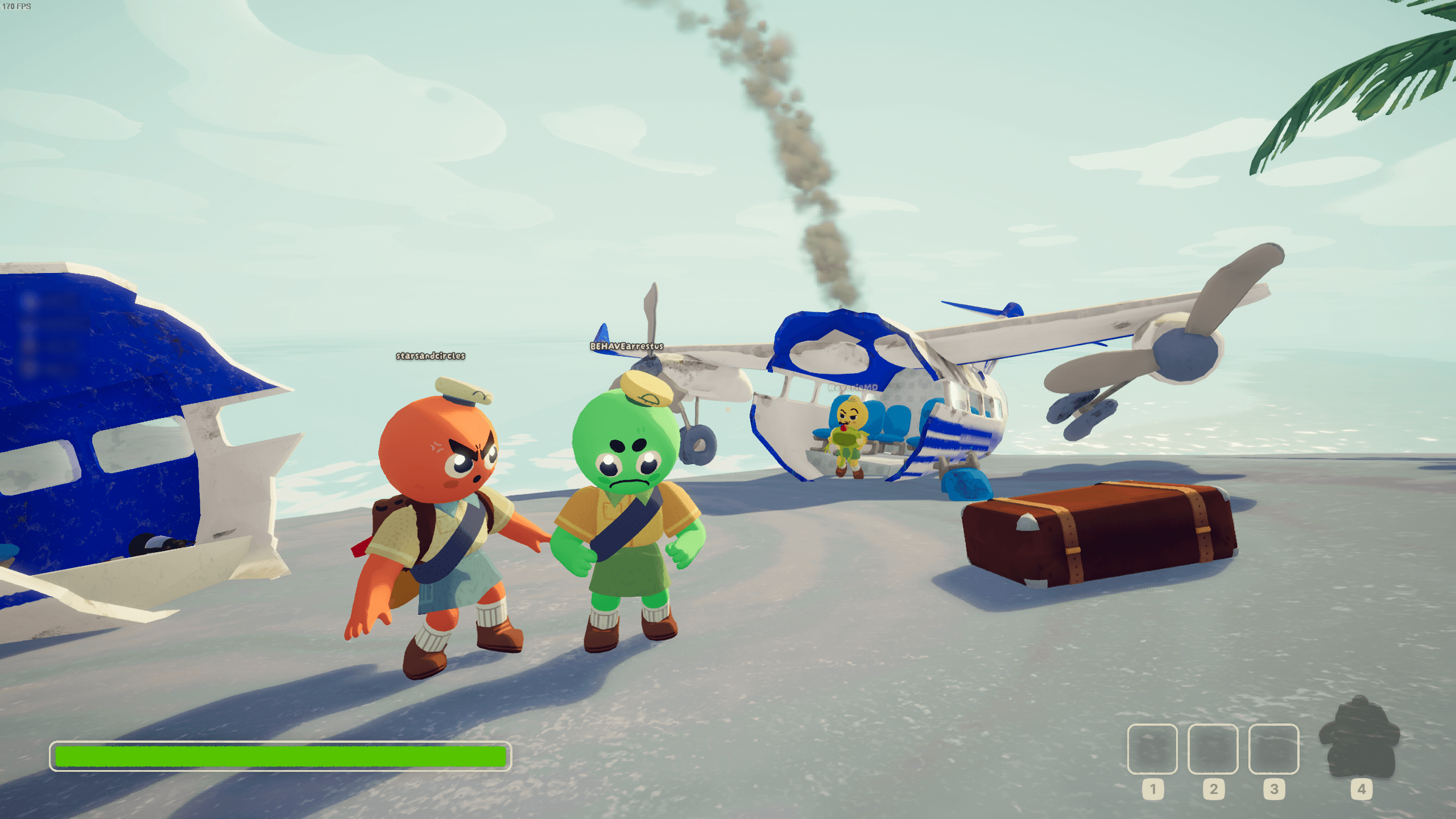
Speaking of indie darlings, we also hopped into a much newer game to hit the zeitgeist, Peak. I’d heard about Peak from podcasts like Rebel FM, but honestly, it seemed like everyone was talking about it for a little while there.

I mean, this picture was too perfect not to use.
“I mean, this picture was too perfect not to use.”

Peak is a cooperative game where you and your friends have to navigate some fairly harsh terrain, including climbing up mountains via some pretty sketchy cliffs. There’s a bit of that wonky physics stuff going on here too, but all and all it feels much more like it’s giving you the basic confines you need to work within to create a bit of a challenge rather than purposely trying to sabotage you. I suppose that’s a fine line and not all that objective, but that’s certainly how it feels to me. There are some neat little touches too, like how climbing works, the ability to give your friends a hand to pull them up, and the numerous items you can loot along the way that can sometimes help you achieve your goals.

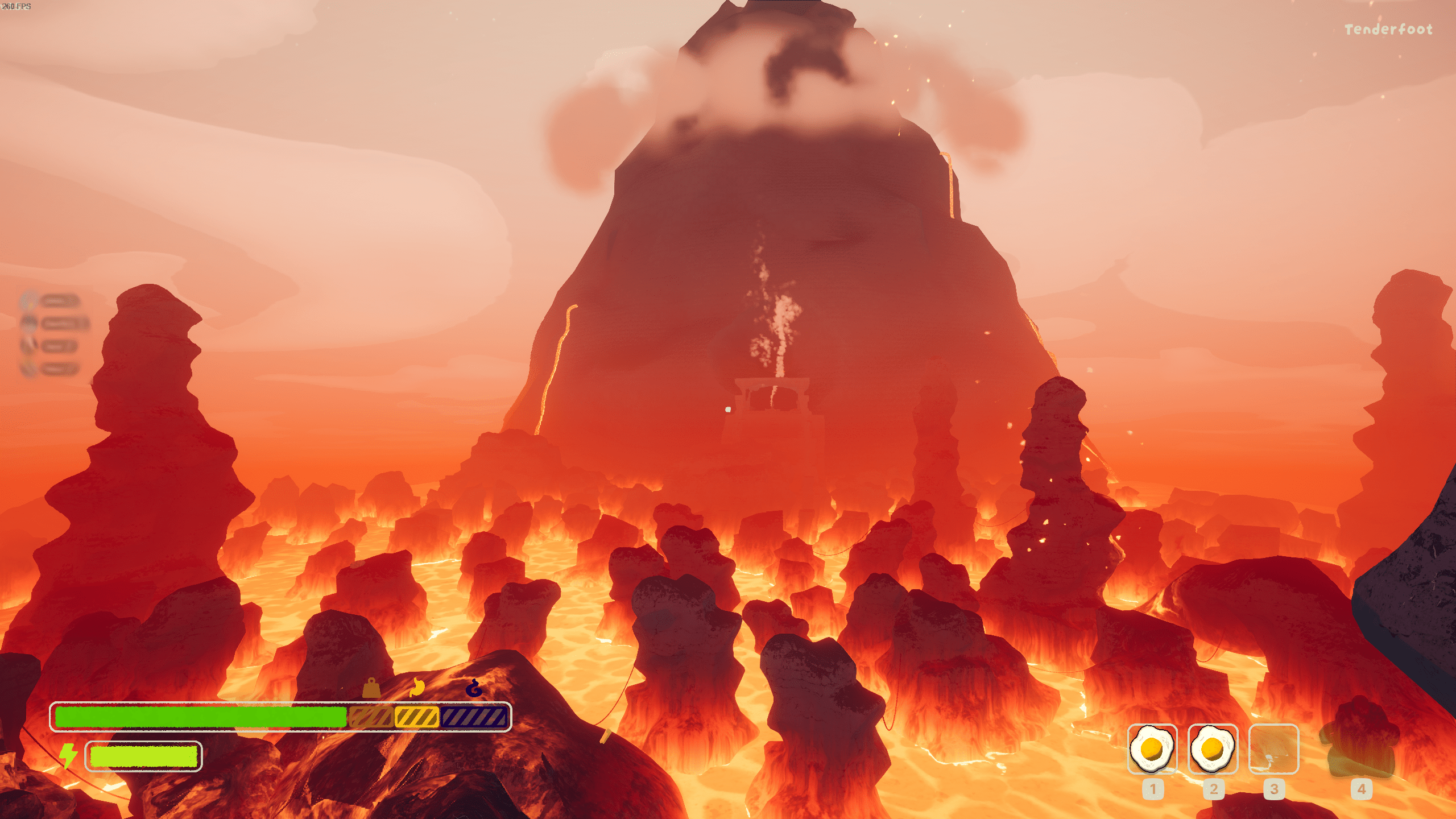
The game also has an optimistic vibe which starts off feeling like a fun adventure with your friends. It doesn’t really stay that way though – while you’ll quickly get better at the game, naturally, the first several attempts to get to the top of the first mountain can feel tense and a little harrowing, and it only gets worse from there. That is, each run in Peak has you navigate through 5 different biomes, procedurally generated daily. Some of these biomes are harder than others, and many have some neat features unique to their themes, like the prevalence of ice anchors and storms in the snowy area, for instance. It’s worth noting that we played before the most recent two types of biomes were added to the game, so no experience with those. Anyway, this culminates in a final area, The Kiln, which is an almost vertical climb up a massive shaft while lava rises beneath you. Ooof!

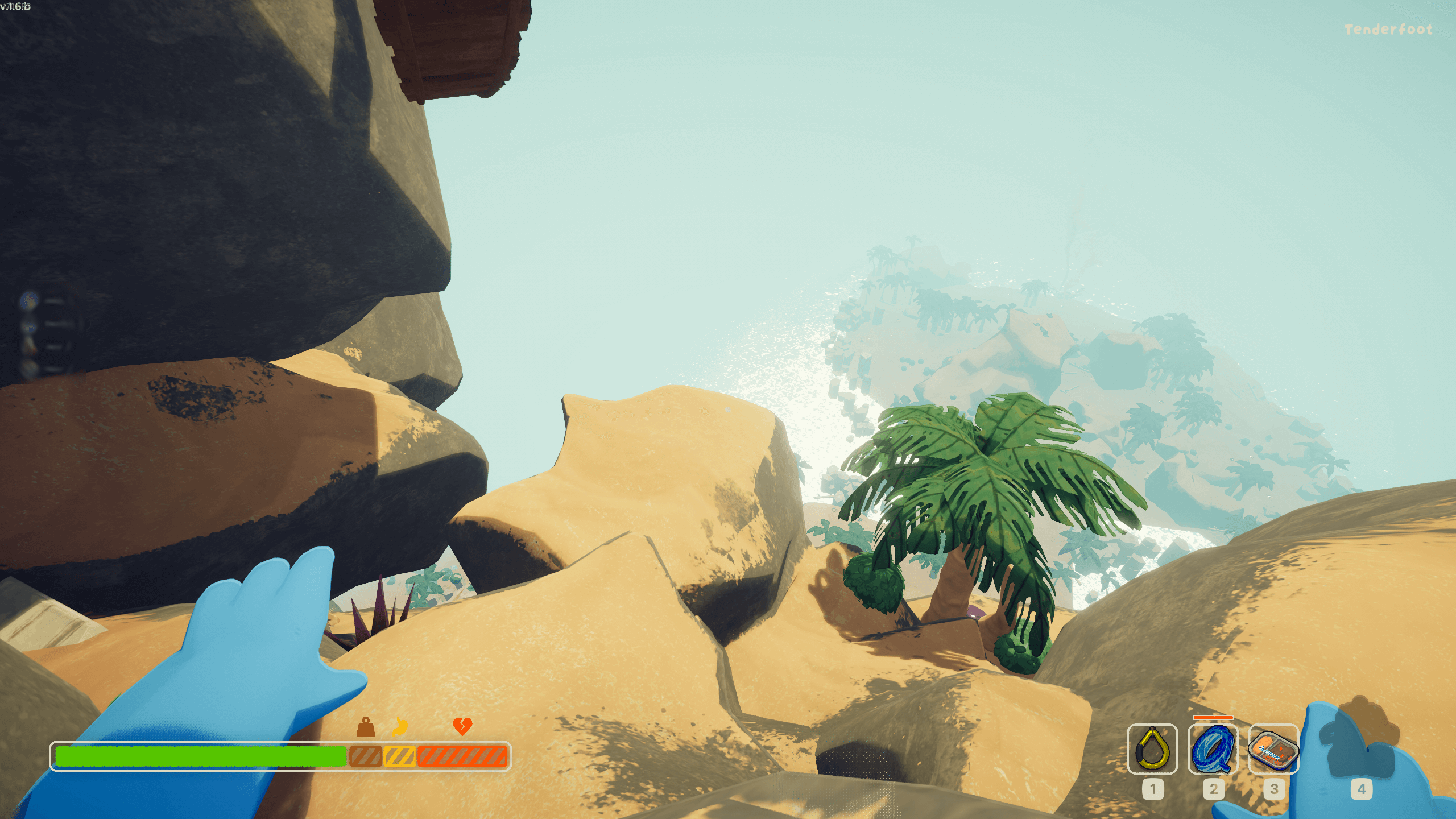
Looking back down onto the beach from the first mountain.
“Looking back down onto the beach from the first mountain.”

Of our sessions, we managed to make it to The Kiln multiple times, but by the time we got there we were in bad shape and had depleted most of our items, and were therefore ill-equipped to make it to the top. Not that we didn’t give it a go regardless. Making it all the way to the end but not beating it multiple times is a bit of a downer, though honestly I think most of our frustration came from other areas. For one, if your character dies and can’t be revived (which is common, since sometimes you’ll die from a nasty fall and your teammates won’t be able to backtrack to where you fell) you can’t be resurrected until reaching the campfire at the summit of the current biome. This means if you die just after getting there, you might be effectively out of the game for a very long time.

There’s also something of a time limit in the form of a rising fog which, not unlike the closing circle in a Battle Royale game, forces you to keep moving and keep somewhat of a decent pace.The fog is rarely a problem in and of itself, though if you all manage to die, be it to the fog or a series of misadventures, you all have to start all over again. I was personally pretty surprised that the first time this happened we didn’t restart back at the last campfire. Having the campfires be checkpoints seems like an absolute no-brainer to me, but I suppose that is counter to the rogue-like “run” design the developers had in mind with Peak. Fair enough, I guess, and it does seem like they’ve added a partial solution to this (the “Checkpoint Flag” item) in their latest content push, so perhaps that will help (although given the random nature of finding items in this game and the fact that its a per player, single use item, I’m skeptical!)

Okay, now shit is getting real!
“Okay, now shit is getting real!”

After my 8 or so hours with Peak, I think my biggest frustration with the game is how close it is to being really, really great. I fully expected the devs to iterate on the design and quickly release more and more content, but it’s been a little slow and underwhelming. These types of games (recently I’ve been hearing them called “Friend Slop” which is both very descriptive and a little unfortunate) tend to be a little short-lived in terms of player interest, with a new one, RV There Yet?, currently getting a lot of attention. Still, I think Peak is a fun game and recommended for people looking for a quick, pick-up-and-play cooperative experience, and I doubt that’ll change even after everyone has moved on from it.

One game I almost forgot we even played was Escape First Alchemist. This was a pretty simple escape room style cooperative game, though unlike the last game of this type I played, We Were Here, EFA feels much more like a true escape room experience – you and up to 3 others are tossed into an area with no prescribed roles, you just have to work together to solve puzzles to progress.

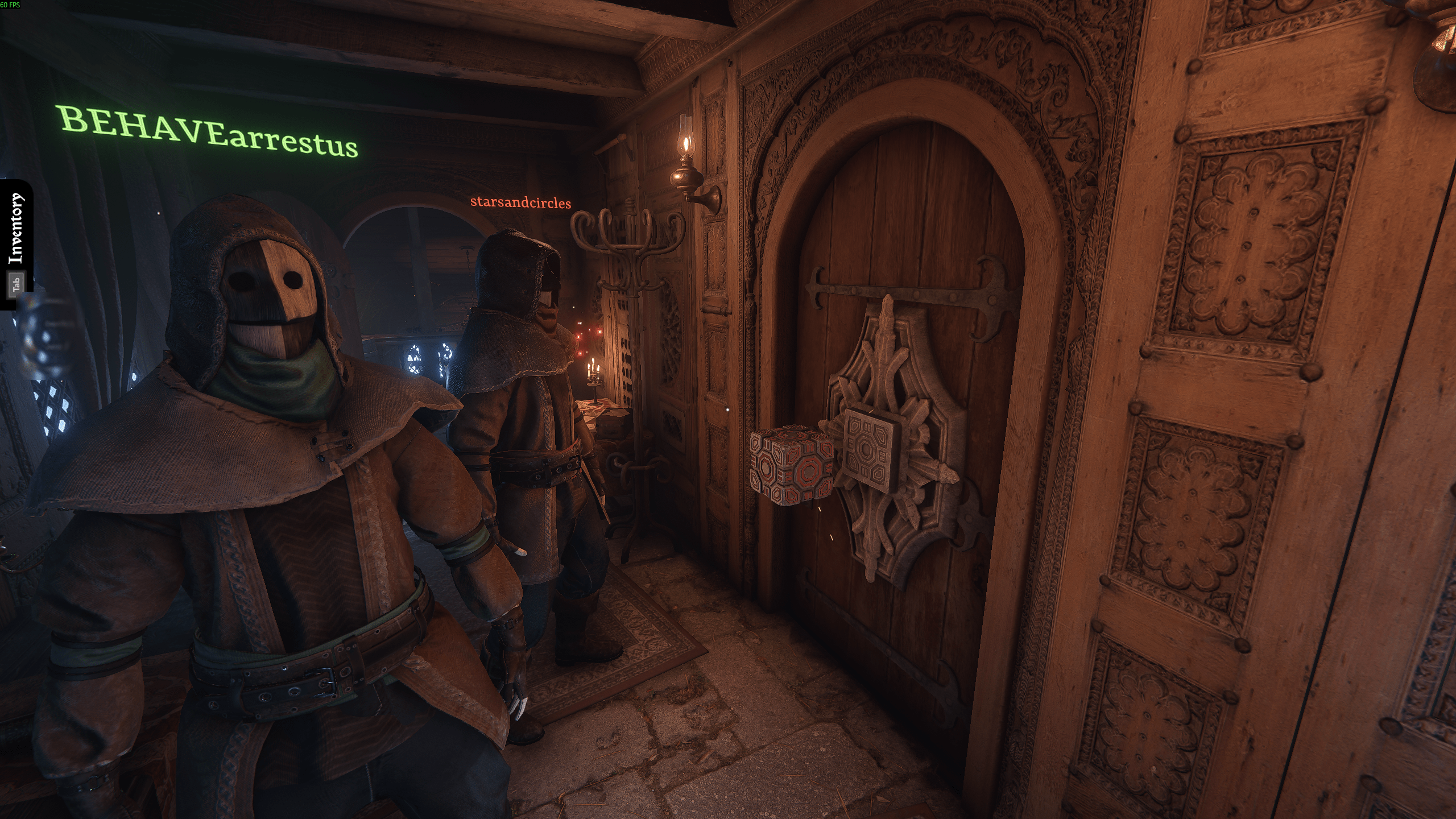
Unraveling the mysteries of... a door.
“Unraveling the mysteries of… a door.”

The setup is that you’re an alchemist’s apprentice, and you’ve got to try to free the master alchemist, Trismegistus, from whatever kind of magical pocket dimension he’s got himself trapped in. The puzzles are themed around this – brewing potions to affect yourself with whatever strange abilities they grant, fiddling with arcane machines, accessing secret passages with interesting mechanisms, that kind of thing. Honestly, while the game no doubt has some very cool moments and interesting ideas, as a whole I didn’t find many of the puzzles or the gameplay overall to be all that compelling. I was especially let down by the ending, which didn’t feel anywhere nearly as climactic as I want from a game like this. Honestly, ending with some vague text is kind of a letdown when the rest of the presentation was so nice.

Still, EFA only takes 2 or 3 hours or so to play through, and as a co-op experience, it’s fun enough. It has some really nice visuals and an excellent presentation overall, which really helps sell the experience, although the magic book that acts as your narrator apparently annoys a lot of people. I think in our case we were too busy talking amongst ourselves to focus too much on it, really. Personally, if Escape First Alchemist sounds appealing to you, I’d probably hold off until it’s on sale.

Well, it definitely looks like a narrative adventure game!
“Well, it definitely looks like a narrative adventure game!”

Radically changing directions, it’s been a while since my partner and I played through a narrative game together, but the mood struck us and we ended up diving into As Dusk Falls. Really, As Dusk Falls has been on my radar since before it was released back in 2022, but despite constantly hearing people sing its praises, I was skeptical of what little I knew of its story, and I actually found its unique art style, which reminds me of a low-rent version of A-ha’s Take On Me music video with its stylized makeovers of static images of real actors choppily stitched together, kind of off-putting. I’m not sure what intrigued her about the game, I’m guessing she heard some buzz about it from somewhere, but when she suggested it, I figured why not finally check this thing out.

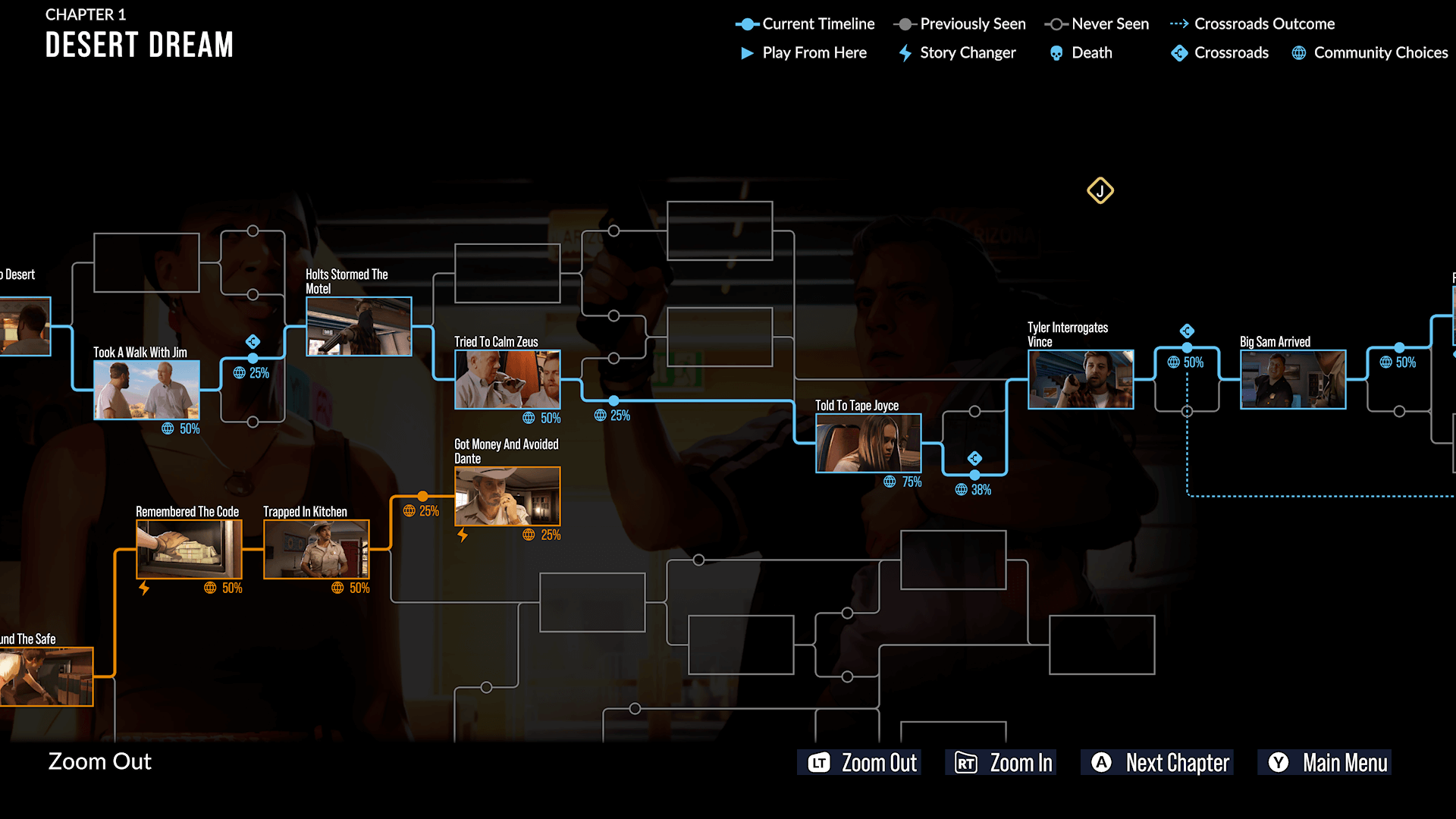
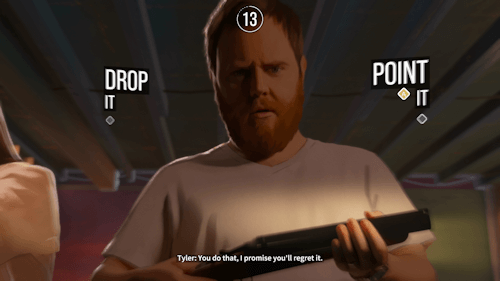
For those unaware, As Dusk Falls falls is a narrative adventure game where you make conversation choices and other decisions, occasionally spiced up with some action scenes in the way of relatively simple QTEs. The game is split up into numerous chapters over 6 episodes, although for some reason the episodes were released all at once rather than the usual strategy of having weeks or even months between releases. In terms of how this is all implemented, I think it falls closer to the confusingly similarly titled Until Dawn or one of SuperMassive’s other horror adventure games (although I believe Quantic Dream’s DNA is what is actually at play here, though I’ve yet to play any of their games so I can’t quite compare them) which is to say that your choices matter a lot more than, say, a Telltale game, in terms of impactful results, with numerous endings (or at least, variations of endings.) The game wants you to be aware of this too, as at the end of each chapter you’re shown a tree of every impactful decision and how they all branch out, which is always really fascinating to look through.


“These end of chapter decision trees are too cool!”

We played ADF via the game’s couch co-op mode, which assigns some decisions and actions to random player, and others more democratically (which may sound weird, but it also supports up to 8 people online, so a majority wins scenario makes a lot more sense there.) Interestingly enough, something I hadn’t seen, or at least not so prominently in other similar games, is that you can tune a lot of the game’s difficulty modifiers, like making it impossible to run out of time when making a decision, or making the timing on QTEs ridiculously easy. At first we had tuned a lot of this stuff to make it all really easy (I mean, who wants to fight against ridiculous QTEs?) but we actually ended up turning it all back up, as these kinds of games are a little broken if you make them too easy. I mean, if you never fail a QTE, you never get to see the resulting branches, and I’d imagine some of these scenes are tuned to be harder than others to push players towards a more likely path. It just made things feel a bit more linear than they were intended to be, and where’s the fun in that?

The story of As Dusk Falls revolves around a couple of brothers who get into some trouble with a corrupt sheriff, which quickly escalates into a hostage situation involving a whole heap of other characters. You mostly play as either one of these brothers, Jay, or as one of the hostages, Vince. Set against the backdrop of a small town in Arizona, the whole “bored teenagers stuck in a seemingly dead end rural wasteland” vibe stuck with me probably more than anything else about the game. I actually find something about that vibe, especially when it comes with crime stories and the desert, a little unappealing, but hey, I love Breaking Bad and No Country for Old Men, so maybe there’s also something in that inner conflict that works for me? That said, it’s hard to feel much sympathy for the Holts, even if Jay was somewhat more relatable and redeemable, and like a lot of good crime stories, there are some pretty harsh outcomes that some might find a little distasteful.

Most of your decisions will be fairly black and white, and very impactful.
“Most of your decisions will be fairly black and white, and very impactful.”

As I suspected, despite kind of disliking the art style, I got used to it pretty quickly, and while I’d occasionally see some animation or other element that was laughable, it mostly ceased to become an issue, and I might have even warmed up to it a little by the end of six episodes. I still don’t really know if this was a budget concession, strictly an artistic choice, or somewhere in between, but alas, if it was done to cut costs, I suppose I’m good with it if it allows more games like this to be released in the future.

In the end, I do think As Dusk Falls is a really good adventure game, but just how much you’re going to enjoy it is going to come down to whether its story, setting, and unique art style work for you. I still have some mixed feelings about it, myself, but I can’t deny that it deserves its place amongst the more notable of these types of games, and I’m quite surprised that INTERIOR/NIGHT still hasn’t followed it up yet, although they did just get the PlayStation port of it out last year, so perhaps they’re just not far enough along yet to make any announcements.

A couple of these As Dusk Falls screenshots were swiped from elsewhere due to us neglecting to take any screenshots while playing, with the exception of that end of chapter 1 decision tree.

Surviving Survival Tres

As mentioned in Surviving Survival Part 2, the next thing on my weekly gaming group’s hit-list was Icarus. Icarus is a game I was entirely oblivious to until one of the group recommended we check it out next, as he’d previously played it a bit and enjoyed it. Released in 2021 by Dean Hall of DayZ fame and his studio RocketWerkz, I’m kind of surprised I hadn’t at least heard of it. Looking for more info, I stumbled across a random entertaining video showing a group of friends and their hijinks in the game. It looked interesting, if not perhaps just a little hardcore for our group, as the game is close to a pure “tree-puncher” style open world survival crafting game, and our enjoyment of it was very likely to hinge on how well that difficulty was tuned.

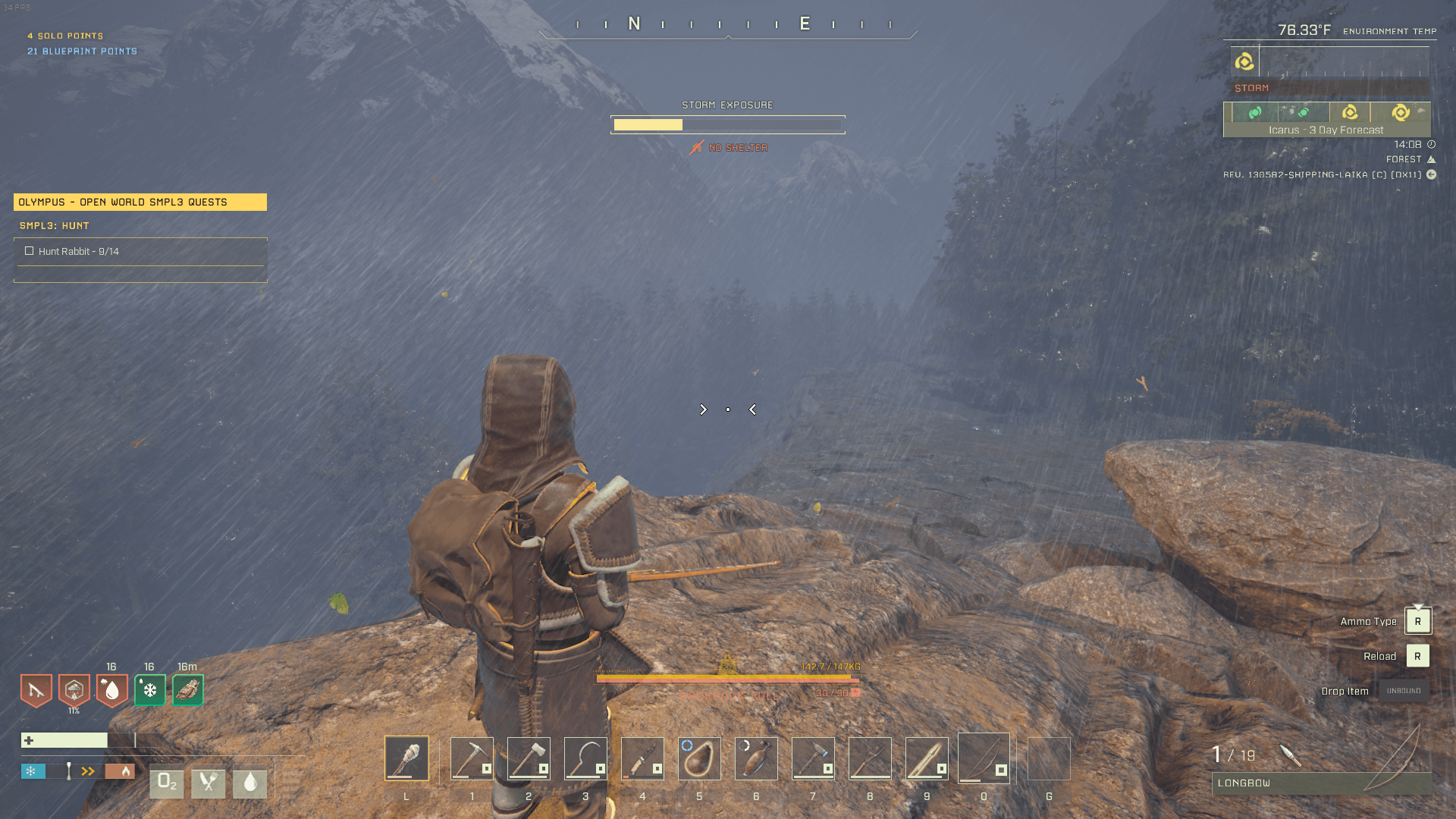
Hunting on a rainy day on Icarus.
“Hunting on a rainy day on Icarus.”

The premise is simple enough. An attempt to terraform a planet (the titular “Icarus”) goes wrong due to the presence of undetected exotic matter, and while the result is not habitable to humans, life evidently found a way. You and your team of disposable prospectors head down to the planet’s surface to collect various samples, run tests, and of course, gather some of these valuable “exotics”, all of which will also require you to become self-sufficient enough to survive the harsh climate for the duration. While the latter aspect is pretty cookie cutter, the former is represented by a series of missions that you can choose on-demand. There are a number of these, many of which are of the “go to this place and do this thing” variety. Usually gather or scan special items, resources or kill/destroy a creature or structure, for example. Completing these will reward you with some of the game’s in-game currencies, which then allow you to purchase supplies that can either be sent down to you, or work as upgrades to your starting gear for future expeditions, rogue-lite style. Those systems are actually pretty neat, and I did appreciate having a bit more structure rather than the experience being totally unguided, though I feel like they could definitely be expanded on quite a bit more. It’s also amusing to think that the United Development Agency sends you down with such meager supplies that your survival journey starts out with you living like a literal caveman, yet are quite capable of offering you a leg up in exchange for some valuable materials. Too realistic!

As mentioned, the teching up (which is done via talent points, earned from performing numerous in-game actions) starts out with you building tools, weapons, and structures out of bone, wood, and stone, but jumps to more and more modern material and equipment as you move between its 4 tiers. Since you’re completely alone on a primitive planet, you pretty much have to craft everything too. It’s fine, and there are even some really neat touches here and there, but man, does it get repetitive damn quickly. But honestly, so does everything else. While the world itself is handcrafted, there is very little of interest here. Yes, it’s fun exploring, finding new caves to clear out, wildlife to hunt or tame, and resources to gather, and some of the missions are quite fun too, but it wears out its welcome fast and begins to feel like a bit of a grind. The relatively nice graphics, which I think look really good at times, can’t really save that from eventually being an issue. I’m not trying to pick on Icarus here, as I think that is a challenge the genre as a whole struggles with, and that balance doesn’t seem like an easy one to strike.

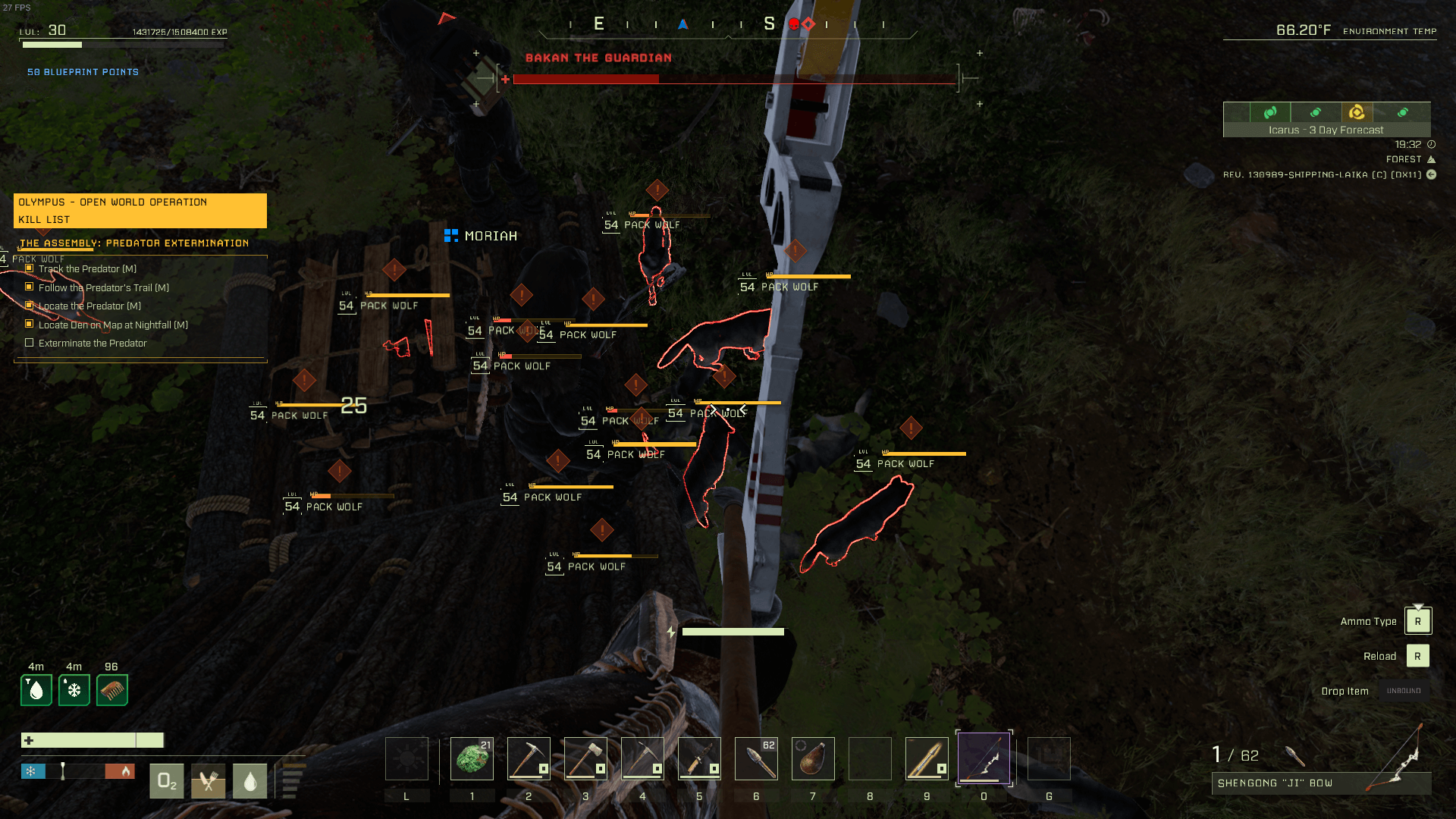
Trapped in a tree-stand by a pack of wolves. Fun!
“Trapped in a tree-stand by a pack of wolves. Fun!”

This, not any perception of difficulty, was the reason why, after 40-some hours, we decided to move on to something new. That said, I really do think if you’re someone who likes a reasonably “pure” survival crafting experience, Icarus should be on your short list of games to check out – you may absolutely love it. It’s a solid game with some unique features, and hey, it’s still getting regular updates with new features and other additions to this day. I could even see enjoying a long solo play-through, if you really like the genre. As for us, it’s definitely possible we’ll come back in the future, though maybe prospecting on a brand new world (which are sold separately as the game’s main DLC strategy.)

I’ll close out Icarus with a little anecdote, a hilarious emergent moment that was so awesome I found myself telling friends at work about it the following day, and was probably a big part of why I was happy to stick it out for so many more hours:

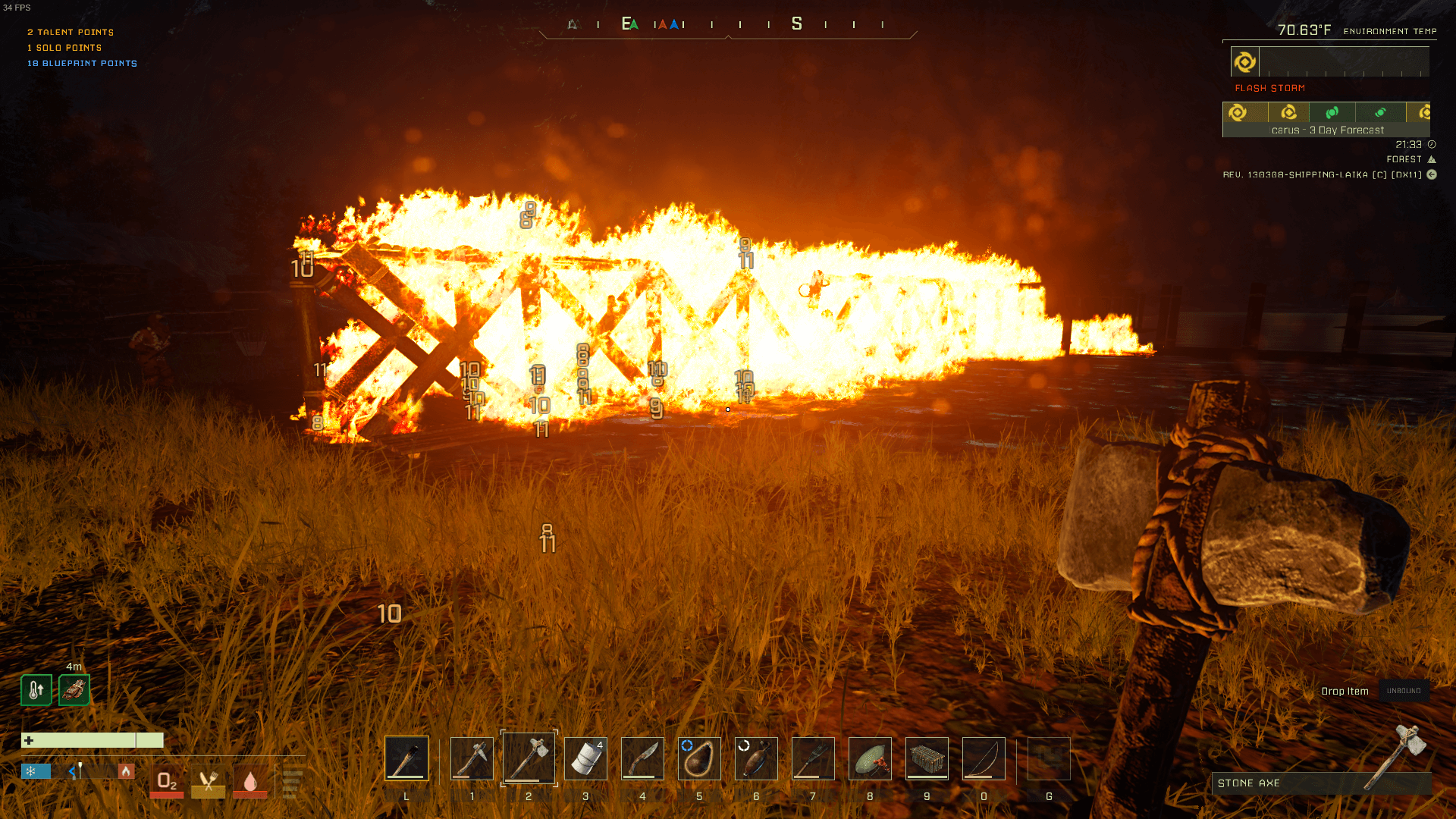
The last moments of our beloved fishing pier...
“The last moments of our beloved fishing pier…”

As part of our very first session, we built our little settlement on the banks of a small lake close to where we initially landed. If you’ve played Icarus, you probably know the one. As the member of our crew who had played before knew he’d want to spend a good chunk of his time fishing, he decided to build a fishing pier to make this a bit easier. At first this started off as a tiny dock, but eventually expanded into a massive pier that reached the middle of the lake, complete with railings and a covered roof, and later an extension to another part of the lake so it could serve as more of a bridge. It was wholly unnecessary, but these kinds of distracting projects can be a key part of the fun of the genre in my opinion. One thing I didn’t mention about Icarus is its dynamic weather system, which can require you to seek shelter from various dangers, depending on the biome you’re in. Right at the end of our session, after our rather impressive pier was totally up and operational, a severe lightning storm rolled in right on top of us. The sustained barrage of lightning strikes ended up catching our pier on fire, and several of us braved the conditions to run out and try to save it, or at the very least, keep the fire from possibly spreading to the rest of our camp. Given that our tech was still effectively tier 1, the best we could do was run into the chaos and try to beat the fire back with primitive “fire whacker” tools. As ineffective as this sounds, it worked okay at first, and we were able to keep the fire from spreading inland, but as it spread, we found ourselves in danger of being cut off and had to retreat. Unfortunately I was stuck in the middle of the pier, surrounded by raging flames, and soon discovered that the railings we’d added for decorative purposes had turned into my prison bars, keeping me from being able to jump off into the safety of the water. In an intense panic, the idea of simply deconstructing them didn’t occur to me, and I finally destroyed one of the floor panels and just barely managed dive into the lake and make it back to shore.

Our session ended with us all standing there watching helplessly as the fire engulfed the entire structure, eventually leaving nothing standing except for some of the timber piles that were below the water line. In terms of our progress, it was a bit of a gut punch, sure, but in the moment? One of the most incredible introductions to a game I can remember experiencing!

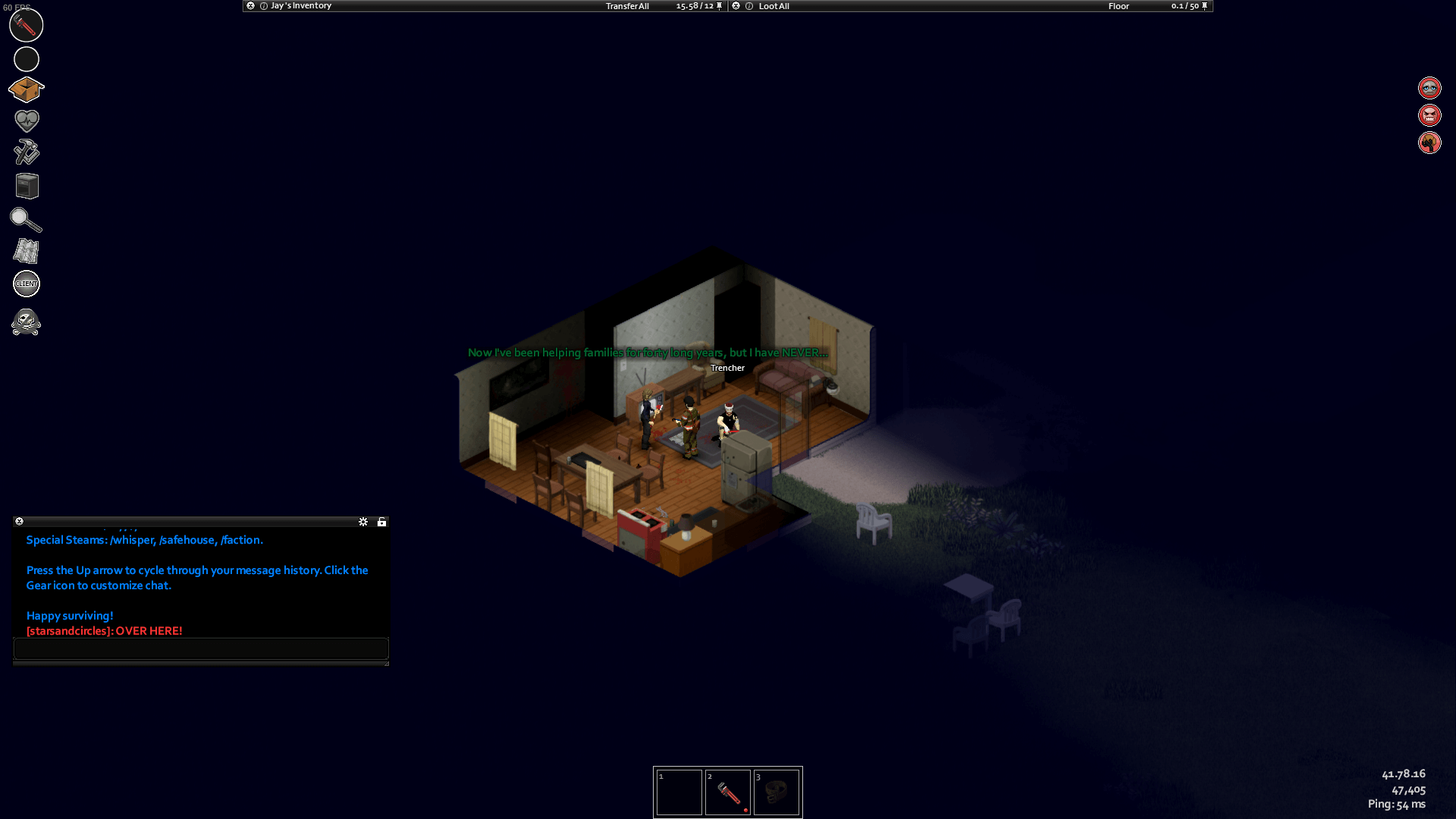
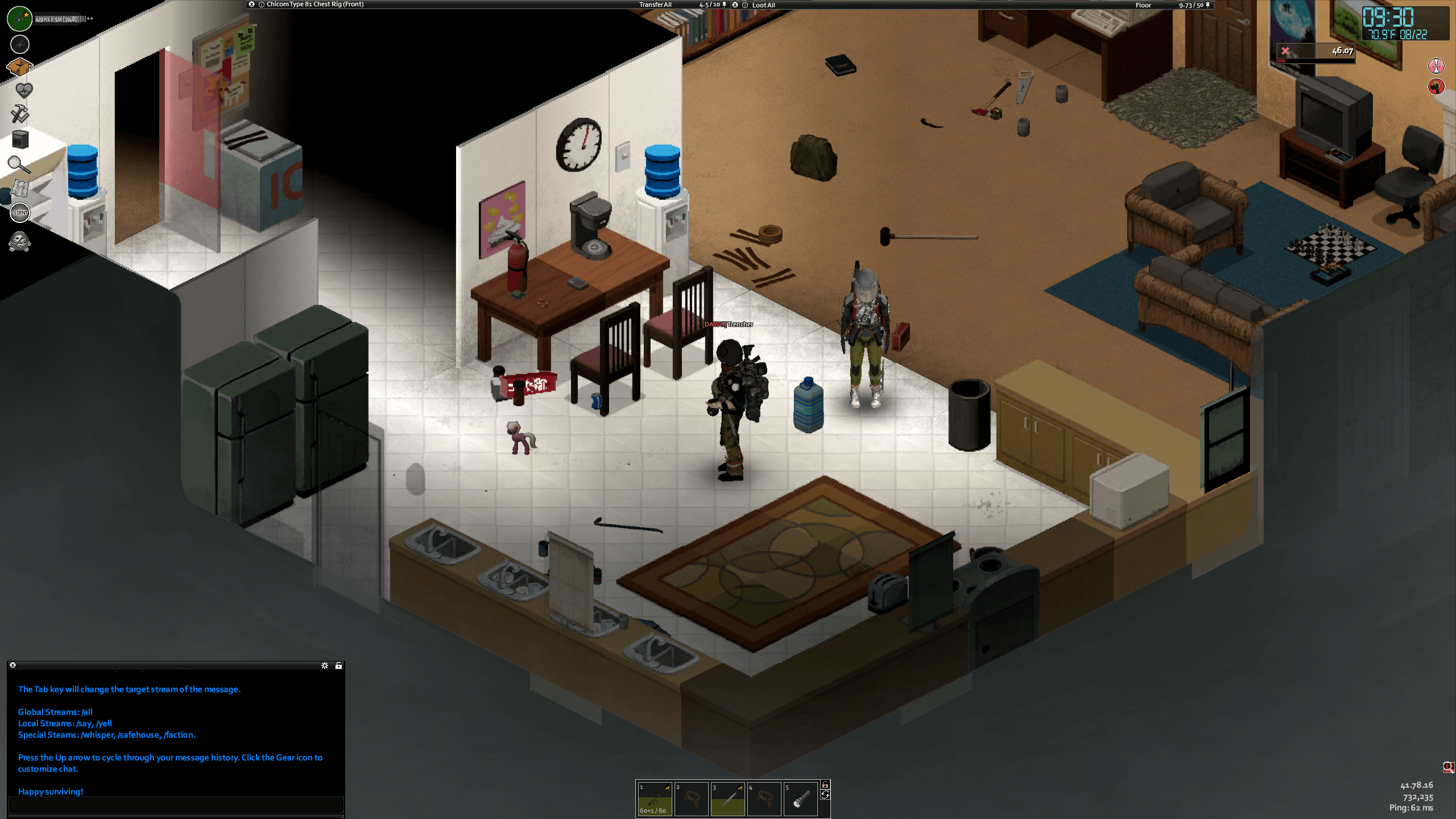
Taking a breather in an abandoned house.
“Taking a breather in an abandoned house.”

Project Zomboid has been brought up frequently in our little gaming group, as it’s one of one member’s all time favorite games. He finally somehow talked everyone into giving it a whirl, so we jumped into a new server he spun up, complete with an impressively massive array of mods to expand numerous systems and add a multitude of new items. If he hadn’t spent so much time curating and optimizing the mod list, I don’t think there would have been any chance we’d have jumped into the deep end like that, but alas, he made it pretty easy for us. It’s a good thing too, as learning the game itself was a big enough drain on our collective energies.

Let me rewind for a moment and talk more about what Project Zomboid actually is. It’s a (stop me if you’ve heard this one before) open world survival game, but as it’s set during a zombie apocalypse, it focuses a lot more on scavenging than progressing your way up through a more traditional gathering, crafting, and base building system. That’s not to say it doesn’t have a ridiculously deep crafting system – it does – but it’s a notable difference after just describing Icarus. It also has a pretty in-depth skill system, including a favorite feature of allowing you to take negative traits to get more points to allocate during character creation, which was greatly expanded by some of the aforementioned mods. On top of all of that, there is a surprising amount of simulation in the game – weird little systems that, while mostly unnecessary, go a long way to add detail to the world which, to me personally, make time spent in the inhospitable world of Project Zomboid so much more immersive. Very cool!

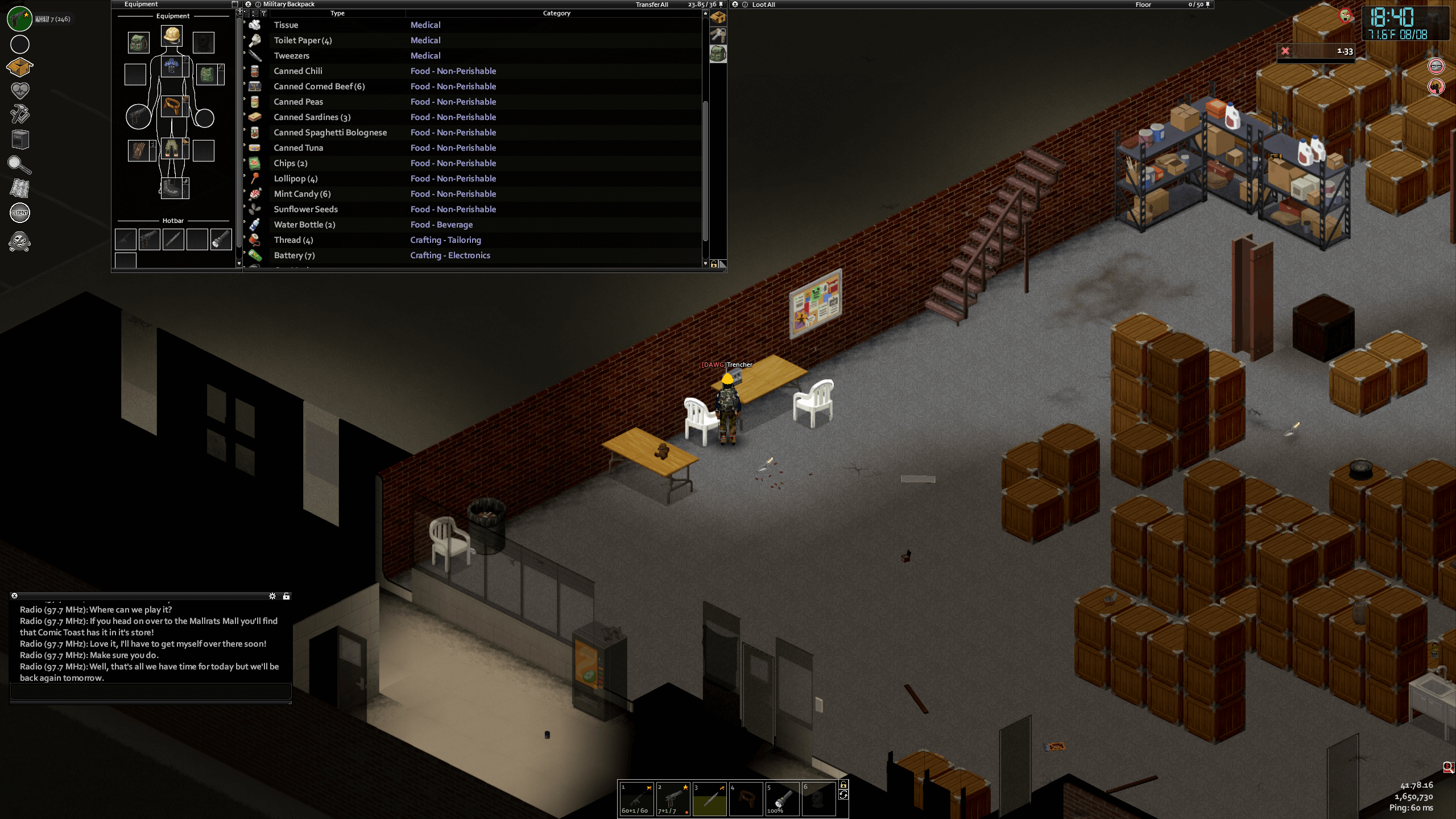
Looting a warehouse.
“Looting a warehouse.”

No, the biggest hurdle a lot of players will have with Project Zomboid is its relatively simplistic isometric graphics. I’m no stranger to getting immersed in an isometric world myself, but I fully expected the others to really struggle with it. Surprisingly, everyone seemed to adapt reasonably quickly. Instead, almost all of the difficulty came from the fact that, especially early on, you’re going to be using melee weapons a lot, and lining up your character with an enemy is quite a bit more fiddly than it really should be, leading to occasionally missing a swing you think you’re perfectly aligned with, for example. One missed hit can cause a fight to quickly spiral out of control, as the next thing you know your character has been bitten, and possibly infected as a result, and now instead of confidently managing the zombie threat around you, you’re suddenly being completely overrun, struggling in a chaotic fight for survival. While yes, when I put it that way that does sound like a cool scene from The Walking Dead or something, when you’re actually playing the game, it can feel incredibly frustrating. Dying when it doesn’t feel like it was your fault is never a fun time, though this became less of a problem the more I started to rely on firearms instead.

While I’m on the subject, the entire health system is quite brutal. Bites happen pretty randomly, even when well protected, and getting infected means you’ll be suffering a slow (well, sometimes quick) demise. This can feel like it comes out of nowhere, though after the first few times you drop dead seemingly randomly, you’ll probably learn to start checking your status a bit more frequently. Thankfully, one of the mods on our server let us loot “zombievoxir ampules” from a rare type of zombie, which could cure the infection instantly, and the hunt for those special zombies was sometimes a pretty enjoyable diversion. Regardless, I liked having some way to cure the infection, which from my understanding does not exist in the base game. The brutality doesn’t stop there though, there are numerous other ways to get hurt or die, and another way that is probably a bit more prominent than it should be, is from car crashes. The roads are littered with hazards and driving really fast is a recipe for disaster. While, unlike a lot of isometric games, you can zoom your view out quite far, there can still be an issue with the engine rendering everything quickly enough to avoid collisions. Getting ejected from a car sucks, naturally, but even minor fender benders can result in a lingering internal injury that you absolutely need to address.

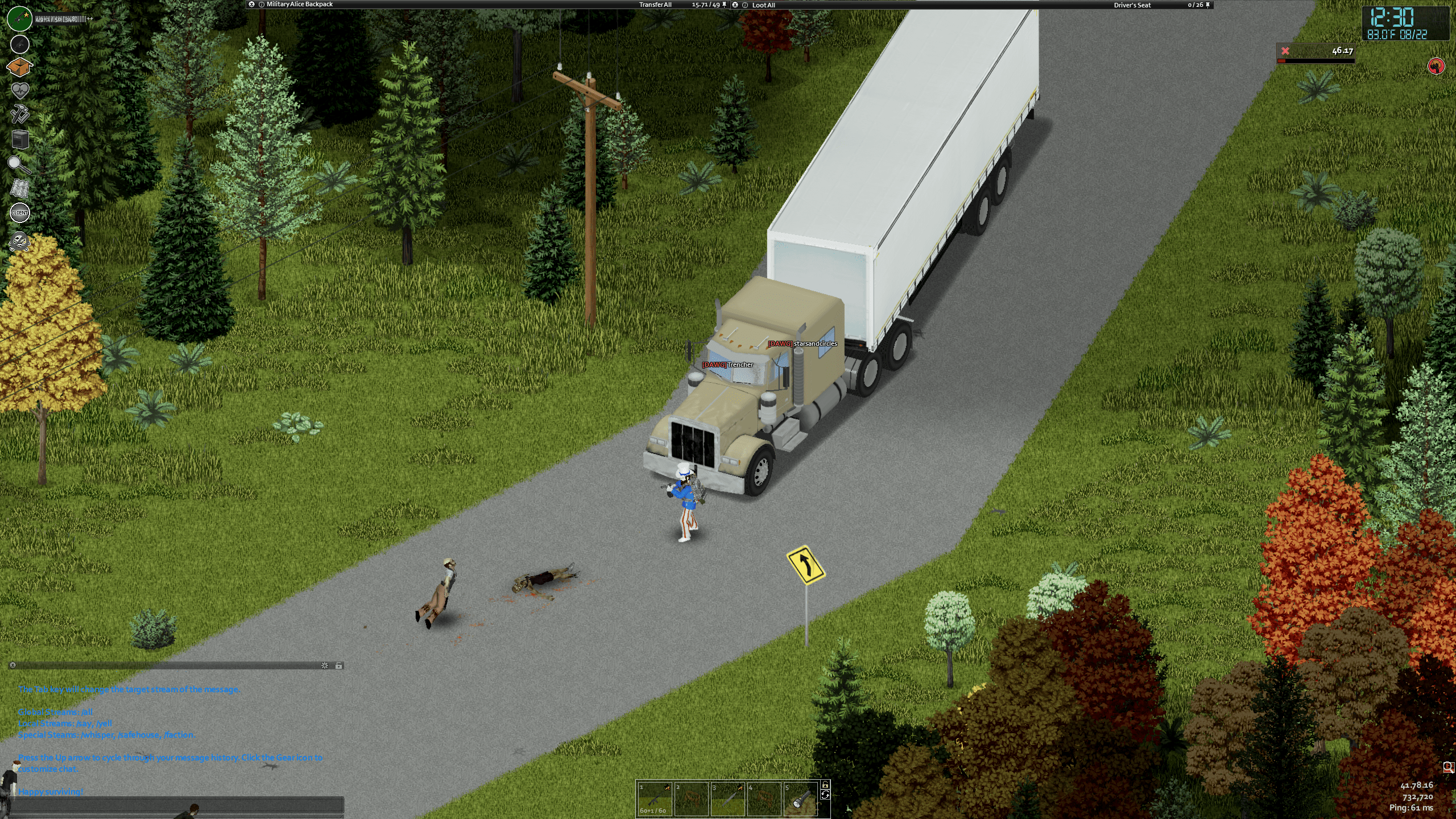
Clearing the road for our convoy... in style!
“Clearing the road for our convoy… in style!”

My last major gripe relates to dying. On one hand, if your character dies, you can simply roll a new one and rejoin the server. Then, with some luck, you can track down your body and at least get your old gear back, though this might require killing the zombie version of your old character first. We also had a mod that awarded extra traits points during character creation depending on how long your previous character survived, which added some nice rogue-lite style progression, and since you were making a whole new character, let you more freely experiment with different builds as an added bonus. On the other hand, one way that skills are learned is via finding and reading books in the world. These don’t actually give you skills directly, but boost the XP multiplier you get while learning them. Unfortunately those bonuses are lost upon death, making the hunt for those books feel like a total waste of time, at least if you’re a newbie who finds the idea of living a long life more outlandish than the possibility of frequent deaths. There are, of course, mods to entirely fix that issue too, we just weren’t using one.

What Project Zomboid really succeeds at is the aforementioned sense of immersion. Somehow its highly interactive environments, numerous detailed functional systems, including some with a fair amount of depth, and the loop of scavenging in a world filled to the brim with useful junk (which I’ve mentioned before on the blog, triggers something in me) really does suck you in quite effectively after you’ve overcome the rest of the game’s idiosyncrasies. All these months later I still have vivid memories of driving our convoy of multiple vehicles around desolate city streets, panicking as a car gets stuck and the horde closes in around us, clearing out nearby towns to stock up on ammo at the local police station, raiding grocery stores for food, hunting down bandits, etc. It doesn’t hurt that the isometric view, ability to pick up and interact with almost everything, and the flexible skill based system reminds me of one of my favorite MMORPGs, Ultima Online.

Chilling in the kitchen of our stronghold.
“Chilling in the kitchen of our stronghold.”

In the end, after something like 50 hours played, we moved on simply because we kind of ran out of things to do. Like a lot of these types of games, once you overcome the basic survival mechanics and “figure out” a lot of the other gameplay systems, there’s not much to do except continuing to live in your virtual world. Sure, you can continue to improve skills and get better and better gear, and maybe build the ultimate stronghold, but to what end? PVP is the answer to that question in a lot of more online oriented games (Rust, Scum, DayZ, etc.) but without some stronger late game content to compel you to keep playing, the loop can start to feel repetitive and stale. That’s not to say everyone will feel this way, as the person on our crew who loves Project Zomboid so much? 850 hours played! 😂

We followed Project Zomboid up with a game I’d been wanting to play since its release in late 2023, The Lord of the Rings: Return to Moria. Return to Moria had the misfortune of being another somewhat budget LoTR game, as one released earlier in the year that became a punching bag for every gaming related content creator out there, The Lord of the Rings: Gollum. While I don’t think Return to Moria was unfairly bashed because of the association, at least not widely, between that and its already niche genre, I do think that it was largely ignored by a lot of people who would have potentially really enjoyed it, as Return to Moria lands on my short list of favorite survival games that I’ve played as part of this series.

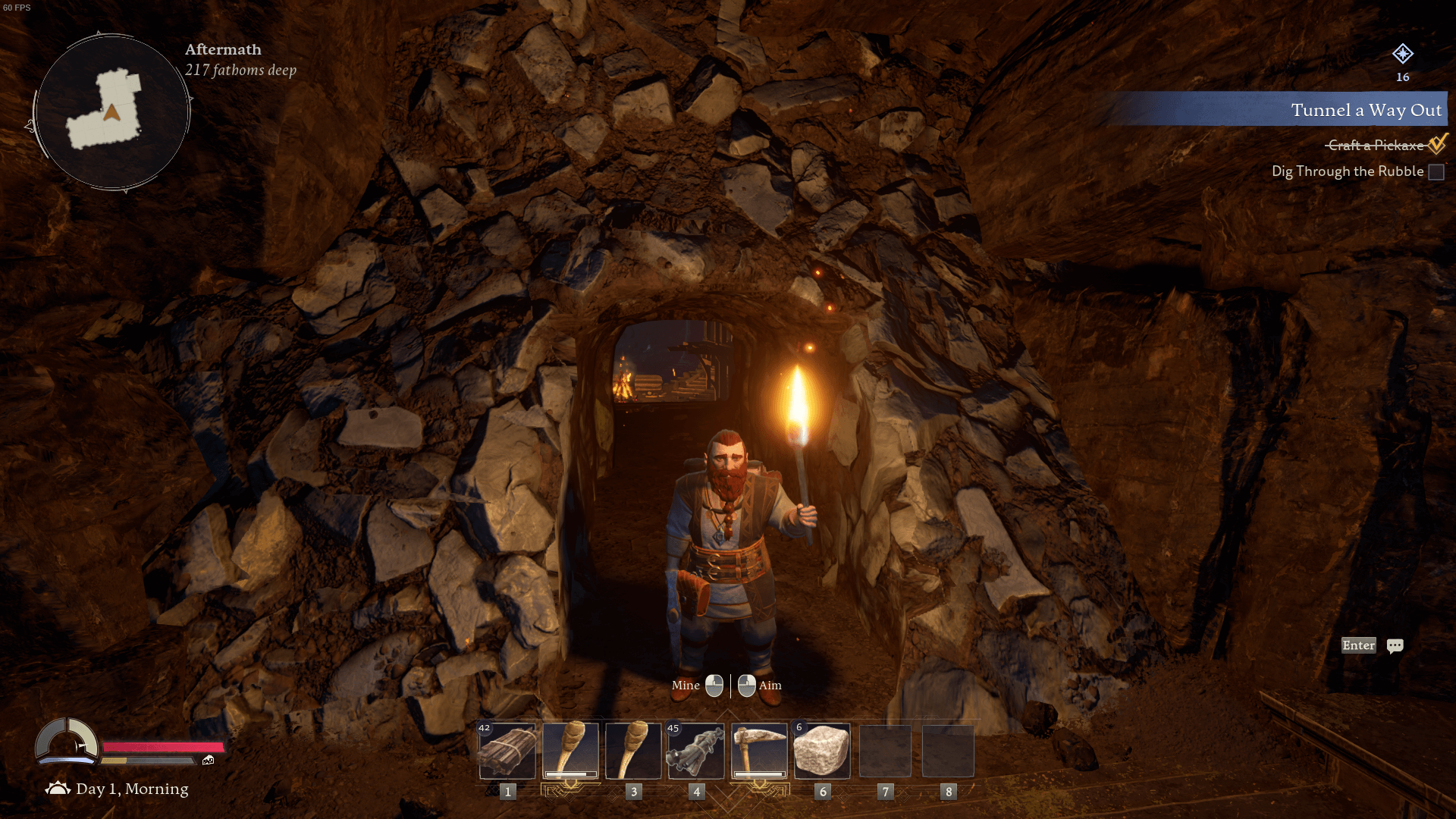
Proud of my very first tunnel...
“Proud of my very first tunnel…”

The basic premise of Return to Moria is that you’re one of Gimli’s company of dwarves seeking to reclaim the once great city of Khazad-dûm and its ancestral riches after the events of The Lord of the Rings and Sauron’s defeat. Yes boys, it’s time to start cranking out Mithril again! Unfortunately you (and if playing co-op, your companions) get stuck inside of Moria during the initial excavation, separated from the rest of the company. You’ll need to explore through the sprawling, ancient structure, which might have been creepy enough if it were simply abandoned, but of course, it’s filled with spiders, orcs, bats, and everything else you might suspect if you’d read the books or seen the movies. On top of that, this is a survival crafting game! You’ll need to build structures and workbenches to make better equipment, repair them after use, cook and brew buff-granting food and drink, etc.

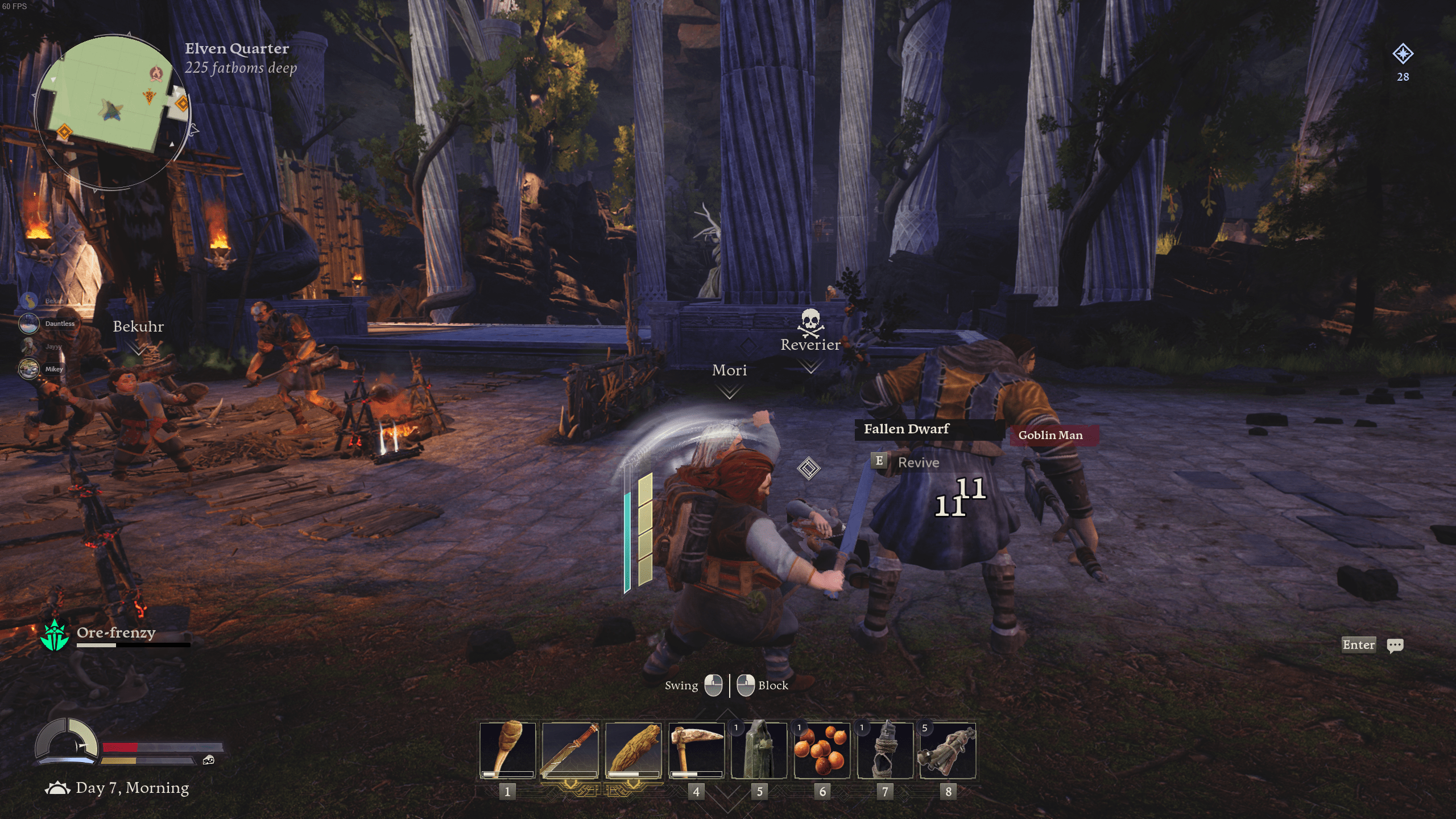
Fighting Goblin Men in the beautiful Elven Quarter.
“Fighting Goblin Men in the beautiful Elven Quarter.”

Right off of the bat, Return to Moria has a level of visual presentation and polish that is uncommon in these kinds of games. While its stylized graphics might not be to everyone’s tastes, it looks great overall. It sounds good too, even bringing John Rhys-Davies back from the movies to voice Gimli, even if that is a bit more like a cameo than any sort of lead role. Early reviewers often pointed out how your own character spoke here and there, and you can even select an all-dwarven dialect voice when creating your character. There’s a lot of nice little touches too, like your dwarves (optionally) singing when mining, which they can do together when playing with others – that never stopped being enjoyable!

Probably the main reason the game was such a success for us was that, not unlike something like Grounded or Abiotic Factor, while it was more or less an open world (with a little gating here and there to control jumps in difficulty) it has a guided, linear path through the story. In this case, as you can probably guess by the story setup I mentioned above, it guides you through various parts of Moria and eventually, with any luck, out of it. One downside is that, like Abiotic Factor, since it is guiding you all around, you might be naturally inclined to take a somewhat nomadic approach to base building, though also not unlike in Abiotic Factor, we built our final base in a place that was reasonably walkable to most mid-game areas, and by the late game we’d unlocked the ability to teleport between “Mapstones” which are static teleportation targets scattered around a small selection of notable places. Absolutely canon-destroying, but fast travel can be invaluable in these types of games. I’m glad we did, as the game also has base invasion events which, while not as intense as a game like 7 Days to Die, does at least give you a reason to fortify your base and think about your design a bit more.

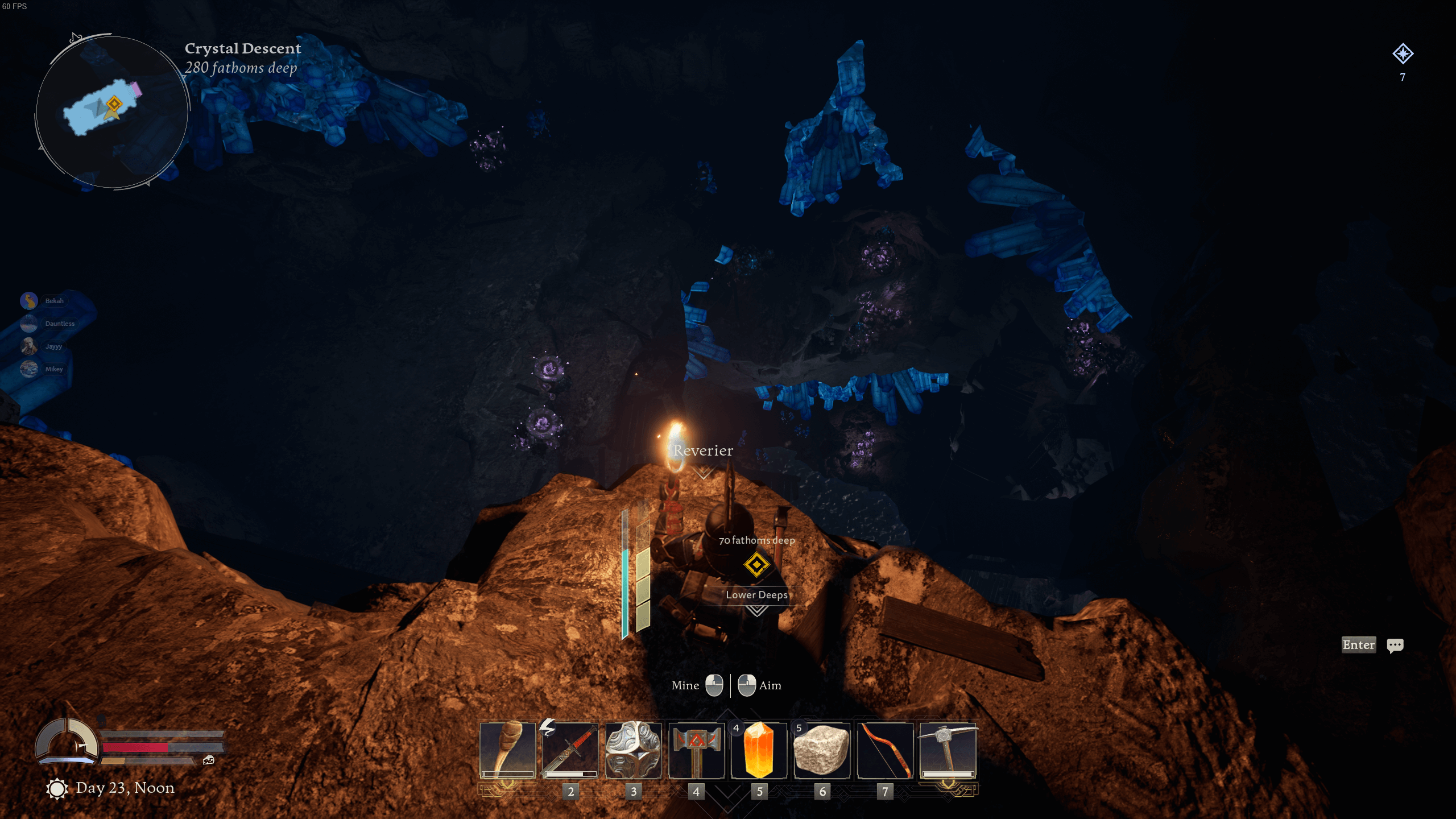
It's a long way down, and we need to climb it...
“It’s a long way down, and we need to climb it…”

Wandering through Moria, which ranges from dreary indoor corridors to massive underground cities, epic chasms, and wide open areas that almost feel like being outdoors, mining for ore and gathering materials, and slaying quite a lot of orcs along the way is pretty damn fun. Combat feels something like a very simplistic take on the now ubiquitous Dark Souls style combat – lots of blocking and rolling, but not much else. It’s a little tricky at first but you’ll likely get comfortable with it quite quickly. To be clear, it is definitely a bit more exploration and combat heavy than a lot of these kinds of games. It probably reminds me most of Enshrouded in that respect, but that’s definitely not a bad thing. Naturally, there’s a lot of verticality in exploring, and as implied, there’s quite a lot of variety here too. Also, I really love the very Norse inspired designs of the weapons and armor here. Oh, and while randomly dolling out compliments, and the lightning system is quite cool too.

There are some negatives, naturally. Some of the enemy designs definitely look a little off, though thankfully that’s not really an issue with the ones you’ll be running into most often, nor your dwarves. The in-game map UI? I fucking hate it. It chops up every major area (or zone) into a small block, and completely fails to give a clear idea of the scale nor any sort of detail, but only a vague idea of how these areas are connected. It looks more like something the designers would have used to show high level zone connectivity and flow than something useful to us players. These map issues compound another problem, which is that your next steps and/or how to achieve them aren’t always obvious. There were at least a couple of steps in the campaign which had us confused and discussing where to go and what to do next. While you could argue that figuring this out ourselves is part of the challenge, it didn’t feel like an intentional design decision, but rather a UX issue.

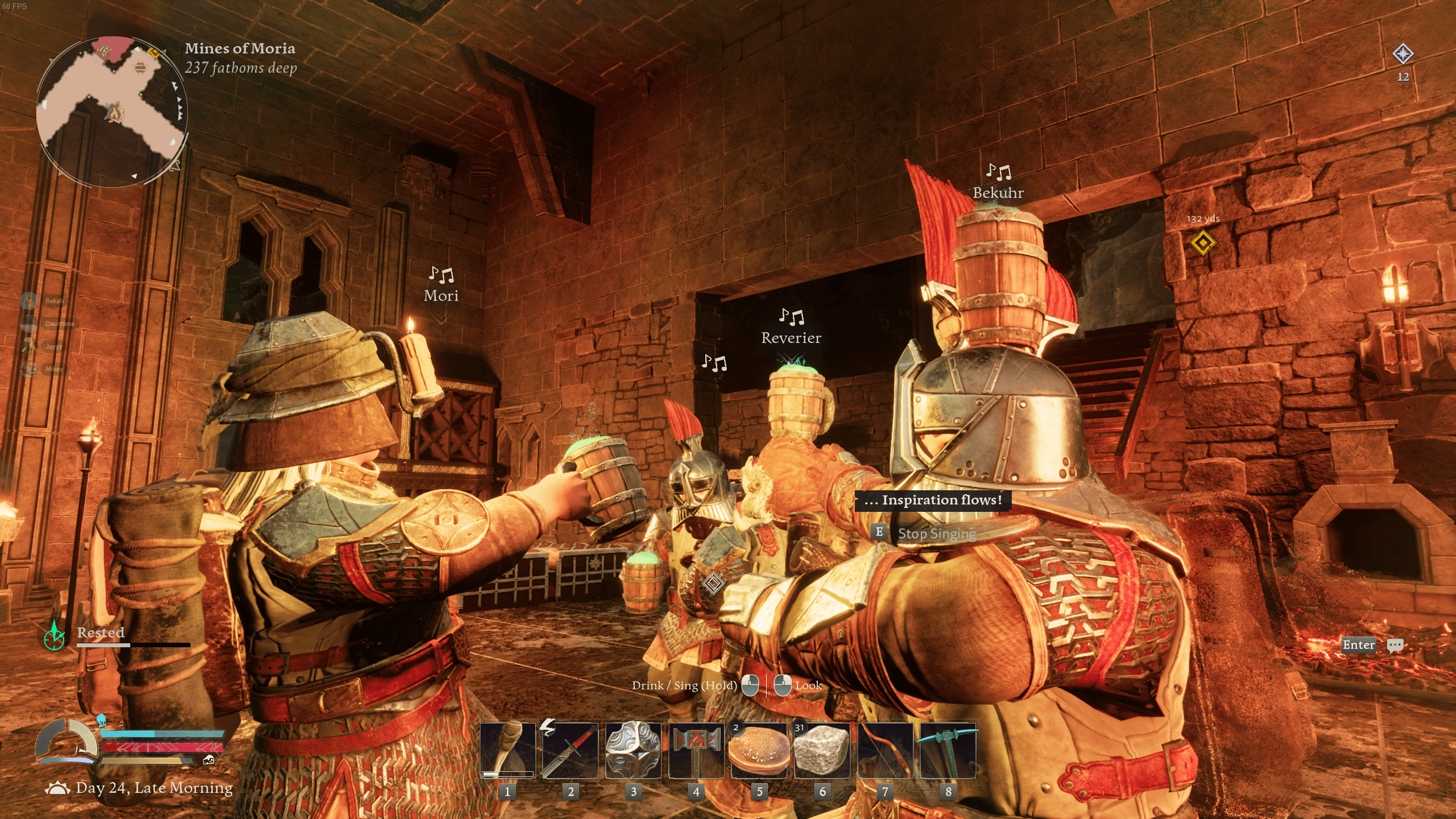
Frequent drinking breaks are mandatory!
“Frequent drinking breaks are mandatory!”

Another thing that I found annoying were the buffs. There are numerous ways to get your characters temporary buffs, most of which stack, so while it’s advisable to fully apply these effects to yourself before heading out on an expedition, I swear these things feel like they wear off a minute after you walk out of your front door. This issue is even more pronounced when using fast travel, which makes the whole system feel almost pointless. Seriously, why have these reasonable developed systems for us to invest in if they’re not actually useful? This feels like an odd balancing issue that would have been fixed ages ago if this were more of an MMO or live service game.

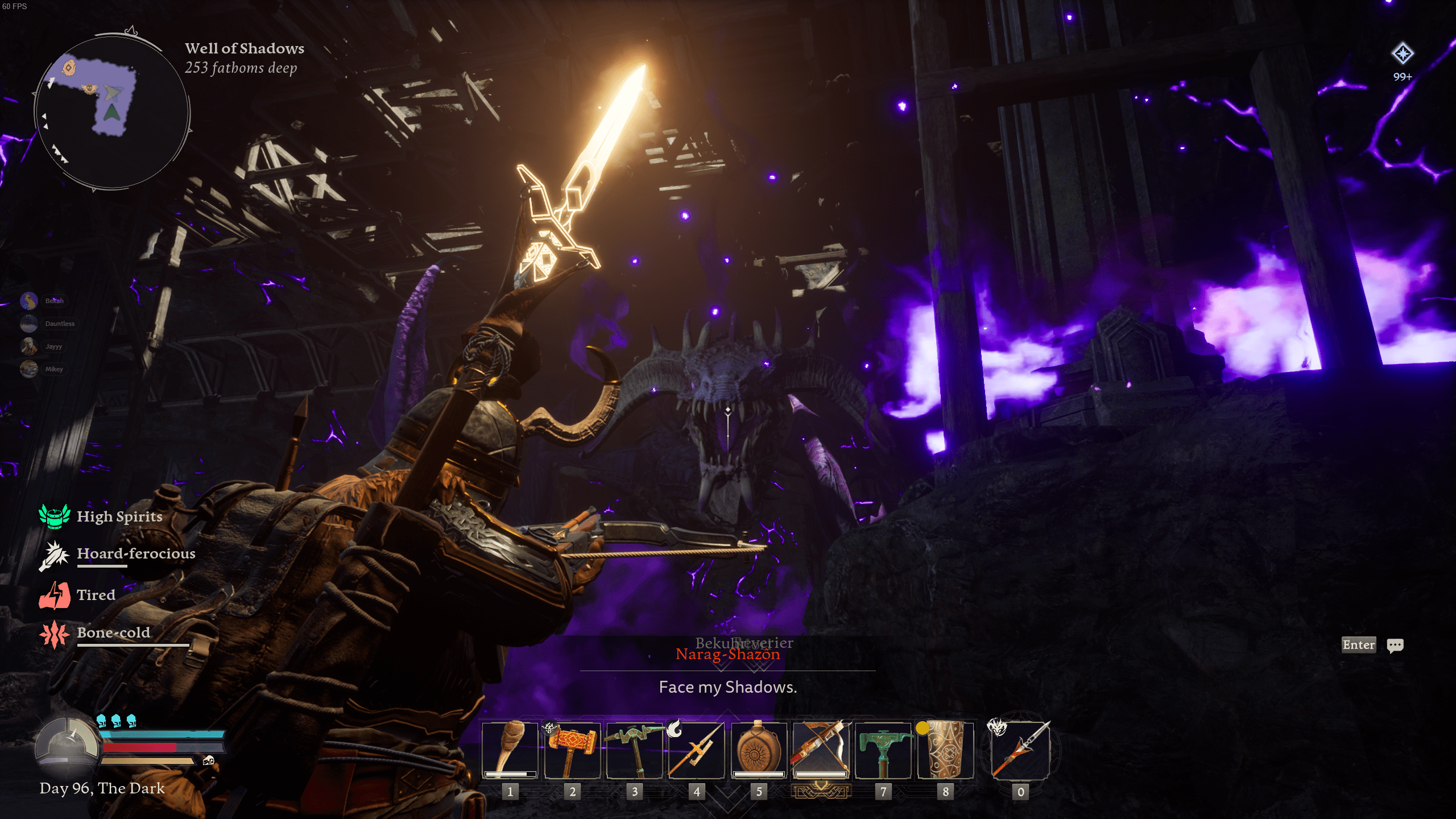
A much smaller gripe is that I wish there was more of, well, everything in the game – weapons, armor, utility items, enemies, etc. There are plenty, don’t get me wrong, but, especially when it comes to tiered weapons and armor, I’d love even more variety here, particularly when it comes to “masterwork” items which are legendary items that you’re only able to ever carry one of, and even have their own special slot. There are very few of these – some utility items, a couple of weapons, and a shield – but these are also tiered, and sometimes it’s hard to choose between them. I mean, would I rather have a permanent light source attached to my backpack, an amazing pick axe, or an awesome weapon? All three, please! You can take this one as more of a compliment though – I want more because I like what is there so much!

Well, it worked in The Hobbit!
“Well, it worked in The Hobbit!”

I can only nitpick about this game so much though. I loved it, and I think my group did as well, despite some confusing and/or challenging parts. I mean, we saw it through to the end, which is rare enough for this series, right? Like with Project Zomboid, I have some vivid memories of my time with Return to Moria, from challenging boss fights against an Orc Warchief that we were probably not quite ready to face, our first run in with a Troll, climbing down the Crystal Descent for the first time, and later, being confident enough to explore the Darkest Deep as a group all immediately come to mind. Unfortunately the linear structure of it means it’s unlikely that we’ll ever go back to it now that we’ve beaten it, though I could see myself returning to it solo in the future, or jumping in with a different group, certainly, especially since they’re apparently not done putting out content for it. Excellent game!

Apologies for the lack of good Icarus and Project Zomboid screenshots. I promise they’re more exciting than I made them look. With PZ in particular, I assume I was far too busy trying to not to get ripped apart limb from limb by the zombie hordes to get any good screenshots.